
Seller net proceeds are the money you actually receive at closing: the sale price minus your mortgage payoff, any liens, and the costs of completing the sale. The formula is simple. The hard part is getting each line right, because the sale price you agree to is never the check you collect. This guide walks through every line, shows a worked Michigan example, and explains how a cash sale changes the math.
TL;DR
- Net proceeds = sale price − loan and lien payoffs − seller closing costs − agent compensation − credits you grant ± prorations.
- Equity is what you own on paper. Net proceeds are what remains after the costs of selling come out of that equity.
- Use your lender’s official payoff statement, not your latest balance, as soon as you have a buyer.
- Compare offers by the net number, not the headline price. A cash offer with no commission and no repairs can land close to a higher-priced listing.
- If the numbers come up short of your payoff, you have options before closing. Talk to your servicer or a HUD-approved housing counselor early.
Table of Contents
- What seller net proceeds actually mean
- The seller net proceeds formula
- Every deduction that can shrink your check
- A worked example with Michigan transfer taxes
- Equity is not the same as net proceeds
- How escrow moves the money at closing
- How net proceeds work in a cash sale
- When proceeds do not cover the payoff
- Inherited and probate homes
- Get a real number for your Michigan house
- FAQ
- Sources
What seller net proceeds actually mean
Net proceeds are the amount a seller keeps after subtracting all costs and expenses from gross proceeds. Investopedia’s definition lists commissions, advertising fees, closing costs and taxes as typical real estate costs. Gross proceeds is the headline number: what the buyer pays. Net proceeds is the number that matters for your next move, whether that is a down payment, a move, paying estate debts, or catching up on bills.
Three terms get mixed up, so keep them apart:
- Sale price: what the buyer agrees to pay.
- Net proceeds: what you receive after everything is paid out of the sale.
- Profit: net proceeds minus what you originally paid for the home and what you put into it. Profit is what the IRS cares about. Net proceeds are what your bank account sees.
A high sale price alone does not tell you how the sale turned out. A $250,000 sale with a $230,000 payoff and $18,000 in costs leaves you with very little, and a $180,000 sale on a paid-off house can leave you with most of it.
The seller net proceeds formula
Every calculator, title company net sheet and agent worksheet is a variation of one equation:
Sale price − mortgage and lien payoffs − seller closing costs − agent compensation − seller credits and concessions ± prorations = estimated net proceeds
That structure matches how HomeOnYourOwn lays out the estimate: payoffs for the mortgage, HELOC and liens, then seller closing costs, agent compensation, credits and concessions, and finally plus-or-minus prorations and closing adjustments.
Work through it in four steps:
- Start with a realistic sale price. Use the offer in hand, or for an early estimate, a range of what comparable homes near you have sold for. If you are weighing offers, run the formula once per offer.
- Subtract everything secured against the house. First mortgage, second mortgage, HELOC, tax liens, mechanic’s liens, judgment liens.
- Subtract the cost of selling. Commission if you have an agent, title and escrow charges, transfer taxes, prorated property taxes, and any repairs or credits you agreed to.
- Adjust for prorations. If you have prepaid taxes or utilities, you may get some back. If taxes are owed through the closing date, that amount comes out.
Every deduction that can shrink your check
Mortgage, HELOC and other liens
This is usually the biggest line. Your payoff amount is not the balance printed on your last statement. The CFPB explains that a payoff amount includes interest due through the day you intend to pay off the loan. It may also include other fees and, where applicable, a prepayment penalty. Your servicer must give you an accurate statement of the total required as of a specified date.
The practical rule: use your latest balance for rough planning, then request an official payoff statement once you have an accepted offer. Ask for a per-day interest figure too, so the number still works if closing slips a few days.
A home equity line of credit is paid at closing as well. According to Bankrate, the title company or closing attorney orders the payoff statement, and the payoff is generally deducted from the buyer’s payment rather than requiring a separate check from you. The first mortgage is paid first, then the HELOC, and what remains goes toward closing costs and then to you.
Agent compensation
On a traditional listing, commissions are often the largest cost after the loan. We break down why in how agent fees reduce home profits and how Michigan sellers keep more at closing. On a cash sale through HouseGoodbye, commissions are $0.
Transfer taxes
Michigan charges both state and county transfer taxes on sales. Per Van Buren County’s register of deeds, the state rate is $3.75 for every $500 or part of it, and the county rate is $0.55 for every $500 or part of it. That is $4.30 per $500 combined. On a $200,000 sale, that is 400 units of $500, or $1,720. Rates for other states differ, and as Redfin notes, this kind of excise tax is paid at closing and varies by state. Michigan law also provides some exemptions, so ask your title company whether one applies to your sale.
Title, escrow and recording
Title search and insurance, escrow or settlement fees, document preparation and recording charges all come out of your side. The New York State Association of REALTORS® seller worksheet is a good picture of how long this list can get: escrow charges, document preparation, title charges, transfer tax, lender discounts, prepayment penalties, real estate taxes, appraisal, survey, inspections, corrective work, home protection plans and unpaid assessments. Our posts on hidden real estate fees and what an escrow fee is go line by line.
Property taxes, HOA dues and utilities
These are prorated to the closing date. You pay for the days you owned the home. If you live in a community with an association, unpaid dues and transfer fees may also come out of your proceeds; see HOA dues at closing for who pays what in Michigan.
Credits, repairs and last-minute adjustments
In a traditional sale, a buyer’s inspection can lead to repair requests or a credit that lowers your net. Those negotiated amounts are part of the equation. Adjustments can also appear late, which is why the closing-date payoff and final settlement statement matter more than any early estimate. The seller closing call process covers additional payoffs and closing adjustments that can change a seller’s final proceeds.
Taxes on your gain
Capital gains tax is not usually withheld at closing, but it can still reduce what you keep in the end. U.S. Bank notes that the federal home-sale exclusion is generally $250,000 for an individual or $500,000 for qualifying joint filers, subject to eligibility. Whether you qualify depends on your situation, so confirm it with a CPA or tax professional before you plan around a number.
A worked example with Michigan transfer taxes
These figures are an illustration we built to show the mechanics, not a quote and not a promise of any outcome. Every house, loan and offer is different.
Assume a homeowner owes $110,000 on the mortgage. We compare a $200,000 listing sale with a $185,000 cash offer.
| Line item | Traditional listing | Cash offer |
|---|---|---|
| Sale price | $200,000 | $185,000 |
| Mortgage payoff | −$110,000 | −$110,000 |
| Agent commission (5.5% assumed) | −$11,000 | $0 |
| Michigan state and county transfer tax | −$1,720 | −$1,591 |
| Title, escrow and other closing costs (assumed) | −$2,500 | −$1,500 |
| Repairs and buyer credits (assumed) | −$4,000 | $0 |
| Estimated net proceeds | $70,780 | $71,909 |
The transfer tax lines use the $4.30 per $500 rate above: $185,000 is 370 units, or $1,591. The other assumed lines are placeholders.
The lesson is not that one route always wins. It is that a $15,000 gap in sale price can shrink or vanish once commission, repairs and credits are counted. The other things the table does not show are time and certainty. A listing can sit for weeks, and every month of mortgage payments, taxes, insurance and utilities is money out of your pocket. Run your own numbers with the formula above, one column per offer.
Equity is not the same as net proceeds
People searching for home sale equity usually want to know how much of the house is theirs. Equity is generally fair market value minus your mortgage balances and existing liens. The catch is that closing costs and other transaction fees are paid out of that equity before you can touch the money.
So a house worth $200,000 with a $110,000 mortgage shows $90,000 in equity. After commission, transfer tax and closing costs, the check might be closer to $75,000. Equity is the starting point. Net proceeds are what survive the sale.
How escrow moves the money at closing
Escrow is the neutral step between the buyer’s funds and your check. A title or escrow company holds the buyer’s earnest money and final funds, then distributes them. Flying S Title & Escrow describes the sequence: escrow requests payoff information, and after all funds are deposited and recording is confirmed, it disburses seller proceeds, loan payoffs, commissions and recording-related fees.
The order matters to you. According to Beycome Title’s description of disbursement, the settlement agent follows the Closing Disclosure, wires the payoff to your lender first, then pays transfer taxes, recording fees, title premiums, commissions and other costs. You receive what is left.
Two habits protect your number:
- Ask for a draft settlement statement a few days before closing and compare it with your own worksheet line by line.
- Confirm how you will receive funds (wire or check) and when they are released after recording.
Our guide to the role of a title company in a fast home sale and the cash closing process show what this looks like on a Michigan cash sale.
How net proceeds work in a cash sale
The formula does not change. What changes is which lines show up.
- Commission: none when you sell through our marketplace.
- Repairs and credits: buyers purchase as-is, so there is no repair list and no inspection-driven credit to negotiate.
- Carrying costs: a close in about a week, versus roughly 73 days on the MLS, means fewer months of payments, taxes and utilities. Those are our own figures for typical closes.
- Closing costs: a cash sale still has title, escrow and transfer-tax charges. Our post on cash buyer closing costs shows what each side usually pays.
- Payoff: your mortgage still has to be satisfied from the proceeds. Read how to avoid coming up short with a mortgage payoff in a Michigan cash sale before you accept an offer.
To estimate a cash offer’s net, take the offer price, subtract your payoff, subtract your share of title, escrow and transfer tax, and stop. If you have several offers, repeat for each. The highest price is not always the highest net, and the fastest close is not always the one with the most deductions.
Perspective
We built HouseGoodbye around a simple observation: sellers compare prices, but they live on net proceeds. A single investor gives you one number and one set of terms. When several vetted Michigan cash buyers bid on the same house, you see every offer side by side and can run each one through the same formula.
That is why we push sellers to build a net sheet before they say yes to anything. Write the payoff at the top. Write the costs under it. Then compare. Our model is designed so there are no listing fees, no agent commissions and no required repairs, so more of the sale price can stay on your side of the table. And if none of the offers works for your numbers, you can walk away with no obligation.
A fast sale is only a good sale when the number at the bottom clears what you need. We would rather you know that number up front.
Bryan
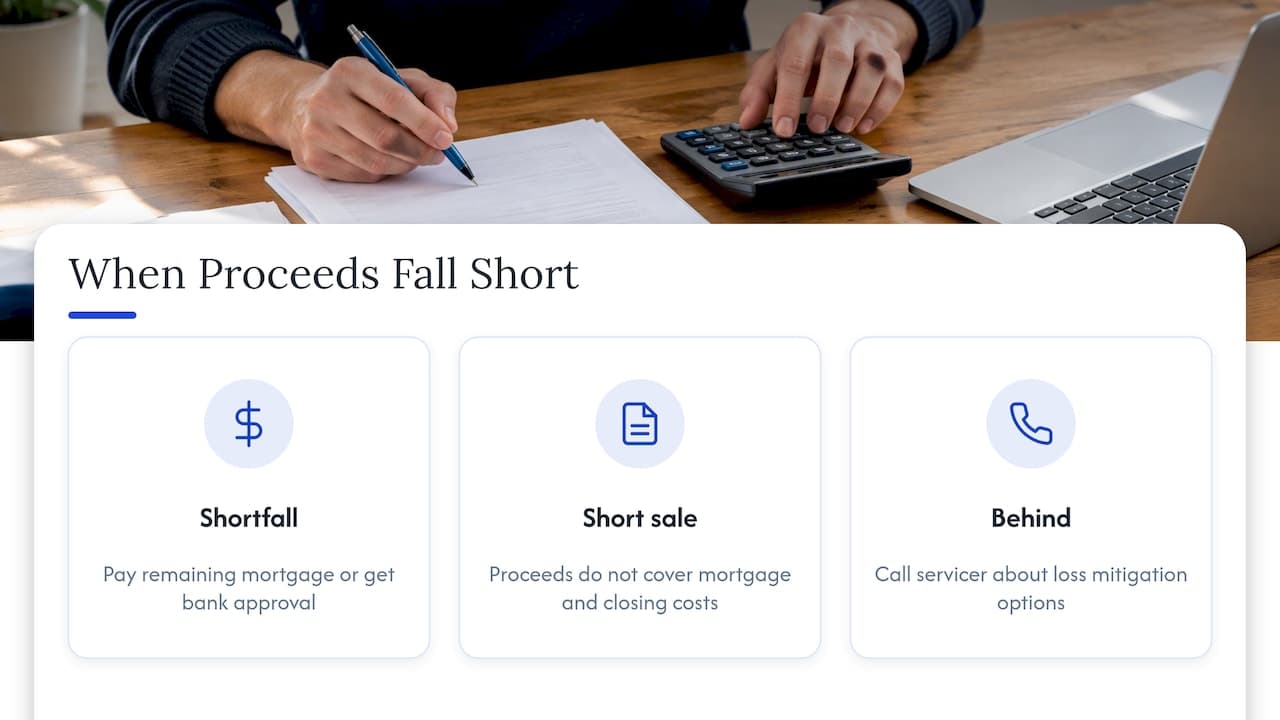
When proceeds do not cover the payoff
If the sale price minus costs is less than what you owe, net proceeds are negative. Investopedia says in that case the seller must pay the remaining mortgage at closing or get bank approval for a short sale. The National Association of Realtors describes a short sale as one where net proceeds will not cover the total mortgage obligation and closing costs, and notes that it differs from a foreclosure. Bankrate adds that an underwater seller with a HELOC may need to bring cash or look at alternatives like a short sale.
If you are behind on payments, act on timing, not just price. Call your servicer, ask about its loss mitigation options, and consider a HUD-approved housing counselor. For legal questions about foreclosure deadlines in Michigan, talk to a Michigan real estate attorney. If you are still above water, selling before a foreclosure sale is usually about protecting whatever equity you have; our avoid foreclosure page explains how competing offers work in that situation.
Inherited and probate homes
Who signs and when you are paid are different questions in an estate. Typically, the personal representative needs court-issued authority before the house can be sold, and proceeds go to the estate to settle debts and then to heirs, not directly to one person. Mortgage payoffs, unpaid property taxes and any liens against the property are paid at closing, the same as any other sale. Because the amount each heir receives depends on the estate’s debts and the will or Michigan’s default rules, ask the probate attorney handling the estate to confirm the distribution. Our pages on selling an inherited house and probate in Michigan cover the process in more detail.
Get a real number for your Michigan house
If you want to see net proceeds for your own home rather than an example, enter your address on HouseGoodbye. Several vetted local cash buyers compete with as-is offers, you see every number, and you can compare them against your payoff. There is no repair list, no showing schedule and no obligation to accept.

We buy houses in any condition across Metro Detroit, Grand Rapids, Flint, Lansing and the rest of Michigan. If you are weighing your options, start with our page on cash home buyers in Michigan and bring your payoff statement.
FAQ
What is the difference between net proceeds and profit?
Net proceeds are the cash you receive after the payoff and selling costs. Profit is net proceeds minus what you originally paid for the home plus improvements. You can have large net proceeds and a small profit, or the reverse. Profit is what matters for taxes.
How do I find my exact mortgage payoff?
Request a payoff statement from your servicer, stating the date you expect to close. It includes interest through that date and any fees, so it will differ from your monthly statement. The CFPB explains that servicers must provide an accurate total as of a specified date.
Do I pay closing costs on a cash sale?
Yes, some. Title, escrow and transfer-tax charges still apply, and the split between buyer and seller is negotiated. What drops out is agent commission and repairs when you sell as-is. See our breakdown of what each side pays.
How long until I get my money after closing?
Escrow releases your funds after all money is deposited and the deed is recorded. Timing depends on the title company and on whether you take a wire or a check, so ask yours when you open escrow. Our cash closing walkthrough shows the typical sequence.
Sources
- Net Proceeds Explained: Definition, Calculation, and More (Investopedia)
- How to Calculate Net Proceeds From a Home Sale (HomeOnYourOwn)
- What is a payoff amount and is it the same as my current balance? (CFPB)
- What Happens To A HELOC When You Sell Your Home? (Bankrate)
- Michigan Real Estate Transfer Tax (Van Buren County)
- Home Sale and Net Proceeds Calculator (Redfin)
- Seller’s Estimated Proceeds Worksheet (NYSAR)
- Home Sale Proceeds (U.S. Bank)
- What Is Home Equity? (Zillow)
- The Escrow Process (Flying S Title & Escrow)
- What is disbursement? (Beycome Title)
- How To Prepare for a Short Sale (NAR)
- Seller Closing Call Process