Michigan sellers typically pay 1% to 4% of the sale price in closing costs when commissions are excluded, or closer to 6% to 8% once agent commissions are folded in. On a $300,000 home, that amount varies depending on the included fees. The biggest swing factors are your commission rate, the state and county transfer tax, and your title insurance premium. Run those three numbers through a seller-net calculator before you list, so you’re not guessing on closing day.
TL;DR:
- Michigan seller closing costs usually range from 1.9% to 4% of the sale price when agent commissions are excluded, rising to 7% to 9% when including them.
- Transfer tax is a fixed cost based on $8.60 per $1,000 of the sale price, independent of agent fees or negotiations.
- Title insurance rates are filed and vary between $3.50 and $6.50 per $1,000 of coverage, with the owner’s policy typically paid by the seller.
- Negotiating responsibility for transfer tax, requesting discounts on title insurance, and comparing rates can significantly reduce closing costs.
- Selling directly to a cash buyer can eliminate agent commissions and shorten closing time, but transfer tax and title costs still apply.
Table of Contents
- How Much Are Closing Costs in Michigan for Sellers?
- What Line Items Show Up on a Michigan Seller’s Closing Disclosure?
- How to Calculate Your Seller Net Proceeds in Michigan
- Can You Lower Your Closing Costs Before You Sell?
- What Should You Double-Check Before Closing Day?
- What a Michigan Seller Should Have Ready at the Table
- A Faster Route Around Traditional Seller Costs
- Where to Verify These Numbers Yourself
- Sources
- FAQ
How Much Are Closing Costs in Michigan for Sellers?
The range you’ll see online varies wildly because different sources count different things. A calculator that excludes agent commissions will show seller closing costs around 1.9% to 4% of the sale price. Add commissions back in, and the seller’s total obligation jumps closer to 7% to 9%, since Michigan agents typically split 5% to 6% between listing and buyer’s agents, with the seller commonly covering both.
- For a sale around $250,000, transfer tax is several thousand dollars and commissions are a significant portion, plus title and settlement fees, yielding total seller costs in the mid five-figure range.
- For a sale around $350,000, transfer tax increases proportionally, commissions rise correspondingly, and total seller costs approach the mid to upper five-figure range.
- For a sale around $400,000, transfer tax and commissions continue to scale up, with total seller costs spanning the upper end of that range.
HomeLight’s Michigan closing cost calculator reported an average of about $6,723 on a $249,000 sale when commissions were excluded, or roughly 2.7% of the sale price. That gap between the “with commission” and “without commission” numbers is exactly why two Michigan closing cost articles can quote wildly different figures for the same home price. Neither is wrong. They’re just measuring different things.
What Line Items Show Up on a Michigan Seller’s Closing Disclosure?
Michigan’s real estate transfer tax is the one cost every seller can calculate exactly, because it’s written into state law. Under MCL 207.525, the state charges $3.75 per $500 of sale price ($7.50 per $1,000), and most counties tack on an additional $0.55 per $500 ($1.10 per $1,000). Combined, that’s about $8.60 per $1,000 of the sale price in most Michigan counties, per county transfer tax rate tables.
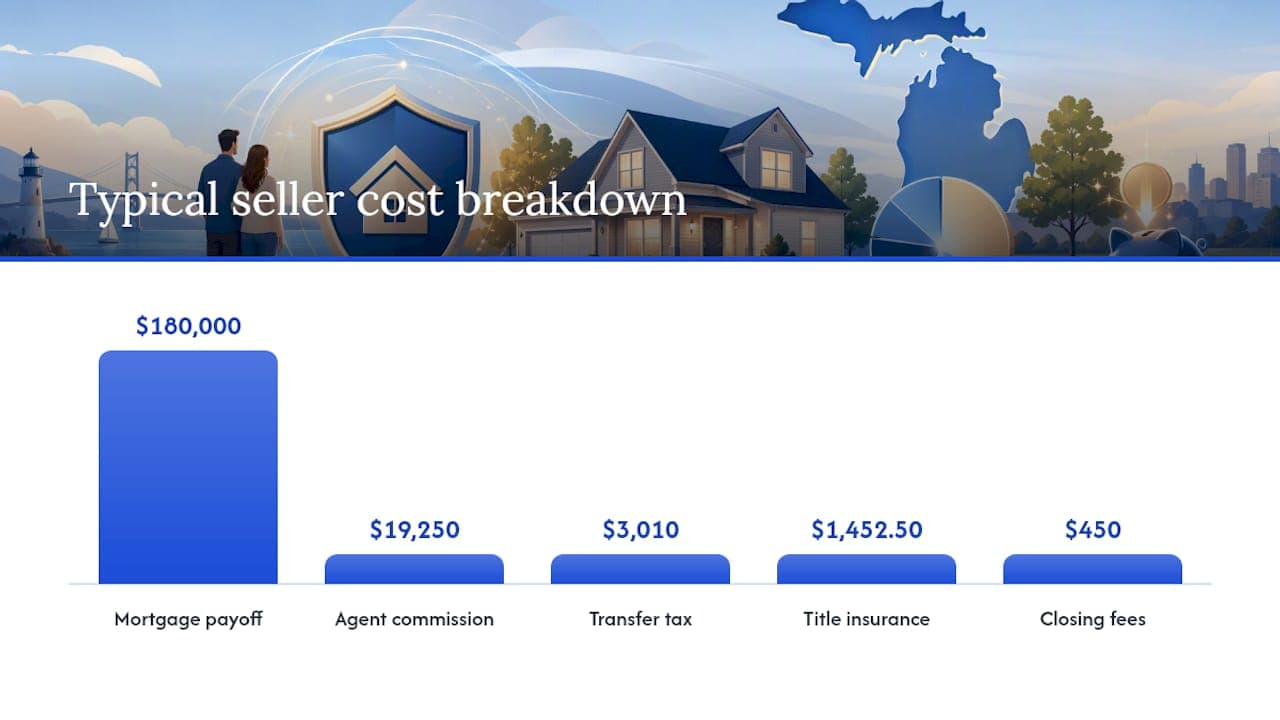
Quick math: On a $350,000 sale, the transfer tax works out to $350 x 8.60 = $3,010. That number doesn’t move based on your agent, your title company, or your negotiating skill. It’s fixed by statute.
Sellers customarily pay this tax, and Michigan law requires it to reach the county treasurer within 15 days of the deed’s delivery, under Act 330 of 1993. If you qualify for an exemption, such as certain transfers between family members or entities, the same statute lays out a refund process, though you generally have to pay first and apply afterward.
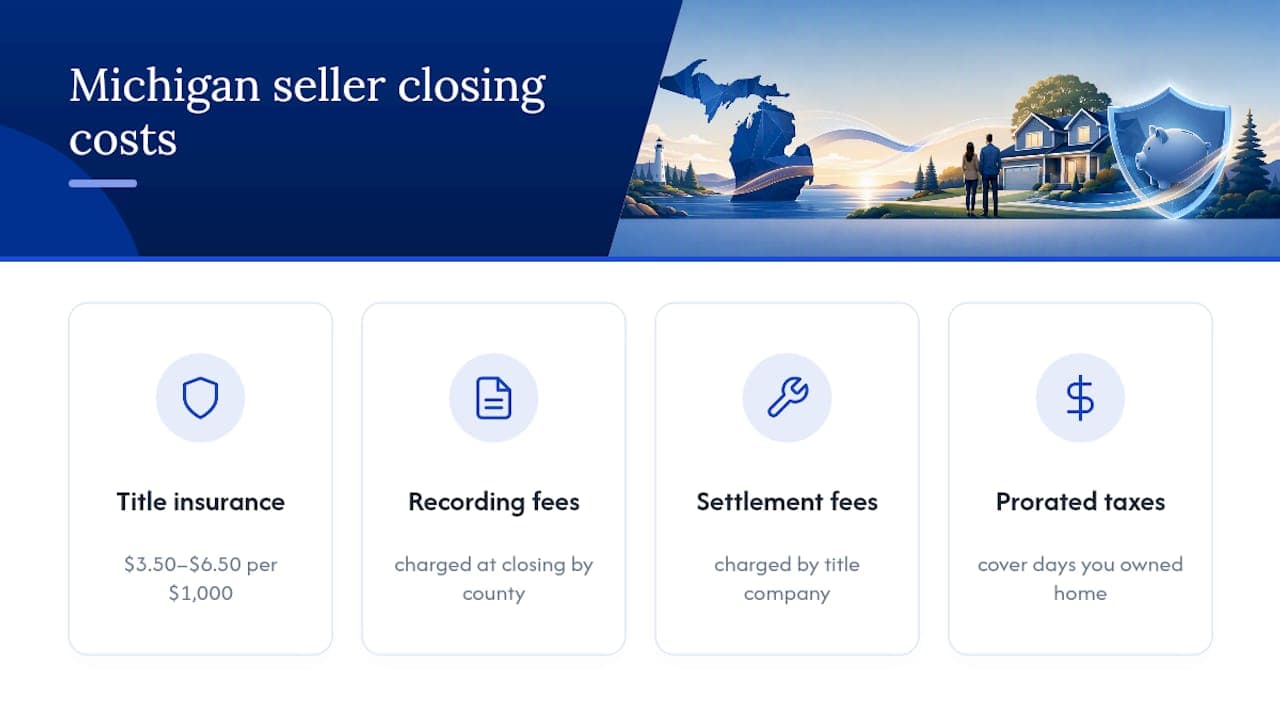
Title insurance is the other major line item, and Michigan handles it differently than most states realize. Michigan is a file-and-use state, meaning insurers file their rates with regulators and can use them without prior approval on every transaction. Owner’s title policies (which protect the buyer and are customarily paid by the seller) typically run $3.50 to $6.50 per $1,000 of coverage, while the buyer usually covers the lender’s policy. Round out the list with county recording fees, escrow or settlement fees charged by the title company, and prorated property taxes covering the days you still owned the home.
How to Calculate Your Seller Net Proceeds in Michigan
Your net proceeds are what actually lands in your account after every cost gets subtracted from the sale price. Here’s the sequence:
- Start with your gross sale price — the number on the purchase agreement.
- Subtract your mortgage payoff, including any prepayment penalty and accrued interest through the closing date.
- Subtract commissions — typically 5% to 6% combined, unless you’re avoiding a listing agent entirely.
- Subtract the transfer tax — $8.60 per $1,000 in most counties.
- Subtract title insurance and settlement fees — use $4.15 per $1,000 as a rough owner’s-policy midpoint, plus $300 to $600 for closing/escrow fees.
- Adjust for prorations and concessions — add back any prepaid taxes owed to you, subtract any buyer concessions you agreed to cover.
Here’s how that plays out on a $350,000 Michigan sale with a $180,000 mortgage payoff:
Plug in your own sale price and payoff on Housegoodbye’s carrying cost calculator to see how holding costs stack up against a quicker sale, and check your remaining balance with the mortgage payoff estimator before you finalize any number.
Can You Lower Your Closing Costs Before You Sell?
Yes, and most sellers leave money on the table simply by not asking. A few moves that actually work:
- Negotiate transfer tax responsibility in the purchase agreement. It’s customary for the seller to pay, but it’s not legally required.
- Ask your title company about simultaneous-issue or reissue discounts, which can shave real dollars off an owner’s policy when a prior policy exists on the home.
- Push back if a buyer’s agreement requests an expanded or enhanced title policy when a standard owner’s policy would satisfy the lender.
- Compare title companies. Rates vary because Michigan lets insurers set their own filed rates.
Pro Tip: *Ask for a title company’s “reissue rate” upfront, even before you have an offer.
What Should You Double-Check Before Closing Day?
Your Closing Disclosure deserves a careful read, not a quick skim before signing.
- Confirm the transfer tax math matches $8.60 per $1,000 (or your county’s specific combined rate) against the sale price.
- Verify which title policy you’re being charged for and whether a simultaneous-issue or reissue discount was applied.
- Check the mortgage payoff figure against your latest lender statement, since interest accrues daily until funds are received.
- Confirm the lien release timeline with your lender. Michigan transfer tax is due to the county treasurer within 15 days of the deed transfer, so this isn’t a step to delay.
What a Michigan Seller Should Have Ready at the Table
Keep three things handy before closing: your final mortgage payoff statement, a copy of the transfer tax calculation for your county, and government ID matching the deed. If repairs, timeline pressure, or commission math is making a traditional sale feel expensive, comparing cash offers is worth a serious look before you sign a listing agreement.
— Bryan
A Faster Route Around Traditional Seller Costs
If commissions, repairs, and a 30 to 60 day closing timeline are the parts of this math that bother you most, there’s a way to sidestep them entirely. A service lets Michigan homeowners collect multiple competing cash offers from vetted local investors, sell the home exactly as it sits, and close in as little as seven days, with no listing, staging, or agent commission involved.

That structure changes the cost picture in a specific way: agent commissions, which run 5% to 6% in a traditional sale, typically disappear entirely, since selling directly to a cash buyer removes the listing agent from the transaction. Some items, like transfer tax and portions of title work, can still apply depending on the deal structure, but the commission line, often the single largest cost on a traditional Closing Disclosure, is the one most sellers notice missing. If you’re weighing whether a fast, as-is sale beats the traditional route for your situation, compare real cash offers from local investors and see the numbers side by side before you decide.
Where to Verify These Numbers Yourself
Don’t take any calculator’s word for it, including this one. Check the state transfer tax rate directly through MCL 207.525, review county-specific rates in Michigan Treasury’s total rates reports, and ask your title company to show you the filed rate before you sign anything. For broader market context, the Maine Real Estate Journal’s market notes offer a useful comparison point on how closing practices differ regionally.
Sources
- MCL 207.525 — Michigan Legislature
- Michigan real estate transfer tax rate table (county + state example)
- Michigan seller closing cost calculator (HomeLight)
FAQ
How Much Is the Closing Cost on a $400,000 Home in Michigan?
Excluding commissions, expect closing costs typically between 1.9% and 4% of the sale price, including transfer tax and title insurance.
How Do I Figure Out Closing Costs as a Seller?
Add up your transfer tax ($8.60 per $1,000 in most Michigan counties), your commission rate, an owner’s title insurance estimate ($3.50 to $6.50 per $1,000), and settlement fees, then subtract that total plus your mortgage payoff from the sale price to find your net proceeds.
How Much Can a Seller Contribute Toward Closing Costs?
Seller concessions toward buyer closing costs are negotiated in the purchase agreement and vary by loan type and lender limits, so the amount depends on what both parties agree to and what the buyer’s mortgage program allows.
What’s the Average Closing Cost on a $300,000 House in Michigan?
Excluding commissions, expect closing costs typically between 1% and 4% of the sale price, including transfer tax and title insurance.
Does Selling for Cash Reduce My Michigan Closing Costs?
Selling through a cash-offer marketplace like Housegoodbye typically eliminates agent commissions since no listing agent is involved, though transfer tax and some title charges can still apply depending on the transaction.