An escrow fee is a one-time closing charge paid to a neutral escrow or title company for managing the paperwork, funds, and signatures that turn a purchase agreement into a finished sale. Most transactions land somewhere between 1% and 2% of the purchase price, though plenty of companies charge a flat rate instead. On a $300,000 home, the escrow fees generally correspond to a moderate cost amount, split between buyer and seller depending on local custom and the contract.
That fee is not the same thing as an ongoing escrow account, sometimes called an impound account, that your mortgage lender sets up to collect property tax and homeowners insurance money every month after you move in. One is a single line item at the closing table. The other follows you for years. Confusing the two is one of the most common mistakes homebuyers make when they see “escrow” on two different documents and assume it’s the same charge twice.
Key Takeaways
Escrow fees are one-time, negotiable closing charges, typically 1% to 2% of the sale price, that pay a neutral third party to manage your transaction safely.
| Point | Details |
|---|---|
| Definition and cost range | Escrow fees are one-time closing charges, usually 1% to 2% of the sale price or a flat provider rate. |
| Not the same as an escrow account | The one-time fee closes the sale; a separate escrow (impound) account covers ongoing taxes and insurance. |
| No fixed payer | Local custom and your purchase contract, not federal law, determine whether buyer, seller, or both pay. |
| Shop before you sign | Getting two or three written quotes is the most reliable way to catch pricing differences between providers. |
| Alternative for time-pressed sellers | Housegoodbye lets Michigan homeowners compare cash offers and close in as little as seven days, bypassing much of the traditional escrow timeline. |
Table of Contents
- What the Escrow Company Actually Does During a Home Sale
- Escrow Fee vs. Escrow Account: What’s the Real Difference?
- How Much Do Escrow Fees Typically Cost?
- Who Pays Escrow Fees: Buyer, Seller, or Both?
- What Drives Escrow Fees Higher or Lower
- Can You Negotiate Escrow Fees, and Is It Worth It?
- When Are Escrow Fees Paid, and Where Do They Show Up on Closing Paperwork?
- Where Sellers and Buyers Usually Get This Wrong
- A Faster Path That Skips Much of This Entirely
- Sources
- FAQ
What the Escrow Company Actually Does During a Home Sale
The fee pays for real work, not a rubber stamp. Escrow and title companies act as a neutral third party holding money and documents until every condition of the sale is satisfied, and that neutrality is the entire point: neither the buyer nor the seller controls the funds until both sides have met their obligations.
Here’s what that fee typically covers:
- Holding the buyer’s earnest money deposit in a secure account until closing
- Preparing the settlement statement that itemizes every charge on both sides of the deal
- Coordinating signatures between buyer, seller, lender, and sometimes attorneys
- Verifying that payoff amounts, liens, and taxes are accurate before funds move
- Disbursing funds to the seller, lender, agents, and other parties once conditions are met
- Recording the deed with the county so ownership officially transfers
On your final paperwork, these charges usually show up under a general “escrow fee,” “settlement fee,” or “closing fee” line rather than being broken out task by task. If you want the itemized version, ask the escrow officer directly. They can walk through exactly which line covers which piece of the work, and reputable companies will do this without hesitation.
Escrow Fee vs. Escrow Account: What’s the Real Difference?
These two costs get lumped together constantly, and it causes real confusion at the worst possible time, right when you’re trying to figure out your final numbers before closing. Escrow fees are one-time transaction costs; escrow accounts are ongoing arrangements your lender maintains for the life of the loan or until you build enough equity to cancel it.
Here’s how they compare side by side:
- Timing: the escrow fee is paid once, at closing. The escrow account collects money every month for as long as your lender requires it.
- Who’s involved: the escrow fee goes to the title or escrow company handling the transaction. The escrow account is managed by your mortgage servicer.
- Purpose: the fee pays for the closing service itself. The account covers future property tax and insurance bills so your lender knows those obligations get paid.
Say your annual property tax bill is $4,800 and your homeowners insurance runs $1,200 a year. Your lender divides that $6,000 by twelve and adds $500 a month to your mortgage payment. That’s on top of principal and interest, and it’s a permanent fixture of your monthly bill, not a one-time cost you pay and forget.
How Much Do Escrow Fees Typically Cost?
Expect somewhere in the 1% to 2% range of your sale price as the most common national benchmark, though some markets and providers use flat-tier pricing or a base fee plus a per-thousand-dollar rate instead. Escrow-related charges on a $400,000 home can land anywhere from roughly $2,000 to $8,000 depending on the provider’s fee structure and whether a flat rate or percentage applies.

Higher-value homes and more complicated deals usually cost more to close because the escrow company takes on more liability and more moving parts to coordinate, including multiple loan payoffs, second mortgages, or unusual title issues.
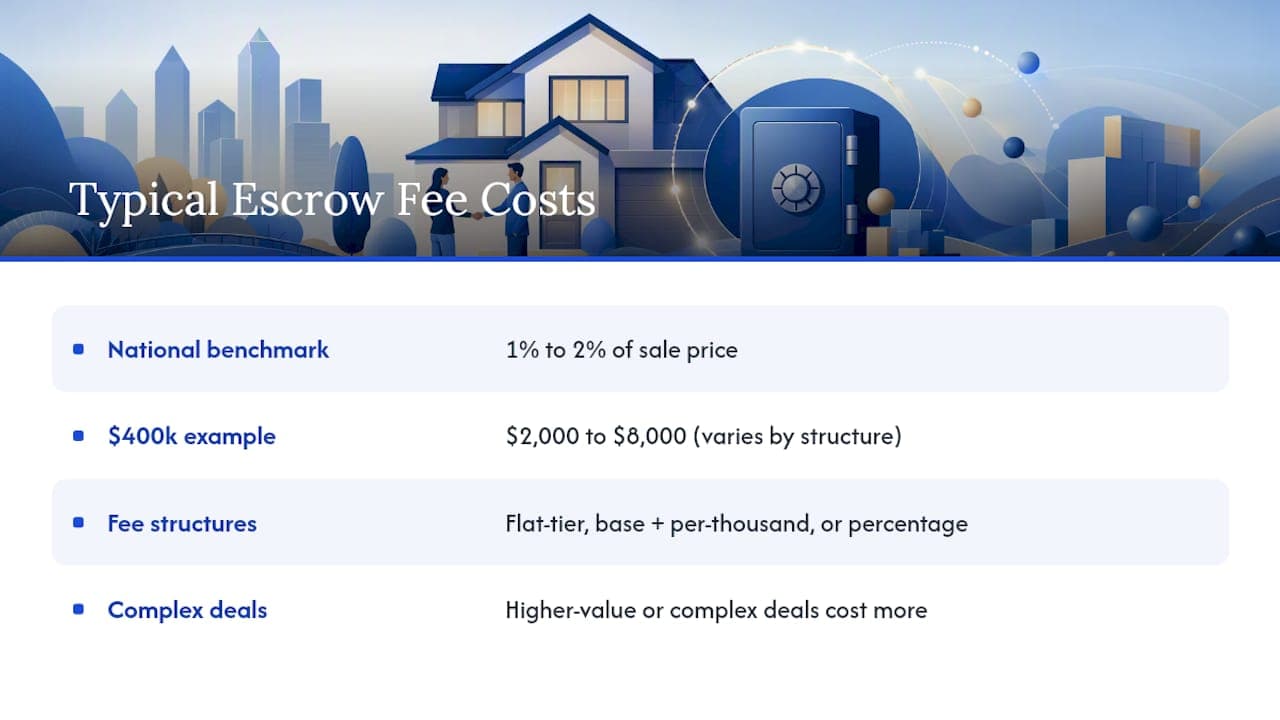
These numbers are illustrative ranges, not a quote. Actual fees depend entirely on your escrow company’s schedule and your state’s customs.
Pro Tip: Call two or three local title and escrow companies before you sign anything and ask for a written fee schedule. Rates vary more within the same city than most homeowners expect, and a five-minute phone call can reveal a few hundred dollars of difference.
Who Pays Escrow Fees: Buyer, Seller, or Both?
There’s no federal rule that assigns this cost to one party. Who pays escrow fees comes down to local custom and whatever the purchase contract says, which means the answer genuinely changes depending on where you live and what you negotiate.
Common patterns include:
- A 50/50 split between buyer and seller, which is standard in many parts of the country
- The seller covering the full fee as part of a broader concession package
- The buyer covering the fee, which shows up more often in competitive seller’s markets
- Attorney-state variations, where legal fees for closing services get bundled differently than in escrow-company states
Market conditions shift this in real time. In a buyer’s market, sellers often absorb more of the closing costs, including escrow fees, to keep a deal moving. In a seller’s market, buyers sometimes volunteer to cover more of those costs to make their offer stand out among competing bids. Whatever gets agreed on, get it in writing early. Raise the topic with your agent or escrow officer before you’re deep into the transaction, not the week before closing when there’s no room left to negotiate.
What Drives Escrow Fees Higher or Lower
Escrow companies don’t pull their pricing out of thin air. A handful of factors consistently push fees up or down, and knowing them helps you evaluate whether a quote is reasonable or padded.
- Sale price: higher-value homes generally mean higher fees, since percentage-based pricing scales with the transaction.
- Transaction complexity: multiple loans, liens, or a short sale add coordination work and cost.
- Title work required: properties with a messy title history need more research and more endorsements.
- State recording and transfer taxes: these vary by county and get bundled into the closing costs even though they’re technically separate from the escrow fee itself.
- Lender coordination: more lenders or more complex loan products mean more paperwork for the escrow officer to manage.
- Attorney involvement: in states that require an attorney at closing, legal fees can replace or supplement traditional escrow charges.
Pricing models also differ by provider. Some charge a flat fee regardless of sale price. Others use tiered brackets, a base rate plus a per-thousand-dollar charge, or a straight percentage. National title companies sometimes charge more than a small local firm, partly because of higher overhead and partly because they carry more liability insurance to cover larger transaction volumes.
Can You Negotiate Escrow Fees, and Is It Worth It?
Yes, escrow fees are negotiable, though state regulators note that fee schedules aren’t fixed by law and vary based on transaction complexity and regional custom, which leaves genuine room to push back. Just keep your expectations realistic. Negotiating on price alone typically nets modest savings, often in the range of $50 to $150, with bigger wins coming from bundling services rather than haggling over a single line item.
Here’s a practical order of operations before you sign escrow instructions:
- Request written quotes from at least two or three escrow or title companies in your area.
- Ask whether bundling title insurance and escrow services with one provider unlocks a discount.
- Check if you qualify for a repeat-customer or referral discount through your agent or lender.
- Ask specifically which line items are negotiable versus fixed by state or county requirements.
- Confirm any negotiated changes appear in writing before closing day.
Don’t cut corners on protections like title insurance just to shave a few dollars off the bill. That’s the wrong place to save money.
Pro Tip: If you’re selling for cash and skipping a traditional mortgage buyer, several lender-required fees disappear entirely, since there’s no loan to underwrite or coordinate. That alone can eliminate a meaningful chunk of the closing paperwork most sellers assume is unavoidable.
When Are Escrow Fees Paid, and Where Do They Show Up on Closing Paperwork?
Your first look at escrow fees comes on the Loan Estimate, a document lenders provide early in the process with projected closing costs. The final, exact numbers appear later on the Closing Disclosure, a form both buyers and their lenders must produce before signing day, along with the seller’s ALTA settlement statement that itemizes the seller’s side of the transaction.
The general timeline looks like this:
- Early in the process: the Loan Estimate gives buyers a preliminary escrow fee figure.
- Three business days before closing: buyers must receive the Closing Disclosure, giving them time to review every fee before signing anything.
- At the closing table: the escrow fee is paid, typically through the closing funds wired or certified by the buyer and deducted from the seller’s proceeds.
That three-day window exists specifically so you’re not blindsided by a number you’ve never seen before. If a fee jumps significantly between your Loan Estimate and your Closing Disclosure, that’s your cue to ask the escrow officer for an explanation before you sign.
Where Sellers and Buyers Usually Get This Wrong
The single biggest misstep I see is people treating the escrow fee like a fixed cost, the way you’d treat a government filing fee. It isn’t. It’s a service price set by a private company, and private company prices move when you push on them. Sellers in particular tend to accept whatever their agent’s preferred title company quotes without ever asking for a second number.
The second mistake is forgetting to negotiate allocation early. Buyers and sellers often leave the “who pays what” conversation until the purchase agreement is basically final, at which point there’s no leverage left to move that line item. Raise it during your initial offer negotiations, not after you’ve already agreed on price.
Where should you spend your energy? If you have time and a competitive local market, shopping two or three escrow quotes is worth the phone calls. If you’re selling under real time pressure, a job relocation, a foreclosure timeline, an inherited property you can’t maintain, chasing a $100 discount on escrow fees is the wrong priority. Speed and certainty matter more than shaving a small percentage off a closing cost line.
One realistic negotiating win: ask your escrow company whether they’ll waive or reduce the courier and wire fees bundled into their closing package. These small add-ons often have more flex than the base escrow charge itself, and officers will frequently drop them just to keep your business. For sellers who need to move fast and skip this entire negotiation, HouseGoodbye’s marketplace connects homeowners with multiple cash offers from vetted investors, cutting out much of the traditional closing complexity altogether.
A Faster Path That Skips Much of This Entirely
Everything above assumes a traditional sale with a lender, a listing agent, and a full escrow process. If you’re facing a tight timeline, a house that needs work you can’t afford, or a sale you just need finished without months of back-and-forth, there’s a different route.

Housegoodbye connects Michigan homeowners with multiple cash offers from vetted local real estate investors, so you can compare bids and pick the strongest one without listing, staging, or paying agent commissions. Selling as-is means no repair negotiations, no inspection contingencies dragging out your escrow period, and no lender-driven paperwork delays, since cash buyers skip the mortgage underwriting process that adds weeks to most closings. Homeowners dealing with an inherited house they don’t want to manage, a property that needs more work than they can invest in, or simply a deadline they can’t move often find this route far less stressful than a traditional listing.
Closings can happen in as little as seven days once you accept an offer. If speed and simplicity matter more than testing the open market, check what cash buyers in your area are offering and see the numbers for your own property.
Sources
A handful of primary sources back the numbers and rules in this guide, and they’re worth bookmarking if you want to dig deeper on your own transaction.
- Escrow fees: what they are, what they cost, and who pays
- What are escrow fees? | Freedom Mortgage
- Escrow fees: who pays and how much? | Rocket Mortgage
This article is general information, not a substitute for advice from a qualified financial advisor. Consult a qualified financial professional about your own circumstances before acting on anything here.
FAQ
How Can I Avoid Paying Escrow Fees?
You generally can’t avoid the fee entirely since it pays for a real service, but you can shift who pays it through negotiation, or reduce it by shopping multiple providers and requesting bundled pricing on title and escrow services together.
Do I Get Any Escrow Money Back at Closing?
If you’re a buyer, any unused portion of your earnest money deposit gets applied to your down payment or closing costs, not returned as cash; if you overfunded your escrow account after closing, your lender typically refunds the surplus after an annual account analysis.
What Is a Typical Escrow Fee on a Home Sale?
Most transactions fall between 1% and 2% of the purchase price, though exact amounts depend on your state, your provider’s fee schedule, and whether they charge a percentage or a flat rate.
Why Do Escrow Fees Feel So High?
The fee covers real administrative liability, holding and disbursing large sums of money, verifying payoffs, coordinating multiple parties, and recording legal documents, and complex transactions with multiple loans or title issues push that cost higher.
Is Selling for Cash a Way to Reduce Escrow-Related Costs?
Selling to a cash buyer removes several lender-required steps from the process, since there’s no mortgage underwriting to coordinate, which is one reason homeowners using a service like Housegoodbye often see a simpler closing overall.