TL;DR:
- The no-fee home sale process involves selling directly to a cash buyer without paying agent commissions. It offers speed and certainty but typically results in lower offers, between 50% and 80% of market value. Proper vetting of buyers and comparing multiple offers ensure a secure, beneficial transaction for sellers facing urgent or distressed situations.
The no-fee home sale process is defined as selling your property directly to a cash buyer or investor without paying real estate agent commissions. Traditional agent fees run 5% to 6% of the sale price, which on a $300,000 home means $15,000 to $18,000 leaving your pocket before you see a dime. The industry term for this approach is a “direct cash sale,” and it works by connecting sellers with investors who buy homes as-is, skip the listing process, and close fast. Housegoodbye facilitates this by generating competing cash offers from multiple investors, which pushes prices up and cuts out the middleman entirely.
How does the no-fee home sale process work step by step?
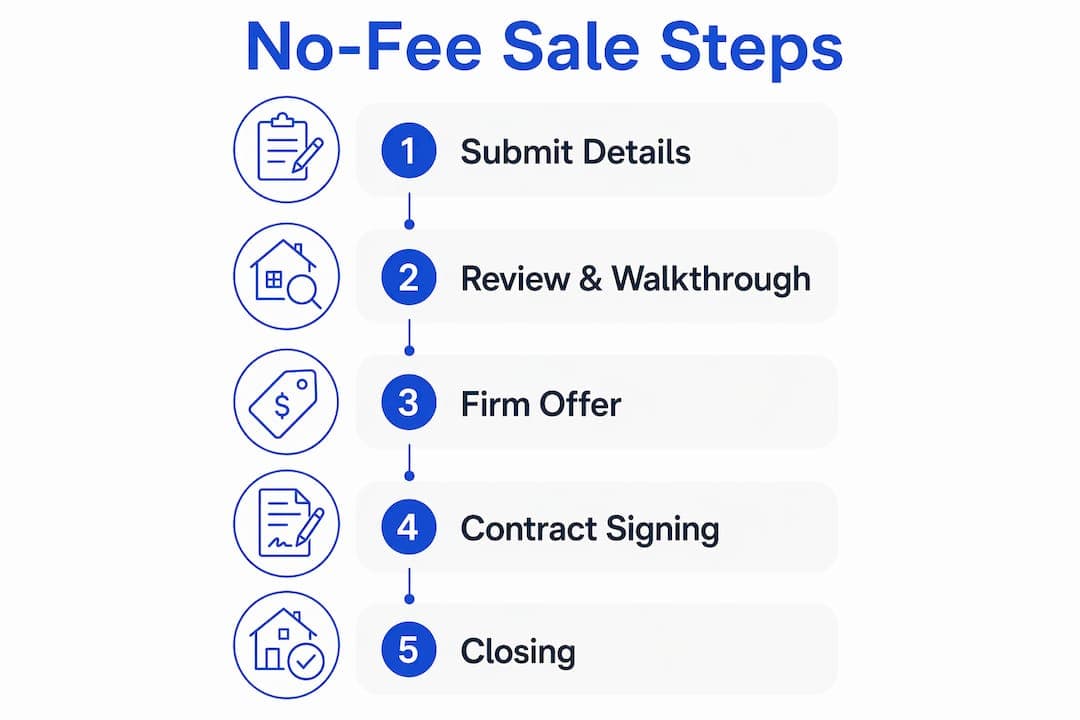
The no-fee home sale process follows a clear sequence from first contact to cash in hand. Understanding each stage helps you move quickly and avoid surprises.
Step 1: Submit your property details. You contact a cash buyer platform or investor directly and provide basic information about your home. This includes the address, condition, and your target closing timeline. No listing photos, open houses, or staging required.
Step 2: Preliminary offer and property review. The buyer reviews your submission and may schedule a walkthrough or request photos. This is not a full inspection. The goal is to assess condition and calculate a preliminary offer range. Cash buyers assess property condition based on repair costs, local market value, and their target profit margin.

Step 3: Firm offer generation. After the review, the buyer presents a written cash offer. This offer is typically firm, meaning it will not change unless the walkthrough reveals undisclosed damage. You have no obligation to accept.
Step 4: Contract signing. If you accept, you sign a purchase agreement. Read this carefully. Check for assignment clauses, which allow the buyer to transfer the contract to a third party. Legitimate buyers will explain every term clearly.
Step 5: Closing. Cash sales close faster than financed deals because there is no mortgage underwriting or appraisal required. The typical timeline runs 7 to 30 days from accepted offer to payment. A title company handles the paperwork, and you receive funds at closing.
Pro Tip: Request your closing date in writing before signing the purchase agreement. Verbal timelines are not binding, and a written date gives you legal recourse if the buyer delays.
The buyer type affects your experience. House flippers use the 70% rule, offering no more than 70% of after-repair value minus estimated repair costs. Institutional investors may offer slightly more but move slower. Knowing which type you are dealing with helps you set realistic expectations from the start.
What are the financial trade-offs and how to calculate your net proceeds?
Speed and convenience come at a price. Investor cash offers typically range from 50% to 80% of a home’s market value. Homes needing significant repairs often land at the lower end of that range, around 50% to 70%, because the buyer factors in renovation costs and profit margin.
Here is how to calculate your net proceeds from both paths:
| Sale Method | Gross Sale Price | Agent Fees (6%) | Repair Costs | Estimated Net |
|---|---|---|---|---|
| Traditional listing | $300,000 | $18,000 | $15,000 | $267,000 |
| No-fee cash sale (75%) | $225,000 | $0 | $0 | $225,000 |
| No-fee cash sale (80%) | $240,000 | $0 | $0 | $240,000 |
The gap narrows significantly once you subtract agent fees and repair costs from the traditional sale. Avoiding agent fees can save sellers 3% to 6% of the sale price, which partially offsets the lower offer price. The real question is not just what the offer says. It is what you actually walk away with after every cost is accounted for.
Pro Tip: Always request a written, itemized cost breakdown from the buyer before signing anything. A detailed cost breakdown protects you from surprise deductions at closing and helps you compare offers accurately.
Watch for hidden fees that some buyers bury in contracts. These include transaction fees, administrative charges, or repair credit deductions taken at closing. A legitimate buyer discloses all costs upfront. If a buyer resists giving you a written breakdown, that is a clear signal to walk away.
What are the risks and how to vet cash buyers for a no-fee sale?
Not every cash buyer operates with the same integrity. Vetting your buyer before signing anything is the single most important step in protecting yourself. Here is what to check:
- Proof of funds. Ask for a bank statement or letter from a financial institution confirming the buyer has the cash available. Any serious buyer will provide this without hesitation.
- Buyer identity. Confirm you are dealing with the actual purchasing entity, not a middleman who plans to assign your contract to an unknown third party. Ask directly: “Are you the end buyer?”
- Earnest money deposit. Legitimate buyers put money down when the contract is signed. Verifying the earnest money deposit and confirming it is held by a reputable title company protects you if the deal falls through.
- Title company verification. Choose your own title company or verify the buyer’s choice independently. The title company handles your funds at closing, so you need to trust them.
- Inspection terms. Understand the inspection period length and what happens if the buyer finds issues. A fair contract limits the inspection window to 7 to 14 days and specifies what can trigger a price renegotiation.
- Assignment clauses. If the contract includes an assignment clause, ask who the final buyer will be and get that information in writing before closing.
- Communication quality. A buyer who avoids direct answers, pressures you to sign quickly, or refuses to put terms in writing is a red flag. Transparency is the baseline standard for any legitimate transaction.
Cash offers have fewer contingencies than financed deals, which reduces the risk of the deal collapsing. That reliability is one of the strongest arguments for the no-fee route. But it only holds when you are dealing with a buyer who actually has the funds and the intent to close.
Who benefits most from a no-fee home sale?
The no-fee cash sale is not the right fit for every seller. It delivers the clearest advantage in specific situations where speed, certainty, or condition outweigh the goal of maximizing sale price.
No-fee home sales work best for sellers in these circumstances:
- Urgent relocation. A job transfer or family emergency that requires you to move within weeks makes a 7 to 30 day closing far more valuable than a higher price six months from now.
- Financial distress. Sellers facing foreclosure, mounting debt, or missed mortgage payments benefit from the speed and certainty of a cash close. A cash sale versus foreclosure comparison almost always favors the cash sale for protecting your credit and recovering equity.
- Inherited or probate property. Homes inherited through an estate often sit vacant, accumulating costs. A fast cash sale stops the bleeding without requiring heirs to fund repairs.
- Fixer-uppers. Homes needing major repairs are difficult to list on the open market. Buyers using mortgage financing often cannot purchase properties in poor condition, so the pool of traditional buyers shrinks dramatically.
- Sellers who want certainty over price. A financed offer can fall apart at the appraisal stage or when the buyer’s mortgage is denied. Cash eliminates that risk entirely.
The trade-off is real. You will almost certainly receive less than full market value. If your home is in excellent condition, you have time to wait, and you can afford agent fees, a traditional listing will likely net you more. The no-fee path is built for situations where speed and simplicity matter more than squeezing out every last dollar.
Key Takeaways
The no-fee home sale process delivers speed and certainty at the cost of a lower sale price, making it the right choice when time, condition, or financial urgency outweighs the goal of maximum proceeds.
| Point | Details |
|---|---|
| No agent fees save real money | Skipping the 5% to 6% commission narrows the gap between cash and traditional sale net proceeds. |
| Offers range from 50% to 80% of market value | Homes needing repairs land at the lower end; condition and location drive the final number. |
| Closings take 7 to 30 days | Cash buyers skip mortgage underwriting and appraisals, which removes the most common deal delays. |
| Vetting buyers is non-negotiable | Always verify proof of funds, earnest money, and title company before signing any contract. |
| Best for urgent or distressed situations | Foreclosure risk, inherited homes, fixer-uppers, and urgent relocations are the clearest use cases. |
What I have learned from watching sellers rush this decision
Bryan here. After years of watching homeowners navigate cash sales, the pattern I see most often is not fraud or bad buyers. It is sellers who accept the first offer without understanding what they are actually comparing.
The most common misunderstanding is treating the cash offer price as the only number that matters. A $220,000 cash offer on a home worth $290,000 sounds like a bad deal until you factor in $15,000 in agent fees, $12,000 in repairs the buyer would require, and two months of carrying costs while the home sits on the market. The math shifts fast.
My honest advice: get at least two or three competing cash offers before deciding. Housegoodbye’s model of generating multiple investor bids exists precisely because a single offer gives you no leverage and no benchmark. One offer is a take-it-or-leave-it situation. Three offers give you a negotiation.
The sellers I have seen regret a cash sale are almost always the ones who skipped vetting, accepted the first number, or did not read the contract before signing. The sellers who walk away satisfied are the ones who treated it like any other financial transaction: with documentation, comparison, and clear expectations from the start. If you are unsure whether a no-fee sale fits your situation, talk to a real estate attorney before you sign anything. That hour of consultation costs far less than a bad deal.
— Bryan
Housegoodbye makes the no-fee sale process straightforward
Selling your home without fees does not have to mean settling for one low offer and hoping for the best.

Housegoodbye connects Michigan homeowners with a network of competing cash investors, so you receive multiple real offers on your property without repairs, agent fees, or delays. The process works whether you are selling as-is in Michigan or need to close in as little as seven days. Housegoodbye is built for sellers who need speed and transparency, including those facing foreclosure, relocation, or inherited properties. If you are in the St. Joseph area, cash buyers in St. Joseph are ready to make offers now. Request your free cash offer and see what competing bids actually look like for your home.
FAQ
What does “no-fee home sale” actually mean?
A no-fee home sale means selling directly to a cash buyer or investor without paying real estate agent commissions. Sellers avoid the standard 5% to 6% agent fee that applies in a traditional listing.
Is no-fee home selling legit?
Yes, no-fee home selling is a legitimate method used by thousands of homeowners annually. The key is vetting your buyer by verifying proof of funds, earnest money, and the title company handling the closing.
How fast can a no-fee cash sale close?
Cash sales typically close within 7 to 30 days because there is no mortgage approval or appraisal process involved. The exact timeline depends on the buyer and title company.
Will I get full market value in a no-fee cash sale?
No. Cash investors typically offer 50% to 80% of market value to account for repair costs and profit margin. The net proceeds gap narrows once you subtract agent fees and repair costs from a traditional sale.
How do I avoid scams when selling without an agent?
Always request written proof of funds, confirm the buyer’s identity, verify the earnest money deposit is held by a reputable title company, and review the contract terms before signing anything.