TL;DR:
- Cash sales in real estate bypass agent commissions because they involve direct investor transactions. This process reduces costs by eliminating fees for agents, repairs, and extended carrying expenses, often resulting in net proceeds similar to traditional sales after accounting for all costs. Sellers in urgent or distressed situations benefit most from the speed, certainty, and simplicity of cash deals, provided they verify offers carefully to avoid scams.
A cash sale in real estate eliminates agent fees because it creates a direct transaction between seller and buyer, with no listing agent or buyer’s agent collecting a commission. Traditional home sales cost sellers 5–6% in agent commissions alone, plus additional closing costs that further reduce net proceeds. On a $300,000 home, that commission alone runs $15,000 to $18,000 out of your pocket. Understanding why cash sale eliminates agent fees starts with recognizing one structural fact: the cash buyer is an investor purchasing for their own portfolio, not a client using a listing service. Housegoodbye connects sellers directly with competing investors, removing the intermediary layer entirely.
Why cash sale eliminates agent fees: the core mechanism
Cash buyers are principal investors, not clients of real estate agents. They purchase properties for their own portfolios, which means no listing agent and no buyer’s agent enter the transaction. That single structural difference is what makes no commission real estate possible in a cash deal.

In a traditional sale, two agents split a commission paid by the seller. The listing agent markets your home, and the buyer’s agent represents the purchaser. Both get paid from your proceeds at closing. A cash sale skips both roles entirely because the buyer needs no representation and you need no listing service.
The direct home sale benefits go beyond just skipping commissions. Cash buyers typically handle their own paperwork and closing logistics. They negotiate directly with you, which means the deal moves faster and with fewer parties involved. The role of a listing agent in a traditional sale includes pricing, marketing, and negotiation support. In a cash deal, those functions either disappear or shift to you and the buyer.
- No listing agent means no MLS listing fee or marketing cost
- No buyer’s agent means no co-op commission paid from your proceeds
- Direct negotiation cuts weeks off the timeline
- Fewer contingencies reduce the chance of a deal falling apart
Pro Tip: Always ask a cash buyer for written proof of funds before signing anything. A legitimate investor provides this immediately. If they hesitate, walk away.
What fees are avoided with cash home sales?
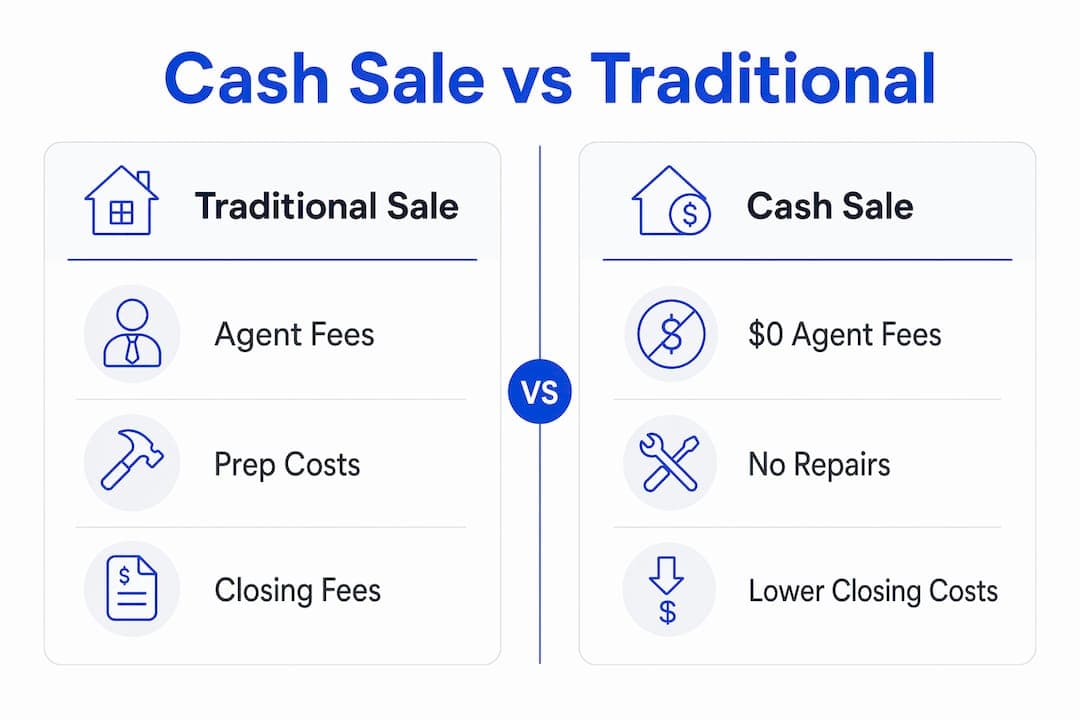
Agent commissions get the most attention, but the fees avoided with cash home sales go much deeper. Traditional sellers carry a full stack of costs that quietly drain net proceeds before closing day arrives.
Staging, repairs, and preparation costs add thousands to the expense column before a single showing happens. A traditional listing also requires you to keep paying mortgage, property taxes, and homeowner’s insurance during the marketing period, which can stretch 30 to 60 days or longer. Cash sales close in as little as 7 to 14 days, cutting those carrying costs dramatically. Cash buyers often cover closing costs themselves and waive inspections and appraisals, removing another layer of seller expense.
| Cost Category | Traditional Sale | Cash Sale |
|---|---|---|
| Agent commissions | 5–6% of sale price | $0 |
| Staging and repairs | $2,000–$10,000+ | $0 (sold as-is) |
| Carrying costs (mortgage, taxes, insurance) | 1–3 months of payments | Minimal (closes in days) |
| Seller-paid closing costs | 1–3% of sale price | Often covered by buyer |
| Appraisal and inspection fees | $500–$1,000+ | Typically waived |
| Deal fall-through risk | High (financing contingencies) | Very low |
The table above shows why the direct home sale benefits extend well past the commission line. A seller who avoids repairs, staging, two months of carrying costs, and closing fees can recover a significant portion of the price difference between a cash offer and a traditional listing price.
Pro Tip: Before comparing offers, calculate your realistic net proceeds from each scenario. Subtract commissions, estimated repairs, two months of carrying costs, and closing fees from the traditional offer. Then compare that number to the cash offer.
Are cash offers too low to make avoiding agent fees worthwhile?
Cash offers average 10–20% below full market value to account for buyer risk and the cost of repairs the investor will handle. That gap sounds large until you run the actual numbers. The net difference narrows considerably once you subtract commissions, repair costs, and carrying charges from a traditional sale price.
Consider a home with a $280,000 market value. A traditional sale at full price nets roughly $252,000 after a 6% commission, before repairs, staging, and carrying costs. A cash offer at 15% below market comes in at $238,000, but if the buyer covers closing costs and you skip $8,000 in repairs and two months of mortgage payments, your net proceeds land much closer than the sticker prices suggest.
The cash sale advantages also include certainty. Financed deals fall through when buyers lose mortgage approval, appraisals come in low, or inspections trigger renegotiations. Each failure costs you time and restarts the clock on carrying costs. A cash deal removes those variables entirely.
- The price gap shrinks once you account for all traditional sale costs
- Certainty of closing has real financial value, especially under time pressure
- Avoiding a deal fall-through saves weeks of additional carrying costs
- Sellers in distress often cannot afford the risk of a financed deal collapsing
The honest evaluation is not “cash offer vs. list price.” It is “cash offer net proceeds vs. traditional sale net proceeds.” Those two numbers are often much closer than sellers expect.
Who benefits most from selling without a realtor for cash?
Sellers facing urgent financial needs or inherited properties benefit most from cash sales because they prioritize speed, certainty, and simplicity over squeezing out the last dollar of sale price. For these homeowners, avoiding agent fees is not just a preference. It is a financial necessity.
Homeowners in financial distress need liquidity fast. A traditional listing that takes 60 days to close while they carry mortgage payments and risk a deal falling through can make a bad situation worse. A cash close in 7 days stops the bleeding immediately. Owners of inherited properties face a different but equally pressing problem. An inherited home often sits vacant, accumulating property taxes, insurance premiums, and maintenance costs. Every month it sits unsold costs money. Selling the inherited home as-is for cash eliminates those ongoing costs and delivers proceeds quickly.
Sellers with properties that need significant repairs also find cash sales far more practical. Listing a distressed property on the open market requires either expensive pre-sale repairs or a steep price reduction to attract buyers willing to take on the work. A cash investor buys the property as-is, which means you skip the repair cost entirely. Homeowners facing relocation deadlines, divorce settlements, or job loss share the same core need: a fast, certain close with no surprises.
How to pursue a cash sale safely and avoid agent fees
Selling without a realtor requires you to take on some of the verification work that an agent would normally handle. These steps protect you from scams and underpriced offers.
- Request proof of funds in writing. Legitimate cash buyers never charge upfront fees and provide proof of funds immediately. A bank statement or letter from a financial institution confirms the buyer can actually close.
- Get multiple offers before accepting. One offer gives you no baseline for comparison. Housegoodbye generates competing investor offers on your property, which pushes prices up and gives you real market data.
- Review the purchase contract carefully. Without an agent, you are responsible for understanding every clause. Pay attention to contingencies, closing timelines, and who covers which costs.
- Hire a real estate attorney for closing. Attorney fees are a fraction of agent commissions and protect you from contract errors. Many states require attorney involvement at closing regardless.
- Verify the buyer’s track record. Search for reviews, check business registration, and ask for references from recent sellers. A reputable investor has a verifiable history of closed deals.
- Understand the as-is sale process before signing. Knowing exactly what “as-is” means in your contract prevents disputes about condition disclosures after the fact.
The Arizona seller closing costs checklist offers a useful breakdown of what traditional sellers pay at closing, which helps you benchmark what you are actually saving by going the cash route.
Key Takeaways
A cash sale eliminates agent fees because the buyer is a direct investor, not a client of a listing service, removing commissions, repair costs, and carrying expenses from the seller’s ledger.
| Point | Details |
|---|---|
| No agent, no commission | Cash buyers purchase directly, so no 5–6% commission is deducted from your proceeds. |
| As-is sales cut repair costs | Cash buyers accept properties without repairs, saving sellers thousands before closing. |
| Faster closings reduce carrying costs | Cash deals close in 7–14 days, stopping mortgage, tax, and insurance payments quickly. |
| Net proceeds gap is smaller than it looks | Once all traditional costs are subtracted, cash offer net proceeds often rival a listed sale. |
| Distressed and inherited sellers benefit most | Speed and certainty matter more than maximum price when time and liquidity are critical. |
What I’ve learned from watching sellers do the math wrong
Most sellers I’ve seen walk away from cash offers make the same mistake. They compare the cash offer to the list price and stop there. That comparison is almost always misleading.
The real calculation is net proceeds after every cost. When you add up a 6% commission, $6,000 in pre-sale repairs, two months of mortgage and insurance payments, and seller-paid closing costs, the gap between a cash offer and a traditional sale shrinks fast. I’ve seen sellers net more from a cash deal on a $250,000 home than from a listed sale at $280,000 once all the costs came out.
The emotional dimension matters too. Homeowners dealing with inherited properties or financial pressure are not just making a financial decision. They are trying to end a stressful chapter as quickly as possible. A cash sale delivers that. A traditional listing stretches the stress out over months, with no guarantee of a clean close at the end.
My honest advice: run the full net proceeds calculation before you decide anything. Get at least two or three cash offers so you have a real baseline. And do not underestimate the value of a guaranteed close date. For sellers in urgent situations, certainty is worth real money.
— Bryan
How Housegoodbye removes agent fees from your sale
Housegoodbye connects homeowners directly with competing cash investors, which means you receive multiple real offers on your property without listing it, staging it, or paying a single dollar in agent commissions.

The process is built for sellers who need speed and simplicity. You submit your property details, Housegoodbye brings in competing investor bids, and you choose the offer that works best for you. Closing happens in as little as seven days. No repairs, no open houses, no commission checks written at the closing table. Learn exactly how cash home sales work and what to expect from the first offer to the final close. If you are in Michigan, Housegoodbye also serves sellers directly in cities like Holland and Warren.
FAQ
Why does a cash sale eliminate agent fees?
A cash buyer is an investor purchasing your property directly, so no listing agent or buyer’s agent is involved. Without agents in the transaction, no commission is owed.
How much can I save by avoiding agent fees in a cash sale?
Agent commissions in traditional sales run 5–6% of the sale price. On a $300,000 home, that is $15,000 to $18,000 in savings before factoring in avoided repair and closing costs.
Do cash buyers cover closing costs?
Cash buyers commonly handle closing costs themselves and often waive inspections and appraisals. This removes additional expenses that sellers typically pay in traditional transactions.
Are cash offers always too low to be worth it?
Cash offers average 10–20% below market value, but once agent fees, repair costs, and carrying costs are subtracted from a traditional sale, the net proceeds difference narrows considerably.
How do I know if a cash buyer is legitimate?
Legitimate cash buyers never charge upfront fees and provide written proof of funds immediately upon request. Always verify their track record with references and business registration before signing any contract.