
TL;DR:
- A cash closing involves purchasing real estate without lender involvement, speeding up the process to 7 to 21 days.
- It requires proof of funds, title search, escrow, and timely deed recording, with certain costs still applicable.
- Unlike mortgage closings, cash deals skip appraisal and underwriting but still face risks like title defects and wire fraud.
A cash closing is a real estate transaction where the buyer pays the full purchase price without a mortgage or any lender involvement. No underwriting, no appraisal, no loan officer. The deed still gets recorded at the county recorder’s office, and the sale isn’t legally complete until that happens — but you get there much faster. Most cash closings wrap up in 7–21 days, compared to the 30–60 days a financed purchase typically requires.
One thing worth clarifying upfront: “cash offer” in real estate usually means the buyer is waiving a financing contingency, not arriving with a briefcase of bills. Payment almost always comes by wire transfer or certified cashier’s check. Attempting to use literal paper currency can actually trigger IRS Form 8300 reporting requirements.
Table of Contents
- What is the cash closing process, step by step?
- How long does a cash closing actually take?
- What closing costs do you still pay with cash?
- Cash closing vs. mortgage closing: what actually changes?
- How do cash deals still fall through?
- What documents do you need for a cash closing?
- How cash-sale marketplaces actually speed up closings
- Key Takeaways
- When cash is the right call
- Sell your Michigan home fast with multiple cash offers
- Useful sources
- FAQ
What is the cash closing process, step by step?
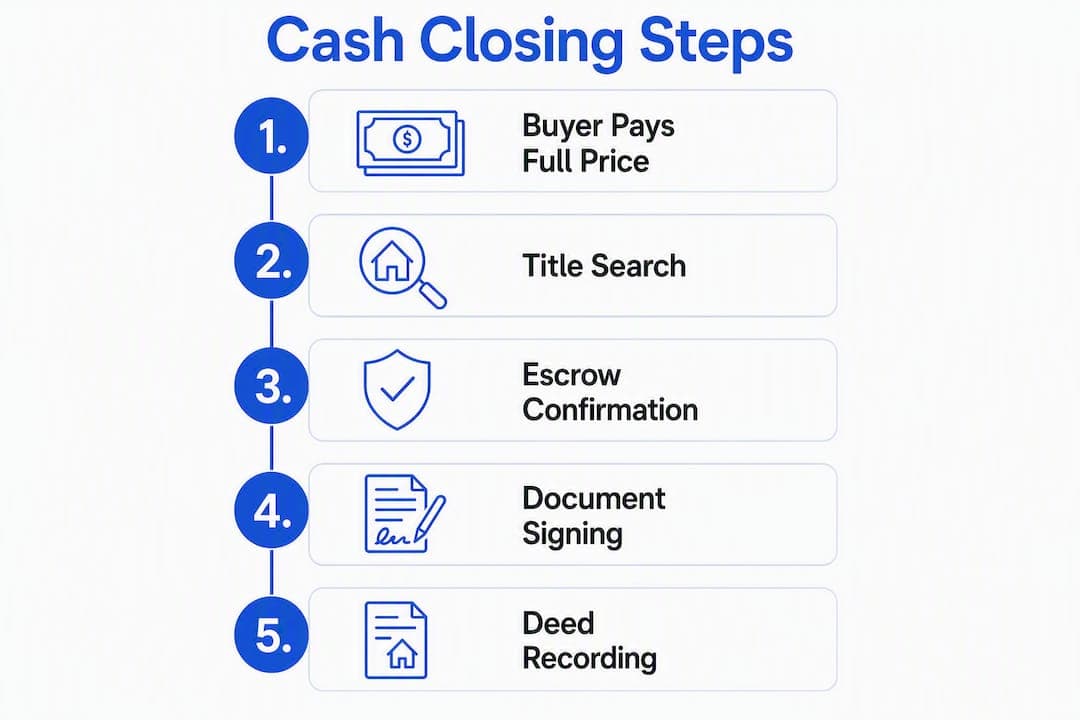
All-cash purchases skip the lender but not the paperwork. Here’s what actually happens between accepted offer and keys in hand:
- Offer acceptance and proof of funds. The seller accepts the offer and typically requests proof of funds within 24–48 hours. This is a bank statement, brokerage statement, or a letter on bank letterhead confirming the buyer has sufficient liquid assets. No proof of funds, no deal.
- Opening escrow and ordering the title search. A licensed title company or closing attorney opens an escrow account and orders a title search. Their job is to verify the seller has clear, marketable title and that no liens, judgments, or competing claims are attached to the property.
- Title search and lien clearance. The title company reviews public records going back decades. Any outstanding mortgage payoffs, mechanic’s liens, or tax liens must be resolved before closing. This step controls the pace of the entire transaction.
- Settlement statement preparation. The title or escrow company prepares the ALTA settlement statement (or a closing disclosure equivalent), itemizing every fee, credit, and proration. Both parties review and approve it before signing day.
- Signing and funds transfer. The buyer wires funds or delivers a cashier’s check to escrow. The seller signs the deed and any required affidavits. The escrow officer verifies that funds have cleared before releasing anything.
- Recording the deed. Once funds are confirmed, the title company submits the deed to the county recorder’s office. Recording creates legal, public notice of the ownership transfer. Until that happens, the sale is not complete.
- Keys and possession. Possession transfers per the purchase agreement, usually on the recording date or the following business day.
Pro Tip: Wire your funds early in the morning. Most county recorders and escrow companies have same-day cutoff times, often 2:00–3:00 PM local time. A wire that arrives at 4:00 PM can push recording to the next business day, delaying your possession date by 24 hours.
For a detailed home closing process checklist that maps each of these steps, that resource is worth bookmarking before your closing date.
How long does a cash closing actually take?
The short answer: faster than you probably expect, but not instant. Cash deals eliminate appraisal and underwriting delays, which are the two biggest time sinks in a financed purchase. What remains is almost entirely driven by how quickly the title company can clear the property’s history.
- 7 days: Achievable when the seller is motivated, the title is clean, and the buyer has funds ready. Platforms like Housegoodbye that work with pre-vetted investors can hit this window.
- 10–21 days: The most common range for standard cash transactions. Title searches in busy counties or on older properties with complex histories take longer.
- 3+ weeks: Expected when title defects surface — an old lien that wasn’t discharged, a boundary dispute, or a missing heir on an inherited property. These require legal resolution before recording.
Other factors that affect timing:
- State recording practices. Some states allow same-day recording; others batch submissions and process them days later.
- Good-funds laws. Many states require escrow to confirm funds have fully cleared before the deed can be recorded, not just that a wire was initiated.
- Bank wire cutoffs. Federal Reserve wire systems close at specific times; a missed window means a one-business-day delay.
- Municipal transfer taxes or approvals. Certain cities require a transfer tax stamp or municipal inspection certificate before recording, adding days to the timeline.
For sellers who need speed, understanding why cash sales close faster comes down to eliminating lender steps, not eliminating title work.
What closing costs do you still pay with cash?

Skipping the lender removes a real chunk of fees. No loan origination fee, no mortgage points, no lender’s title insurance, no prepaid interest, no flood certification fee. But a meaningful list of costs remains.
Cash buyers typically pay closing costs in the 1%–3% range of the purchase price, compared to 2%–5% for financed transactions that include lender fees.
| Cost Category | Who Typically Pays | Notes |
|---|---|---|
| Title search fee | Buyer | Required; cost varies by county |
| Owner’s title insurance | Buyer (negotiable) | Strongly recommended; one-time premium |
| Escrow / closing fee | Split or buyer | Paid to title company or closing attorney |
| Recording fees | Buyer | Paid to county recorder |
| Transfer taxes | Varies by state | Some states charge seller; some split |
| Prorated property taxes | Seller credit to buyer | Adjusted to closing date |
| Attorney fees | Varies | Required in some states |
One cost that surprises cash buyers: owner’s title insurance is still worth buying even without a lender requiring it. A lender’s policy protects the bank. An owner’s policy protects you. If a title defect surfaces after closing — a forged deed in the chain of title, an undisclosed heir — the owner’s policy covers your legal defense and potential loss. Skipping it to save a few hundred dollars on a six-figure purchase is a poor trade.
Sellers can also reduce their own closing costs significantly. Selling without an agent eliminates commission fees, which typically run 5%–6% of the sale price in a traditional transaction.
Cash closing vs. mortgage closing: what actually changes?
The structural difference is straightforward: a mortgage closing requires a lender to approve the buyer, the property, and the transaction. A cash closing requires none of that. Here’s how that plays out in practice:
| Step | Cash Closing | Mortgage Closing |
|---|---|---|
| Financing contingency | None | Standard (30–45 days) |
| Appraisal | Not required | Required by lender |
| Underwriting | None | 2–4 weeks typical |
| Loan documents | None | Promissory note, mortgage, disclosures |
| Closing Disclosure | Not required | Required (3-day waiting period) |
| Title search | Required | Required |
| Deed recording | Required | Required |
| Typical timeline | 7–21 days | 30–60 days |
One distinction worth understanding: an “all-cash” offer often means the buyer is waiving a financing contingency, not that they literally have no mortgage. Some buyers use portfolio lenders or bridge loans and still present as “cash” because they’re removing the contingency. Sellers value that certainty. A deal that can’t fall apart due to loan denial is worth more than a higher offer that might.
That said, a financed offer can still compete when:
- The buyer has a fully underwritten loan commitment (not just pre-approval)
- The lender offers a quick-close program with a 21-day guarantee
- The buyer waives the appraisal contingency and covers any gap in writing
- The seller’s timeline is flexible and price matters more than speed
How do cash deals still fall through?
Cash removes the lender risk. It doesn’t remove all risk. These are the failure points that actually derail cash transactions:
- Title defects. An old lien that wasn’t properly discharged, a boundary encroachment, or a probate issue on an inherited property can halt closing indefinitely. The role of the title company is to catch these before funds move.
- Wire fraud. This is the fastest-growing closing scam in U.S. real estate. Fraudsters intercept email communications and send fake wiring instructions. Buyers wire funds to the wrong account and recovery is rare.
- Identity or signature mismatches. The name on the deed must match the seller’s government-issued ID exactly. A maiden name, a middle initial, or a name change after marriage that wasn’t updated on the deed can stop recording.
- Failed or late funds transfer. A wire that arrives after the escrow cutoff, or a cashier’s check drawn on a bank the escrow company can’t verify same-day, pushes closing to the next business day.
- Missing documentation. Payoff statements for existing mortgages, HOA estoppel letters, or required municipal certificates that weren’t ordered in time.
Pro Tip: Always verify wiring instructions by calling the title company directly using a phone number you found independently, not one from an email. Wire fraud losses are rarely recoverable. Confirm the account number verbally before sending any funds.
A short checklist to reduce risk on both sides:
- Buyer: confirm proof of funds is on official letterhead with account numbers partially redacted
- Seller: order payoff statements and lien releases at least two weeks before closing
- Both: verify all names on IDs match the deed and purchase agreement exactly
- Both: schedule funds transfers for early morning, not end of day
What documents do you need for a cash closing?
Arriving at the closing table without the right paperwork is one of the most avoidable delays in real estate. Here’s what to gather in advance:
Buyer documents:
- Proof of funds (bank or brokerage statement dated within 30–60 days, or a bank letter on official letterhead)
- Government-issued photo ID matching the name on the purchase agreement
- Signed and approved settlement statement
Seller documents:
- Current deed (the title company will need this to prepare the new deed)
- Payoff statements for any existing mortgages or home equity lines
- Lien release documentation for any resolved judgments or contractor liens
- HOA estoppel letter (if applicable)
- Keys, garage codes, and security system information
Title and escrow documents:
- ALTA settlement statement or closing disclosure equivalent
- Owner’s title insurance commitment and final policy
- Deed (prepared by title company or closing attorney)
- Transfer tax declarations (state and county specific)
- Recording forms for the county recorder
For inherited properties specifically, additional affidavits of heirship or probate court orders may be required. The inherited home cash sale process has its own document requirements worth reviewing separately.
How cash-sale marketplaces actually speed up closings
The speed advantage of a marketplace like Housegoodbye isn’t magic. It comes from eliminating the front-end delays that slow traditional sales: no listing period, no open houses, no weeks of negotiation, no buyer who needs 45 days to get loan approval.
Pre-vetted investor networks mean proof of funds is already verified before an offer is submitted. The marketplace handles offer comparison and buyer qualification upfront, so by the time a seller accepts, the transaction is ready to move directly into title and escrow — skipping the weeks of pre-contract friction that add time to traditional sales.
What marketplaces cannot shortcut: title clearance and escrow good-funds confirmation. Those steps are legally required regardless of how the buyer is sourced. A property with a clean title and a motivated seller can close in seven days through a marketplace. A property with a lien dispute takes the same time to resolve whether the buyer came from a marketplace or a traditional listing.
The competitive-offer model also matters for price. When multiple investors bid on the same property, sellers often recover more than they would from a single off-market offer, even after accounting for the as-is condition discount.
Pro Tip: When evaluating a cash-sale marketplace, ask specifically: What proof-of-funds format do your investors provide? Which title companies do you work with regularly? A marketplace that can answer both questions with specifics is one that has actually closed deals, not just collected leads.
Key Takeaways
A cash closing transfers property ownership without lender involvement, but title work, escrow confirmation, and deed recording are still legally required before the sale is complete.
| Point | Details |
|---|---|
| Legal completion requires recording | The deed must be recorded at the county recorder’s office before ownership legally transfers. |
| Typical timeline is 7–21 days | Most cash closings finish within a short timeframe; title complexity is the primary variable. |
| Costs run 1%–3% of purchase price | Title, escrow, recording, and transfer taxes remain; lender fees disappear. |
| Wire fraud is the top cash-deal risk | Always verify wiring instructions by phone before transferring funds. |
| Housegoodbye accelerates the front end | Michigan sellers receive multiple vetted investor offers, skipping listing delays and closing in as little as 7 days. |
When cash is the right call
The conventional wisdom treats cash offers as universally superior. They usually are, but the reason matters more than the label. A cash offer from a buyer who has never closed a deal, has no established relationship with a title company, and is wiring funds from an overseas account is not safer than a fully underwritten mortgage from a local lender. The speed and certainty come from the buyer’s preparation and the transaction infrastructure behind them, not the word “cash” on the offer letter.
Where cash genuinely wins: urgent timelines, inherited properties with deferred maintenance, sellers facing foreclosure, and anyone who needs to skip the repair-and-stage cycle entirely. In those situations, the 10%–15% price discount that sometimes comes with a cash offer is a reasonable trade for certainty and speed. A sale that closes in two weeks at 88 cents on the dollar is often worth more than a listing that sits for three months and closes at full price — if it closes at all.
The sellers who get the best outcomes in cash transactions are the ones who treat it like any other closing: they verify proof of funds, they pick a reliable title company, and they don’t assume “cash” means “nothing can go wrong.”
Sell your Michigan home fast with multiple cash offers
Waiting months for the right buyer is one option. Getting competing cash offers in days is another.
Housegoodbye connects Michigan homeowners directly with vetted local investors who are ready to buy as-is, no repairs, no staging, no agent commissions. Submit your property, receive multiple bids, compare them side by side, and choose the offer that fits your timeline and price expectations. The platform’s investor network comes pre-qualified with proof of funds, so when you accept an offer, the transaction moves straight into title and escrow.

Closings happen in as little as seven days. There’s no obligation to accept any offer, and no fee to use the platform as a seller. For homeowners dealing with an urgent move, a distressed property, or an inherited home they don’t want to manage, this is the path that skips the friction without sacrificing the sale.
See how the cash-offer process works or request your as-is cash offers to see what Michigan investors will pay for your home today.
Useful sources
- Consumer Financial Protection Bureau: What happens at closing — The CFPB’s plain-language overview of the closing process, including what documents to expect and when.
- LegalClarity: All-cash in real estate, definition and IRS rules — Covers what “all-cash” legally means, IRS reporting requirements, and what paperwork remains required.
- LegalClarity: What happens at closing when paying cash — Step-by-step breakdown of the cash closing sequence, including recording and funds verification.
- Bankrate: Buying a house with cash vs. a mortgage — Side-by-side comparison of costs, documents, and trade-offs between the two paths.
- Linear Title & Escrow: Cash closing vs. mortgage closing — Industry-level explanation of which lender steps disappear and what title companies still control.
FAQ
How much does a cash closing cost the buyer?
Cash buyers typically pay 1%–3% of the purchase price in closing costs, covering title search, owner’s title insurance, escrow fees, recording fees, and transfer taxes. Lender fees are eliminated entirely.
Does the seller get money on the day of closing?
Not always. In some states, payment settlement takes 2–5 business days depending on escrow practices and recording timelines. Same-day disbursement is common in wet-closing states; dry-closing states may take longer.
Can a cash sale still fall through on closing day?
Yes. Title defects, wire fraud, identity mismatches, and missing documentation can all derail a cash deal even on closing day. Cash buyers reduce sale risk primarily by removing financing contingencies, not all contingencies.
Should sellers accept all-cash offers on their home?
Usually, yes, especially when the buyer provides verified proof of funds and a reliable title company is involved. The certainty of a non-contingent offer is worth more than a slightly higher financed offer that could fall apart during underwriting.
When is a cash closing legally complete?
The sale is legally complete only after the deed is recorded at the county recorder’s office. Signing documents and transferring funds are necessary steps, but recording is what creates public, legal notice of the ownership change.