Yes, you can sell a house that has a second mortgage. Both loans are paid from the sale price at closing, the first mortgage first and the second after it, and whatever is left is yours. The only real question is whether the price covers both payoffs plus the costs of selling. If it does, the sale is routine. If it does not, you have options, and the earlier you choose one, the more of them you keep. We built HouseGoodbye so Michigan sellers can see several competing as-is cash offers side by side and judge each one against their actual payoff numbers.
TL;DR
- A second mortgage does not block a sale. The title company pays off the first mortgage, then the second, from your proceeds at closing.
- Get a written payoff statement from each lender. A payoff is not your balance: it includes interest through the closing date and any fees.
- Subtract both payoffs and your selling costs from the offer. A positive number is your cash at closing; a negative number is a shortfall.
- If there is a shortfall, you can bring cash, negotiate a short sale, or wait. Get any deal on the debt in writing before you sign.
- If you are behind on payments, act early. Selling before a sheriff’s sale gives you the most control.
Table of Contents
- What happens to a second mortgage when you sell
- Step 1: Find out what you actually owe
- Step 2: Run the numbers before you list or accept anything
- Step 3: Sell in a way that keeps costs low
- Step 4: Close and confirm the liens are released
- If the price does not cover both loans
- If you are behind on payments
- Inherited, vacant or damaged homes with a second mortgage
- Sell your house with a second mortgage through HouseGoodbye
- Our perspective
- FAQ
- Sources
What happens to a second mortgage when you sell
A second mortgage is a loan secured by your home that sits behind your original loan. It might be a home equity loan, a home equity line of credit (HELOC), or a piggyback loan taken out with the purchase. The Consumer Financial Protection Bureau explains that if the home is sold to pay off debts, the second lender, called a junior lien, is paid after the first. If there is not enough equity, the second lender may not get everything it is owed. That is also why second mortgages usually carry higher interest rates.
In a normal sale, you do not write those checks yourself. The title company or closing attorney collects the buyer’s money and pays your lenders directly. You can see it on paper: the CFPB’s sample Closing Disclosure lists “Payoff of First Mortgage Loan” and “Payoff of Second Mortgage Loan” as separate lines in the seller’s column, followed by a “Cash From/To Seller” total. That last line is the number you care about.
The order matters. Each lien has to be cleared for the buyer to receive clear title. A buyer, cash or financed, will not close on a house with an open lien that is not being paid off at the table.
Step 1: Find out what you actually owe
Your statement balance is not your payoff. The payoff amount is the balance plus interest accrued through the closing date plus any unpaid fees. Closing a week later means a little more interest on both loans.
Call each lender, or use its online portal, and ask for a written payoff statement with a per-day interest figure. Do this for the first mortgage and the second. If you have a HELOC, also ask what the lender needs in writing to close the line. Paying a HELOC to zero does not necessarily close it, and a line left open can leave a lien on title.
While you are gathering paper, check for anything else recorded against the property. Unpaid property taxes, judgments and contractor liens all come out of the same proceeds. If you suspect back taxes, our page on selling a house with back taxes or tax liens in Michigan walks through how they are handled.
Step 2: Run the numbers before you list or accept anything
The math is a short subtraction:
- Start with the sale price you expect.
- Subtract the first mortgage payoff.
- Subtract the second mortgage payoff (or HELOC payoff).
- Subtract selling costs: agent commissions if you list, title and closing fees, transfer taxes, prorated property taxes, and any repairs or credits the buyer negotiates.
- The result is your net proceeds.
Here is a hypothetical example, not a quote. A Michigan seller receives a $215,000 as-is cash offer. The first mortgage payoff is $168,400 and the second mortgage payoff is $31,200, both including per-day interest. Closing costs come to $3,000.
| Line | Amount |
|---|---|
| Offer | $215,000 |
| First mortgage payoff | -$168,400 |
| Second mortgage payoff | -$31,200 |
| Closing costs | -$3,000 |
| Cash to seller | $12,400 |
Now take the same house on the open market with a commission and repairs. Every dollar of commission and every repair bill comes straight out of that last line, and on a house with a second mortgage there is often little cushion to absorb them. That is why the cost side matters more here than for a seller who owns the house free and clear.
Two checks keep the estimate honest. First, make sure nothing is counted twice and nothing is missing: both payoffs, per-day interest, any lien-release or wire fees, taxes and HOA dues owed through closing. Second, treat any early estimate as provisional until the lender’s official payoff figure is in hand, because that number moves with the closing date. Until the day you hand over the keys, you also keep paying the mortgage, taxes, insurance and utilities, so a slow sale has its own cost.
Step 3: Sell in a way that keeps costs low
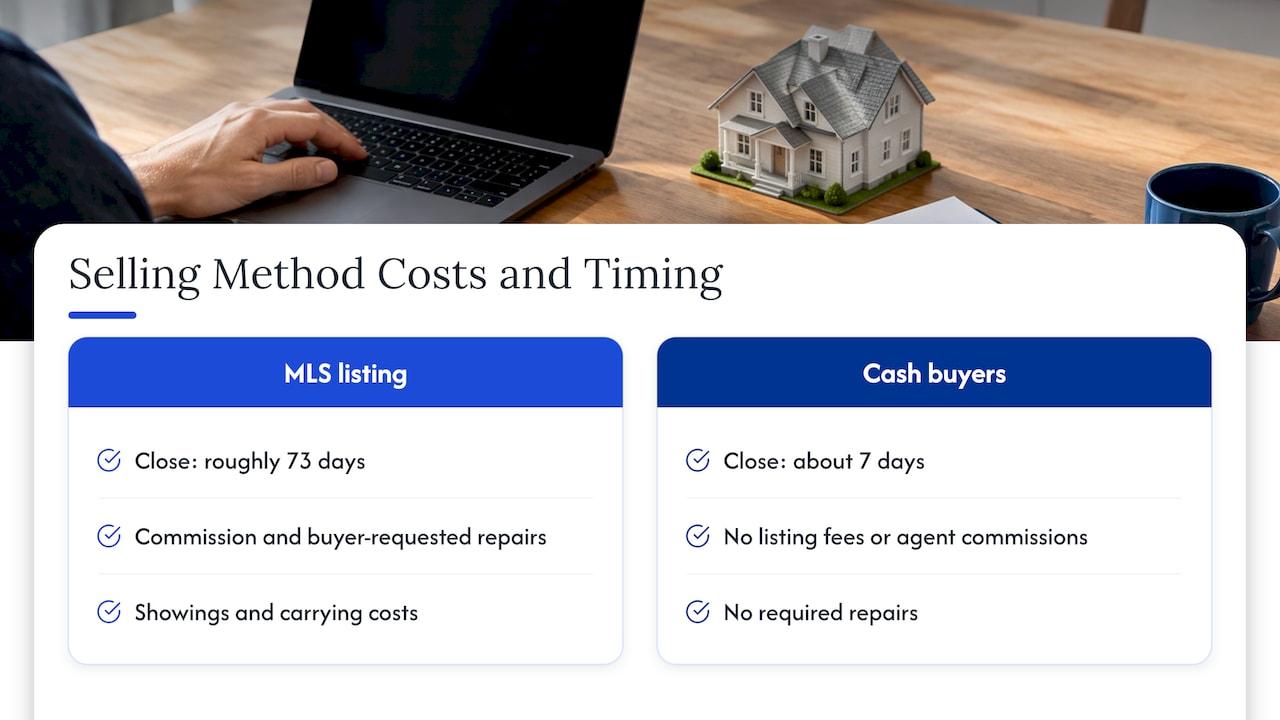
With a thin margin, how you sell can decide whether you walk away with money or have to bring it. A traditional listing means commission, repairs the buyer’s inspection asks for, showings, and months of carrying two loan payments while you wait. Our typical close is about 7 days, versus roughly 73 days on the MLS, according to our own figures, so the interest and payments that pile up during a listing mostly never start.
On HouseGoodbye you enter your address and several vetted local cash buyers bid on the house as-is. There are no listing fees, no agent commissions and no required repairs. You see every offer, and you can walk away if none of them works. For a seller with a second mortgage, that comparison is useful for a plain reason: the highest offer is the one most likely to clear both payoffs. If you want the process in detail, see how competing cash offers work.
A practical tip: have both payoff figures ready before you read the offers. Then each offer becomes one subtraction, and you can see right away which ones clear your debts and by how much.
Step 4: Close and confirm the liens are released
At closing, the title company pays the payoffs from the buyer’s funds. Two things are worth confirming afterward.
First, in Michigan the lender must release the lien on the public record. Under MCL 565.41, once a mortgage is paid, the mortgagee must prepare a discharge, file it with the county register of deeds, and pay the recording fee within the statutory period. Ask the title company to confirm the discharge is recorded rather than assuming it is.
Second, if the second loan is a HELOC, send the lender a written request to close the account when it is paid off, so no one can draw on a line that is secured by a house you no longer own.
We cover the paperwork side of cash closings in more depth in our guide to avoiding a shortfall on a mortgage payoff in a Michigan cash sale.
If the price does not cover both loans
Sometimes the numbers come out negative. This usually happens when the house needs work, values dipped after you borrowed, or a HELOC was drawn up close to the limit. You still have choices.
Bring the difference. If you have savings or family help, you can pay the shortfall at closing and the sale goes through normally. It is the cleanest route, and nothing is left owing.
Negotiate a short sale. A short sale means selling for less than you owe with your lenders’ agreement. Each lienholder has to approve, and the second lender, who often stands to receive the least, can be the hardest to persuade. Approvals commonly take months, and a house sitting on the market during that time keeps costing you. Our comparison of a short sale versus a cash sale in Michigan lays out the timing difference.
Pause and pay down. If you are not under deadline pressure, you can take the house off the market and reduce the balances first. This only works if you are current on payments.
Lien release is not debt release
This is the detail that catches people. A second lender can agree to release its lien so the sale can close and still expect you to pay the balance afterward. In Michigan, a lender may be able to seek a deficiency judgment after a short sale unless the agreement says the lender waives its right to the deficiency. So ask each lender in writing whether it is forgiving the debt or only giving up its claim on the house, and get the answer in the approval letter before you commit to a closing date. For anything unclear in that letter, have a Michigan real estate attorney read it before you sign.
One working order of attack for a negotiation: start with the junior lender. It sits last in line and has the most reason to accept a reduced payoff, so its answer tells you whether the whole deal is possible.
If you are behind on payments
A second mortgage makes missed payments more dangerous, because either lender can start foreclosure. The CFPB notes that because your home’s equity backs the loan, you could lose the home if you cannot repay a home equity loan or HELOC.
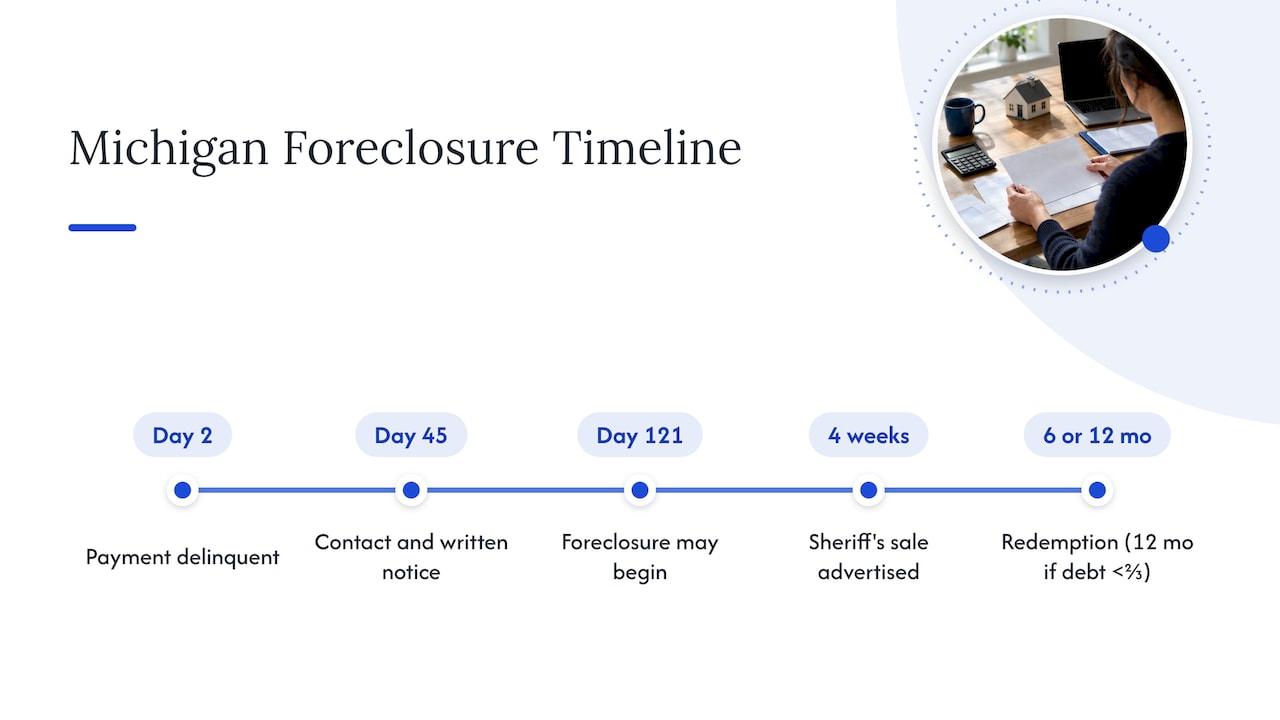
The Michigan State Housing Development Authority (MSHDA) lays out the timeline on its stages of foreclosure page. A payment due on the 1st is delinquent on the 2nd. The servicer must make contact and send written notice by day 45. If attempts to resolve the default fail and no hardship application is received, foreclosure can begin at day 121. A sheriff’s sale is then advertised for four consecutive weeks, and the redemption period, during which you can still reclaim the home, is most commonly six months, or 12 months if the amount due is less than two thirds of the original debt. MSHDA also points to free help from an approved housing counseling agency, and it advises asking your lender for a deficiency waiver if you sell for less than you owe.
Selling before the sheriff’s sale usually leaves you in a better position than letting it run. A foreclosure sale also has a cost to the second lender’s side of the table: Michigan’s Court of Appeals held in a 2017 surplus funds case that leftover foreclosure proceeds go to a junior mortgagee ahead of the owner’s estate. In other words, a second mortgage can claim any surplus before you see it.
If you are in this position, start with our pages on selling to avoid foreclosure and selling a house when you are behind on the mortgage. For the legal side of timing, our guide to selling during pre-foreclosure in Michigan explains what you can still do and when.
Inherited, vacant or damaged homes with a second mortgage
The payoff math is the same when the house came to you through probate, sits empty, or has fire, water or code problems. What changes is the price: condition lowers offers, and a lower offer leaves less room above two loans. Three points help.
- Inherited homes. A second mortgage and a first mortgage stay attached to the property even when the owner has died. The estate’s personal representative arranges the sale, and the payoffs come from proceeds like any other. Whether heirs owe anything personally for a shortfall depends on the loan documents and state law, so have a probate attorney confirm before anyone signs a short sale letter. Our page on selling an inherited house or probate property covers the process.
- Vacant homes. Interest keeps running while the house is empty, and so do taxes and insurance. A faster close shortens that drain. See selling a vacant house.
- Damaged or cited homes. Selling as-is means you do not pay for repairs before closing, which protects the cash left after the two payoffs. See selling a fire or water damaged house and selling a house with code violations.
Sell your house with a second mortgage through HouseGoodbye
HouseGoodbye is a Michigan marketplace, not a single cash buyer. You enter your address, vetted local cash buyers compete with as-is offers, and you compare the numbers against your two payoffs. There are no commissions, no repairs, no showings and no obligation, and a close can happen in about a week.

If you are ready to see what your house would bring, start with selling your house fast for cash, or see how we buy houses as-is across Metro Detroit, Grand Rapids, Flint, Lansing and the rest of Michigan.
Our perspective
Most sellers with a second mortgage come to us asking the wrong question. They ask whether a buyer will take a house with two loans on it. Buyers do not care how many loans there are. They care about the price, and the title company handles the rest.
The real question is how much is left after both payoffs, and the best way to answer it is to put several offers in front of you at once. One investor making one offer tells you what that investor wants to pay. Several buyers bidding on the same house tell you what the house is worth to the market as it stands today, with no repairs and no commissions taking a bite.
That is why we built HouseGoodbye as a marketplace. Your first and second payoffs are fixed numbers. The offer is the only part you can move, and competition moves it. If no bid clears your debts, you can walk away with nothing owed to us. If one does, you can close in about a week and stop the interest clock.
If you are behind on payments, do not wait for the lender’s letters to decide for you. Selling while you still have time is the point at which you have the most choices.
Bryan
FAQ
Do I need my second mortgage lender’s permission to sell?
You do not need permission to sell, but the lender must be paid and must release its lien for the buyer to get clear title. You request a payoff statement, the title company pays it at closing, and the lender then records a discharge. Permission is only needed if you are selling for less than you owe, since that requires the lender’s approval of a short sale.
What if I owe more than the house is worth?
You can bring cash to closing to cover the difference, negotiate a short sale with both lenders, or wait and pay down the balances. If you pursue a short sale, ask each lender in writing whether it waives the remaining debt. In Michigan, a lender may still pursue a deficiency unless the agreement waives it, so read the approval letter carefully and have an attorney review it if anything is unclear.
Can I sell a house with a HELOC?
Yes. A HELOC is a second mortgage and is paid off from proceeds like any other. Ask the lender for a payoff figure, then send a written request to close the line. Confirm with the title company that the discharge is recorded, since a zero balance alone does not remove the lien.
How long does it take to sell a house with a second mortgage?
A normal sale takes as long as any other. About 73 days is the typical MLS timeline we use, while cash sales through HouseGoodbye often close in about 7 days. A short sale adds lender approvals and commonly takes months, so if you are on a deadline, check whether your numbers work without one.
Does selling my house stop foreclosure?
If the sale closes and the lenders are paid before the sheriff’s sale, the foreclosure ends because the debt is paid. Michigan’s redemption period and foreclosure timeline are set out by MSHDA, and free counseling is available through its approved agencies. Time matters, so start as soon as you fall behind.
Sources
- What is a second mortgage loan or “junior-lien”? (CFPB)
- Sample Closing Disclosure (CFPB)
- MCL 565.41 (Michigan Legislature)
- Deficiency Judgment Laws in Michigan (Nolo)
- Stages of Foreclosure (MSHDA)
- In re $55,336.17 Surplus Funds, Michigan Court of Appeals, 2017