TL;DR:
- Agent fees can significantly decrease your home sale profit because they are percentage-based and deducted at closing. A cash sale without agent commissions often results in higher net proceeds, especially when factoring in repair, staging, and holding costs. Housegoodbye offers a fast, commission-free alternative by buying homes as-is with multiple competing cash offers.
Agent fees reduce what you take home because commissions are calculated as a percentage of your final sale price and paid directly out of your proceeds at closing. The national average sits at 5.7%, which translates to roughly $20,374 on a median U.S. home sale. Cash buyers like Housegoodbye skip that line item entirely.
- Commissions scale with price: a $600,000 home at 5.7% costs $34,200 in fees alone.
- The money is deducted at closing by the escrow or title company, so you feel it when you see your final check.
- Housegoodbye buys for cash with no agent commissions, avoiding this cost altogether.
Table of Contents
- How do agent commissions actually work?
- What other seller costs come with an agent-assisted sale?
- What does the math actually look like? Net proceeds compared
- When does paying an agent still make sense?
- What are the realistic alternatives to paying full commission?
- How do you decide: agent or no agent?
- Key Takeaways
- The case for skipping the agent isn’t always obvious
- Skip the commission and get competing cash offers with Housegoodbye
- Useful sources
- FAQ
How do agent commissions actually work?
A real estate commission is a percentage of the final sale price, not a flat fee. On a $500,000 sale at 5.7%, that’s $28,500 leaving the seller’s column before anything else. The total commission is split between the listing and buyer sides (roughly 2.88% and 2.82% respectively), and each agent then splits their share again with their brokerage, often 70/30.
Here’s what that looks like at three price points:
- $300,000 home: 5.7% = $17,100 in commissions
- $500,000 home: 5.7% = $28,500 in commissions
- $800,000 home: 5.7% = $45,600 in commissions
The agent’s actual workload doesn’t triple when a home price doubles, but the dollar fee does. That’s the structural problem with percentage-based commissions. Post-2024, the NAR settlement changed how buyer-agent compensation is advertised, making these fees more negotiable than they used to be. Still, most sellers pay close to the historical average.
What other seller costs come with an agent-assisted sale?
Commissions are the biggest line item, but they’re rarely the only one. A full-service listing typically triggers several additional expenses that further reduce net proceeds. Per IRS Publication 523, commissions and advertising fees count as selling expenses that reduce your taxable capital gain, which is worth noting at tax time.
Common added costs:
- Home staging: $500–$3,000 depending on home size and market
- Pre-sale repairs: Highly variable; cosmetic fixes alone can run $2,000–$10,000+
- Professional photography: $150–$500
- Holding costs: Mortgage, utilities, insurance, and property taxes continue every month the home sits on market. On a $400,000 home with a $2,000/month mortgage, two extra months costs $4,000 before utilities.
- Buyer concessions: Sellers often cover 1%–3% of the purchase price in closing cost credits to attract buyers.
- Closing costs paid by seller: Transfer taxes, title fees, and attorney fees vary by state but typically add $1,000–$3,000.
These hidden real estate fees can easily add $8,000–$20,000 on top of the commission, depending on property condition and time on market.
What does the math actually look like? Net proceeds compared

Using the national median as a baseline ($357,445 in 2026), here’s how the numbers break down:
Agent-assisted sale:
- Gross sale price: $357,445
- Commission at 5.7%: ($20,374)
- Staging + repairs (conservative): ($5,000)
- Holding costs (60 days): ($4,000)
- Buyer concessions (2%): ($7,149)
- Net proceeds: subtract commission, costs, and mortgage pay-off.
Cash sale (no commission, as-is):
- Cash offer (5% below list): $339,573
- No commission, no staging, no repairs: $0
- Closes in 7 days, minimal holding costs: ($500)
- Net proceeds: subtract only holding costs and mortgage pay-off.
The cash offer is lower on paper. The seller nets more by avoiding commission and ancillary costs. (Figures anchored to 2026 PR Newswire median commission and home price.)
| Dimension | Agent-Assisted Sale | Cash Sale (No Commission) |
|---|---|---|
| Net proceeds (example) | ~$165,184 | ~$184,630 |
| Time to close | 45–90 days | 7 days |
| Repairs required | Often yes | No (as-is) |
| Certainty of closing | Contingency risk | High certainty |
| Upfront seller costs | $5,000–$10,000+ | $0 |
| Concessions/closing costs | 1%–3% typical | None |
Break-even formula: If a cash offer is X% below list price, the agent sale only wins if the agent’s net (after commission + costs + holding) exceeds the cash net. At 5.7% commission plus $10,000 in ancillary costs, a cash offer needs to be less than roughly 8%–9% below list to break even.
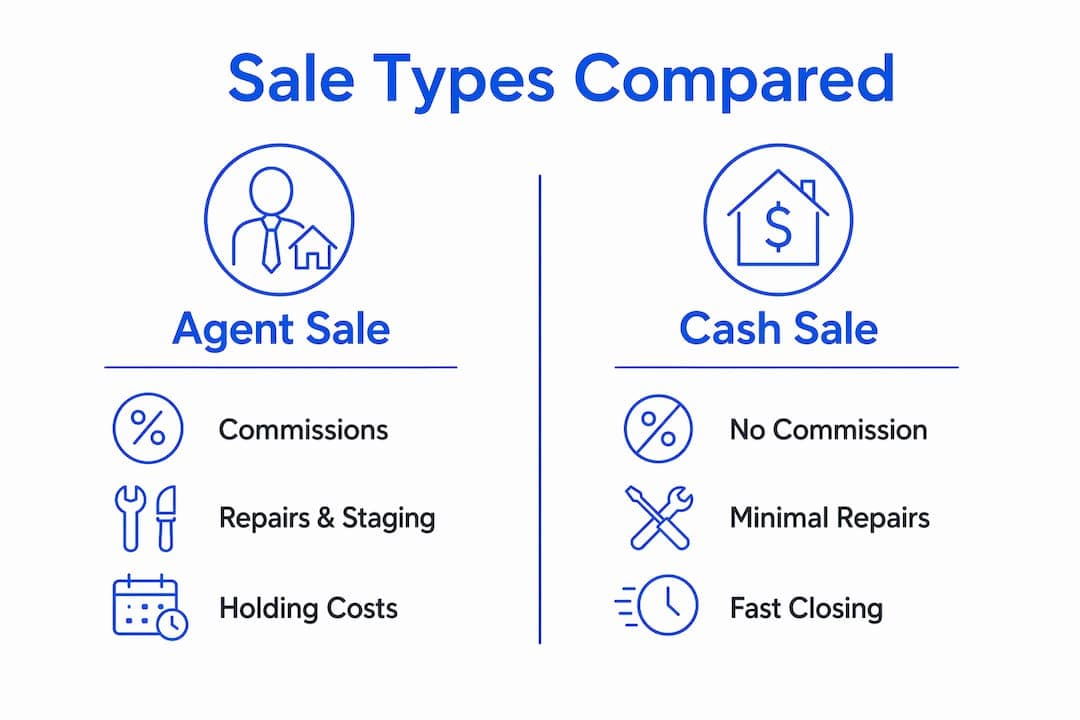
A 1.5% commission difference on an $800,000 sale equals $12,000 of equity retained or lost. Small percentage shifts matter enormously at higher price points.
When does paying an agent still make sense?
Not every seller should skip the agent. There are real situations where the commission earns its keep:
- Complex transactions: Estate sales, short sales, or properties with title complications benefit from professional guidance.
- High-end listings: Luxury markets where an agent’s network genuinely attracts premium buyers who wouldn’t find the home otherwise.
- Sellers without negotiation experience: If you’ve never negotiated a real estate contract, an agent’s skill can recover more than their fee.
- Competitive seller’s markets: When multiple offers are likely, an agent can run a structured bidding process that pushes the price above list.
- Time-rich sellers: If you have 60–90 days, no urgent financial pressure, and a move-in-ready home, the traditional route may net more.
The key test: estimate the agent’s likely sale price premium, subtract the full commission plus ancillary costs plus holding costs, and compare that to a realistic cash offer. If the math favors the agent, hire one. If it doesn’t, you have better options.
What are the realistic alternatives to paying full commission?
Selling without a realtor doesn’t mean selling blind. Several paths exist between “hire a full-service agent” and “figure it out alone.”
| Option | Net Proceeds | Time to Close | Repairs Required | Contingency Risk | Upfront Costs | Concessions |
|---|---|---|---|---|---|---|
| Full-service agent | Highest potential, lowest net after fees | 45–90 days | Usually yes | Moderate | $5,000–$10,000+ | Common |
| Flat-fee/discount listing | Mid-range | 30–60 days | Usually yes | Moderate | $1,000–$4,000 | Common |
| FSBO | Variable | 30–90+ days | Usually yes | Higher | $1,000–$4,000 | Common |
| Cash buyer/investor | Lower gross, often higher net | 7 days | No (as-is) | Low | $0 | Rare |
| Auction | Unpredictable | 30–60 days | Sometimes | Low | Auction fees | Rare |
FSBO core costs typically run $1,000–$4,000 for flat-fee MLS access, photos, and an attorney. That’s a fraction of a full 5%–6% commission. The trade-off is that FSBO sellers take on pricing, marketing, showings, and contract negotiations themselves, and NAR data show a median FSBO sale price gap versus agent-assisted sales, though this partly reflects selection effects rather than pure agent value.
Flat-fee and discount brokers sit in the middle: some marketing support, reduced fees, less negotiation help. Commissions are now more negotiable than at any point in recent history, so even if you list with an agent, pushing for a 1%–1.5% listing-side reduction is a reasonable ask.
Pro Tip: Before choosing between a cash offer and a traditional listing, run the full math: cash offer minus zero commission minus zero repairs versus list price minus 5.7% commission minus estimated repair and staging costs minus two months of holding costs. The gap is usually smaller than sellers expect, and sometimes it flips.
How do you decide: agent or no agent?
Work through this checklist before committing to either path:
- What’s your timeline? If you need to close within 30 days, a traditional listing is a long shot.
- How much equity do you have? Low-equity sellers lose a disproportionate share of their profit to commissions.
- What condition is the property in? Significant repair needs add cost and time to an agent-assisted sale; cash buyers take it as-is.
- How competitive is your local market? A hot seller’s market narrows the gap between cash and list price.
- Can you manage showings, negotiations, and contracts? If not, factor in the cost of mistakes, not just the cost of an agent.
- Do you need legal or contract help? Some states require an attorney regardless; others don’t.
Red flags that warrant extra caution when selling solo: complex title issues, tenant-occupied property, major structural problems, pending litigation, or significant unpaid property taxes. These situations benefit from professional guidance, whether that’s an agent, a real estate attorney, or both.
For a quick net-proceeds check, run the numbers using your estimated sale price, your mortgage payoff, and the costs in this article before making any decision.
Key Takeaways
Agent fees reduce home profits because they are percentage-based, paid from proceeds at closing, and scale automatically with price, making a cash sale the higher-net option for many sellers who factor in the full cost picture.
| Point | Details |
|---|---|
| Commissions scale with price | At 5.7%, a median-priced U.S. home sale costs $20,374 in fees before any other expenses (2026 average, PR Newswire). |
| Hidden costs compound the loss | Staging, repairs, holding costs, and concessions can add $8,000–$20,000 on top of commission. |
| Cash sales often net more | A cash offer below list price can still produce a higher net after eliminating commission and ancillary costs. |
| Alternatives exist at every level | FSBO, flat-fee MLS, and discount brokers offer middle-ground options between full commission and cash. |
| Housegoodbye | Buys as-is with no agent commission, multiple competing cash offers, and closes in as little as seven days. |
The case for skipping the agent isn’t always obvious
The conventional wisdom says agents earn their commission by getting you a higher price. Sometimes that’s true. But the math only works in the agent’s favor when the price premium they generate actually exceeds the full cost of their involvement, including the commission, the repairs you did to get the home show-ready, the two months of mortgage payments while it sat on market, and the 2% concession you gave the buyer to close the deal.
For sellers who are time-pressured, sitting on a property that needs work, or simply done with the uncertainty of contingency-laden offers, that math often doesn’t add up. The agent’s value is real in the right circumstances. It just isn’t automatic. The sellers who benefit most from a no-fee cash sale are those who need certainty over maximum gross price: someone relocating for work, managing an inherited property from out of state, or facing a financial situation where a seven-day close matters more than squeezing out another $10,000 over 90 days.
If you’re in that group, ask any cash buyer or investor two things before you sign: proof of funds and their average days-to-close on recent transactions. Those two data points tell you more than any pitch.
Skip the commission and get competing cash offers with Housegoodbye
Most sellers assume a cash offer means accepting a lowball number from a single buyer. Housegoodbye works differently. The platform solicits multiple competing cash offers from investors, which pushes prices up while keeping the process commission-free. You sell as-is, no repairs, no staging, no agent fees eating into your proceeds.

Housegoodbye guarantees closing in as little as seven days, which means holding costs stop almost immediately after you accept an offer. For sellers in Michigan, the process is straightforward: submit your property details, receive competing offers, pick the one that works for you, and close on your schedule. No commissions, no surprises on the settlement statement.
Ready to see what your home nets without the agent fees? Get your cash offers at Housegoodbye and run the comparison yourself.
Useful sources
- PR Newswire: “The Typical U.S. Home Sale Costs Over $20,000 in Realtor Fees in 2026” — source for the $20,374 median commission figure and 5.70% average rate.
- Agentsorted: Real Estate Commission Statistics 2026 — national average commission rate (5.7%) and equity-impact examples by price point.
- US Realty Training: Real Estate Agent Commission in 2026 — explains percentage-based commission structure and listing/buyer-side splits.
- HomeCostLab: Real Estate Agent Commission 2026 (post-NAR Settlement) — covers negotiability of commissions and the impact of the 2024 NAR settlement.
- Best FSBO Guide: Cost to Sell a House Without a Realtor (2026) — FSBO cost ledger ($1,000–$4,000), flat-fee MLS options, and FSBO sale price data.
- IRS Publication 523: Selling Your Home — confirms commissions are a selling expense that reduces taxable capital gain.
FAQ
How much do agent fees reduce your home sale profit?
At the national average commission rate, agent fees reduce gross proceeds by a significant amount on a median-priced U.S. home, and that figure rises proportionally with price.
Can a cash offer net more than a full-price agent sale?
Yes. Once you subtract commission, repairs, staging, holding costs, and concessions from an agent-assisted sale, a cash offer 5%–8% below list price often produces a higher net check.
Are real estate commissions negotiable in 2026?
Commissions are negotiable, and the 2024 NAR settlement made buyer-agent compensation especially open to negotiation since sellers are no longer required to pre-advertise a buyer-agent fee on the MLS.
Does paying agent commission reduce your tax bill?
Per IRS Publication 523, commissions count as a selling expense that reduces your “amount realized,” which lowers your taxable capital gain on the sale.
How fast can Housegoodbye close compared to a traditional listing?
Housegoodbye guarantees closing in as little as seven days, compared to the typical 45–90 days for an agent-assisted sale, which also eliminates months of holding costs.