You can sell a Fenton house as-is in Michigan, with no repairs, no cleaning and no showings, as long as you tell the buyer what you know about the property. The simplest way to do it is to let several vetted local cash buyers bid on the same house, so you compare real numbers instead of accepting one. That is how HouseGoodbye works: you enter your address, buyers compete with as-is offers, and you can walk away if none of them work.
This guide covers what “as-is” means under Michigan law, what you must still disclose, what a sale really costs you, and how to compare offers.
TL;DR
- “As-is” means the buyer accepts the house in its current condition. It does not let you hide defects you know about.
- Michigan sellers generally complete a Seller’s Disclosure Statement. Some sales, such as probate, foreclosure and divorce transfers, are exempt.
- Skipping repairs, staging and showings saves money, and a cash sale also avoids agent commissions. Transfer taxes still apply to nearly every sale.
- Our marketplace lets multiple vetted cash buyers bid on your house, with no obligation. We typically see about 7 days to close, versus about 73 days on the MLS.
- Compare offers on net proceeds, closing date and terms, not just the top number.
Table of Contents
- What “as-is” means in Michigan
- What you disclose when you sell as-is
- When the disclosure form does not apply
- What an as-is sale costs, and what it saves
- As-is cash sale or fix up and list?
- How to compare cash offers on your Fenton house
- Steps to sell your Fenton house as-is
- Special situations
- Selling as-is with HouseGoodbye
- Our perspective
- FAQ
- Sources
What “as-is” means in Michigan
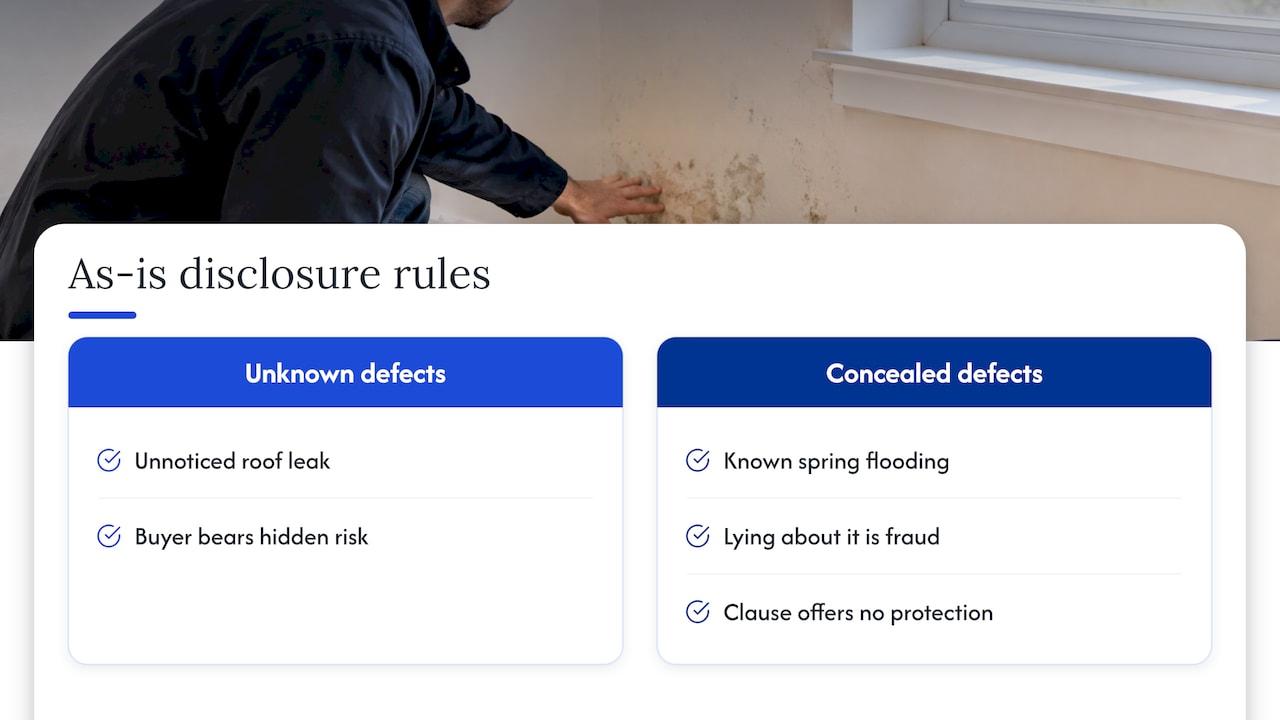
An as-is sale means you agree to sell the property in its present condition and the buyer agrees not to ask you for repairs or credits. In Michigan the clause does real work. The Michigan Bar Journal explains that courts treat the only exception to caveat emptor (“buyer beware”) in as-is sales as latent defects the seller fraudulently concealed. The same article notes that an as-is clause shifts the risk of conditions neither side knew about to the buyer.
In plain terms: if the roof leaks in ways nobody has noticed, that is the buyer’s risk. If you know the basement floods every spring and say otherwise, that is fraud, and the clause will not protect you. A Michigan law firm summarizing the case law puts it the same way: an as-is clause likely does not shield a seller from intentional misrepresentations or failure to disclose known issues.
So the safe approach is simple. Sell as-is, and be honest about what you know. If you are unsure whether a point is a defect, a lawyer licensed in Michigan can tell you before you sign, especially for a contested estate or a complicated title.
What you disclose when you sell as-is
Michigan’s Seller Disclosure Act requires most sellers of residential property to give the buyer a signed statement on the condition of the home. The form is set out in MCL 565.957, and it asks item by item about:
- appliances and systems: electrical, plumbing, water heater, well and septic, heating
- the roof and any infestation history
- environmental hazards such as asbestos, radon, lead-based paint and fuel or chemical tanks
- structural problems, major damage, unpermitted work and zoning violations
- legal matters such as encroachments, outstanding assessments and pending litigation
The statute also says that if a seller fails to give the buyer a signed statement, the buyer may be able to terminate an otherwise binding purchase agreement. That is why the form is worth doing right, even on a house you are selling for cash.
Two practical points:
- Answer from what you actually know. The Act limits your liability for things outside your personal knowledge, such as problems only an inspector with special tools could find. “Unknown” is an honest answer where it is true. A blank is not.
- Older homes carry more boxes to check. Many houses in and around Fenton, including lake houses and older homes, have original plumbing, wells or septic systems. Those are exactly the items the form asks about. Our guide to Michigan seller disclosure rules walks through the form, and the page on lead paint disclosure in Michigan covers the federal lead rule for older homes.
A city, township or county can also add its own disclosure requirements under state law. If you are unsure what applies to your Fenton address, ask the local building or assessing office.
When the disclosure form does not apply
Not every sale needs the statement. MCL 565.953 lists the exceptions, including:
- transfers ordered by a court, such as probate administration, foreclosure sales and bankruptcy trustee sales
- transfers to a mortgage lender by a borrower in default
- transfers by a fiduciary who has never occupied the home and is administering an estate, trust, guardianship or conservatorship
- transfers between co-owners or to close family members
- transfers related to a divorce
This matters if you are an heir or an executor. A house sold out of an estate by an executor who never lived there often falls in the exception, which makes an as-is sale simpler. If the executor or a beneficiary lived in the house, or the house has already been distributed to heirs, the exception may not fit, so confirm with the probate attorney handling the estate. Our page on selling an inherited house in Michigan and the probate guide cover how cash buyers handle these sales.
What an as-is sale costs, and what it saves
The appeal of selling as-is is what you skip: repairs, paint, staging, deep cleaning, open houses and the months waiting for a buyer whose lender might back out. When you sell through us, there are no listing fees and no agent commissions, and the buyers purchase the house in its current state. Our own figures put a typical close at about 7 days, against about 73 days on the MLS.
What does not go away are the taxes and standard closing items. Michigan charges a state transfer tax of $3.75 for every $500 of the sale price, plus a county tax of $0.55 for every $500, per county register of deeds guidance. Together that is $4.30 per $500. Whether the seller or buyer pays any share is negotiated in the contract, and sellers commonly pay it.
A worked example on a $200,000 sale:
| Item | Calculation | Amount |
|---|---|---|
| State transfer tax | 400 increments of $500 x $3.75 | $1,500 |
| County transfer tax | 400 increments of $500 x $0.55 | $220 |
| Total transfer tax | $1,720 |
Other items that may appear on your closing statement are any mortgage payoff, unpaid property taxes or water bills, and title or settlement charges. Ask each buyer which of these they cover and which come out of your side. Our article on keeping more at closing in Michigan lists the usual lines, and the one on average agent commission in Michigan shows what a traditional listing adds on top.
As-is cash sale or fix up and list?
A traditional listing can bring a higher sale price when the house is in good shape, you have months to spare and you can fund the work. It also brings commissions, repairs requested after the inspection, showings and a buyer who may need a loan to close.
An as-is cash sale makes the most sense when one of these is true:
- Time is the problem. A foreclosure date, a job relocation, a divorce settlement or a probate deadline does not wait for a listing to sit.
- Condition is the problem. Fire or water damage, code violations, a failing foundation or years of deferred upkeep make a retail buyer’s lender and inspector hard to satisfy.
- Effort is the problem. A vacant house you are paying taxes and utilities on, or a rental with tenants, costs you every month it sits.
- Fees are the problem. If the commission would swallow the equity you have, skipping it changes the math.
A fair way to decide is to compare your likely net in each route, after repairs, commissions, carrying costs and the months of waiting. If you are on the fence, our sell now or wait quiz is a quick gut check.
How to compare cash offers on your Fenton house
One offer tells you almost nothing. Two or three offers on the same address tell you what your house is worth to people who buy houses for a living. When offers arrive, line them up on these points:
- Net to you, not the headline. Subtract every fee, credit, repair deduction and tax that comes out of your side. An offer that is $3,000 lower but has no deductions can leave you with more.
- Closing date. Can the buyer close in about a week if you need it, or wait weeks if you need time to move? A flexible date can matter more than a few hundred dollars.
- Proof of funds. A genuine cash buyer can show the money is there. The buyers on our marketplace are vetted local investors.
- Contingencies. Does the offer depend on an inspection, financing or the buyer selling another property? Fewer conditions means less chance the deal falls apart.
- Terms in writing. Price, closing date, who pays which costs and what happens to anything left in the house should all be in the purchase agreement.
- No pressure. You should be free to say no. Our offers carry no obligation.
Be careful with any offer that reshapes the deal, for example a sale-leaseback or a long option period. Our page on real cash offers in Michigan explains the traps to look for.
Steps to sell your Fenton house as-is
- Gather the basics. Your mortgage payoff, any tax or lien notices, and what you know about the roof, systems, water and structure. This is also what you will need for the disclosure form.
- Request offers. Enter your address on our competing cash offers page. Several vetted local buyers bid on the same house, and you see every number.
- Compare on net proceeds and timing. Use the checklist above.
- Complete the disclosure if it applies. Be accurate. Check the exceptions above if your sale is a probate, foreclosure or divorce transfer.
- Sign the purchase agreement. Read the price, closing date and costs. For anything involving an estate, a divorce decree or a foreclosure, have your attorney look it over.
- Close. A title company handles the paperwork and you hand over the keys. You do not need to clean out the house to the standard of a listing, and you can agree on what stays.
Special situations
Behind on the mortgage or facing foreclosure
Time is the main asset here. A sale before the foreclosure sale lets you pay off the loan and keep any equity, and it keeps a foreclosure off your record. The sooner you request offers, the more options you have. See our pages on avoiding foreclosure and selling when you are behind on the mortgage. Talk to your lender and, where you can, a housing counselor or attorney about your deadline.
Inherited or probate houses
Inherited houses often arrive full of belongings, with deferred maintenance and several heirs who live in different states. An as-is sale lets you sell without cleaning out or renovating. Confirm with the probate attorney that the personal representative has the authority to sell.
Vacant, damaged or code-violation houses
Vacant houses cost you taxes, insurance and utilities every month, and damaged ones lose value further. Buyers on our marketplace purchase houses with fire or water damage, open code violations and years of neglect. You can read more about selling a vacant house, fire or water damaged houses and selling with code violations.
Selling as-is with HouseGoodbye
HouseGoodbye is a Michigan marketplace, not a single buyer making a single offer. You enter your Fenton address, and multiple vetted local cash buyers bid on your house as-is. You see every offer, with no repairs, no showings, no listing fees and no agent commissions, and you can walk away if none of the numbers work.

If you are ready to see what buyers will pay, start on our as-is home selling page. If you want the full cash-sale routine first, read how to sell your house for cash in Michigan.
Our perspective
Most homeowners who call us about an as-is sale are not asking whether it is legal. They are asking whether they are being cheated. The honest answer is that a single buyer making a single offer has every reason to bid low, because you have nothing to compare it to.
That is why we built a marketplace. When several vetted local buyers bid on the same house, the price is set by competition, not by one investor’s formula. You see every offer, you decide, and you pay no commission and no listing fee.
The other half is honesty on your side. Sell as-is, disclose what you know, and keep the paperwork clean. A clear, honest sale closes faster and holds up afterward. We are built to take the repairs, the showings and the waiting off your list, so the only decision left is which offer to take.
Bryan
FAQ
Can you sell a house as-is in Michigan?
Yes. Michigan law allows as-is sales, and the clause moves the risk of unknown defects to the buyer. It does not protect a seller who knowingly hides a problem or gives false answers, so complete any required disclosure honestly.
Do I have to make repairs before selling as-is?
No. In an as-is sale the buyer accepts the property in its current condition. On our marketplace, buyers bid on houses in any condition, including fire or water damage and code violations, with no repairs required.
Do I still pay taxes and fees on an as-is sale?
Some costs remain. Michigan transfer tax is $4.30 per $500 of price combined, state and county, which is $1,720 on a $200,000 sale, and any mortgage payoff or unpaid taxes come out at closing. With us there are no listing fees or agent commissions.
How fast can a cash sale close?
Our typical close is about 7 days, compared with about 73 days on the MLS. The date depends on title and your situation, and you can choose a later closing if you need time to move.
Sources
- Michigan Bar Journal: the law behind “as is” clauses
- Maddin Hauser: does an as-is clause protect a Michigan seller
- MCL 565.957, Seller’s Disclosure Statement
- MCL 565.953, disclosure exceptions
- Van Buren County Register of Deeds: Michigan real estate transfer tax