Cash buyers typically pay about 1% to 3% of the purchase price in closing costs, compared with 3% to 6% for financed purchases, according to a lender’s buying guide. If you are the homeowner selling to that buyer, though, your side of the closing statement looks different. This guide covers both halves: what a cash buyer pays, what a Michigan seller can still owe, and how to read the numbers before you sign.
TL;DR
- A cash buyer’s closing costs usually land between 1% and 3% of the price, because lender fees disappear. Title, recording and escrow charges stay.
- Sellers do not escape closing costs in a cash sale. Mortgage payoff, unpaid property taxes, liens, prorations and Michigan transfer tax can all appear on your statement.
- The biggest seller savings come from skipping agent commissions, not from the closing line items themselves.
- Before you accept any cash offer, ask for a written net-proceeds estimate and compare it across offers, not just the headline price.
- On HouseGoodbye, several vetted Michigan cash buyers bid on your house, so you can compare the net numbers side by side.
Table of Contents
- What closing costs a cash buyer actually pays
- How much closing costs run on common price points
- Who pays closing costs when you sell for cash
- What a Michigan seller can still owe at a cash closing
- Worked example: a $200,000 Michigan house, cash versus listing
- Do cash buyers close faster, and does speed change the cost?
- Our perspective on cash closing costs
- How to check an offer before you accept it
- Compare cash offers on HouseGoodbye
- FAQ
- Sources
What closing costs a cash buyer actually pays
Paying cash removes the lender from the deal. That removes a long list of charges, but not all of them. Lender-driven fees such as loan origination, mortgage application, credit report and loan processing fees do not apply to a cash purchase.
What remains is the work of proving and recording the transfer of ownership. Realtor.com lists the common cash-buyer costs as transfer taxes, title insurance, county processing and filing fees, appraisals and home inspections. In practice, a cash buyer’s bill is made of these pieces:
| Cost | Who usually orders or pays it | Does cash remove it? |
|---|---|---|
| Loan origination, underwriting, processing | Financed buyer | Yes |
| Lender’s title insurance | Financed buyer | Yes |
| Mortgage insurance | Financed buyer | Yes |
| Owner’s title search and insurance | Negotiated, often the buyer | No |
| Escrow or settlement fee | Often split | No |
| Recording fees | Buyer | No |
| Appraisal and inspection | Buyer, by choice | Optional |
| Prorated property taxes | Split by closing date | No |
The appraisal and inspection are worth a note. A lender forces the appraisal on a financed buyer. A cash buyer can skip it, and many investors who buy as-is do, because they price the repairs themselves.
How much closing costs run on common price points
The 1% to 3% range makes the math simple. Apply it to a few Michigan-typical prices and you get a rough band for what the buyer spends:
| Purchase price | At 1% | At 2% | At 3% |
|---|---|---|---|
| $150,000 | $1,500 | $3,000 | $4,500 |
| $250,000 | $2,500 | $5,000 | $7,500 |
| $350,000 | $3,500 | $7,000 | $10,500 |
| $450,000 | $4,500 | $9,000 | $13,500 |
The $450,000 row matches the $4,500 to $13,500 range the same lender guide gives for that price. These are estimates, not quotes. Your buyer’s real number depends on the title company’s fee schedule, local transfer taxes, whether a survey is needed and how property taxes are prorated.
Why the same price can cost different amounts
Two cash buyers closing on identical $250,000 houses can end up with bills a few thousand dollars apart. Three things drive it:
- Who pays transfer tax. In Michigan this is customarily a seller item, so it often does not touch the buyer at all.
- Title company choice. Title search, insurance and settlement fees are set by each company’s schedule.
- Optional extras. A survey, an inspection or an appraisal adds cost only if the buyer orders it.
Who pays closing costs when you sell for cash
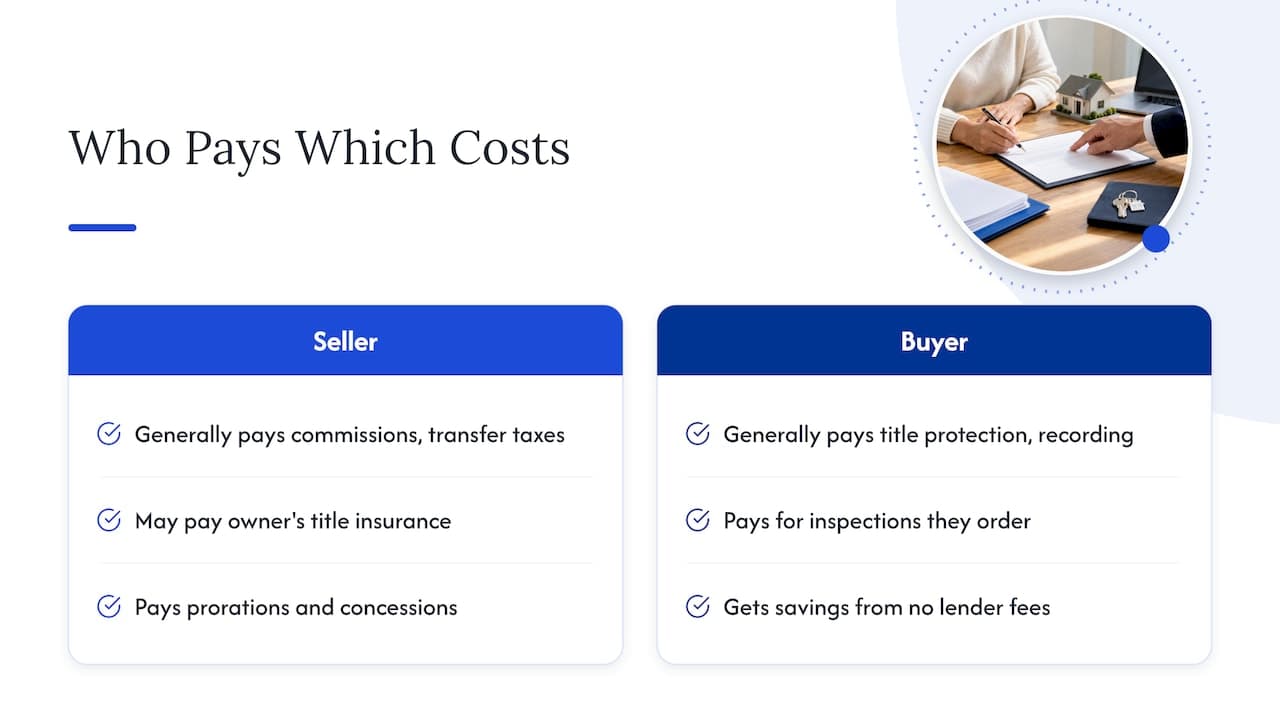
In a cash sale, both parties pay closing costs, split by local custom and by what the signed purchase agreement says. Sellers generally cover agent commissions and transfer taxes. Buyers generally cover title protection, recording fees and any inspection they order. Escrow or settlement fees are frequently split equally, though the contract controls.
One point is easy to miss. The savings from dropping lender fees belong to the buyer. Seller closing costs on a cash sale still include commission where an agent is involved, transfer tax, owner’s title insurance where the seller pays it, prorations and concessions. A cash deal does not make your closing line items vanish.
What it does is shrink the biggest one. If you sell directly to a buyer, there is no listing agent to pay. We break that down in our guide to why a cash sale eliminates agent fees, and in why agent fees reduce home profits.
What a Michigan seller can still owe at a cash closing
Here is what typically shows up on a Michigan seller’s closing statement, even when the buyer is paying cash:
- Mortgage payoff. Whatever you still owe the lender comes out of your proceeds at closing.
- Unpaid property taxes. Taxes accrued up to the closing date are settled on the statement.
- Liens. Any recorded lien must be cleared for the buyer to get clean title.
- Michigan transfer tax. Customarily the seller’s cost, though it is negotiable.
A Michigan closing guide describes this list, including that transfer tax is customarily paid by the seller but can be negotiated. Treat it as a map of what to ask about, and confirm the details with your title company.
The transfer tax math
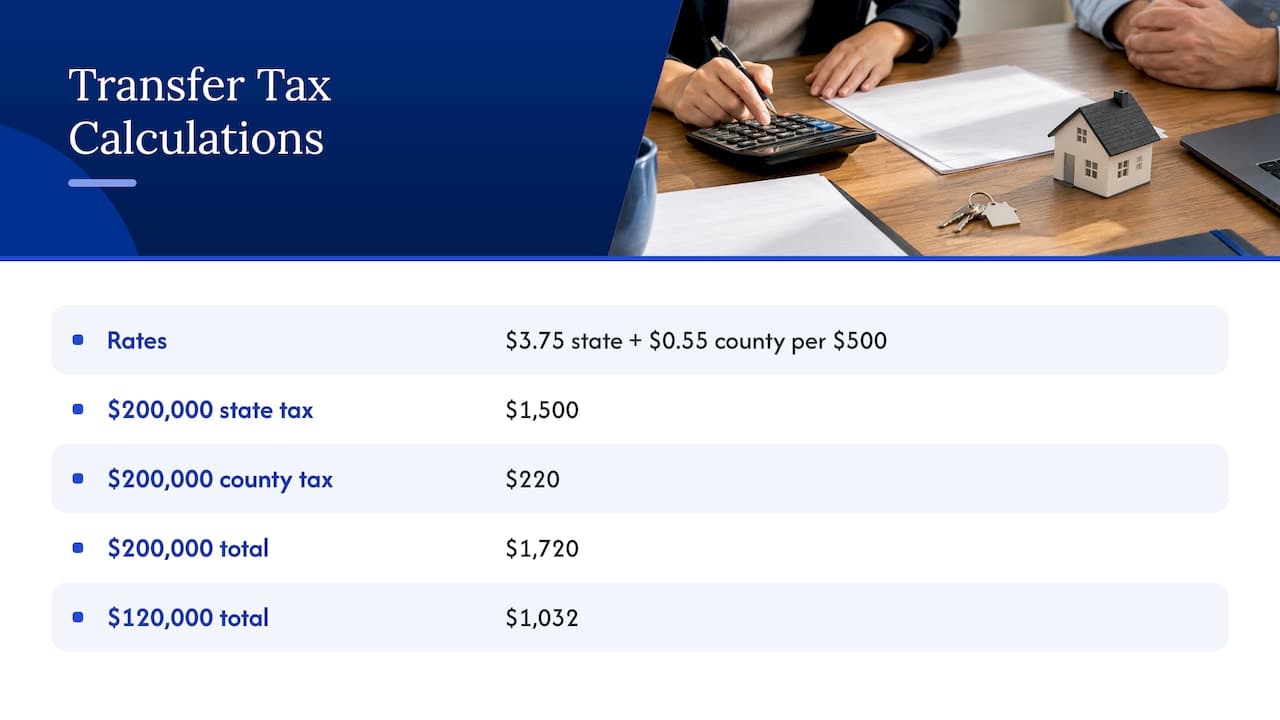
Michigan charges both state and county transfer taxes. As Van Buren County’s register of deeds explains, the state rate is $3.75 for every $500 of value, or part of it, and that county’s rate is $0.55 for every $500. County rates differ, so check your own county’s register of deeds.
Using those two rates, a $200,000 sale has 400 units of $500. That is 400 × $3.75 = $1,500 in state tax plus 400 × $0.55 = $220 in county tax, or $1,720 in total. On a $120,000 house the same math gives $1,032. These are my own calculations from the published rates, and your county’s number may differ.
Items that are not closing costs, but cost you money
A cash buyer’s offer is usually as-is. That means you skip repairs, cleaning and staging. It also means you should compare that to the traditional route, where inspection negotiations can cost sellers real money after the contract is signed. Repair credits and concessions are closing-table costs in disguise. In an as-is cash sale, they mostly do not exist.
Worked example: a $200,000 Michigan house, cash versus listing
The table below is an illustration with assumed figures, not a quote and not a guarantee. It shows how the structure of costs differs. It assumes an agent commission of 6% on the listing route, the transfer tax figure from above, and a seller who owes $90,000 on a mortgage.
| Line | Traditional listing | Direct cash sale |
|---|---|---|
| Sale price | $200,000 | $200,000 |
| Agent commissions (assumed 6%) | $12,000 | $0 |
| Michigan transfer tax (from above) | $1,720 | $1,720 |
| Mortgage payoff | $90,000 | $90,000 |
| Repairs and concessions | Varies | $0 as-is |
| Other title and settlement items | Varies | Varies |
The real-world price on a cash offer is often lower than a retail listing price, because the buyer is taking on repairs and risk. That is why the right comparison is net proceeds after all costs, plus the carrying costs of waiting. Our guide to closing costs for Michigan sellers walks through that comparison in more detail, and the article on hidden real estate fees covers the smaller charges that surprise people.
Do cash buyers close faster, and does speed change the cost?
Cash buyers typically close faster than buyers who need financing, because there is no underwriting or lender appraisal to wait on. For a seller, speed is a cost item too. Every month you hold a house you keep paying the mortgage, insurance, utilities and property taxes, and a vacant house adds risk.
The pace is set by the title work, not the money. Title search, payoff letters and recording are the steps that decide whether a closing takes a week or a month. Our fast closing seller playbook shows how to get the paperwork ready early, and the cash closing process explains each step in order. If an escrow or settlement fee is on your statement, this explainer on escrow fees covers what it pays for.
Our perspective on cash closing costs
Most of what ranks for this search is written for the buyer. That is fair, but it leaves out the person on the other side of the table. Homeowners who contact us are usually behind on a mortgage, handling an inherited house, or sitting on a property that needs more work than they can afford. For them, the question is not what a buyer’s bill looks like. It is what they will walk away with.
We think the honest answer is a net number. A high headline offer with seller-paid extras can leave you with less than a lower offer that pays its own way. That is why we built HouseGoodbye as a marketplace rather than a single buyer. When several vetted Michigan cash buyers bid on the same house, you can put the offers side by side, ask each one who pays for title, escrow and recording, and pick the best net result, or walk away if none of them work. Nothing about that costs you a listing fee or a commission.
One habit we would push on every seller: ask for the closing costs in writing before you commit. A real offer should be able to say who pays what.
— Bryan
How to check an offer before you accept it
A cash offer is a contract, so the paperwork matters as much as the price. Use this checklist:
- Ask for a net-proceeds estimate. It should show the price, your payoff, taxes, transfer tax and any fees, ending in the amount you receive.
- Read the purchase agreement for cost allocation. Look for who pays title insurance, escrow or settlement, and recording.
- Confirm the as-is language. You want no repair requests or credits after signing.
- Check the closing date and what can delay it. A liens or probate issue can add time. Ask how the buyer handles it.
- Review the final settlement statement before closing day. Match every line to your estimate and question anything that moved.
A note on the last step. The federal rule that requires a lender to deliver a Closing Disclosure three business days before closing applies to mortgage lending, and the CFPB advises borrowers to check its closing costs and cash to close. A pure cash sale has no lender, so that rule does not drive your paperwork. That is the reason to ask your title company for the settlement statement early and review it as carefully as a borrower would.
If the numbers involve probate, a lien dispute or a pending foreclosure, talk to a Michigan real estate attorney or your title company about your specific situation before you sign.
Compare cash offers on HouseGoodbye
If you want to see real numbers for your house, enter your address on HouseGoodbye. Vetted Michigan cash buyers bid on the same property, you see every offer, and there is no obligation to accept one. We buy houses in any condition, with no repairs, showings or agent commissions.

If your situation has a clock on it, we have pages for avoiding foreclosure in Michigan and selling an inherited house. You can also read about how cash house buyers work before you decide.
FAQ
How much are closing costs for a buyer paying cash?
Usually 1% to 3% of the purchase price. On a $400,000 home that works out to roughly $4,000 to $12,000, depending on location and service providers. The exact figure depends on title fees, recording, transfer taxes and whether the buyer orders an appraisal or inspection.
How much is the closing cost on a $350,000 cash deal?
At 2%, about $7,000. The full 1% to 3% range gives $3,500 to $10,500. Local transfer taxes, a survey and the title company’s fee schedule can move the figure up or down.
Who pays closing costs when I sell my house for cash?
Both sides pay, split by local custom and your signed agreement. In Michigan, the seller customarily pays transfer tax, though it is negotiable, and any mortgage payoff or liens come out of proceeds. The buyer typically pays for title protection and recording. Read the purchase agreement to see the exact split.
Do cash buyers close faster?
Yes, typically. Without a lender there is no underwriting or lender-required appraisal. The title work and any liens or probate issues still set the real pace, so a clean file closes faster than a complicated one.
Sources
- The Complete Guide to Buying a House with Cash (AmeriSave)
- If I Pay Cash for a House, What Else Will I Owe? (Realtor.com)
- Who Pays Closing Costs in a Cash Sale (Legal Clarity)
- Seller Closing Costs on a Cash Sale (Dashloops)
- Michigan Closing Procedures (Open Exam Prep)
- Michigan Real Estate Transfer Tax (Van Buren County)
- Cash Home Purchase Closing Costs (Tally Close)
- Closing Disclosure explainer (CFPB)