At closing, the seller pays HOA dues through the closing date and the buyer takes over from the next day. Anything past due gets paid off from the seller’s proceeds, so the title can transfer clean. Transfer or capital contribution fees depend on your association’s documents, and you should see them on the settlement paperwork before you sign.
The details trip people up. Dues are often paid in advance, so a refund or reimbursement may be involved. Past-due balances come out of your check. Some associations also charge fees that nobody mentioned until the title company asked for them. This guide walks through each piece with a worked example, the Michigan rules, and what to do if you are behind on dues and need to sell.
TL;DR
- Dues are split by days of ownership. The seller covers through closing day, and the buyer covers every day after.
- Past-due dues, late charges and fines are normally paid from the seller’s proceeds at closing so the title is clear.
- In Michigan, a condo buyer is not liable for undisclosed unpaid assessments if the association’s written statement was requested at least 5 days before the sale. So the statement matters.
- Transfer, processing and capital contribution fees vary by community. Read your bylaws and question anything unclear on the closing paperwork.
- If you are behind on dues, you can still sell. Delinquency is a payoff item, not a dead end.
Table of Contents
- How HOA dues are handled at closing
- A worked example of proration
- Past-due dues: what comes out of your proceeds
- Fees that are not dues
- Why delinquent HOA dues can slow or kill a sale
- What to do before you list or accept an offer
- Our perspective: HOA balances are a numbers problem, not a reason to wait
- Selling an HOA home as-is with competing cash offers
- FAQ
- Sources
How HOA dues are handled at closing
HOA dues are a recurring bill that travels with the property. You owe them for as long as you own the home, and the new owner owes them once the deed transfers. Because closings rarely land on the first of the month, the title or settlement company splits the current period between the two of you. This is called proration.
Three separate things can show up at the table, and it helps to keep them apart:
- Prorated current dues. Your share of the current month, quarter or year.
- Past-due balances. Unpaid dues, late charges, interest, fines and collection costs.
- One-time community fees. Transfer fees, document or resale certificate fees, move-in fees, or a capital contribution the buyer pays into the reserve fund.
The federal Closing Disclosure explainer from the CFPB describes how unpaid items and adjustments between buyer and seller appear in the Summaries of Transactions section. When we review offers with Michigan sellers, this is the page we tell them to read line by line, because HOA items often land there.
A worked example of proration
The numbers below are made up to show the method. Your association’s amounts and your title company’s calendar will differ.
Say your dues are $300 a month, billed on the first, and you already paid for the month. You close on the 10th of a 30-day month.
- You owned the home for 10 days of that month, so your share is 10/30 of $300, or $100.
- The buyer owns the remaining 20 days, so their share is $200.
- Because you prepaid the full $300, the buyer reimburses you $200 at closing.
Now flip it. If dues are billed in arrears, or you have not paid the month yet, you owe your $100 share and it comes off your proceeds.
Some title companies prorate by actual days in the month and some use a 30-day convention. The difference is small, but ask which method applies so the numbers do not surprise you. If your dues are quarterly or annual, the same math applies over a longer period, so the credit or charge can be larger.
Past-due dues: what comes out of your proceeds
If you are behind, the balance does not disappear at closing. It gets paid. The title company asks the association for a payoff or ledger figure, and any delinquent assessments, late fees and attorney costs are deducted from what you receive. The CFPB’s closing guidance notes that unpaid items are documented in the Summaries of Transactions, so you can see exactly what was taken and why.
That is the reason a lien matters. In Michigan, sums assessed to a condominium co-owner that go unpaid, with interest, late charges and collection costs, are secured by a lien. The association’s lien generally ranks behind a first mortgage recorded earlier, but that does not make it harmless. It can still block a clean sale. If you want a deeper read on how liens interact with a transfer, this overview of liens and levies explains how a recorded claim can hold up a title transfer and the settlement.
Condo or subdivision: Michigan treats them differently
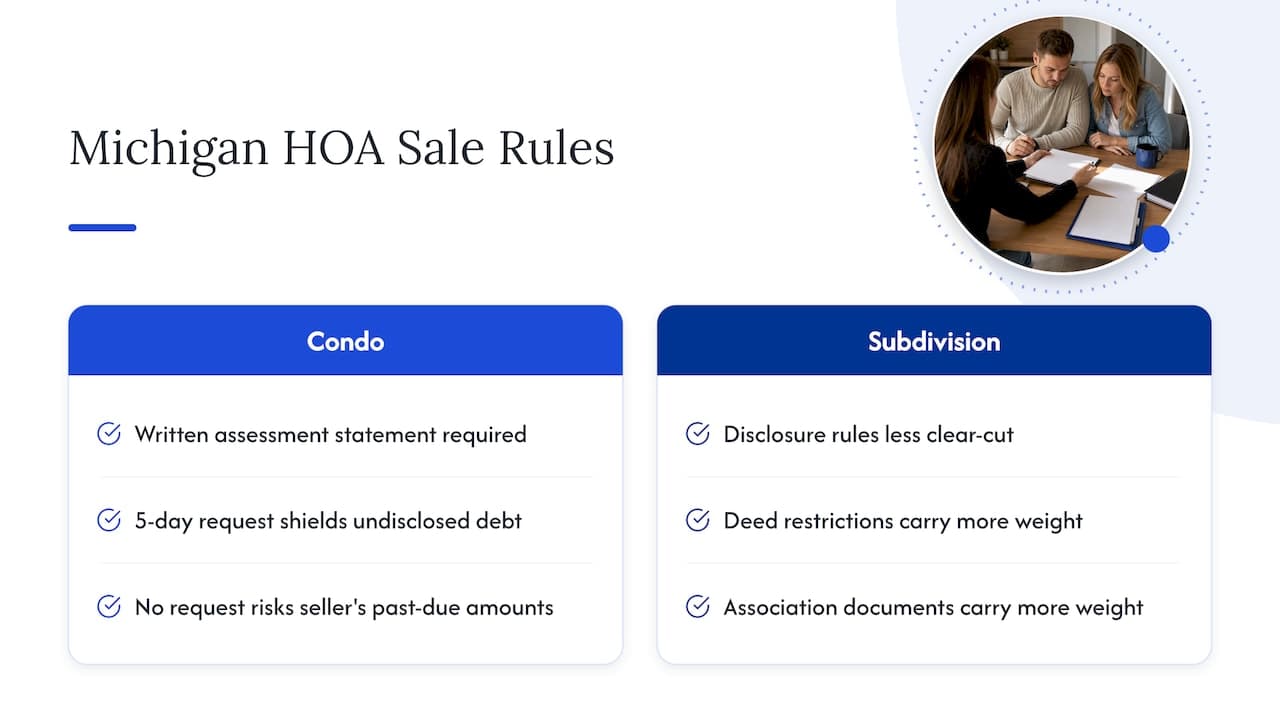
Michigan’s condominium statute is explicit. MCL 559.211 says that on the sale of a condominium unit, unpaid assessments are to be paid, and the association must provide a written statement of what is owed. A buyer who asked for that statement at least 5 days before the sale is not liable for amounts the statement did not disclose. A buyer who never asked can end up on the hook for the seller’s past-due amounts.
That protects buyers, and it shapes how a smart seller behaves: order the statement early and fix any errors before the closing date.
For a platted subdivision with a homeowners’ association rather than a condo, one Michigan law firm notes the disclosure rules are less clear-cut. Your deed restrictions and the association’s own documents carry more weight there. In either case, ask the association for a written payoff.
Fees that are not dues
These are the charges that most often catch sellers off guard:
| Charge | Who usually pays | Notes |
|---|---|---|
| Prorated monthly or quarterly dues | Split by days of ownership | Seller covers through closing |
| Past-due dues, late fees, fines | Seller | Paid from proceeds |
| Resale certificate or statement fee | Often the seller, sometimes the buyer | Set by the association or its management company |
| Transfer fee | Varies | Depends on the bylaws |
| Capital contribution | Usually the buyer | Goes into the reserve fund |
| Move-in or elevator reservation fee | Buyer | Common in condo buildings |
Who pays is a matter of your documents and the purchase agreement, not a universal rule. The CFPB has warned that closing costs can be inflated by junk fees that are not strongly shaped by competition. Check every HOA line against your governing documents. Some processing charges are set by management companies, so it is reasonable to ask whether a figure is fixed by the bylaws or just a company’s standard fee. This HOA checklist also covers which community charges tend to be negotiable during a sale.
One more tip: the CFPB points out that closing costs have risen sharply, with the median borrower paying nearly $6,000 in 2022. When the buyer’s costs climb, they look for room to negotiate, so a surprise HOA charge on your side can become a bargaining chip against you. Know your numbers first.
Why delinquent HOA dues can slow or kill a sale
Your own balance is only half of the problem. If the association itself has many owners behind on dues, a buyer using a conventional loan can run into trouble. Fannie Mae’s condo review rules say that no more than 15% of a project’s units can be 60 or more days past due on common expense assessments for the project to qualify under a full review. A building over that line can be hard to finance.
That is one reason cash buyers matter in HOA communities. A buyer paying cash is not waiting on a lender’s project approval. They still care about the association’s health, since a poorly run HOA affects resale value, but the transaction does not hinge on a lender’s condo review.
What to do before you list or accept an offer
- Get your ledger. Ask the association or management company for a statement of what you owe, including late fees and fines. Check it against your own records.
- Order the written statement early. For a Michigan condo, the 5-day mark in the statute is a minimum, not a target. Give yourself weeks.
- Read your governing documents. Look for transfer fees, right of first refusal, rental or sale restrictions, and who pays for resale paperwork.
- Ask which fees are fixed. If a management company charges a processing fee, ask if the bylaws set it.
- Put HOA items in writing in the offer. State who pays each fee in the purchase agreement, so nothing is left to the title company’s default.
- Review the final figures before closing day. Compare the draft settlement statement to your ledger and the agreement.
If you are selling because of a foreclosure threat, remember the HOA can be one of several creditors. Michigan’s lien rules mean the association’s priority depends on when its lien was recorded relative to the first mortgage, so a standard mortgage foreclosure does not automatically clear HOA debt. Talk to a Michigan real estate attorney about your specific situation before you assume a balance will vanish.
Also a caution on taxes: if a lender forgives part of your mortgage debt, the IRS can treat that differently from HOA arrears. The IRS says homeowners’ associations are not applicable entities for Form 1099-C reporting, but foreclosure itself can carry tax consequences. A tax professional can tell you what applies to you.
Our perspective: HOA balances are a numbers problem, not a reason to wait
We talk with Michigan homeowners who are selling under pressure: behind on payments, dealing with an inherited condo, or relocating after a job loss. A surprising number delay selling because of an HOA balance they are embarrassed about. We would push the other way. The balance is a fixed number. It gets bigger every month you wait, with late fees and collection costs, and it is not an obstacle to a sale.

Our view is built on how the process works. Investors bidding on a home are pricing the property with its liabilities in mind. When an HOA payoff is known, they can subtract it and give you a firm number. When it is unknown, they pad the offer to cover the risk. So the single most useful thing you can do is get the ledger in hand before you compare offers. Then you are comparing net proceeds, not headline prices.
We also think sellers should look at the whole closing sheet. Commissions, escrow charges and HOA fees all come from the same pot. Our guides on seller closing costs in Michigan, hidden real estate fees and what an escrow fee is go through the other lines. And a month of dues, taxes and utilities on a house that is not selling is a holding cost you can avoid.
— Bryan
Selling an HOA home as-is with competing cash offers
If you own a condo or a home in an HOA community and want a quick sale without repairs, showings or agent commissions, we can help. HouseGoodbye brings competing cash offers from vetted Michigan investors to your door, so you can compare real numbers and choose. Bids are free and carry no obligation, and closings can happen in as little as seven days.
Tell us about the HOA when you request offers, including any balance you know of. Investors can then price the payoff in, and you see what you would net. Start at HouseGoodbye, or see how we handle as-is sales and fast closings. For the mechanics, read how a cash closing works and why a cash sale removes agent fees.
FAQ
Who pays HOA dues at closing, the buyer or the seller?
Both, for their own time as owner. The seller pays dues through the closing date and the buyer pays from the day after. If the seller prepaid, the buyer reimburses the unused portion. The purchase agreement can adjust who pays one-time fees.
What happens if I owe HOA dues when I sell?
The title company requests a payoff from the association, and the past-due amount, with late charges and fees, is deducted from your proceeds. That clears the way for the title to transfer. You can still sell, but the balance reduces your net.
Is a buyer responsible for the seller’s unpaid HOA dues in Michigan?
For a condominium unit, a buyer who requested the association’s written statement at least 5 days before the sale is not liable for undisclosed unpaid amounts. A buyer who did not request it can be liable. Rules for non-condo subdivisions depend more on their documents, so ask a Michigan real estate attorney.
Can I negotiate HOA transfer or processing fees?
Sometimes. Fees set in the bylaws are usually fixed, but charges added by a management company may be open to question. Ask for the source of each fee in writing, and raise it before closing, not at the table.
Sources
- Michigan Legislature, MCL 559.211
- Michigan Legislature, MCL 559.208
- CFPB, Closing Disclosure explainer
- CFPB, Junk fees are driving up housing costs
- CFPB, Prepared remarks of Director Rohit Chopra
- Fannie Mae Selling Guide, Full Review Process
- IRS, Cancellation of Indebtedness
- Are Sellers Required to Disclose Delinquent HOA Dues?