Possession after closing means the title passes to the buyer on closing day, but you keep living in the house for an agreed number of days. In effect, you become the buyer’s tenant for a short, fixed period. It works well when it is written down with a move-out date, a daily charge, a deposit and clear responsibility for damage. It works badly when it is a handshake. If you are selling for cash in Michigan, you can compare offers on these terms as well as on price, which is the strongest position to negotiate from.
TL;DR
- Possession after closing (also called seller occupancy, rent-back or post-closing occupancy) lets you stay in a house you have already sold, for a fixed period.
- Most agreements run from a few days to about 60 days. Lenders on owner-occupied loans commonly cap it at 60 days, and cash deals are not tied to that cap.
- You normally pay a daily or monthly charge, put down a deposit, and carry the risk of damage you cause. Put every term in writing.
- The buyer owns the house and takes over its insurance, but you still need renter’s coverage for your belongings.
- Compare cash offers on the move-out window as well as the price. A slightly lower number with a comfortable move-out date can be worth more to you.
Table of Contents
- What possession after closing actually means
- When sellers ask for it
- How long can you stay?
- What it costs you
- What goes in the written agreement
- How to ask for it without losing the sale
- Why sellers lose money on post-closing possession
- Comparing cash offers when time matters
- Special cases
- Where HouseGoodbye fits
- Our view on staying after you sell
- FAQ
What possession after closing actually means
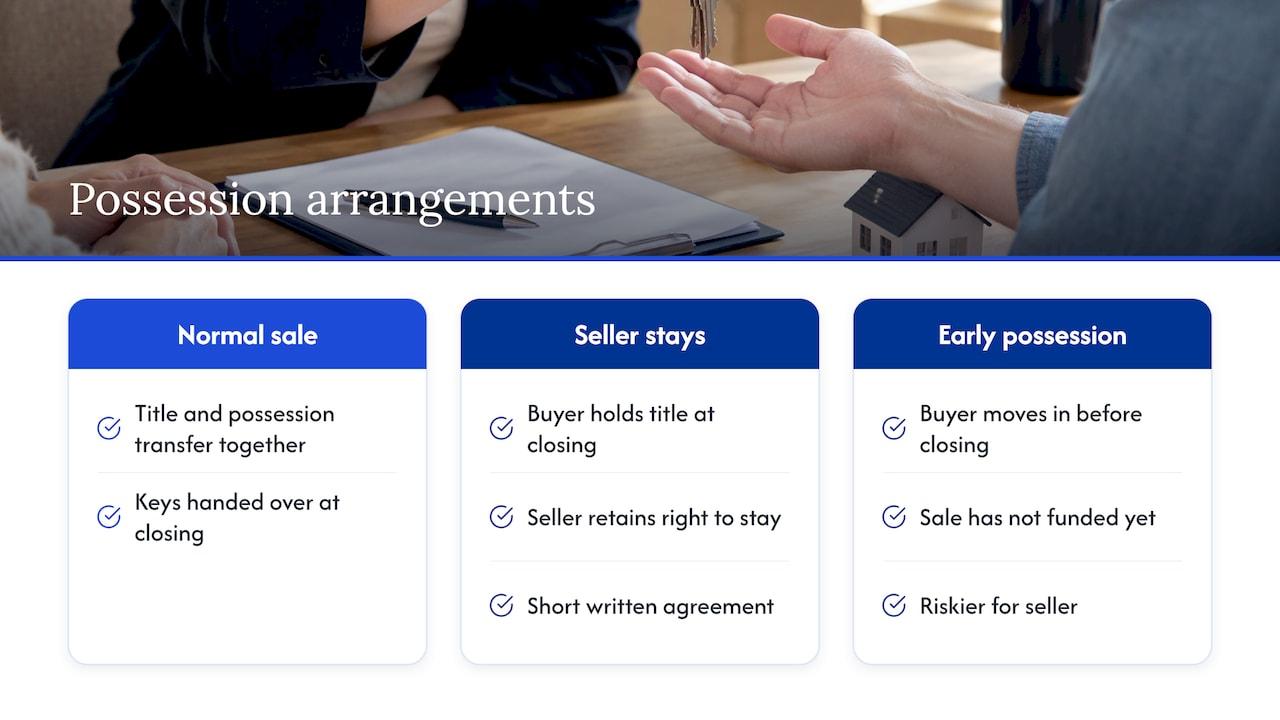
In a normal sale, ownership and possession change hands together. You sign, the funds move, and you hand over the keys, often the same afternoon. “Possession” is the right to occupy the property. “Title” is legal ownership. Post-closing possession splits the two: the buyer holds title on closing day, and you hold the right to stay under a short written agreement.
You will see several names for the same arrangement: rent-back, sale-leaseback, post-settlement occupancy. The paperwork agrees on a move-out date, a daily or monthly rent, a security deposit and who handles what while you remain.
The reverse also exists. A buyer who asks to move in before closing is asking for early possession, which is a different and riskier arrangement for the seller because the sale has not funded yet. This article is about the seller staying after the sale.
When sellers ask for it
Most sellers who want occupancy after closing are solving a timing gap, not a housing problem:
- You are buying or building elsewhere and the new place is not ready on the day this one sells.
- You are relocating for work and need to finish a school term, a lease end or a job transition. Our guide on how a job move forces a fast sale covers that pressure in more detail.
- You inherited the house and the family needs time to sort belongings. If this is you, our page on selling an inherited house walks through the situation.
- You are behind on the mortgage and need the sale to close before a deadline, but you also need a few weeks to move. See selling before the auction in Michigan.
- You are in a divorce and one spouse needs a short, orderly exit.
In each case, a fast closing paired with a short, defined stay can beat a slower sale that tries to match the move date exactly.
How long can you stay?
The length is whatever you and the buyer agree to, but there are practical ceilings.
When the buyer uses a mortgage, the lender usually expects the buyer to move in themselves soon after closing. Most lenders limit rent-back periods to 60 days because Fannie Mae and Freddie Mac require an owner-occupant to live in the home. The same source describes most contracts as running from a few days to 60 days.
A cash buyer has no lender to satisfy, so the limit is whatever the buyer is comfortable with. Investors still want the house back to renovate or resell, so expect shorter windows, often measured in days or a few weeks, not months. A realistic ask is the time you need to pack and move, with a firm date.
| Situation | Typical ask | What decides it |
|---|---|---|
| Packing and moving locally | A few days to 2 weeks | How much you own and how ready you are |
| Waiting for a new home to close | 2 to 4 weeks | The date your next closing is set for |
| Finishing a school term or lease | Up to about 60 days | Buyer’s plans for the house |
| Estate with a full house to clear | 1 to 3 weeks | Number of people sorting belongings |
These are planning ranges, not rules. The agreement controls.
What it costs you
Staying after you have sold is not free. Three charges are standard.
Daily or monthly occupancy charge
Sellers are commonly asked to pay rent equal to the buyer’s daily carrying costs: principal, interest, taxes and insurance. With a cash buyer there is no mortgage payment, so the number is simply negotiated. Ask for the daily rate in writing, and check how it is calculated.
Security deposit
The same source says deposits typically run one to two months of the agreed rent, sometimes a flat amount, and a title company often holds it. Michigan’s standard Realtors purchase agreement has an occupancy clause that works on this principle: you pay an amount per day from closing until you vacate, and funds are set aside at closing to cover it, with any balance refunded after you move out.
Damage and repairs
Under that standard Michigan form, the seller is liable for damage to the property after closing and before moving out, to the extent the buyer’s homeowners policy does not cover it, plus any deductible. Photograph every room and the exterior on closing day so there is no argument later about what was already there.
What goes in the written agreement
A short agreement beats a verbal one every time. Make sure it covers:
- The exact move-out date and time, not “around the end of the month.”
- The daily rate and how it is paid, whether from proceeds at closing or on a schedule.
- The deposit amount, who holds it and when it is returned.
- Who pays utilities during the stay. It is normally you.
- Insurance. The buyer insures the structure. You insure your belongings with a renter’s policy.
- Condition on handover: broom clean, personal property removed, nothing left behind.
- What happens if you stay late: usually a higher daily rate, and sometimes a legal process to remove you. Treat the date as firm.
- Access for the buyer, such as a final walk-through before you leave.
If the sale is complex, because of probate, a divorce, a lien or a foreclosure timeline, have a Michigan real estate attorney review the occupancy terms before you sign. In a probate sale, the personal representative signs for the estate.
How to ask for it without losing the sale
Timing matters. Raise occupancy when you ask for offers, not after you have accepted one. Buyers price their risk, and a surprise request at the closing table is a reason to renegotiate.
Be specific. “We need 10 days after closing to complete the move” is easier to accept than “we may need some extra time.”
Offer something in return. A higher daily charge, a larger deposit, or a clean handover with photos all reduce the buyer’s worry.
Keep the term short. A week is an easy yes for most investors. Two months is a negotiation.
Stay out of the way of the buyer’s plans. If the buyer wants to start work or list the property, a short window protects their schedule.
Why sellers lose money on post-closing possession
The mistakes are predictable:
- No deposit and no photos. Any damage dispute becomes your word against theirs.
- A vague end date. Without a firm date, the stay drifts, and the buyer’s carrying costs keep running.
- Skipping renter’s insurance. The buyer’s policy covers the structure, not your furniture.
- Trading too much price for too much time. If a 10-day stay cuts the offer by thousands of dollars, a short-term rental or storage unit may be the cheaper way to buy yourself time.
- Forgetting the move-out costs. Haulers, storage and deposits on the next place do not disappear because you have a few extra weeks.
Comparing cash offers when time matters
When you sell with one buyer, you take their terms. When several buyers bid on the same house, you can put the offers side by side and compare more than the headline number: closing speed, the move-out window, what you must leave behind, and who pays closing costs. That comparison is where occupancy terms get settled in your favor.
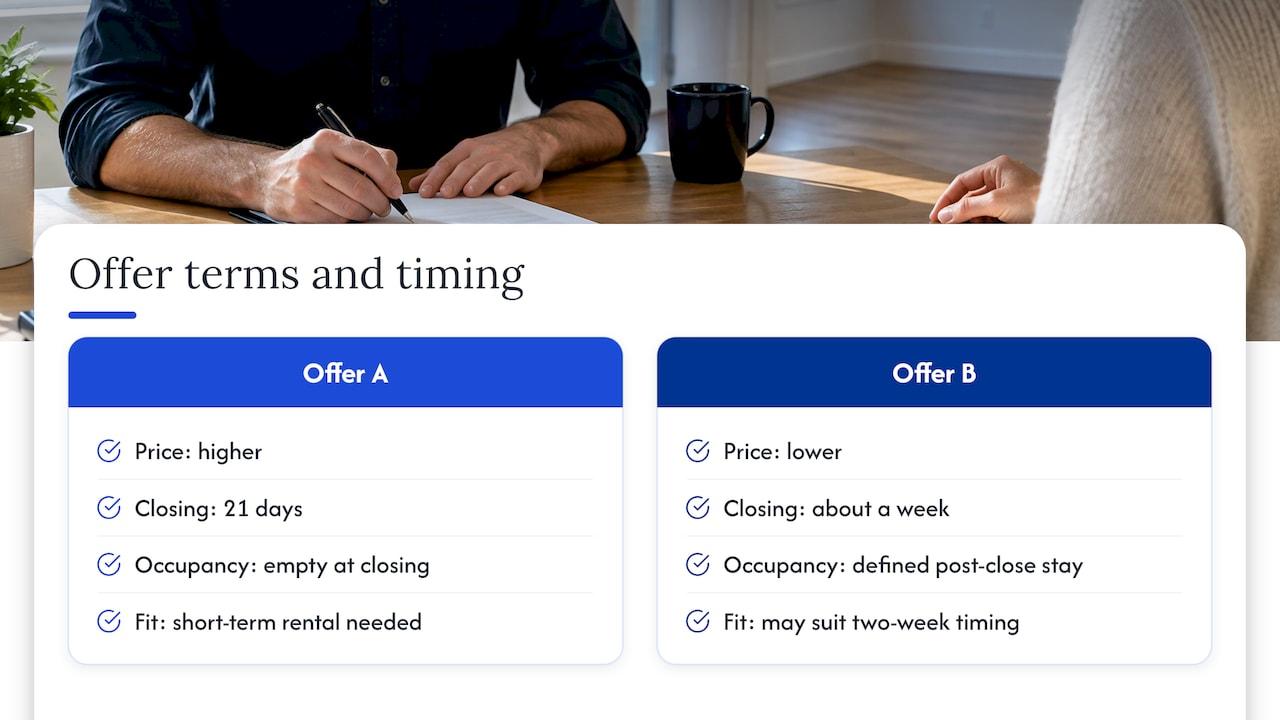
A simple worked example. Offer A is higher on price but closes in 21 days and expects the house empty at closing. Offer B is lower on price, closes in about a week and gives you a defined stay after closing. If your new home closes in two weeks, Offer B might be the one that actually fits your life, and Offer A would force you into a short-term rental. You can only see that trade-off when the offers are in front of you.
On the other side, a fast sale can also remove the need for post-closing occupancy altogether. If you are able to line up your move for the closing date, an as-is sale with no repairs, no showings and no cleaning-out project is simpler. Our guide on selling without cleaning explains how that works, and the seller playbook for closing in 7 to 10 days shows how the timeline fits together.
Special cases
Foreclosure and being behind on payments
If you are in foreclosure, closing before the sale date is what protects you, and every day of stay after closing is a day the buyer owns the house. Get the closing date locked first. Read what “sold as-is” means in a foreclosure and our page on selling to avoid foreclosure before you plan any stay after closing. Talk to a housing counselor or a Michigan attorney about your exact deadline.
Rental properties with tenants
If tenants live in the property, the question is different: do they stay under their lease or leave before closing? The buyer’s terms and Michigan lease law decide it. Our guide on selling a house with tenants in Michigan and the page for selling a rental property cover it.
When the buyer keeps pushing the date
A stay after closing only works if closing happens on time. If the buyer is stalling, see what Michigan sellers can do when a buyer keeps delaying closing.
Where HouseGoodbye fits
HouseGoodbye is a Michigan marketplace where several vetted local cash buyers bid on the same house with as-is offers. There are no listing fees, agent commissions or required repairs, and a typical close is about 7 days compared with about 73 days on the MLS. You see every offer and can walk away if none work.
For a seller who needs a few extra days in the house, that matters. You can compare offers on price, timing and the terms you need, instead of accepting one investor’s version of the deal.

Enter your address on our competing cash offers page to see what Michigan buyers will bid on your house. There is no obligation. If you want the full picture first, start with how to sell your house fast for cash.
Our view on staying after you sell
We see post-closing possession as a tool, not a goal. Most sellers who ask about it are really asking, “How do I avoid being homeless for three weeks between two closings?” The answer is a sale that is fast and certain enough to plan around.
That is why we built HouseGoodbye as a marketplace instead of a single buyer. When several vetted local cash buyers bid on your house as-is, you do not have to guess whether the terms you were handed are the best available. You can see every offer, compare the numbers, and walk away if none work.
Our advice is simple. Decide your move-out date before you ask for offers. Write the stay into the agreement with a date, a daily rate and a deposit. Photograph the house at closing. And remember that a close in about a week, with no commissions and no repairs, often gives you more room to plan your move than a long listing ever could.
Bryan
FAQ
How long after closing do you get possession of a house?
Usually the buyer takes possession on closing day, once funds are disbursed and documents are recorded. If the contract includes post-closing possession, the buyer takes possession on the move-out date you agreed. Without a clause, you are expected to be out when the sale closes.
Can a seller stay in the house after closing?
Yes, if the buyer agrees and the terms are in writing. The usual structure is a short rent-back: a set number of days, a daily charge, a deposit and responsibility for damage. With a mortgage buyer, lenders commonly cap the stay at 60 days. A cash buyer sets its own limit.
Who pays for damage during seller occupancy?
That is set by the agreement. Under the standard Michigan Realtors purchase agreement, the seller is liable for damage after closing and before moving out, to the extent the buyer’s homeowners policy does not cover it, plus any deductible. Photograph the house at closing and keep renter’s insurance on your belongings.
Do I need a lawyer for a rent-back agreement?
For a short stay in a simple sale, a clear written agreement is often enough. In a probate sale, divorce, tax lien or foreclosure timeline, have a Michigan real estate attorney review it, because the deadlines and signers differ.