Accepting a cash offer on a house takes five steps: compare the written offers, check the buyer’s proof of funds, read the terms, sign the purchase agreement without changes (or counter), and then move through title work to closing. Signing is the moment your decision becomes a contract, so the work happens before it. When several vetted buyers bid on the same house, as they do on HouseGoodbye, you can run that check on every offer side by side and sign only the one that holds up.
This guide walks through the process in the order you will meet it. It is written for Michigan homeowners selling as-is: a house behind on the mortgage, an inherited or probate property, a vacant or damaged home, or a sale you simply want done without an agent, repairs or showings.
TL;DR
- You are never required to accept a cash offer, even a high one. A full-price cash offer does not obligate a seller to take it.
- In Michigan, a purchase agreement must be in writing and signed by both sides before it is a binding contract.
- Before you sign, check the price, the proof of funds, the earnest money, any contingencies, the closing date and who pays which costs.
- Any change you make to an offer is a counteroffer, not an acceptance.
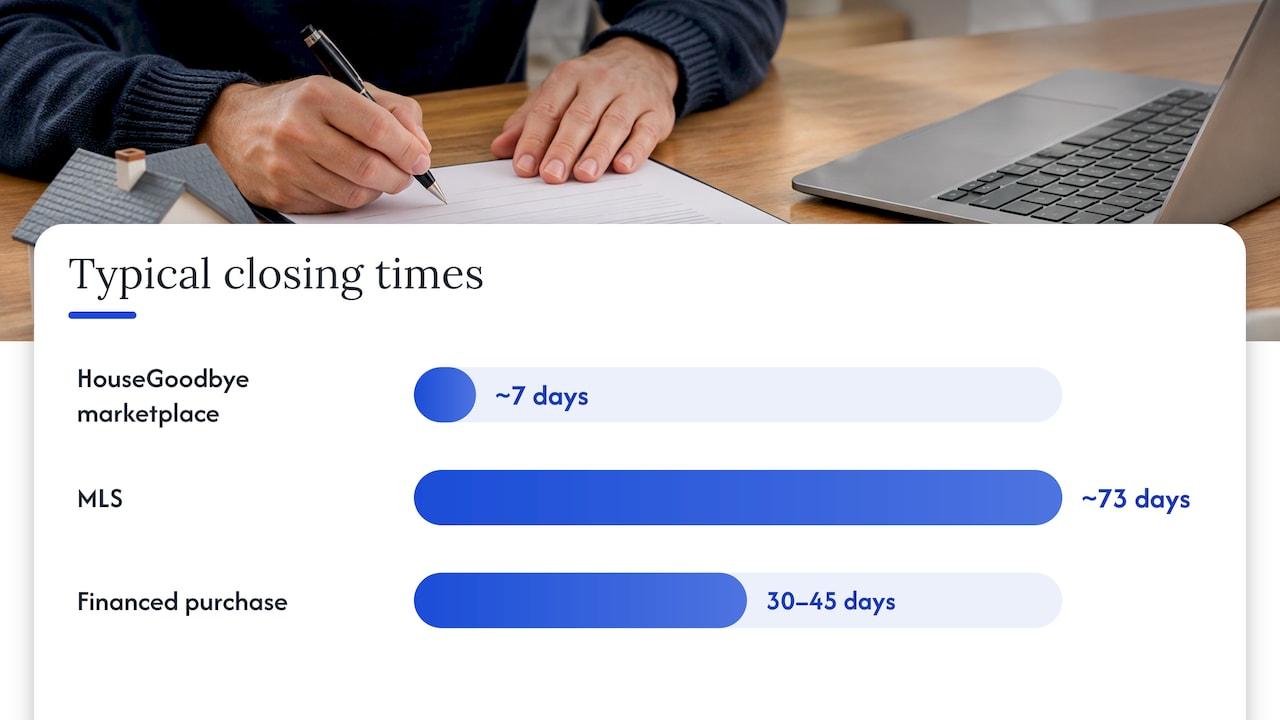
- After signing, title work and closing follow. Our marketplace closes in about 7 days, against roughly 73 days on the MLS.
Table of Contents
- What “accepting” a cash offer really means
- Step 1: Gather every offer in writing
- Step 2: Confirm the buyer actually has the cash
- Step 3: Read the terms that decide what you actually get
- Step 4: Special terms for as-is, inherited, vacant and damaged homes
- Step 5: Sign, or counter
- Step 6: What happens between acceptance and closing
- A worked example
- Red flags before you sign
- Where HouseGoodbye fits
- Our perspective
- FAQ
- Sources
What “accepting” a cash offer really means
A cash offer is a buyer’s written proposal to buy your house with their own money, with no mortgage lender involved. Nothing in it binds you until you accept. Accepting means agreeing to every term the buyer wrote, and the agreement becomes a contract when both of you have signed it.
The State Bar of Michigan explains that a purchase agreement must be in writing and signed by both parties. Once you both agree on all terms and sign, you have a binding contract, subject to any contingencies written into it. A contingency is a condition that lets one side cancel if something specific goes wrong, such as a bad inspection or a title problem.
A verbal “yes” on the phone is therefore not the finish line. The signed document is. That is good news for you: until you sign, you can compare, ask questions and walk away.
Step 1: Gather every offer in writing
The first mistake sellers make is accepting the first number they hear. A single investor making a single offer has no reason to bid against themselves. When buyers compete for the same house, the numbers move.
On our marketplace, you enter your address and several vetted local cash buyers submit as-is offers. You see every offer, compare them, and can walk away if none work. There is no obligation to take any of them. The page on competing cash offers shows how that works.
Whatever route you use, get each offer in writing and ask for the same things from every buyer, so the offers can be compared line by line:
- Purchase price
- Earnest money amount and who holds it
- Closing date
- Contingencies, if any
- Who pays closing costs, title insurance and any transfer taxes
- Whether you must clean out the house
- Proof of funds
A higher headline price with a long list of conditions can be worth less than a slightly lower price with none. Put the offers in a simple table.
| Term | Offer A | Offer B | Offer C |
|---|---|---|---|
| Price | |||
| Earnest money | |||
| Contingencies | |||
| Closing date | |||
| Costs you pay | |||
| Proof of funds received |
Step 2: Confirm the buyer actually has the cash
A cash offer is only as good as the money behind it. Before you accept, you want to see evidence that the funds exist, are available now and belong to the party named on the offer.
What to look for in a proof-of-funds document:
- Recent date. A statement from months ago says little about today’s balance.
- Matching name. The account holder should be the buyer or the company named in the agreement. If the buyer is an LLC or a trust, the person signing should have authority to act for it.
- Enough money. The balance should cover the price plus closing costs.
- Available funds. Money that depends on selling another property or drawing a loan is not cash on hand.
Our guide to proof of funds from a bank explains what these letters look like, and the walkthrough on how to verify a cash home buyer covers the wider background check. Keep account numbers blacked out when you share documents, and send them through a secure channel rather than plain email.
This is one place a marketplace saves you effort. The buyers bidding on HouseGoodbye are vetted local investors, so you are not starting from an anonymous name that texted you an offer.
Step 3: Read the terms that decide what you actually get
The price is the part everyone reads. The terms are the part that costs money. The American Bar Association notes that a written agreement should spell out contingencies, earnest money, title, closing, possession and risk of loss before you sign. Here is how each applies to a cash sale.
Earnest money
Earnest money is a deposit the buyer puts down to show good faith. The Michigan Bar brochure says the agreement should state the amount, where it is held (for example by a broker or title company) and how it is applied, returned or forfeited. Typical returns to the buyer happen when the seller cannot deliver good title or a contingency is not met. If the deposit is tiny, a buyer can back out cheaply, so compare it across offers.
Contingencies
In a financed sale, common contingencies include obtaining a mortgage, attorney review and a satisfactory inspection. A cash deal has no loan to wait for, but an inspection or title contingency can still appear. The Michigan Bar advises spelling out contingencies as clearly as possible. Ask each buyer which ones apply, how long they last and what happens when they end. An as-is offer should say plainly that you are not making repairs.
Closing date and possession
Pick the date that fits your situation. A seller facing a foreclosure deadline needs speed. An heir clearing out a family home may want a few extra weeks to remove belongings. Write the date and the move-out day into the agreement so neither is a surprise.
Title, damage before closing and disputes
General guidance on purchase agreements says they usually cover closing details, dispute resolution, earnest money and its holder, title insurance, and what happens if the property is damaged before closing. That last item matters most for vacant houses, where a burst pipe or break-in between signing and closing is a real risk. Ask who carries that risk.
Costs
With no agent, there is no commission. Our marketplace charges sellers $0 in commissions. Closing costs still exist, so ask each buyer which ones they cover. Our overview of cash buyer closing costs lists what each side usually pays.
Step 4: Special terms for as-is, inherited, vacant and damaged homes
The offer you accept should fit the house you have. A few situations call for extra questions.
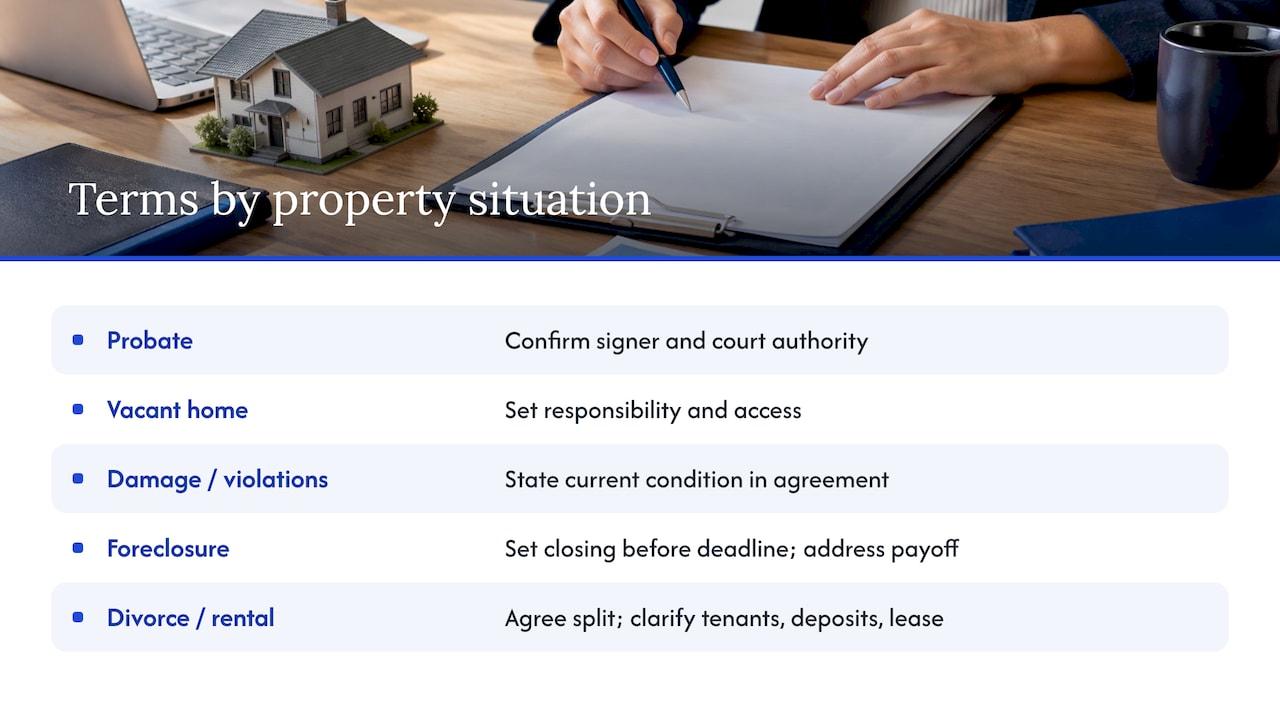
Inherited or probate homes. Ask who is signing for the estate and whether the buyer will wait for court authority if the sale needs it. Our page on selling a house in probate in Michigan and the guide to cash buyers for estate properties cover how the timing works. If several heirs share ownership, each needs to agree before anyone signs.
Vacant houses. Ask who is responsible for the property between signing and closing, and whether the buyer needs access before then. See our page on selling a vacant house.
Fire or water damage and code violations. State in the agreement that the buyer takes the house in its current condition, including known damage and open violations. Do not leave it to an assumption. Our pages on fire and water damaged houses and houses with code violations explain how as-is offers handle these.
Behind on the mortgage or facing foreclosure. Time is the issue. Share your timeline with every buyer, ask for a closing date before your deadline, and make sure the payoff of your loan is addressed in the agreement. If you are in this position, start with our page on selling to avoid foreclosure. For legal questions about your loan or deadlines, talk to a Michigan real estate attorney or a HUD-approved housing counselor.
Divorce sales. Both owners usually need to sign. Agree on how proceeds are split before you accept. See selling a house during divorce.
Rentals with tenants. Ask whether the buyer takes the property with the tenants in place and what happens to deposits and leases. See selling a rental property with tenants.
Step 5: Sign, or counter
You have three choices with each offer: accept, counter or decline.
Accept. Sign the offer exactly as written. The North Carolina Real Estate Commission explains that a seller accepts by signing the offer without changes, and that changes create a counteroffer. That commission’s rules are North Carolina’s, but the principle is the general one: edit a single term and you have not accepted, you have proposed something new.
Counter. If the offer is close, propose changes: a later closing date, a larger deposit, different cost splits. The Michigan Bar says seller changes are counteroffers that should be initialed or signed in a revised version. Keep the paper trail clean, so there is one final document that both sides signed.
Decline. You owe no one a yes. Official guidance from the Maine Real Estate Commission states that a full-price cash offer does not obligate the seller to accept it. Rules differ by state, but nowhere should you feel cornered into signing.
When the contract becomes binding
In Michigan the contract exists once the written agreement is signed by both parties. In North Carolina, the commission notes the contract becomes binding when the signed acceptance is communicated to the buyer, and until then the seller may still consider a competing offer. Do not rely on that flexibility. Treat your signature as final, and sign only after you have compared everything.
The same commission warns that misunderstandings over offer and acceptance can have serious legal and financial consequences, and advises consulting an attorney when any point is unclear before entering a binding contract. If anything in the paperwork confuses you, ask a Michigan real estate attorney before you sign.
Step 6: What happens between acceptance and closing
After both parties sign, the deal moves through a short, predictable sequence:
- Earnest money is deposited with the holder named in the agreement.
- Title work begins. A title company searches the property’s ownership history for liens, unpaid taxes or other claims, and requests payoff figures for any mortgage.
- Contingencies are handled, if the agreement has any.
- Closing documents are signed. You sign the deed and settlement papers, and funds move by wire or certified funds.
- The deed is recorded with the county, and you hand over the keys.
The pace comes from what you do not need. A financed purchase often takes 30 to 45 days from accepted offer to closing, driven by the lender’s timeline, according to an Illinois closing-law firm. A cash purchase has no appraisal or loan underwriting to wait on. Title problems or repair negotiations can still stretch it, which is why a clear title and a short contingency list matter.
On our marketplace, a typical close is about 7 days, compared with roughly 73 days on the MLS. Our explainers on the cash closing process, why cash sales close faster and closing in 7 to 10 days go deeper.
A worked example
Say you inherit a house in Warren with a leaking roof and a full basement of belongings. You enter the address and receive three written offers.
- Offer A is the highest price, but it carries a 30-day inspection contingency and a small deposit.
- Offer B is $4,000 lower, with no contingencies, a larger deposit and a 10-day close.
- Offer C wants you to clear the house first.
Offer A’s price is attractive, but the inspection contingency gives the buyer a way to cancel or renegotiate after weeks of waiting. Offer C costs you time and cleanup money. Offer B may leave you with more certainty, and a faster close lowers your carrying costs: taxes, insurance and utilities on an empty house. You might counter Offer A to ask for no contingency, then pick whichever response comes back clean. The point is that you could make that comparison only because you had several offers on the table.
The numbers here are illustrative, not a quote.
Red flags before you sign
- Pressure to sign today, with no time to read.
- A buyer who will not name who is buying, whether a person or a company.
- Proof of funds that does not match the name on the offer.
- Blank spaces in the agreement, or terms discussed verbally but missing in writing.
- Fees that appear for the first time at closing.
Any one of these is a reason to slow down. A competing offer gives you somewhere else to go.
Where HouseGoodbye fits
HouseGoodbye is a Michigan cash-offer marketplace, not a single buyer. You enter your address, and several vetted local cash buyers compete with as-is offers. There are no listing fees, no agent commissions and no required repairs, showings or staging. We buy houses in any condition across Metro Detroit, Grand Rapids, Flint, Lansing and the rest of Michigan. You see every offer and owe nothing if none work.
If you are ready to compare numbers, start on the page to sell your house fast for cash, or see how selling as-is works for homes that need work.

Our perspective
Most sellers come to us after one offer arrived and felt too low, or after a buyer vanished at the last minute. The fix for both is the same: more than one serious bid, and a signature only after you have read every line.
We built HouseGoodbye as a marketplace because one investor making one offer has no reason to compete with himself. When vetted local buyers bid on the same house, you see the real range of what your house is worth to cash buyers, in writing, and you decide with no obligation.
Acceptance should be the calm part. Compare price, deposit, contingencies and closing date, pick the offer with the fewest strings, and the sale can close in about a week with $0 in commissions.
Bryan
FAQ
Do I have to accept a cash offer if it is for full price?
No. Sellers in the United States are generally not compelled to accept any offer, including full-price cash ones. Maine’s real estate commission guidance says so explicitly. You can accept, counter or decline.
Can I change my mind after I accept?
Once a purchase agreement is signed by both parties, it is a binding contract, subject to the contingencies written into it. Your way out is whatever those contingencies allow, so read them before signing. If you are unsure, ask a Michigan real estate attorney first.
How long does it take from acceptance to closing on a cash sale?
Cash deals skip the lender, so they can move much faster than financed sales, which commonly take 30 to 45 days. On our marketplace a typical close is about 7 days. Title issues or repair negotiations can add time.
What should I ask for to confirm a buyer has the cash?
Ask for a recent bank statement or bank letter showing enough funds for the price plus closing costs, in the same name as the buyer on the offer. Our guide on proof of funds explains what a good one looks like.
Can I counter a cash offer?
Yes. Any change you make is a counteroffer, which the buyer can accept or reject. Put it in a revised, signed or initialed document so the final terms are clear to both sides.
Sources
- Real Property Law Section: Purchase and Sale of a Home, State Bar of Michigan
- Questions and Answers on Offer and Acceptance, North Carolina Real Estate Commission
- Offers and Counteroffers Guidelines, Maine Real Estate Commission
- The Purchase Contract, American Bar Association
- Does a Home Seller Have to Accept a Full-Price Offer?, Nolo
- The Illinois Home Closing Process, Step by Step