Yes, you can sell a house while renters live in it. A sale does not cancel a lease. The new owner steps into the landlord’s shoes, and the tenant keeps the rights the lease gives them. What you decide is whether the buyer takes the house with the tenant in place or whether you end the tenancy lawfully before closing. Each path has a different buyer pool, timeline and price.
This guide walks through what happens to the lease, how to handle notice and showings, what to do with the security deposit, and how to sell fast when the property is tenant-occupied, with Michigan specifics where the law is clear.
TL;DR
- You generally do not need a tenant’s permission to sell, but the lease still binds the new owner, and a fixed-term lease normally runs to its end.
- A month-to-month tenancy can be ended with the notice state law requires. A fixed-term lease usually cannot be ended early without the tenant’s agreement.
- Investors often value a documented lease and a paying tenant. Owner-occupant buyers who need to move in quickly are the group a tenant shuts out.
- In Michigan, the security deposit stays your responsibility until it is transferred to the buyer and the tenant is told, or returned.
- On HouseGoodbye, local cash buyers bid on your tenant-occupied house as-is, so you can compare offers without repairs, showings or commissions.
Table of Contents
- Can you sell a house with tenants living in it?
- What happens to the lease when the house is sold
- Is it harder to sell a house with tenants?
- Telling your tenant and arranging showings
- The security deposit when the landlord changes
- What if the buyer wants the house empty?
- Perspective: why we steer landlords toward investor buyers
- Selling a tenant-occupied house for cash in Michigan
- Paperwork to gather before you take offers
- Mistakes that cost landlords money
- FAQ
- Sources
Can you sell a house with tenants living in it?
Yes. Nolo’s guide to selling with existing tenants says a landlord can generally sell a property while a tenant is still there. What you have to account for is the lease, the rules on entering the home and showing it, and whether your buyer is willing to take the property subject to the tenancy.
That last point is the real question. Most people who search for this are not asking whether it is legal. They want to know whether a tenant will wreck the sale, cost them money, or leave them stuck owning a rental they no longer want.
The short answer: it depends on who the buyer is and what the lease says. Start with the lease.
What happens to the lease when the house is sold
Unless the lease says otherwise, the new owner must honor it. The Texas State Law Library puts it plainly: a fixed-term lease continues for its remaining term after a sale, because the transfer changes the landlord, not the tenant’s bargained-for rights. The same general principle applies in Michigan, where leases are contracts that run with the tenancy, though you should confirm the details of your own lease with a Michigan landlord-tenant attorney.
Here is how it breaks down by type of tenancy.
| Tenancy type | What the sale does | Your main options |
|---|---|---|
| Fixed-term lease (for example, 12 months) | The lease generally continues after closing | Sell to a buyer who accepts the lease, wait for the term to end, or negotiate an early move-out |
| Month-to-month | The buyer inherits the tenancy, but it can be ended with the notice state law requires | Give lawful notice before listing, or let the buyer decide |
| No written lease or unclear terms | Harder to prove what was promised | Document the arrangement in writing before you market the house |
Nolo notes the same split: a fixed-term lease generally continues after sale, while a month-to-month tenancy may be ended with the notice your state requires. In Michigan, the SCAO notice to quit form (DC 100c) is the court-approved form used for terminating a tenancy, so you can see the process in writing before you start.
Two things to avoid:
- Do not try to force a tenant out because you are selling. LawDepot’s guidance is that landlords generally cannot make tenants leave just because the property is on the market. Changing locks, shutting off utilities or removing belongings is not a shortcut.
- Do not assume a seven-day notice applies. Michigan’s short demand periods are tied to specific grounds. The state’s DC 100b form, for example, covers extensive continuing damage or a serious continuing health hazard. Selling the house is not one of those grounds.
If a tenant does not leave after a valid notice, you file in court. The DC 100c form states that the tenant may present reasons against eviction if the landlord starts a case. Plan on that taking time.
Is it harder to sell a house with tenants?
Sometimes, and it depends on who you are selling to.
Nolo’s view is that the buyer pool depends on the tenancy. Owner-occupant buyers who need to move in quickly may walk away, because they cannot take possession at closing. Investors, on the other hand, may value a property with a reliable tenant and a lease already in place, since the rent starts on day one.
The same source does not support a fixed percentage discount or a set timeline, and you should be skeptical of any page that quotes one. What actually moves the price in practice:
- Rent is current. A tenant who pays on time makes the house look like an income asset.
- The lease is documented. A signed lease, a rent ledger and a record of the deposit let a buyer underwrite the deal quickly.
- Rent is near market. A below-market rent locked in for a long term lowers what an investor will pay.
- The tenant is cooperative. Easy showings and a clean property are worth real money.
- Condition of the house. A tenant-occupied house in rough shape is harder for a retail buyer and a normal mortgage appraisal. Investors who buy as-is are more comfortable with it.
If you list on the open market with an agent, expect fewer showings, tighter scheduling and a buyer pool that skews toward investors anyway. That is why many Michigan landlords skip the listing and go straight to cash buyers.
Telling your tenant and arranging showings
Talk to your tenant early and in writing. A short letter should say that you plan to sell, whether you expect the lease to continue with the new owner, how showings will be scheduled and who to contact. You are not asking permission. You are making the sale easy for them to live through.
On showings, LawDepot says landlords must give the legally required notice before entering and should work with tenants to find reasonable times. Entry-notice rules vary by state, so the same source advises checking your lease and state law before you book anything. Michigan’s landlord-tenant statute does not give a general entry-notice rule the way some states do, which makes your lease’s access clause the document that matters. If it is silent, give at least 24 hours’ written notice anyway and get consent. It costs you nothing and protects you.
To keep a tenant on your side:
- Offer fixed windows. Two or three set slots a week beat daily surprises.
- Limit the number of visits. Group showings or a single investor walk-through reduce disruption.
- Consider a small incentive. A rent credit for cooperation is common and cheap compared with a stalled sale.
- Skip the open house. Private, scheduled viewings are less intrusive.
- Put agreements in writing. Any promised credit, move-out date or cash-for-keys deal should be signed by both sides.
Nolo’s advice for a difficult situation is to make showing times convenient for the tenant. Cash buyers who bid on the house as-is often need only one visit, which is one of the biggest practical advantages of selling this way.
The security deposit when the landlord changes
This is where sellers make avoidable mistakes. In Michigan, the Landlord and Tenant Relationships Act caps a residential security deposit at one and one-half months’ rent (MCL 554.602) and treats the deposit as the tenant’s lawful property until the landlord establishes a right to keep it.
When your interest ends by sale, MCL 554.614 says you stay liable for the deposit until one of these happens:
- The deposit is transferred to the buyer and the tenant is notified by ordinary mail of the transfer and the buyer’s name and address.
- The buyer complies with the statute.
- The deposit is returned to the tenant.
In practice, handle it at closing. Ask the title company or closing attorney to show the deposit as a credit to the buyer on the settlement statement, mail the tenant the transfer notice, and keep a copy. If you skip this, a tenant can come after you for the deposit months after you have been paid and moved on.
What if the buyer wants the house empty?
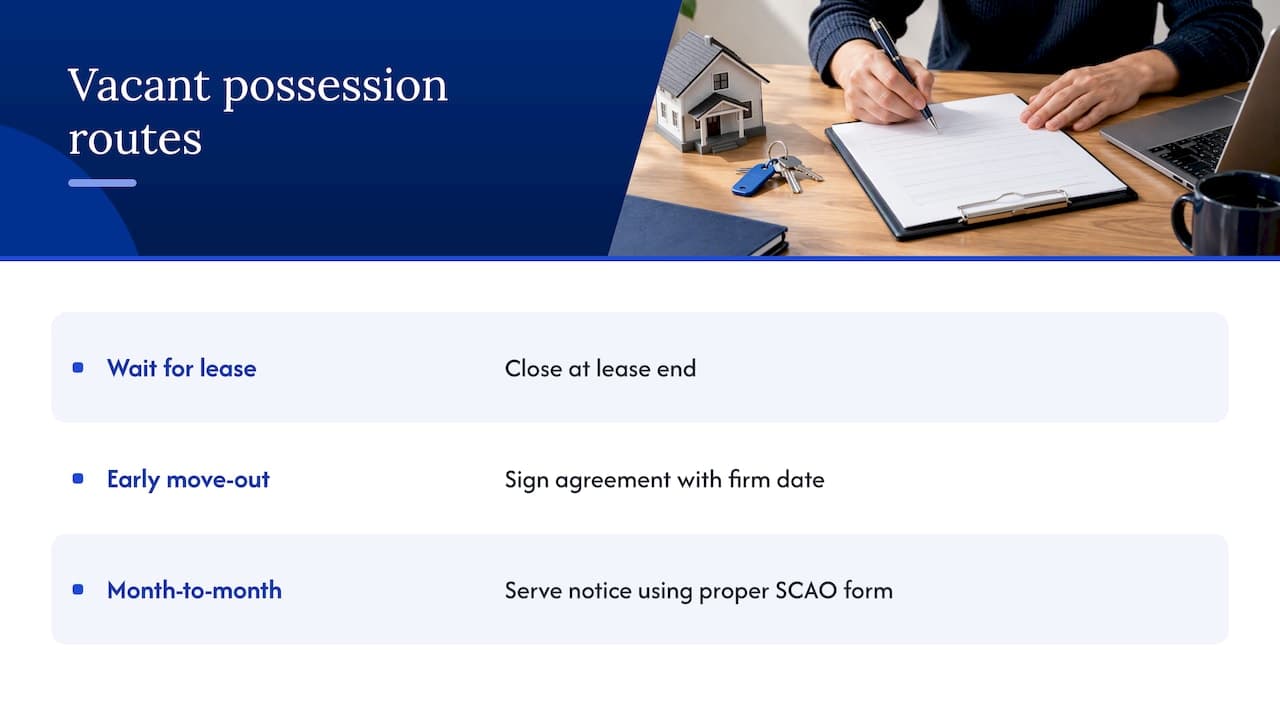
Some buyers, especially people who plan to live in the house, want vacant possession. You then have three realistic choices.
Wait for the lease to end. If the term is short, this is often the cleanest way. Time the closing for the end date.
Negotiate an early move-out. Nolo suggests, for a long-term lease, negotiating an early move-out or waiting until the lease ends. A cash-for-keys payment, a waived final month or help with moving costs can cost less than months of carrying the house. Put it in a signed agreement with a firm move-out date and a condition-of-the-unit clause.
End a month-to-month tenancy. Serve the notice state law requires, using the proper SCAO form, and let the timing drive your sale date.
None of these is quick if the tenant refuses. That is the main reason landlords choose a buyer who takes the tenant along.
A note on foreclosure
If the house is going to foreclosure, tenants have federal protection. The UNC School of Government explains that the Protecting Tenants at Foreclosure Act generally gives bona fide tenants at least 90 days’ notice, and a bona fide fixed-term tenant generally keeps the tenancy through its term unless the purchaser will live there as a primary residence. A bona fide tenant cannot be the mortgagor or the mortgagor’s child, spouse or parent, the lease must be arm’s length, and the rent must not be substantially below fair market unless subsidized.
Michigan’s DC 100c form also flags that, after foreclosure, the notice must be the lease-required period or at least one rental period unless another law applies, including that 90-day federal protection. If you are behind on the mortgage and also have tenants, selling before the auction avoids that situation altogether. Our page on how to avoid foreclosure in Michigan explains the timeline.
Perspective: why we steer landlords toward investor buyers
We built HouseGoodbye because most Michigan sellers with a tenant face a bad choice: list with an agent and fight the showings, or take one lowball offer from a single investor who knows you are stuck.
Our view is that a tenant is a feature to the right buyer and a problem only to the wrong one. Local cash buyers already own rentals, already have property managers and lawyers, and do not need the house empty to close. When several of them bid on the same address, the tenant stops being a discount argument, because each buyer prices it independently and the highest number wins. You see every offer and you can walk away if none of them works.
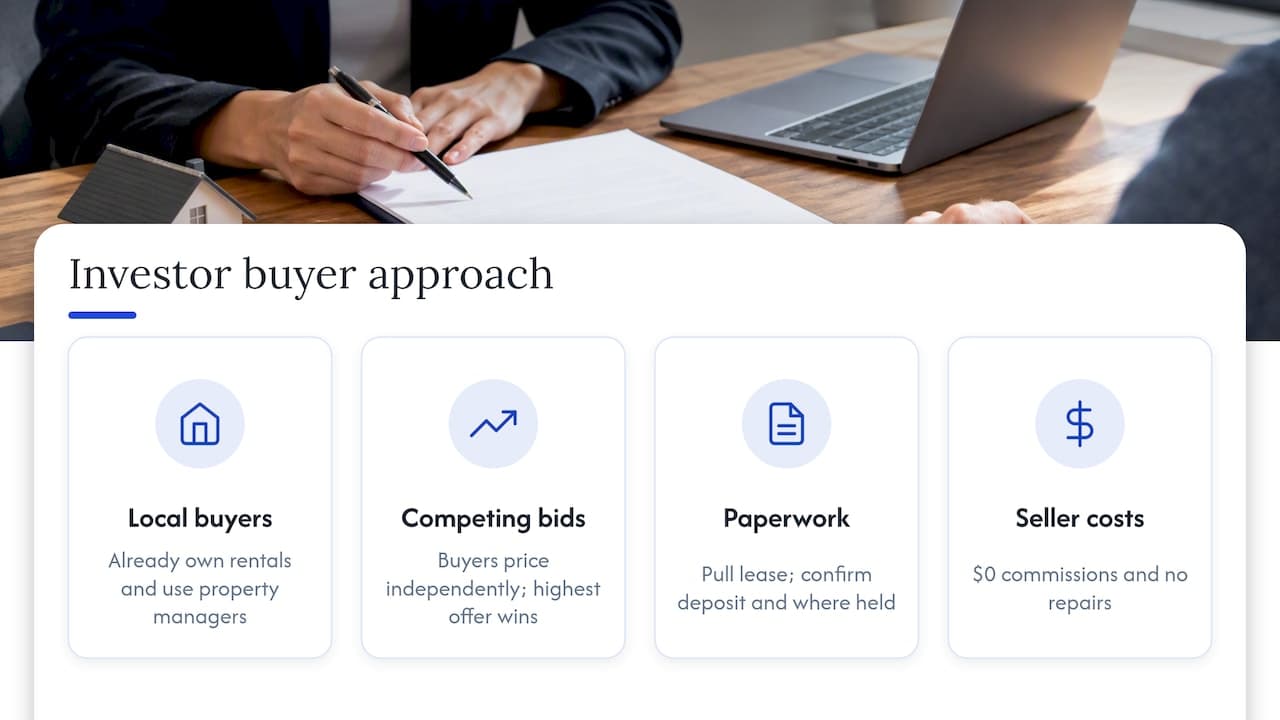
We also tell landlords to do three things before they take a single bid: pull the lease, confirm the deposit amount and where it is held, and write to the tenant. Buyers pay more for clean paperwork, and they close faster.
We do not publish a fixed price, because every house and lease is different. What we can say is that the process is built to cost you $0 in commissions and no repairs.
— Bryan
Selling a tenant-occupied house for cash in Michigan
On HouseGoodbye you enter the address and vetted local cash buyers submit as-is offers. You do not fix anything, stage anything or clean out the tenant’s space. There are no listing fees and no agent commissions, and closing can happen in about 7 days, compared with roughly 73 days we see on the MLS. Compare the offers, and if none works, you owe nothing.
For a rental, the useful details are practical. Tell us whether the tenant is on a lease or month-to-month, what the rent is and whether the deposit is held. Buyers can then say whether they will take the tenant in place or want a different arrangement. Our sell a rental property page covers how this works with tenants, and if the house is a two-unit building, our guide to selling a duplex for cash will help.

Ready to see numbers? Get competing cash offers on your Michigan property and compare them side by side. We buy in Metro Detroit, Grand Rapids, Flint, Lansing and the rest of the state, in any condition.
Paperwork to gather before you take offers
Buyers and their attorneys will ask for the same documents. Having them ready shortens the process:
- The signed lease and any addenda
- A rent ledger for at least the last 12 months
- The security deposit amount and where it is held
- Tenant contact details, if the tenant agrees to be contacted
- Utility responsibilities, and who pays what
- Repair requests and records from the tenant
- Your Michigan disclosures. Our guide to the Michigan seller disclosure rules shows what applies, and if the house was built before 1978, see the lead paint disclosure rules
If the property has open code issues, tell buyers up front. A house with violations can still sell as-is, and we explain how in our article on selling a house with code violations.
Mistakes that cost landlords money
Listing before reading the lease. A clause on assignment, a purchase option or a right of first refusal can derail a closing. Read it first.
Promising a buyer vacant possession you cannot deliver. If the tenant has a lease with months left, a buyer who relies on your promise may sue when closing slips.
Forgetting the deposit. See above. The statute leaves you liable until the transfer is done.
Entering without notice. Even if Michigan law is less specific than other states, a lease access clause and basic good faith still apply.
Treating the tenant as the enemy. A tenant who feels threatened is the one who refuses showings and delays closing. A tenant who gets clear communication and a small incentive usually helps.
Taking the first offer. A single buyer knows you have a tenant and a deadline. Competing bids remove that leverage.
FAQ
Do I need my tenant’s permission to sell the house?
Generally no. Nolo says a landlord can sell while a tenant lives there, provided you follow the lease and give proper notice for showings. You still owe the tenant the rights the lease grants, and the buyer takes the house subject to them.
What happens to my tenants when the house sells?
A fixed-term lease normally continues with the new owner until it ends. A month-to-month tenant can be given the notice state law requires, by you before closing or by the buyer afterward. Nobody can lawfully lock out or remove a tenant without the proper court process.
Who holds the security deposit after the sale?
In Michigan, you remain liable until the deposit is transferred to the buyer and the tenant is notified by ordinary mail, the buyer complies with the statute, or you return it. Settle it on the closing statement and mail the notice the same week.
Will a tenant lower what my house sells for?
It can, mostly with owner-occupant buyers who need to move in right away. Investors may value a paying tenant and a documented lease. No reliable fixed percentage applies to every sale, which is why comparing several offers tells you more than any rule of thumb.
Sources
- Tips for Selling a Property With Existing Tenants (Nolo)
- My landlord sold the property. Can the new owner kick me out? (Texas State Law Library)
- Selling a Property When Renters Are Living There (LawDepot)
- Landlord and Tenant Relationships Act, Michigan Legislature
- MCL 554.614, Michigan Legislature
- DC 100c, Notice to Quit to Recover Possession of Property (Michigan courts)
- DC 100b, Demand for Possession, Damage/Health Hazard (Michigan courts)
- The Protecting Tenants at Foreclosure Act (UNC School of Government)