
Yes, you can sell a house as-is in Michigan, and the fastest reliable route is a cash-buyer sale that closes in about one to two weeks instead of the roughly 35 days a conventional sale typically takes. Selling as-is means you’re not making repairs, but it doesn’t erase your legal duty to complete Michigan’s Seller Disclosure form before signing a binding agreement.
TL;DR:
- Selling to a cash buyer typically closes within one to two weeks, significantly faster than the usual 35-day timeline for conventional sales.
- A seller must still complete Michigan’s Seller Disclosure form and cannot omit disclosure of known defects, even when selling as-is.
- The discount for an as-is sale often ranges up to 20% or more for properties with major structural issues, reducing net proceeds accordingly.
- If repairs are minor and inexpensive, making them can increase sale price and outweigh the benefits of an as-is quick sale.
- Using a platform like Housegoodbye allows sellers to receive multiple vetted cash offers, ensuring a fast sale with transparency and legal protections.
Table of Contents
- When Does It Make Sense to Sell Your House As-Is?
- What Does “As-Is” Actually Mean Under Michigan Law?
- What Are Your Options for Selling an As-Is House?
- Your Step-by-Step Checklist to Sell As-Is in Michigan
- What Will You Actually Net After Closing Costs?
- How I’d Weigh Your Options If This Were My House
- Get Multiple Cash Offers Without Lifting a Hammer
- Sources
- FAQ
When Does It Make Sense to Sell Your House As-Is?
Selling as-is is the right call when your circumstances outweigh your desire for top dollar. It’s the wrong call when a little elbow grease would net you a lot more money.
Homeowners lean toward as-is sales for a handful of predictable reasons. You inherited a property nobody in the family wants to manage, and it needs a new roof, updated wiring, and a full kitchen gut. You’re behind on payments and need to close before a lender forces the issue. You’re relocating for a job in three weeks and can’t babysit a renovation from another state. Or the house has damage from a burst pipe, fire, or years of deferred maintenance that would cost more to fix than you’d recoup in resale value.
Here’s when as-is selling stops making sense:
- The repairs are small and cheap. A $600 paint job and some landscaping that could add $8,000 to your sale price isn’t worth skipping.
- You’re in a strong seller’s market. If comparable homes in your neighborhood are getting multiple offers, buyers may be more forgiving of minor flaws anyway, and a light cleanup could still net more.
- You want the highest possible price and have time to wait. As-is sales trade speed and certainty for a lower ceiling on price.
- The property needs work a buyer’s lender will flag. If a conventional loan appraisal will kill the deal anyway, as-is to a cash buyer might be your only realistic path.
The tradeoff boils down to three variables pulling against each other: speed, price, and financing risk. A cash sale gives you speed and removes financing risk, but usually costs you some percentage of top market value. Listing with an agent and making at least cosmetic repairs can push your price higher, but it takes longer and depends on a buyer qualifying for a mortgage. Homeowners heading toward foreclosure often don’t have the luxury of choosing the higher-price option, no matter how much more it might net on paper.
What Does “As-Is” Actually Mean Under Michigan Law?
“As-is” in a Michigan purchase agreement means the buyer accepts the property’s physical condition and you’re not obligated to make repairs before closing. It does not mean you can skip disclosure. Those are two separate legal concepts, and confusing them is where sellers get into trouble.
Under the Seller Disclosure Act (MCL 565.951–565.966), anyone selling a residential property of one to four units must provide a written disclosure statement before or at the time a purchase agreement is signed. If you hand it over after the buyer has already signed, they get a window to walk away: a limited time window after disclosure delivery during which the buyer can terminate the agreement.
Buyer termination windows: 72 hours for in-person delivery, 120 hours for registered mail delivery, starting from the moment the buyer actually receives your disclosure statement.
The disclosure form itself asks pointed questions covering:
- Appliances and major systems (furnace, water heater, electrical, plumbing)
- Roof age and known leaks or water intrusion
- Foundation issues, settling, or structural repairs
- Unpermitted additions or renovations
- Environmental hazards like mold, asbestos, or lead paint
- Known defects in wells, septic systems, or fireplaces
An “as-is” clause allocates the risk of undiscovered defects to the buyer. It does not protect you if you knew about a cracked foundation or a failing septic field and checked “no known issues” anyway. Michigan courts and the Michigan Bar Journal are clear that fraudulent concealment remains actionable even under a signed as-is agreement. Buyers who later discover you lied on the disclosure form can sue for damages, and “silent fraud,” staying quiet about something you had a duty to reveal, carries real legal weight in Michigan.
A few transfer types are exempt from the disclosure requirement altogether: court-ordered transfers like probate)/documents/mcl/pdf/mcl-Act-92-of-1993.pdf), foreclosure sales, and transfers by a bankruptcy trustee. If none of those apply to your situation, assume the disclosure requirement applies to you and plan accordingly.
What Are Your Options for Selling an As-Is House?
You’ve got more than one path to an as-is sale, and each one trades speed for price in a different way.
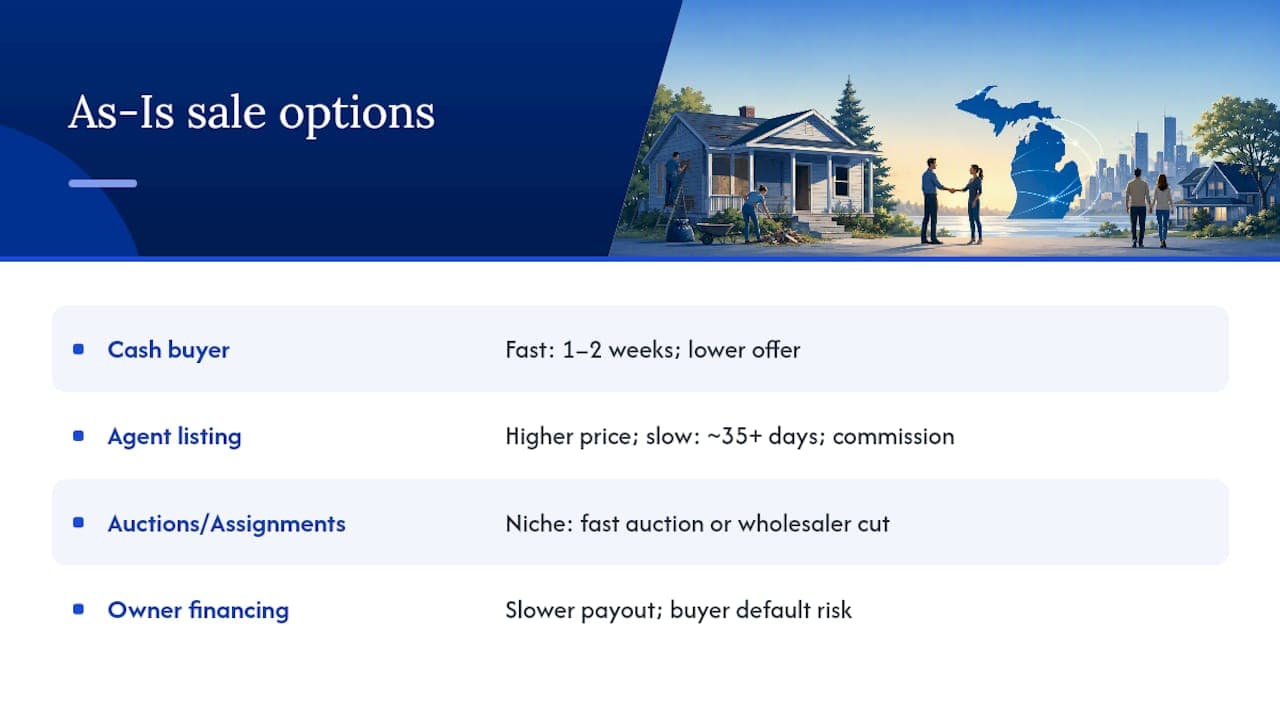
Selling to a cash buyer or investor is the fastest and most predictable option. These buyers purchase homes in whatever condition they’re in, don’t require financing contingencies, and typically close within about one to two weeks. Expect a lower offer than retail market value since the buyer is pricing in repair costs and their own profit margin, but you eliminate the risk of a deal falling through over inspection surprises or appraisal gaps.
Listing with an agent, marketed as-is, can bring in a higher final price, particularly if the home just needs cosmetic work rather than structural repairs. Agents market the property to a broader buyer pool, including owner-occupants who might pay closer to market value. The tradeoff is time (you’re looking at a conventional 35-day close at minimum, often longer with negotiation and repair credits) plus a standard commission that eats into your net proceeds.
Auctions and assignment contracts show up less often but serve niche situations. Auctions can move a distressed property fast when a seller wants a hard deadline and is willing to accept whatever the market bids. Assignment contracts, where a wholesaler markets your home to their investor buyer list, can work but add a middleman taking a cut of the deal.
Owner financing occasionally makes sense for sellers who don’t need all their cash immediately and want to widen the buyer pool to include people who can’t qualify for a traditional mortgage. It’s a slower path to full payout and carries its own risk if the buyer defaults.
The financing wildcard deserves its own mention. When a buyer plans to use a conventional or government-backed loan, the lender’s appraiser often flags condition issues, missing handrails, exposed wiring, a leaking roof, that can stall or kill the deal entirely. That’s a major reason as-is sellers gravitate toward cash buyers: no appraisal contingency means no last-minute derailment.
Pro Tip: Ask any potential buyer, cash or financed, how they plan to fund the purchase before you accept an offer. A “cash buyer” who’s actually planning to get a hard money loan at the last minute isn’t the certainty you think you’re getting.
Your Step-by-Step Checklist to Sell As-Is in Michigan
Selling as-is legally and efficiently comes down to sequencing. Do these in order and you’ll avoid most of the headaches that trip up first-time as-is sellers.
- Gather your paperwork first. Pull your mortgage payoff statement, deed, property tax records, appliance receipts, and any permits for past renovations. You’ll need these for disclosure accuracy and for the title company later.
- Complete the Michigan Seller Disclosure Statement. Fill it out honestly and completely, covering every item the form asks about, and deliver it before anyone signs a purchase agreement.
- Solicit and compare offers on a net basis. Don’t just compare sale price. Subtract estimated closing costs, commissions if any, and repair credits to see what actually lands in your pocket. If speed matters, gathering multiple cash offers at once gives you real leverage.
- Expect an inspection anyway. Even in as-is deals, most buyers still order an inspection, not to request repairs, but to confirm the condition matches what they’re paying for and to plan their own renovation budget.
- Run a title search and clear any liens. A title company checks for unpaid taxes, old mortgages, or contractor liens that could delay or derail closing. Handle this early so it doesn’t surprise you the week of closing.
- Set a realistic closing date and confirm the funds transfer process. Cash deals can close in a week or two; financed deals need more runway for underwriting.
| Step | Typical timing | Who’s involved |
|---|---|---|
| Gather documents | Day 1–3 | You |
| Deliver disclosure | Before agreement signed | You, buyer |
| Compare offers | Day 3–7 | You, buyers/agent |
| Inspection | Within days of accepted offer | Buyer, inspector |
| Title search | Concurrent with inspection | Title company |
| Closing | Day 7–14 (cash) or ~35 days (financed) | Title company, both parties |
If your property has specific complications, unpermitted work, mold, or other disclosure-heavy issues, address those honestly on the form rather than hoping they go unnoticed.
What Will You Actually Net After Closing Costs?
Selling as-is typically means accepting a discount off comparable move-in-ready homes. A ballpark range often cited by market guides is a noticeable discount below repaired comparable homes, with the wider end reserved for homes with major structural, mechanical, or safety issues. A house with foundation damage or a failed septic system can land closer to 20% or beyond.
Transfer taxes are one cost you can calculate exactly. Michigan charges a state transfer tax calculated per portion of the sale price, and most counties add a county transfer tax commonly calculated per portion of the sale price. Combined, that works out to a combined transfer tax amounting to just under one percent of the sale price, and these taxes are customarily paid by the seller in Michigan.
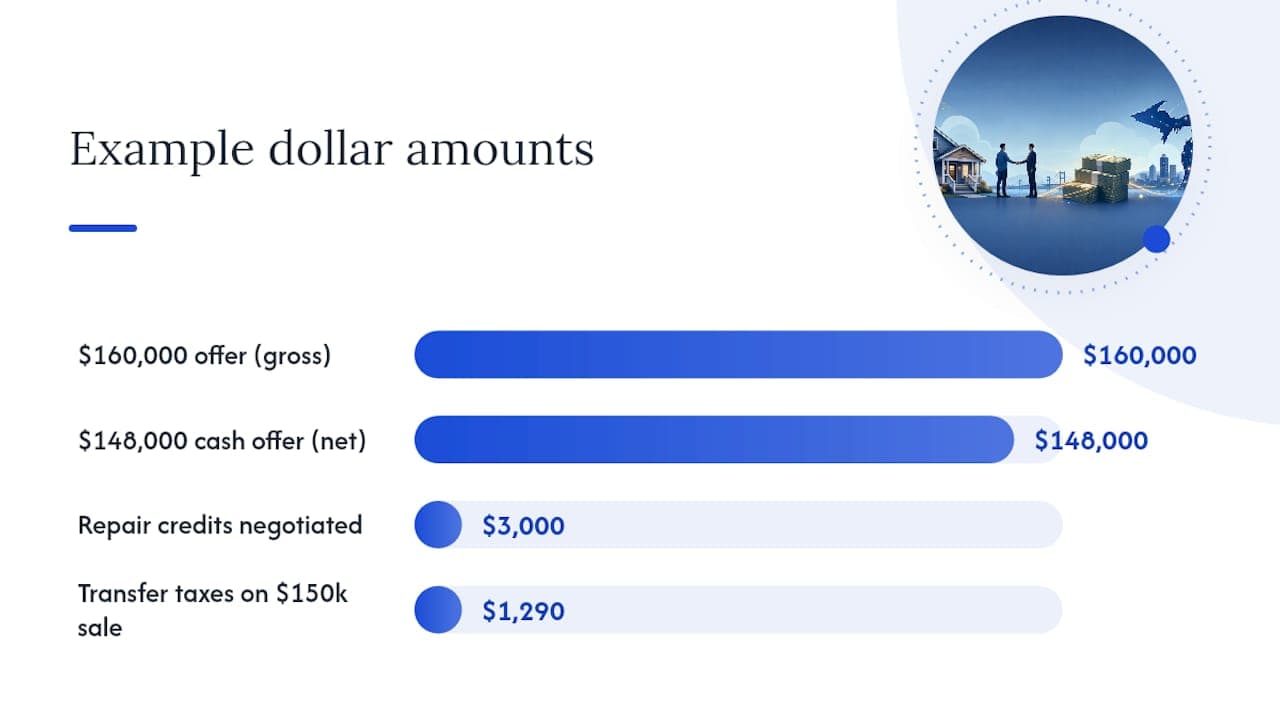
Quick math: on a $150,000 sale, transfer taxes alone run about $1,290. Add title insurance, prorated property taxes, and any outstanding liens, and your net proceeds can run several thousand dollars below the headline sale price.
Beyond transfer tax, budget for:
- Title insurance premiums, typically split by local custom or negotiated in the offer
- Prorated property taxes for the portion of the year you owned the home
- Outstanding liens that must clear before you can transfer clean title
- Agent commission, if you’re not selling directly to a cash buyer
Run the numbers on every offer using net-to-seller math, not headline price. A $160,000 offer with a 6% commission and $3,000 in negotiated repair credits can net less than a $148,000 cash offer with no commission and a 10-day close.
How I’d Weigh Your Options If This Were My House
If your house needs less than $5,000 in cosmetic work and you can wait 60 to 90 days, list it as-is with an agent and let the market pay you for the patience. If your situation involves a deadline, an inherited property nobody wants to manage, or repairs that would cost more than they’d return, a cash sale is the more rational choice even at a lower headline number.
The biggest mistake I see sellers make isn’t picking the wrong sale method. It’s treating the disclosure form as a formality instead of a legal document. Fill it out completely, keep dated notes about what you knew and when, and put a clear as-is addendum in your purchase agreement. That paper trail is what protects you if a buyer comes back six months later claiming you hid something.
For sellers who need speed without sacrificing the protection of a documented, transparent process, a marketplace model like Housegoodbye’s, where multiple vetted investors compete for your property, solves the two biggest pain points at once: it’s fast, and it still runs through proper title and disclosure channels.
— Bryan
Get Multiple Cash Offers Without Lifting a Hammer
Housegoodbye is the alternative to the single-lowball-offer experience most as-is sellers dread. Instead of negotiating with one investor who knows you’re in a hurry, you get multiple vetted local buyers competing for your property, no repairs, no staging, no agent commission, and a potential close in as little as 7 days.

This model works especially well if you’ve inherited a property you don’t want to manage from out of state, you’re racing a relocation deadline, or the house has damage significant enough that a traditional listing would sit unsold while buyers request repair credits you can’t afford to give. Before you start, have your mortgage payoff amount, a rough idea of any liens, and access to the property for a quick walkthrough ready to go. From there, comparing real cash offers takes a few days, not a few months. If you’re anywhere from Sterling Heights to Farmington Hills, start your as-is sale and see what competing offers actually look like for your property.
Sources
- As Is Clauses: The law behind ‘as is’ clauses — Michigan Bar Journal
- MCL §565.957 — Michigan Legislature (Seller’s Disclosure)
- ILRG — Michigan real estate purchase forms and timelines
For complications like disputed liens, tenant occupied properties, or unclear title history, loop in a Michigan real estate attorney or a title company early rather than after you’ve accepted an offer.
FAQ
Can You Sell a House As-Is in Michigan?
Yes. Michigan law permits as-is sales, but you must still deliver a completed Seller Disclosure Statement before or at the time of signing a purchase agreement under MCL 565.951–565.966)/documents/mcl/pdf/mcl-Act-92-of-1993.pdf).
Is It Better to Sell Your Home As-Is or Fix It Up First?
It depends on your timeline and the scope of repairs needed. Minor, inexpensive fixes often pay for themselves in a higher sale price, while major structural or mechanical issues frequently cost more to repair than they’d add to your final price, making an as-is sale to a cash buyer the more practical choice.
How Can Michigan Sellers Reduce Capital Gains Tax When Selling a House?
Most homeowners who lived in the property as their primary residence for at least two of the last five years qualify for a federal capital gains exclusion of up to $250,000 for single filers or $500,000 for married couples filing jointly; consult a tax professional to confirm your specific situation, since exclusion rules and state tax treatment can vary by circumstance.
Is It Worth It to Sell a Home As-Is?
It’s worth it when speed, certainty, or avoiding repair costs matters more than squeezing out the last few percentage points of sale price. Selling as-is through a platform like Housegoodbye, where multiple cash buyers compete for your property, can offset some of the typical as-is discount by creating competitive bidding instead of a single take-it-or-leave-it offer.
How Fast Can an As-Is Sale Actually Close in Michigan?
Cash-buyer sales commonly close in about one to two weeks, compared to roughly 35 days for a conventional financed sale, mainly because cash deals skip mortgage underwriting and appraisal contingencies.