
If your buyer keeps pushing back the closing date, you have four moves: demand specifics in writing, grant a short extension with firm terms, enforce the contract’s remedies, or line up another buyer. The right one depends on why the delay is happening and what your contract says. Michigan sellers should also talk to a real estate attorney before ending a deal over a missed date, because Michigan courts have not enforced closing deadlines consistently.
TL;DR
- Ask for the exact reason and paperwork the same day. “We need more time” is not an answer you can plan around.
- Never rely on a text or a verbal “a few more days is fine.” Any extension should be a signed written amendment with a new date.
- Your contract decides your leverage. Look for a “time is of the essence” clause, a termination right, and the earnest money terms.
- Before you end a Michigan deal, talk to a real estate attorney. Courts here have not always held parties to closing deadlines.
- If the delays keep coming, a cash sale with no lender can close in about a week. That is one way out of a stalled deal.
Table of Contents
- Why buyers delay closing
- Delay or stall: how to tell the difference
- What to do in the first 48 hours
- Do you have to agree to an extension?
- Put every extension in writing
- What “time is of the essence” means in Michigan
- If the closing date passes
- The real cost of waiting
- Why financed deals stall and cash deals do not
- Our perspective
- Get competing cash offers while you decide
- FAQ
- Sources
Why buyers delay closing
Most delays are not a buyer’s attempt to string you along. They come from a short list of causes, and knowing which one you face tells you how worried to be.
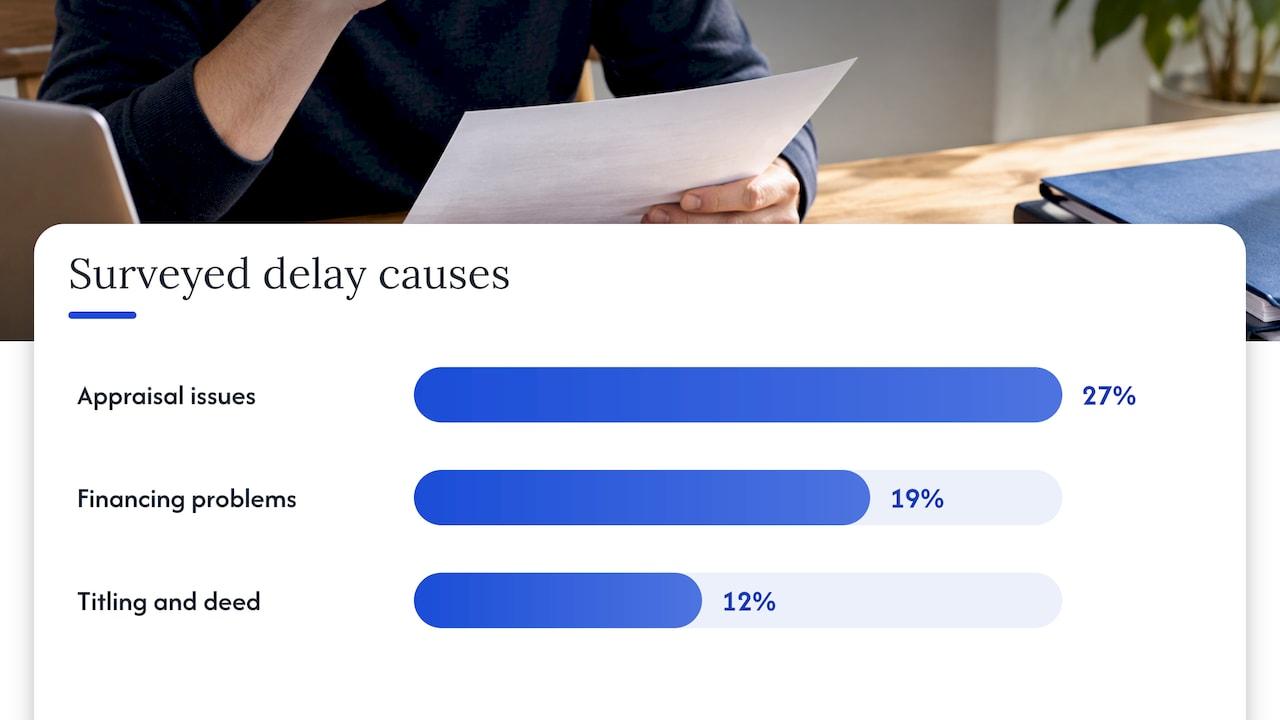
Financing and underwriting. The lender has not finished the file, or a condition is still open. A real estate professionals survey from July 2021 attributed 27% of delayed closings to appraisal issues and 19% to financing problems. That is nearly half combined, in that survey.
Changes in the buyer’s finances. Chase notes that a closing can stall when the credit report shows new debt that was not on the application, when the loan offer expires, or when fees change significantly from the original estimate. A buyer who finances a car or furniture mid-process can derail their own approval.
A low appraisal. If the appraised value comes in under the price, the buyer needs more cash, a lower price, or a different loan. All of that takes time.
Title problems. Marine CU lists unresolved liens and ownership disputes among the causes that can push closing back by days or weeks. The same survey put titling and deed issues at 12% of delays.
A home sale contingency. The buyer cannot close until their own house sells. That puts your timeline in the hands of a stranger’s transaction.
Document and scheduling problems. Catalyst Legal lists missing signatures, late disclosure or payoff documents, repair disputes, and scheduling trouble at the closing office.
A chain of closings. One late closing can ripple through the others. One mortgage research article explains that a chain can link three or four transactions, so a single delay affects every deal in it, including your own purchase.
The cause matters beyond curiosity. Catalyst Legal points out that it can affect both the solution and who is responsible, and that these examples do not settle fault on their own.
Delay or stall: how to tell the difference
A real delay has a named problem, a person working on it, and a believable date. A stall has none of those. Compare what you are hearing:
| What you hear | What it usually means | Your next step |
|---|---|---|
| “The underwriter has one more condition.” | A real, fixable financing delay | Ask for the lender’s written status and a target date |
| “The appraisal came in low.” | A renegotiation is coming | Decide your floor price before the call |
| “We’re waiting on our house to sell.” | A contingency problem outside your control | Check your contingency deadline and termination rights |
| “We just need a few more days.” (no reason) | Unknown, possibly a stall | Ask for documentation the same day |
| Silence, missed calls, no lender contact | Possible default or a buyer who cannot close | Review default terms and call an attorney |
The most useful signal is whether the buyer can produce paperwork. A buyer who cannot show a lender letter or title update is telling you something about how close the deal really is.
What to do in the first 48 hours
- Reread your purchase agreement and every addendum. Find the closing-date clause, any extension language, notice requirements, contingency deadlines, and the default and termination provisions. Also check whether an earlier amendment has already moved the date. Catalyst Legal recommends this review as the first step.
- Ask for the reason and a realistic timeline. Get specifics: what is outstanding, who is handling it, and what date the lender or title company considers realistic.
- Keep everything in writing. Follow up phone calls with an email summarizing what was said. If you have an agent, loop them in. If you are selling without one, keep your own log of dates and names.
- Price out the delay. Another mortgage payment, taxes, insurance, utilities, lawn care, movers on hold, and possibly a rate lock on your next home. Put a dollar figure on each week.
- Confirm your own timeline. If you have a purchase closing on the other end, tell your lender and title company now.
Do you have to agree to an extension?
Usually, no. A seller generally does not have to allow more time unless the contract or state law requires it. Catalyst Legal says that a party generally cannot force the other side to accept an extension just because the delay seems reasonable. It also warns that refusing can carry consequences if the contract sets out a remedy, a notice period, or a termination right.
That is why a request for more time is a negotiation, not a favor. You can say yes, say yes with conditions, or say no. Common conditions include:
- A short, fixed extension. Days, not an open-ended “until the lender is ready.”
- A per diem. The buyer pays a daily amount covering your carrying costs from the first day of the extension.
- Additional earnest money. The buyer shows commitment by adding to the deposit, which becomes yours if they fail to close.
- A hard end date. If the buyer misses the new date, you are free to terminate.
- Proof up front. A lender letter, a clear-to-close status, or a title update before you sign.
One agent blog describes a common structure of a two-week extension with a per diem starting on day one and a firm termination date at the end. Treat it as an example of how deals are structured, not a standard. Terms vary by contract and by market.
Put every extension in writing
A text that says “a few more days is fine” can cause trouble later. Catalyst Legal advises that a written extension should name the revised closing date and say whether any other dates or terms are changing. You may also need to address:
- possession and occupancy after the original date
- repairs you agreed to make
- rate-lock costs and per-diem charges
- earnest money treatment
- whether time is of the essence for the new date
Both parties sign the amendment. Do not let the closing slide through unsigned “understandings.”
What “time is of the essence” means in Michigan
If your contract says time is of the essence for closing, the date is a strict deadline. If it does not, many courts treat the date as a target and expect closing within a reasonable time afterward, according to one agent-education article. Some state contract forms also include a built-in grace period before you can treat the missed date as a default.
Michigan has its own wrinkle. In Grade v. Loafman (Mich. 1946), the Michigan Supreme Court held that time was of the essence even though the agreement did not say so. The court looked at the agreement’s terms and the extension agreement. It treated a new agreement extending the time of performance as evidence that the parties considered time material. In practice, a signed extension with a firm date can strengthen your hand.
The practical limit comes from Michigan REALTORS. Its June 2026 legal column states that Michigan courts have not consistently enforced time deadlines in purchase agreements. It advises sellers who want to terminate over a buyer’s inability to close on time to talk to an attorney first. That is especially true if they plan to hold out for a better price.
If the closing date passes
When the date passes, the buyer may be in breach. Under a typical contract, your options generally include keeping the earnest money, asking a court to force the sale (specific performance), or suing for damages. Those three paths are laid out in a real estate law firm’s guide to termination dates.
Two points help you weigh them.
- Most sellers keep the deposit. A Dayton law firm notes that sellers choose retaining the deposit in the vast majority of cases. Specific performance means an expensive, drawn-out, uncertain lawsuit that ties up the property the whole time. The same firm advises talking to an experienced real estate attorney before declaring the buyer in breach.
- You cannot collect twice. An exam-prep reference explains that a seller cannot keep liquidated damages and also sue for actual damages. Check which remedy your contract makes exclusive.
If the buyer has gone silent, do not simply relist the house. Rules vary by state and by contract form. In North Carolina, for example, the state REALTORS association advises accepting only backup offers unless counsel says otherwise. That is one state’s guidance, but it shows why a call to your attorney comes before any move. In Michigan, that call should come before you sign with anyone else.
The real cost of waiting
Every week of delay costs money, and the bill is easy to underestimate. Add up your mortgage payment, property taxes, insurance, utilities, yard care, and the cost of keeping the house show-ready. Add storage or movers you booked, and any purchase on your side with a date you cannot miss.
If you are selling an inherited house, delays can be especially costly because the property is empty and still has to be cleared. Planning an estate cleanout in 10 to 14 days can keep your own side of the timeline from becoming the next bottleneck.
If you owe on a mortgage that is already behind, each month of delay can make your options narrower. Our guide on avoiding a shortfall at closing explains how payoffs work in a cash sale. If foreclosure is on the calendar, see how a cash sale compares with foreclosure.
Why financed deals stall and cash deals do not
Most of the causes above run through a lender: underwriting conditions, appraisals, rate locks, new debt. A cash buyer skips those steps. What remains is title work and signing, which is why we explain why cash sales close faster and what the cash closing process involves. A title company still has to confirm the property can transfer cleanly, as described in our piece on the role of a title company in a fast sale.
A seller with a deadline, such as a new job or a foreclosure date, does not have to wait for a buyer’s lender. Our seller playbook for closing in 7 to 10 days walks through the steps. If a job start date is the pressure, see how to coordinate your home sale with a job start date.
Our perspective
We see this situation from the seller’s side of the table. A buyer’s delay is rarely just a scheduling problem. It is a seller carrying a mortgage payment, a moving truck, and sometimes a foreclosure notice while someone else’s lender takes another week.
Our view is that sellers should not have to bet their timeline on one buyer’s financing. That is why HouseGoodbye is built as a marketplace. Several vetted local cash buyers bid on the same house, you see every offer, and you can walk away if none work. The offers are as-is, so there are no repairs, no showings, and no commissions.
If you have a contract that is stalling, handle it properly: get specifics, get any extension in writing, and talk to an attorney before ending the deal. If you decide you want a different path, we are here, and a typical close is about a week.
Bryan
Get competing cash offers while you decide
If your current deal keeps slipping, you can see what other buyers would pay without committing to anything. At HouseGoodbye, you enter your address and multiple vetted local cash buyers compete with as-is offers. There is no listing fee, no agent commission, and no required repairs. We buy houses in any condition across Metro Detroit, Grand Rapids, Flint, Lansing, and the rest of Michigan.

See how it works on our competing cash offers page, or start at the page for selling a house fast for cash. If you are under contract, ask your attorney how to approach it so you do not create a conflict with your current buyer.
FAQ
What happens if the buyer misses the closing date?
It depends on your contract. If time is of the essence, the date is a strict deadline and you may be able to terminate or pursue remedies. If not, closing is usually expected within a reasonable time. Michigan courts have not consistently enforced deadlines, so talk to an attorney before you terminate.
Can I refuse to extend the closing date?
Usually, yes. A seller generally does not have to grant more time unless the contract or state law requires it. Check your contract for notice periods, remedies, and termination rights, because refusing can have consequences if the contract provides for them.
Do I keep the earnest money if the buyer never closes?
Often, but it depends on the contract. The most common remedy in residential deals is liquidated damages, where the seller keeps the buyer’s deposit. You generally cannot keep the deposit and also sue for actual damages. Ask an attorney how your contract treats the deposit.
How long should I let a buyer delay?
Long enough to get a documented reason and a believable date, not longer. Give a short extension with a per diem and a hard end date, and put it in a signed amendment. If the buyer cannot produce paperwork, start planning for another route.
Sources
- Delayed Closings: How to Handle and How to Keep Your Closing on Track (Paymints)
- 5 Common Reasons Why Buying a House Takes so Long (Chase)
- What causes delays with closing? (Marine CU)
- The Closing Date Passed: What to Do When a Real Estate Closing Is Delayed (Catalyst Legal)
- Reasons Home Closings Get Delayed (Mortgage Research)
- Your Buyer Wants to Extend Closing: Options
- Why Closings Get Delayed and Who Pays for It
- Grade v. Loafman, 22 N.W.2d 746 (Mich. 1946)
- Closing Responsibilities, FTMB (Michigan REALTORS)
- Maximum termination date in a real estate purchase agreement (Golm Law)
- Seller’s Legal Options When a Buyer No-Shows or Refuses to Close
- What Happens When a Buyer Breaches? (LicensePrep)
- Can I make my listing active when it’s still under contract (NC REALTORS)
- Estate cleanout in 10 to 14 days