If your job relocation gives you less than a month to sell, cash offers are usually the fastest reliable way to close. Cash buyers routinely finish deals in as little as seven days, compared to 30 to 60-plus days for a financed sale, and platforms like Housegoodbye let you collect several competing bids instead of settling for the first number an investor throws out. The trade-off is price: you’ll typically net less than full market value in exchange for speed and certainty. Before you sign anything, take these steps:
- Request proof of funds from any buyer before you let them walk through the house.
- Get multiple offers through a service like Housegoodbye rather than negotiating with one investor alone.
- Order a title search now, even if closing feels weeks away.
Key Takeaways
Cash offers close faster than financed sales because they skip loan underwriting entirely, but sellers who verify proof of funds and earnest money terms protect themselves from the deals most likely to fall apart.
| Point | Details |
|---|---|
| Speed comes from skipping financing | Cash sales can close in as little as seven days versus 30 to 60-plus for a financed buyer. |
| Certainty beats top dollar for relocations | Sellers on a deadline typically value a guaranteed close date over maximizing sale price. |
| Verify before you sign | Demand proof of funds and a real escrowed earnest money deposit, not a token amount. |
| Watch contract red flags | Assignment clauses and long inspection windows let buyers walk away with little cost to them. |
| Compare multiple bids | Housegoodbye’s multi-offer model lets Michigan sellers pit competing cash bids against each other instead of accepting one investor’s first number. |
Table of Contents
- How Job Relocation Affects Mortgage Approval and Your Sale Timeline
- What to Check Before You Sign With Any Cash Buyer
- How Housegoodbye’s Multi-Offer Process Works for Relocating Sellers
- Turn One Offer Into Several Before You Commit
- Sources
- FAQ
How Job Relocation Affects Mortgage Approval and Your Sale Timeline
The phrase “how job relocation affects mortgage approval” usually points people toward lender underwriting questions. But if you’re the one selling because of a transfer, your real problem is different: you have a fixed start date in another city and a mortgage balance that needs to be paid off before or at closing. Relocation doesn’t change what a buyer’s lender requires of them. It changes how much runway you have to find a buyer, clear your loan, and release the lien before you’re due at a new desk 800 miles away.
That distinction matters for how you shop your options. A financed buyer’s approval timeline, appraisal contingency, and loan underwriting all sit outside your control and can add four to eight weeks you may not have. A cash buyer skips that chain entirely, which is why relocating sellers tend to value closing certainty over squeezing out the last dollar of equity. Your mortgage payoff and lien release happen at your closing table, coordinated by title and escrow, not by anyone else’s loan officer.
Which fast-sale route fits your deadline?
Not every “we buy houses fast” option is the same animal. Here’s how the main categories break down.
A few patterns hold across most relocations:
- Under 7 days: only a vetted cash buyer or a multi-offer platform realistically closes this fast, and even then you need funds verified upfront.
- 14 to 30 days: cash options still work best, but you also have room to weigh a couple of competing bids and negotiate terms instead of grabbing the first offer.
- 30+ days: an agent-assisted sale becomes viable if your equity position rewards holding out for a financed buyer, though you’re betting on that buyer’s loan actually closing.
If your mortgage payoff is close to your equity, a short sale process eats weeks you probably don’t have. If your job start date is firm, that timeline mismatch alone should rule it out.
What to Check Before You Sign With Any Cash Buyer
Speed doesn’t mean skipping diligence. Reporting on the cash-buyer industry has documented contracts with earnest money deposits as low as $100 on a $157,000 deal, a number so small it costs a buyer nothing to walk away weeks before your move. Here’s the order to work through:
- Get proof of funds in writing before you agree to anything beyond a walkthrough. A legitimate investor can produce a bank statement or letter within a day.
- Insist on a real earnest money deposit held in escrow. Industry guidance suggests 1% of the sale price or more as a reasonable floor; anything under that gives a buyer little reason to follow through.
- Read the contract for assignment clauses. These let a buyer sell your contract to someone else before closing, often the sign of a wholesaler rather than an actual buyer.
- Watch inspection and exit windows. A 30-day escape clause defeats the purpose of a fast sale and leaves you exposed right up against your relocation date.
- Hire a real estate attorney for contract review, even on a fast deal. Sellers still carry disclosure obligations for known defects, and a one-time attorney fee is cheap insurance against a bad clause.
- Order an independent title search now. Liens or title defects surface faster than you’d expect, and clearing them early keeps your closing date from sliding.
Pro Tip: Don’t sign a contract at the kitchen table the same day a buyer shows up. Reporting on cash-buyer practices has flagged on-the-spot contract pressure as a common tactic. Take 24 hours, even during a tight timeline, to have your attorney glance at the terms.
For a fuller rundown of contract pitfalls tied to a tight window, this guide on mistakes that delay a home sale after a sudden life change covers similar red flags worth knowing before you sign.
How Housegoodbye’s Multi-Offer Process Works for Relocating Sellers
A single investor has no incentive to bid you up. That’s the core problem Housegoodbye’s model solves: instead of negotiating alone against one buyer’s number, you submit your property once and receive competing, obligation-free bids from vetted local investors across Michigan.
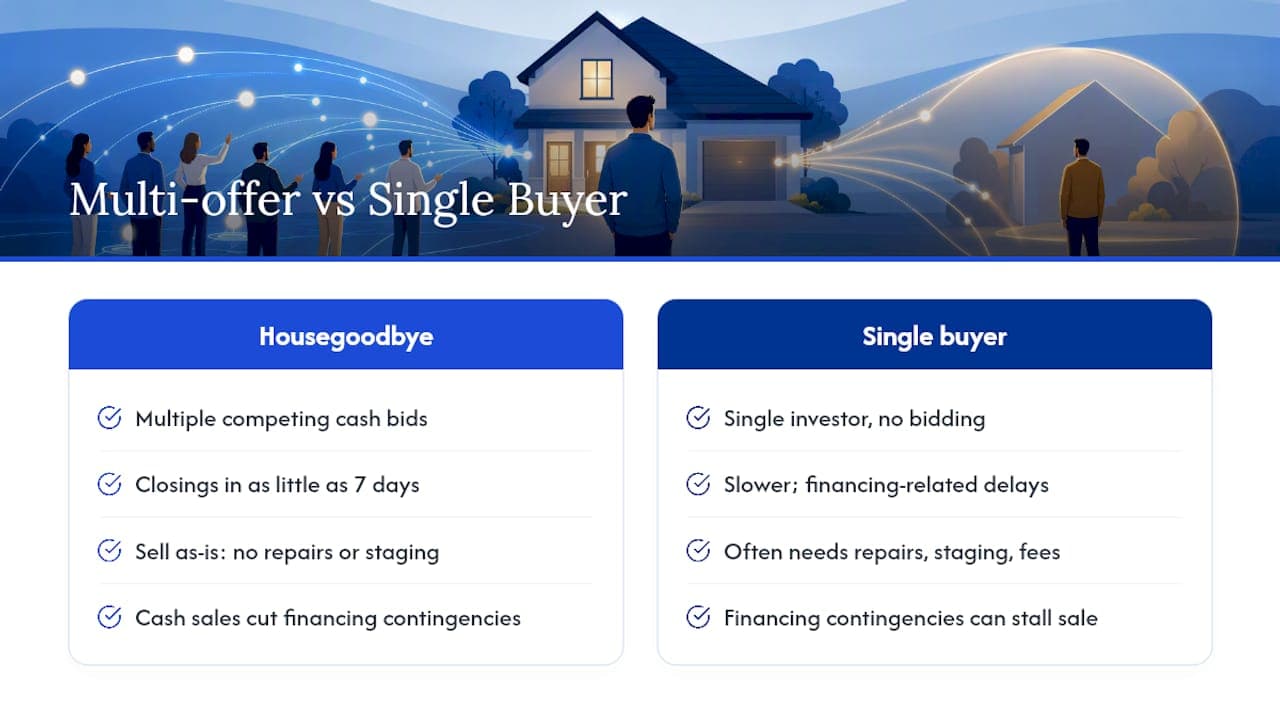
The process is built for exactly the deadline pressure a job transfer creates. You get bids quickly, closings can happen in as little as seven days, and every sale runs as-is, meaning no repairs, cleaning, staging, or agent commissions eating into what you walk away with. Cash sales generally cut out financing contingencies that stall or kill traditional deals, which matters when your start date isn’t moving.

Expect the same seller protections outlined above to still apply here: request proof of funds from whichever investor’s bid you accept, confirm escrow handling of earnest money, and have an attorney glance over the final contract even though the process moves fast. Housegoodbye’s guide on coordinating a home sale with a job start date walks through how sellers typically sequence offers, inspections, and moving logistics against a hard relocation deadline.
If you’re weighing this against a slower financed sale, a bridge loan is worth a look if you need to buy in your new city before your current home sells; it’s a different tool for a different piece of the timeline puzzle. Ready to see what your property is actually worth to competing buyers? Compare real cash offers on your Michigan home and start the clock on your own terms.
What I’d do with 30 days to relocate
I’d stop chasing the highest possible number and start chasing certainty. Run proof of funds and a title search in the same week, before you’ve even picked a buyer. Get a real estate attorney to glance at the contract for under a few hundred dollars, not because you expect trouble, but because it’s cheap compared to a deal collapsing in week three. And if your timeline has any slack at all, use two or three competing offers against each other. That’s the one lever left once speed is locked in.
Turn One Offer Into Several Before You Commit
Housegoodbye exists because a single cash offer almost never reflects what your home is actually worth to the local investor market. When you’re racing a job start date, that gap costs you real money if you accept the first number that lands in your inbox. Housegoodbye puts your property in front of multiple vetted Michigan investors at once, so their bids compete against each other instead of you negotiating alone against one buyer’s opening offer.

Every bid comes obligation-free, closings can happen in as little as seven days, and you sell as-is with no agent commissions cutting into your proceeds. If your relocation deadline is already circled on the calendar, see what your house is worth to competing cash buyers and get your first round of offers moving this week.
Sources
- Legal Considerations When Selling Residential Property To Cash Investors. - Conventus Law
- Want to Sell Your Home for Cash? Read This First — ProPublica
- Beyond the traditional sale: The benefits of cash offers for relocating sellers - AZ Big Media
FAQ
How fast can a cash sale actually close?
Cash buyers commonly close in as little as seven days since there’s no loan underwriting or appraisal to wait on.
How much less will I get selling to a cash buyer?
Expect a discount below full market value in exchange for speed and no repairs; getting multiple competing bids through a platform like Housegoodbye narrows that gap compared to negotiating with a single investor.
What earnest money amount should I require?
Industry guidance points to 1% of the sale price or more, held in escrow, since deposits as small as $100 have let buyers walk away from deals with little downside.
Do I still need a real estate attorney for a cash sale?
Yes. Sellers retain disclosure obligations for known defects regardless of how fast the deal moves, and a brief attorney review before signing catches problem clauses early.
What’s the biggest red flag in a fast-sale contract?
Assignment clauses that let the buyer sell your contract to someone else, paired with a tiny earnest money deposit, are the clearest sign a buyer has little intention of following through.