“Foreclosure sold as-is” means you sell your home in its current condition, the buyer accepts all repairs, and you walk away without fixing anything — but you still must disclose known defects under your state’s law. If you’re in pre-foreclosure right now, the single most important thing you can do is sell before the auction date. Waiting costs you equity, credit, and options.
Here’s what that looks like in practice:
- As-is sale: The buyer takes the property with all its flaws. You make no repairs and offer no credits. Selling as-is removes repair costs but typically lowers your sale price.
- Disclosure still required: State law in most U.S. jurisdictions requires you to disclose known defects regardless of an as-is clause.
- Pre-foreclosure window: Between your notice of default and the auction, you still hold title and can sell. Once the auction happens, that window closes.
- Fast cash option: Housegoodbye connects distressed homeowners with multiple competing cash offers, with closings in as little as seven days — no repairs, no agent fees.
Table of Contents
- What does “sold as-is” actually mean for your legal duties?
- How selling as-is affects your price and foreclosure outcome
- What are your realistic sale options in pre-foreclosure?
- How do you evaluate buyers and avoid traps?
- What happens step by step from offer to closing?
- When is selling as-is actually the wrong move?
- Key Takeaways
- A frank take on fast-cash as-is sales
- Housegoodbye: multiple cash offers, no repairs, fast close
- Useful sources
- FAQ
What does “sold as-is” actually mean for your legal duties?
Selling a property as-is means you are not obligated to make repairs or offer credits for defects the buyer discovers. The buyer accepts the property in its current condition and prices their offer accordingly. What it does NOT mean is that you can hide what you know.
“As-is” shifts repair responsibility and risk to the buyer — but it does not erase the seller’s duty to disclose known defects under state law. Concealing a known problem can expose you to fraud claims even after closing.
State disclosure obligations survive an as-is clause in virtually every U.S. jurisdiction. If you know the roof leaks, the foundation has cracks, or there’s mold, you must disclose it. What you’re not required to do is fix it. The buyer can inspect, walk away, or negotiate — but they can’t sue you later for something you disclosed.
Cash buyers and investors typically waive traditional contingencies but still conduct inspections to confirm they’re comfortable with the agreed price. That’s different from a financed buyer, whose lender may require repairs before approving the loan.
Pro Tip: Get a real estate attorney to review your state’s specific disclosure form before signing anything. A one-hour consultation costs far less than a post-closing fraud claim.
How selling as-is affects your price and foreclosure outcome
The financial reality is blunt: as-is buyers discount their offers to cover repair costs, title risk, and the uncertainty of what they can’t see. Investors treat the discount as an unknowns allowance — they build an unknown repair reserve into every offer that grows larger when utilities are off, the property is occupied, or the title has clouds.

Financed buyers face an additional hurdle. FHA and VA loans both require appraisals confirming minimum property standards. If your home doesn’t meet those standards, financed buyers can’t close without repairs — which is exactly why cash buyers dominate as-is foreclosure sales.
The timeline comparison matters enormously:
| Stage | Who controls title | Typical outcome for seller |
|---|---|---|
| Pre-foreclosure | You | Can sell, pay off mortgage, preserve equity |
| Auction | Court/lender | You lose title; equity often wiped out |
| REO (post-auction) | Lender | Lender sells below market value; you get nothing |
Selling before the auction is the clearest path to preserving whatever equity remains. If the property reaches REO status, the lender prices it to move fast and recover the debt — not to maximize your proceeds.
What are your realistic sale options in pre-foreclosure?
Four paths exist, and each suits a different situation:
- Traditional as-is sale on the MLS. Listed publicly, open to all buyers. Slower (30–90 days typically), but reaches the widest buyer pool. Works best when you have time and some equity cushion.
- Short sale. You sell for less than the mortgage balance with lender approval. Avoids foreclosure on your record but requires lender cooperation and can take months. Useful when you’re underwater.
- Deed-in-lieu of foreclosure. You hand the deed directly to the lender. Faster than foreclosure, but the lender must agree, and you may still face a deficiency judgment depending on your state.
- Fast cash sale to investors. Closes in days, not months. No repairs, no agent commissions, no financing contingencies. The trade-off is a lower sale price than a fully marketed listing — but if the auction is two weeks away, speed beats price.
| Option | Typical timeline | Foreclosure stopped? | Price vs. market |
|---|---|---|---|
| Traditional as-is MLS | a few weeks to a few months | Yes, if closed in time | Closest to market |
| Short sale | several weeks to months | Yes, with lender approval | Below market |
| Deed-in-lieu | a few weeks to a couple months | Yes | No proceeds |
| Cash sale to investors | within a few weeks | Yes | Discounted |
How do you evaluate buyers and avoid traps?
Not every cash offer is a good offer, and not every buyer who says “fast close” can actually deliver. Before you sign anything, work through this checklist:
- Verify proof of funds in writing — a bank letter or escrow confirmation, not a verbal promise.
- Confirm the exact closing date and whether it can be moved if title issues arise.
- Ask who pays closing costs. Some buyers shift costs back to the seller in the fine print.
- Check how the buyer handles existing liens or occupants. Unresolved liens can delay or kill a closing.
- Get everything in writing before you vacate or make any agreements about possession.
Questions worth asking directly:
- Will you pay cash, and can you show proof of funds today?
- Can you close before my auction date of [specific date]?
- Do you require any repairs or inspection contingencies?
- How do you handle title issues or existing liens?
- What happens if closing is delayed — is there a penalty or extension clause?
Red flags: vague closing timelines, pressure to sign before you’ve reviewed terms, refusal to use a licensed escrow or title company, and any buyer who won’t put the offer in writing.
Pro Tip: Always use as-is sale negotiation tactics to compare at least two offers side by side — even a small difference in net proceeds can matter when you’re paying off a mortgage.
What happens step by step from offer to closing?
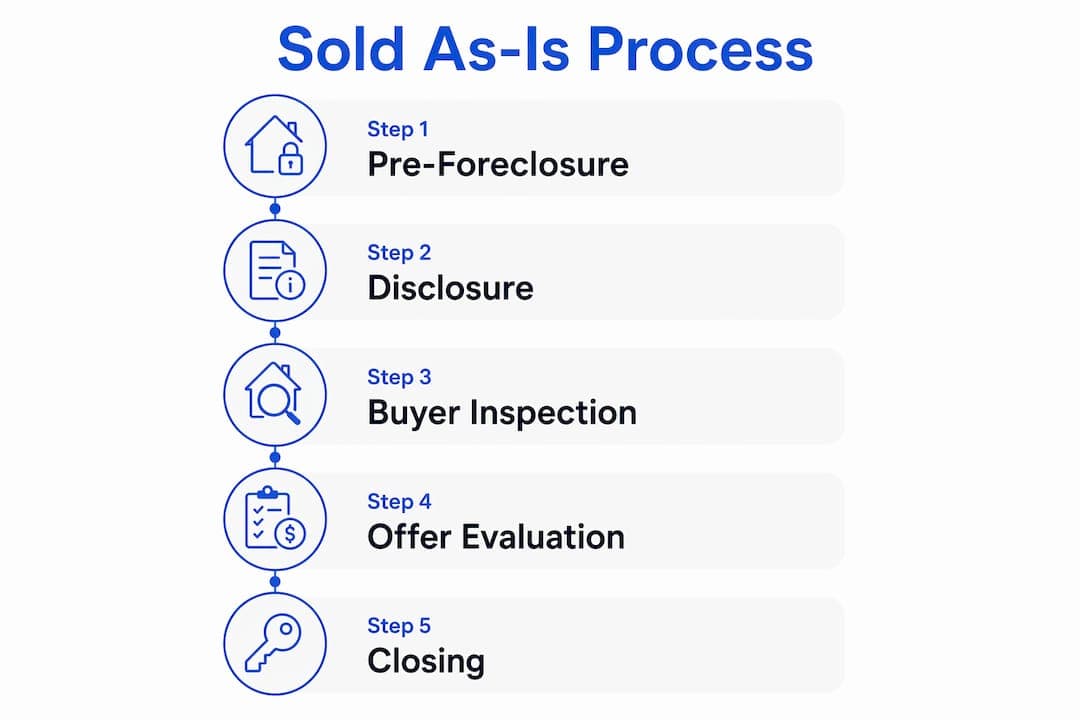
Here’s the sequence for a pre-foreclosure as-is sale, with rough time windows:
- Verify your auction date (Day 1). Pull your notice of default or notice of sale. This is your hard deadline.
- Gather documents (Days 1–2). Mortgage payoff statement, title report, any lien notices, and your disclosure forms.
- Request and compare offers (Days 2–5). Get at least two written offers with proof of funds. Review net proceeds after payoff and closing costs.
- Sign the purchase agreement (Day 5–7). Have an attorney review before signing. Confirm the closing date is before the auction.
- Open escrow and order title search (Days 7–10). The title company identifies liens, judgments, or clouds that need resolution.
- Lender payoff coordination (Days 10–14). Your lender receives the payoff amount at closing. Confirm the figure is current — payoff amounts change daily with accruing interest.
- Close and vacate (Day 14–21). Funds disburse, mortgage is paid off, and you receive any remaining proceeds. Clarify your move-out date in the purchase agreement to avoid post-closing disputes.
Critical dates to track: notice of default date, scheduled auction date, and any statutory redemption period your state allows after a sale. Some states give former owners a window to reclaim the property after auction — knowing whether yours does affects your strategy.
When is selling as-is actually the wrong move?
As-is isn’t always the right answer. Three situations where it likely costs you more than it saves:
- You have substantial equity and the repairs are manageable. If a $15,000 kitchen fix adds $40,000 to your sale price, selling as-is leaves $25,000 on the table. Run the numbers before deciding.
- Title or lien problems are unresolved. An as-is sale with a clouded title often falls apart in escrow. Clearing the lien first — even if it takes a few weeks — can make the difference between a closed deal and a failed one.
- Your lender will accept a short sale. If you’re underwater, a negotiated short sale can eliminate a deficiency judgment that would follow you for years.
Before committing to an as-is sale, ask yourself: if I spent 30 days and a defined repair budget, would the net proceeds after repairs exceed what I’d net selling as-is today? If the answer is yes and you have the time, repairs may be worth it.
The pros and cons of selling as-is depend entirely on your equity position, timeline, and the gap between your current offers and what a repaired home would fetch.
Key Takeaways
Selling a foreclosure property as-is stops the auction clock but requires full legal disclosure and a realistic read on what buyers will actually pay.
| Point | Details |
|---|---|
| As-is shifts repair risk, not disclosure duty | You must disclose known defects under state law even in an as-is sale. |
| Pre-auction window is critical | Selling before the auction preserves equity; post-auction REO sales benefit the lender, not you. |
| Cash buyers close fastest | Financed buyers face appraisal and repair hurdles; cash buyers can close quickly in a short timeframe. |
| Investor offers include a discount buffer | Buyers price for unknown repairs, title risk, and occupancy — expect offers below market value. |
| Housegoodbye option | Housegoodbye generates multiple competing cash offers, closing in as little as seven days with no repairs or agent fees. |
A frank take on fast-cash as-is sales
The conventional wisdom says “avoid selling as-is if you can.” That’s true in a normal market. In a foreclosure situation, it misses the point entirely.
Speed is the asset. When the auction is 21 days away, the question isn’t whether you’ll get full market value — you won’t, regardless of how you sell. The question is whether you walk away with something or nothing. A discounted cash offer that closes before the auction beats a foreclosure that wipes your equity and stays on your credit report for seven years.
What people underestimate is the compounding cost of delay. Every week you spend trying to find a higher offer is a week of accruing interest, legal fees, and auction risk. The “better offer” that takes 60 days to materialize may net you less than a lower offer that closes in 10 — once you account for the additional mortgage payments, carrying costs, and the real possibility the auction happens first.
Housegoodbye’s model addresses this directly. Multiple competing offers mean you’re not stuck accepting the first lowball that comes in. The bidding process creates real competition, which tends to push offers higher than a single-investor approach. That’s not a guarantee of full market value — it’s a realistic way to get a better cash price than you’d get from one buyer with no competition.
The fairness note: fast sales do trade some price for speed and certainty. Anyone who tells you otherwise isn’t being straight with you.
Housegoodbye: multiple cash offers, no repairs, fast close
When the auction date is close and repairs aren’t an option, the math on a traditional listing rarely works. Housegoodbye is built for exactly this situation: you submit your property details, competing investors bid, and you pick the offer that works for your timeline and payoff needs.

No agent commissions, no repair requirements, and no waiting on financing approvals. Closings happen in as little as seven days. To request offers, have your mortgage payoff statement, any lien or notice documents, and basic property details ready. The process is transparent: you see multiple offers, verify proof of funds, and choose. If none of the offers work, you’re not obligated to accept.
Sell your home as-is through Housegoodbye and get competing cash offers without the repair costs or agent fees that eat into your proceeds. Or learn how the cash sale process works before you decide.
Useful sources
Authoritative resources to verify legal details, timelines, and your options:
- Selling a House Before Foreclosure (Nolo) — explains the pre-foreclosure sale window, equity preservation, and what happens if you wait.
- What Does “As-Is” Really Mean? (NCREC Bulletin) — plain-language breakdown of seller disclosure duties and buyer inspection rights in an as-is sale.
- Buying a Home in Foreclosure (Freddie Mac) — industry framing of foreclosed home conditions and lender pricing behavior.
- How a Foreclosure Sale Works (LegalClarity) — covers the auction-to-eviction timeline and statutory redemption rights by state.
- Buying a House As-Is (Chase) — explains financing hurdles, appraisal requirements, and why cash buyers dominate as-is sales.
- Home inspections and mortgage loans guide — useful for understanding how inspections interact with financed purchases.
When to get professional help:
- Real estate attorney: before signing any purchase agreement, especially if liens, judgments, or title issues are involved.
- HUD-approved housing counselor: free or low-cost guidance on foreclosure alternatives; find one at hud.gov.
- Housegoodbye resources: cash sale vs. foreclosure outcome and the as-is sale checklist for sellers who want a structured next step.
FAQ
What does “sold as-is” mean in a foreclosure?
It means the buyer accepts the property in its current condition with no repairs or credits from the seller. The seller still must disclose known defects under state law.
Can I sell my home as-is before the foreclosure auction?
Yes. During the pre-foreclosure window, you still hold title and can sell to stop the auction. Selling before the auction typically preserves more equity than waiting for the lender to take over.
Do I have to disclose defects in an as-is foreclosure sale?
Yes. An as-is clause shifts repair responsibility to the buyer but does not eliminate your legal duty to disclose known problems. Concealing defects can expose you to fraud claims after closing.
Why do cash buyers pay less for as-is foreclosure properties?
Cash buyers build a discount into every offer to cover unknown repairs, title risk, and carrying costs. The less access they have to inspect the property, the larger that discount tends to be.
How fast can I close an as-is sale to stop foreclosure?
With a cash buyer, closings can happen in 7–21 days. Housegoodbye’s process can close in as little as seven days, which is fast enough to stop most pending auctions if you act early.
This article is general information, not legal or financial advice. Foreclosure laws and disclosure requirements vary by state — confirm the rules that apply to your situation with a licensed real estate attorney or HUD-approved housing counselor.