A cash sale contract is a purchase agreement in which the buyer pays the full price at closing with their own funds, not a mortgage. It works like any home sale contract: price, deposit, closing date, conditions and what happens if someone walks away. What changes is the risk profile. No lender means no loan approval to wait on, but you still need to read every term, because “cash” does not mean “simple” or “guaranteed.”
This guide walks through each clause a seller should check, what closing costs look like, how a cash deal moves from signature to closing, and the Michigan-specific points that matter when the house is inherited, damaged or facing foreclosure.
TL;DR
- A cash sale contract removes the mortgage but not the other terms. Check price, earnest money, closing date, contingencies, cancellation rights and who pays which costs.
- Contingencies and deadlines decide whether a “fast” cash deal is really fast. Fewer contingencies and clear dates mean less room for the buyer to renegotiate or exit.
- Closing costs still exist in a cash sale. Ask for a written estimate of what you will pay before you sign.
- Do not rely on a verbal promise. Whatever was said about speed, repairs or fees should be in the signed document.
- In Michigan, a probate, foreclosure or code-violation sale adds timing and paperwork issues, so confirm them early.
Table of Contents
- What a cash sale contract actually is
- The terms to check, clause by clause
- How much closing costs in a cash sale
- From signature to closing: what happens next
- Can you write your own purchase agreement?
- Michigan situations that change the contract
- What to verify before you rely on a fast closing
- Our perspective: compare contracts, not just numbers
- Get competing cash offers for your Michigan house
- FAQ
- Sources
What a cash sale contract actually is
A cash sale contract is usually a standard residential purchase agreement with the financing section removed or marked “cash.” It is a legally binding agreement once both sides sign, and it states the price, terms and conditions of the sale. That means a signature has consequences even before the closing table.
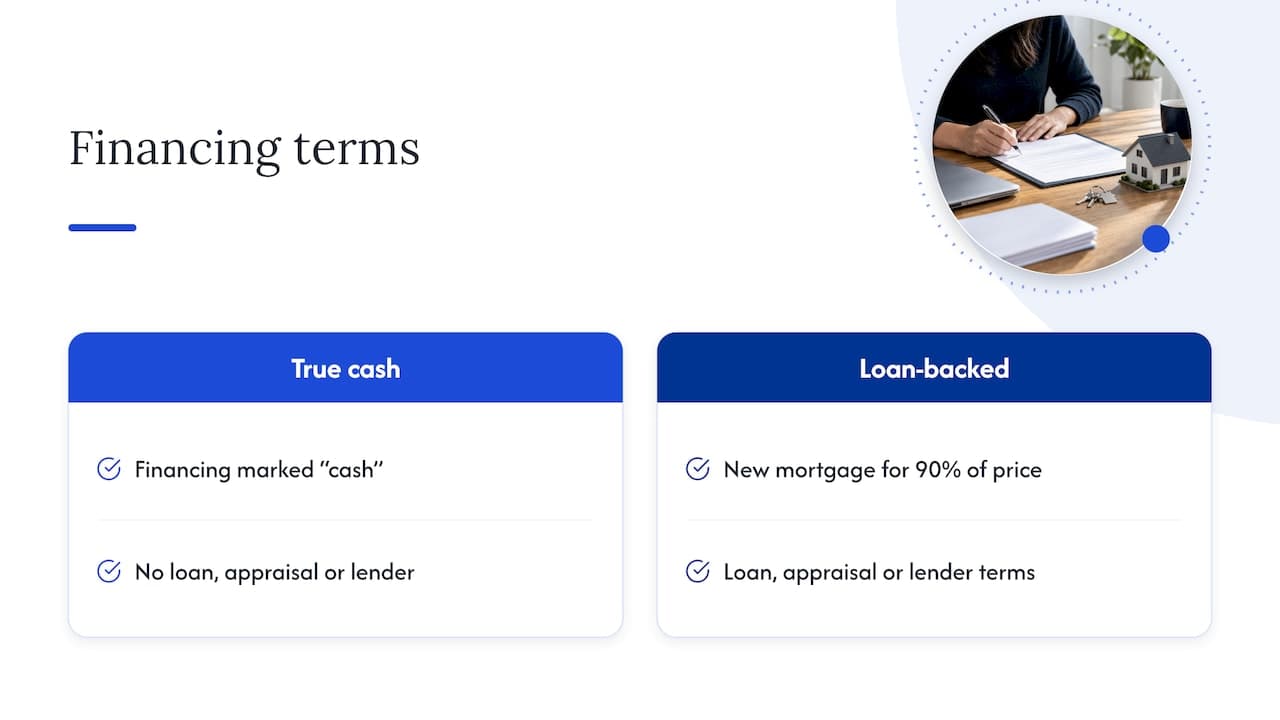
The label “cash” can be loose in practice. A Michigan Court of Appeals opinion from 2024 involved a residential purchase agreement described as a cash sale but subject to a new mortgage for 90% of the price. The lesson for sellers: read the actual financing language. If the contract mentions a loan, an appraisal or a lender, it is not a true cash deal, and the risks look like those of any financed sale.
When you search for a template, you will find many generic cash purchase agreements. They are a starting point for understanding the structure, not a substitute for a contract that fits your property, your county and your situation.
The terms to check, clause by clause
Sellers often look at the price and the closing date and skim the rest. The rest is where deals change. A good checklist, drawn from what Lawyers.com lists as terms to review, includes the earnest-money amount and who holds it, the closing agent, the closing date, the possession date, the promise of clear title, any inspection contingency and who is responsible for property expenses until closing.
Here is how to read each one.
Purchase price
Confirm the number is the number you will be paid for, not a headline figure that shrinks later. Look for any line that lets the buyer reduce the price after an inspection, and look for credits, repair allowances or deductions that are not obvious. If the offer was “as-is,” the contract should say so plainly and should not leave room for repair demands.
Also check what is included: appliances, fixtures, anything left in the house. If you want to leave furniture or belongings behind, say so in writing so nobody argues about it at closing.
Earnest money
Earnest money is a deposit the buyer puts down to show commitment. In a cash deal, check three things: the amount, who holds it (usually a title company or escrow agent, not the buyer or an investor), and under what conditions it is refunded or forfeited.
A tiny deposit, or none, makes it easy for a buyer to walk away. A deposit held by a neutral third party is a better sign than a promise to “bring it later.” The contract should say what happens to the deposit if the buyer defaults and what happens if a contingency fails.
Closing date and possession
The closing date is when ownership transfers and you are paid. The possession date is when you hand over the keys. They can be different, and both matter. If you need two extra weeks to move, build it into the contract rather than asking informally.
Watch for language like “on or about” or “within 30 days of acceptance,” which can stretch. A firm date with a stated consequence for missing it protects you better than a flexible window.
Contingencies
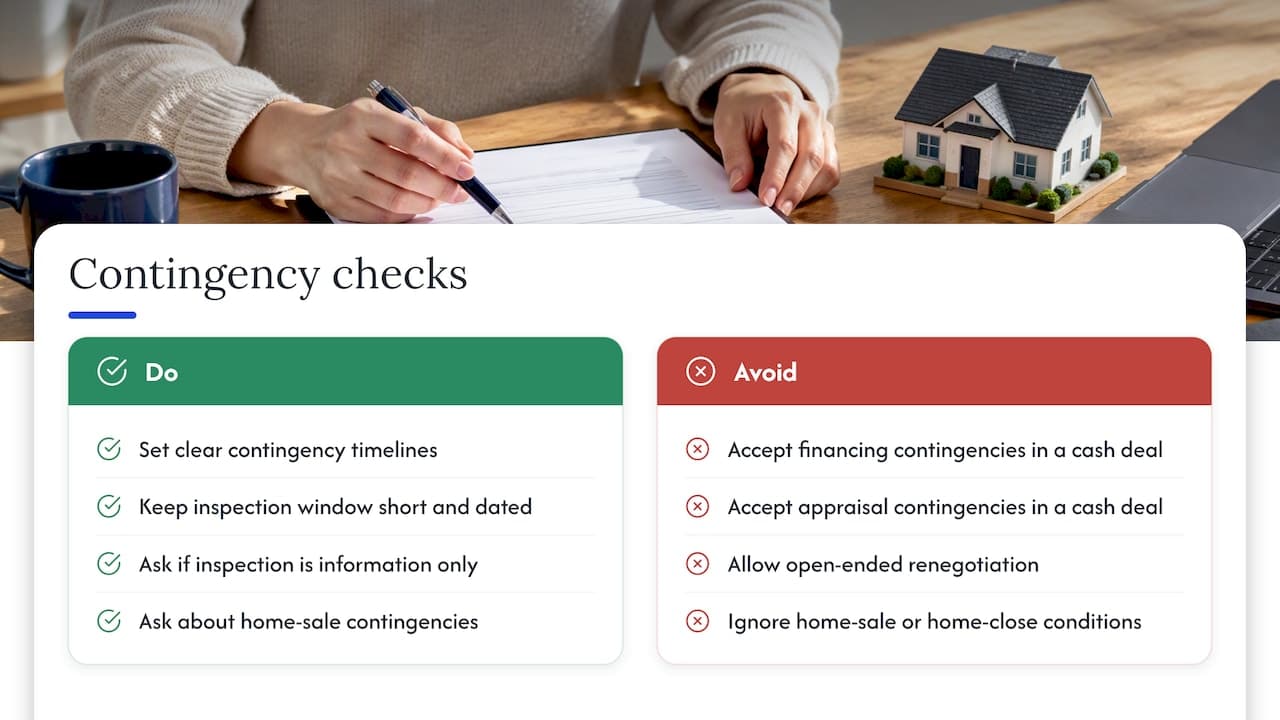
Contingencies are the conditions that must be met before the sale can be completed. The National Association of REALTORS® says they should include clear timelines, and it names common ones: inspection, title, appraisal, financing, insurance, HOA-document review, home-sale and home-close contingencies.
In a true cash purchase you should not see financing or appraisal contingencies. Be cautious if you do. An inspection contingency may still appear, and it is normal for a buyer to want a short window to look at the property. What matters is that the window is short, defined by dates, and does not give the buyer an open-ended right to renegotiate. For a house sold as-is, ask whether the inspection is for information only or whether it can trigger a price cut.
A home-sale or home-close contingency means the buyer needs to sell or close on another property first. That is a financing risk in disguise, so ask about it directly.
Cancellation rights
The same NAR guidance explains that if a contingency is not satisfied within its period, a buyer or seller may be able to cancel without penalty when acting in good faith, and that the contract should state the deadlines and consequences. Read this clause twice. Ask yourself:
- Can the buyer cancel for any reason, and until when?
- Does the buyer lose the deposit if they cancel after the inspection window?
- Can you cancel if the buyer misses the closing date, and what do you keep?
A contract where only the buyer can cancel, with no cost, is an option for the buyer, not a commitment.
Assignment
Some investor contracts let the buyer assign the contract to someone else. That is not automatically bad, but you should know who you are actually selling to. If the contract says the buyer can assign it, ask who the end buyer is likely to be and whether the price and the closing date remain the same. A clause that bars assignment, or requires your consent, keeps the deal with the party you vetted.
Title and who pays what
The contract should promise that you will deliver clear title, meaning no unresolved liens or claims that block the transfer. If there is a mortgage, a tax lien or a judgment on the property, the closing agent will pay it from your proceeds. Know the payoff figures before you sign, so the final number is not a surprise. We cover this in more detail in our guide to mortgage payoff in a cash sale in Michigan.
If you want a plain-language definition of terms such as escrow, lien or contingency while you read, a real estate glossary for home sellers can help you keep the vocabulary straight.
How much closing costs in a cash sale
Sellers ask whether a cash sale is cheaper at closing. Often it is, because there are no lender fees and, when you sell directly, no agent commission. But there are still costs, and they are set by the contract and by local practice.
Redfin reported in 2025 that cash buyers usually pay around 1% to 3% of the purchase price in closing costs, depending on location, property value and service providers. Its list of costs includes title work, escrow, transfer taxes, recording, attorney fees, inspections and tax prorations. That figure describes the buyer’s side, but it shows which line items exist in the deal and need an owner.
The contract can assign them. Total Mortgage notes that escrow fees are often split equally, though the amount depends on the services and location, and the parties can negotiate who pays closing costs. In other words, nothing is automatic. If an offer says the buyer pays all closing costs, make sure the contract says that, line by line.
A practical way to compare offers:
| Line item | Where it appears | What to ask |
|---|---|---|
| Title search and insurance | Closing statement | Who pays, and which title company |
| Escrow or closing fee | Closing statement | Is it split or paid by the buyer |
| Transfer taxes | Closing statement | Which party pays, and any exemption |
| Property taxes and utilities | Proration | Through which date are you responsible |
| Mortgage or lien payoff | Closing statement | Written payoff figure |
| Agent commission | Listing agreement | $0 if you sell directly |
For the Michigan side of this, see our breakdown of seller closing costs in Michigan and what agent commissions typically look like so you can compare a cash net against a listing net.
From signature to closing: what happens next
Once both sides sign, the process is short but not instant.
- Deposit and opening of escrow. The buyer delivers the earnest money to the title company or closing agent.
- Title work. The title company searches records for liens, unpaid taxes, probate issues and ownership problems.
- Inspection window. If the contract has one, the buyer looks at the property within the stated days.
- Payoffs and documents. Mortgage or lien payoffs are requested, and you sign the deed and closing documents.
- Closing and funding. The buyer wires the funds, the deed is recorded and you receive your proceeds.
- Possession. You hand over the keys on the agreed date.
Our cash closing process guide goes through each of these in detail, and a cash home sale timeline and checklist shows how a seven-day close is typically sequenced.
What if the buyer backs out or misses the date?
The answer is in your contract, which is why the cancellation and default clauses matter. If the buyer cancels within a contingency period, you generally get your property back on the market and the deposit follows the contract terms. If the buyer simply fails to close, check whether the deposit is forfeited to you and whether you have the right to cancel and sell to someone else.
The practical protection is to have a real deposit with a neutral holder, a firm closing date, and a short list of conditions. If you have already signed and the buyer is slipping, talk to a Michigan real estate attorney before you sign any extension, because an extension can change your rights.
Can you write your own purchase agreement?
You can use a template, and many sellers do. But a homemade or downloaded form carries risks: it may omit state-specific disclosures, leave out the deposit mechanics, or fail to say what happens on default. A mistake in a clause about contingencies or possession can cost more than the attorney fee you tried to avoid.
If you are selling a house with complications, such as an inherited property, a lien, tenants or code violations, a Michigan real estate attorney or the title company can review the draft. In Michigan, sellers of most residential property must also complete the seller disclosure statement under Act 92, and it is worth knowing how that applies to an as-is cash sale.
Michigan situations that change the contract
Foreclosure
If you are behind on the mortgage, timing is the key term. The Michigan Courts’ landlord-tenant benchbook explains that a mortgagee may foreclose by advertisement when the mortgage has a power of sale, and that any surplus funds from a foreclosure sale are distributed under MCL 600.3252. If you are in this position, the contract’s closing date has to land before the sale date, and the payoff figure has to be current. Our page on how to avoid foreclosure in Michigan covers the options, and our comparison of a short sale versus a cash sale explains the trade-offs.
Inherited and probate houses
When a house is inherited, the person signing must have legal authority to sell. That may mean letters of authority from the probate court or agreement among all heirs. A cash buyer’s contract should state who is signing and in what capacity, and the closing date should leave room for probate steps. If you are in this situation, see how to sell an inherited house in Michigan.
Damaged, vacant or code-violation properties
For these, the as-is language carries the most weight. Make sure the contract says the buyer accepts the property in its present condition, and that any city violation notices or required fixes are addressed in the document: who handles them, and by when.
What to verify before you rely on a fast closing
A promise of a closing in a week is only as good as the buyer’s ability to deliver. Before you sign:
- Ask for proof of funds, such as a recent bank or account statement showing the money is available.
- Ask which title company will close, and call it to confirm it has the file.
- Ask whether the buyer intends to close in their own name or assign the contract.
- Make sure every verbal promise about speed, repairs and fees is written in the contract.
- Compare more than one offer, because the price and the terms differ between buyers.
If an offer pressures you to sign before you have read it, or asks for fees from you up front, treat it as a warning sign.
Our perspective: compare contracts, not just numbers
We see sellers focus on the headline price and sign the first contract that arrives. In our experience, the sellers who feel good afterward are the ones who compared terms as well as numbers: the deposit, the closing date, the contingencies, the cancellation language and who pays what.
That is why HouseGoodbye works as a marketplace rather than as a single buyer. Several vetted local cash buyers bid on the same house, you see every offer, and you can walk away if none of them work. When bids sit side by side, a thin deposit or a loose cancellation clause stands out, and you can ask a buyer to improve it. A single offer gives you nothing to measure against.
If you are choosing between a listing and a cash sale, the difference is not just speed. It is certainty. Typical MLS timelines run long, while a cash sale can close in about a week when the paperwork is clean and the title is clear. Read the contract with that in mind: every contingency you remove is a day you save and a way out you take from the buyer.
— Bryan
Get competing cash offers for your Michigan house
If you own a house in Michigan and want to see what cash buyers will pay, enter your address on HouseGoodbye. Vetted local buyers bid as-is, with no repairs, showings, listing fees or agent commissions, and you decide whether to accept. You can also read how cash home buyers in Michigan compare before you start.
FAQ
Why would a seller want a cash buyer?
Because there is no mortgage approval to wait for, a cash sale can close faster and is less likely to fall apart over a loan or appraisal. It also suits houses that would not qualify for financing because of their condition. The trade-off is that you should compare offers, since price and terms vary.
Why is a cash sale better than a mortgage sale?
It is better when speed and certainty matter most. Without a lender, there is no loan underwriting or appraisal to delay or cancel the sale. It is not automatically better on price, so compare the net amount after costs.
Can I back out of a cash sale contract?
Only in the ways the contract allows. Some contracts give the seller a cancellation right if a deadline is missed or a contingency fails, and others do not. Read the cancellation and default clauses before you sign, and ask a Michigan real estate attorney if you are unsure.
Does a cash buyer pay all the closing costs?
Not automatically. Closing costs are assigned by the contract, and the parties can negotiate who pays which fees. Ask for a written estimate of your costs before you sign.
Sources
- Michigan Court of Appeals, Richardson v Wright (2024)
- NAR Consumer Guide: Real Estate Sales Contract Contingencies
- Lawyers.com: Understand Your Home Purchase Agreement Before You Sign
- Redfin: Are There Closing Costs if You Pay Cash for a House?
- Total Mortgage: Who Pays the Closing Costs in a Cash Sale?
- Michigan Courts: Mortgage Foreclosures by Advertisement