TL;DR:
- Multiple cash offers involve competing all-cash bids from buyers who can close quickly and without contingencies. They give sellers leverage, market insights, and the ability to compare net proceeds, not just highest gross price. This approach is especially beneficial for urgent sales, properties needing repairs, or when faster closings reduce uncertainties.
Multiple cash offers are defined as competing all-cash bids from buyers who can close without financing contingencies, giving sellers real options to compare speed, certainty, and net proceeds. The industry term for this process is a “competitive cash offer scenario,” and it works by putting buyers against each other rather than leaving sellers to accept or reject a single take-it-or-leave-it bid. Understanding how multiple cash offers work gives sellers the leverage to make a data-driven decision instead of a desperate one. Housegoodbye facilitates exactly this process, connecting sellers with competing investors who buy homes as-is, with no repairs or agent fees required.
How multiple cash offers work: the core process explained
Multiple cash offers occur when a seller receives bids from several cash buyers at the same time. Each buyer submits a written offer backed by proof of funds, not a mortgage pre-approval letter. That distinction matters because financing denial accounts for 37% of failed traditional sales. Cash buyers remove that risk entirely.

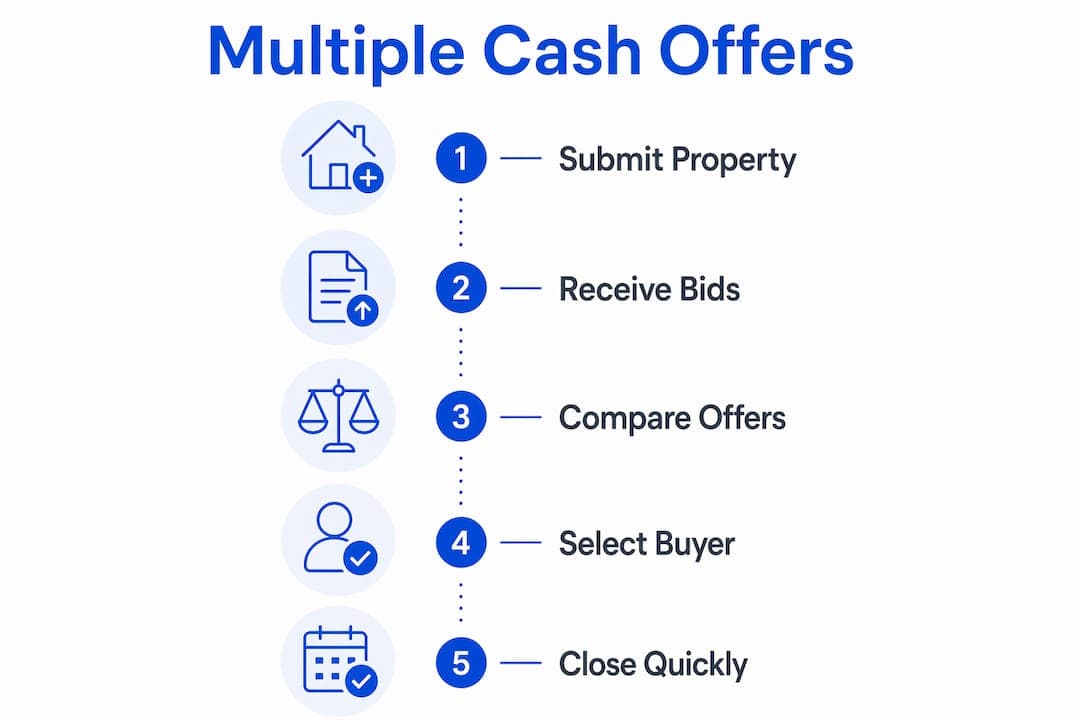
The process typically starts when a seller submits their property details to a platform or contacts multiple investors directly. Buyers then conduct their own valuations and return offers within 24–72 hours. The seller reviews each bid side by side, comparing not just the dollar amount but the proposed closing timeline, any contingencies, and what costs the buyer covers. Sellers can accept the best offer, counter one or more buyers, or walk away with no obligation.
Speed is the defining feature of this process. Cash offers close in 7–21 days, compared to 45–90+ days for traditional listings. That timeline difference is the reason sellers facing urgent relocations, financial pressure, or inherited properties consistently choose this route.
How cash buyers determine their offer price
Cash buyers do not guess at a number. They use a structured valuation method that accounts for current market data, the property’s condition, and their own profit requirements.
The three most common valuation approaches are:
- Automated valuation models (AVMs): Algorithm-based tools that pull recent comparable sales, tax records, and neighborhood trends to generate a baseline price.
- Independent appraisals: A licensed appraiser physically inspects the property and produces a formal value estimate. Independent appraisals tend to yield higher offers than in-house valuations, which can skew low to protect the buyer’s profit margin.
- Investor walk-throughs: The buyer or their representative visits the property, notes repair needs, and adjusts the offer accordingly.
After establishing a baseline value, buyers subtract estimated repair costs, holding costs (property taxes, insurance, utilities during renovation), and their target resale margin. A buyer planning a full renovation will offer less than one who intends to rent the property long-term. That difference in exit strategy directly explains why two buyers looking at the same house can submit offers that differ by tens of thousands of dollars.
Sellers make a critical mistake when they focus only on the gross offer price. Experienced sellers evaluate offers on net proceeds and risk profiles. A $280,000 cash offer with zero fees and a 10-day close can outperform a $310,000 listed price that carries $18,000 in commissions, $8,000 in repairs, and a 45-day wait.
Pro Tip: Ask every cash buyer to provide a written breakdown of how they calculated their offer. Any buyer unwilling to show their math is a buyer worth skipping.
What are the benefits of receiving multiple cash offers?
Receiving a single cash offer puts all the power with the buyer. Receiving several shifts it back to the seller. That shift is the core benefit of this approach.
- Competitive pricing: When buyers know they are competing, they submit stronger opening bids. A buyer who might start at $240,000 in a one-on-one negotiation will often open closer to $255,000 when they know three other investors are in the room.
- Market intelligence: Multiple cash offers provide sellers with a clear competitive baseline, revealing what investors believe the property is actually worth. That data is useful even if the seller ultimately decides to list traditionally.
- Negotiation leverage: A seller holding three written offers has real leverage with a traditional agent or a single buyer. The offers function as documented proof of market demand.
- Flexible terms: Cash buyers routinely offer flexible closing dates, as-is purchase conditions, and seller-chosen possession timelines. Traditional buyers rarely offer the same flexibility. Sellers who need to stay in the home an extra 30 days after closing can often negotiate that directly with a cash buyer.
- Certainty of close: 16% of traditional real estate sales fail before closing, mostly due to financing denial and inspection disputes. Cash buyers eliminate both risks. A signed cash contract has a near-zero fall-through rate.
Sellers dealing with urgent financial situations gain the most from this process. When time is the constraint, certainty of close is worth more than a slightly higher gross price that might collapse in week six.
Cash offers vs. traditional home selling: a real numbers comparison
The gap between a cash offer and a traditional listing price looks large on paper. The gap in net proceeds is much smaller, and sometimes reverses entirely.
Cash offers typically come in 10–20% below market value, but they eliminate the 10–15% in costs that traditional sales carry. Those costs include agent commissions, repair and staging expenses, and carrying costs during the listing period.
| Cost category | Traditional listing ($300K home) | Cash offer ($255K, 15% below) |
|---|---|---|
| Gross sale price | $300,000 | $255,000 |
| Agent commissions (5–6%) | $18,000 | $0 |
| Repairs and staging | $10,000 | $0 |
| Carrying costs (taxes, utilities) | $4,935 | $0 |
| Closing costs | $4,000 | $0 |
| Net proceeds | ~$263,065 | ~$255,000 |
A traditional listing on a $300,000 home nets roughly $263,065 after all costs. A cash offer at 15% below market nets approximately $255,000 with no deductions. The real difference is about $8,000, not $45,000.
Traditional listings produce higher gross prices when homes are move-in ready and market conditions strongly favor sellers. Cash offers outperform when speed, property condition, or financial pressure are factors. Sellers with a home needing $20,000 in repairs before it can list competitively will often net more from a cash sale than from a traditional listing that requires that upfront investment.
Pro Tip: Before rejecting a cash offer as “too low,” calculate your actual net proceeds from a traditional sale. Include commissions, repairs, staging, carrying costs, and the probability of a deal falling through.
How to solicit and evaluate multiple cash offers effectively
Getting one cash offer is easy. Getting several strong, verified offers requires a deliberate approach.
- Use a multi-offer platform: Services like Housegoodbye submit your property to a network of competing investors simultaneously, generating multiple bids without requiring you to contact buyers one by one.
- Verify proof of funds: Every legitimate cash buyer provides a bank statement or letter from a financial institution confirming available funds. Never accept a verbal assurance.
- Request a written offer breakdown: Ask for the offer price, proposed closing date, any contingencies, and a list of costs the buyer will cover. Compare these line by line, not just by headline number.
- Calculate net proceeds for each offer: Subtract any costs you will still bear, such as title fees or unpaid taxes, from each offer. The highest gross offer is not always the best net offer.
- Use offers as leverage: If you plan to list traditionally, bring your cash offers to your agent. Documented investor interest sets a price floor and accelerates negotiations with retail buyers.
Sellers managing inherited properties or homes with deferred maintenance benefit most from this multi-offer approach. The as-is purchase condition removes the need to invest in a property you may not want to keep.
Common misconceptions and pitfalls in cash offer scenarios
The biggest misconception about cash offers is that they are always a bad deal for sellers. After accounting for commissions, repairs, and closing costs, the best selling method depends on the seller’s urgency and property condition. Cash offers are not inherently low. They are priced differently.
The real risks come from specific buyer behaviors, not from the cash offer model itself:
- Bait-and-switch pricing: Some buyers submit a strong initial offer, then lower it after inspection via flat repair deductions rather than documented line items. Demand itemized repair estimates, not percentage-based cuts.
- In-house appraisals that skew low: Buyers using their own internal valuations have an incentive to undervalue your property. Prefer buyers who use independent appraisals.
- Unverified buyers: Not every “cash buyer” has the funds ready. Always confirm proof of funds before signing anything.
“Multiple offers are the best protection against any single buyer’s lowball tactics. When you have three offers in hand, you have the data to recognize when one is out of line — and the leverage to walk away from it.”
Receiving several competing bids makes these risks far easier to spot. An outlier low offer stands out immediately when you have two or three others for comparison.
Key Takeaways
Multiple cash offers give sellers the clearest, fastest path to a data-driven sale decision by creating competition among buyers and eliminating the costs and risks of traditional listings.
| Point | Details |
|---|---|
| Net proceeds matter most | A cash offer 15% below list price can net within $8,000 of a traditional sale after costs. |
| Competition improves offers | Multiple buyers bidding simultaneously push opening offers higher than single-buyer negotiations. |
| Cash closes faster | Cash transactions close in 7–21 days versus 45–90+ days for traditional listings. |
| Verify every buyer | Always confirm proof of funds and demand a written, itemized offer breakdown before signing. |
| Bait-and-switch is real | Reject flat-percentage repair deductions; insist on line-item documentation from any buyer. |
Why I think most sellers underestimate the power of multiple cash offers
Sellers tend to anchor on the gross offer number and stop there. That is the wrong instinct. After years of watching sellers navigate this process, the pattern is clear: the sellers who come out ahead are the ones who treat competing cash offers as a research tool, not just a transaction.
Getting three or four cash bids before making any decision tells you what the market actually thinks your home is worth to buyers who have real money and no contingencies. That information is genuinely valuable, whether you ultimately sell to a cash buyer or take the traditional listing route. Sellers facing mortgage payment problems often discover that a fast cash sale nets them more than a drawn-out listing that costs them three more months of payments, stress, and uncertainty.
The sellers I see make the worst decisions are the ones who receive one cash offer, decide it is too low without doing the math, and then spend $15,000 on repairs and six months on the market. The multiple-offer process forces you to do the math early. That is its real value.
— Bryan
Housegoodbye makes it easy to compare real cash offers
Sellers in Michigan who want competing cash bids without the hassle of tracking down individual investors have a direct option with Housegoodbye. The process is straightforward: submit your property details, receive multiple verified cash offers from competing investors, and review transparent net proceeds breakdowns with no obligation to accept.

Housegoodbye buys homes as-is with no repairs needed, no agent commissions, and no closing costs charged to the seller. Closing can happen in as little as seven days. Sellers across Michigan, including those in Warren, Roseville, and Flushing, use Housegoodbye to get real, competing offers fast. If you want to see what your home is actually worth to cash buyers today, compare real cash offers and make a decision with full information.
FAQ
What does a multiple cash offer process look like?
A seller submits their property to one or more platforms, receives written bids from several cash buyers within 24–72 hours, and compares offers by net proceeds, closing timeline, and terms before accepting or countering.
Are cash offers always lower than market value?
Cash offers typically come in 10–20% below market value, but they eliminate commissions, repairs, and closing costs that reduce traditional sale proceeds by 10–15%, making the net difference much smaller than the headline gap suggests.
How do I know if a cash buyer is legitimate?
Always request a bank statement or proof-of-funds letter from a financial institution. Legitimate cash buyers provide this documentation without hesitation before any contract is signed.
When do cash offers outperform traditional listings?
Cash offers outperform traditional listings when a home needs significant repairs, the seller faces a time-sensitive situation, or the risk of a deal falling through is a serious concern. Traditional listings may net more for move-in-ready homes in strong seller markets.
Can I use cash offers as leverage if I still want to list traditionally?
Yes. Multiple written cash offers establish a documented price floor and give sellers real negotiating power with traditional agents and retail buyers, even if no cash offer is ultimately accepted.