An instant cash offer for a house is a purchase price a buyer commits to quickly, usually after you share your address and a few details about the home. There are no showings and no financing contingency. It is fast and optional, but it is almost always lower than what the open market would pay, and the first number is not always the final one. This guide explains how the offer is built, what can change it, and how to compare offers so you keep more of your equity.
TL;DR
- An instant cash offer is a quick, online or phone-based price for your home, often returned within 24 to 48 hours, with closings in as little as seven days.
- Expect it to sit below market value, because the buyer prices in repairs, holding costs and profit.
- The offer can drop after an inspection, so describe the home’s condition honestly up front.
- Comparing several offers on the same house is the simplest way to see whether a number is fair.
- You can say no. A real no-obligation offer costs you nothing to decline.
Table of Contents
- What an instant cash offer actually is
- How the process works, step by step
- How the number is calculated
- Offer versus market value: do the math on your net
- One offer or several: why comparison changes the math
- Warning signs: when a cash offer is not what it seems
- How fast can it really close?
- Situations where an instant offer fits best
- Our perspective
- See what Michigan cash buyers will pay for your house
- FAQ
- Sources
What an instant cash offer actually is
The phrase covers a few different things, and search results for it are mostly about cars. For houses, Bankrate describes an instant home offer as a cash offer from a company to buy your home, produced quickly from algorithms and public data. You request it online or by phone with basic details, and a preliminary offer typically arrives within 24 to 48 hours.
The speed comes from one thing: the buyer is not waiting on a mortgage lender. Bankrate notes that because these buyers pay in full, some deals close in as few as seven days, and some buyers will stretch the timeline for a few months if you need it.
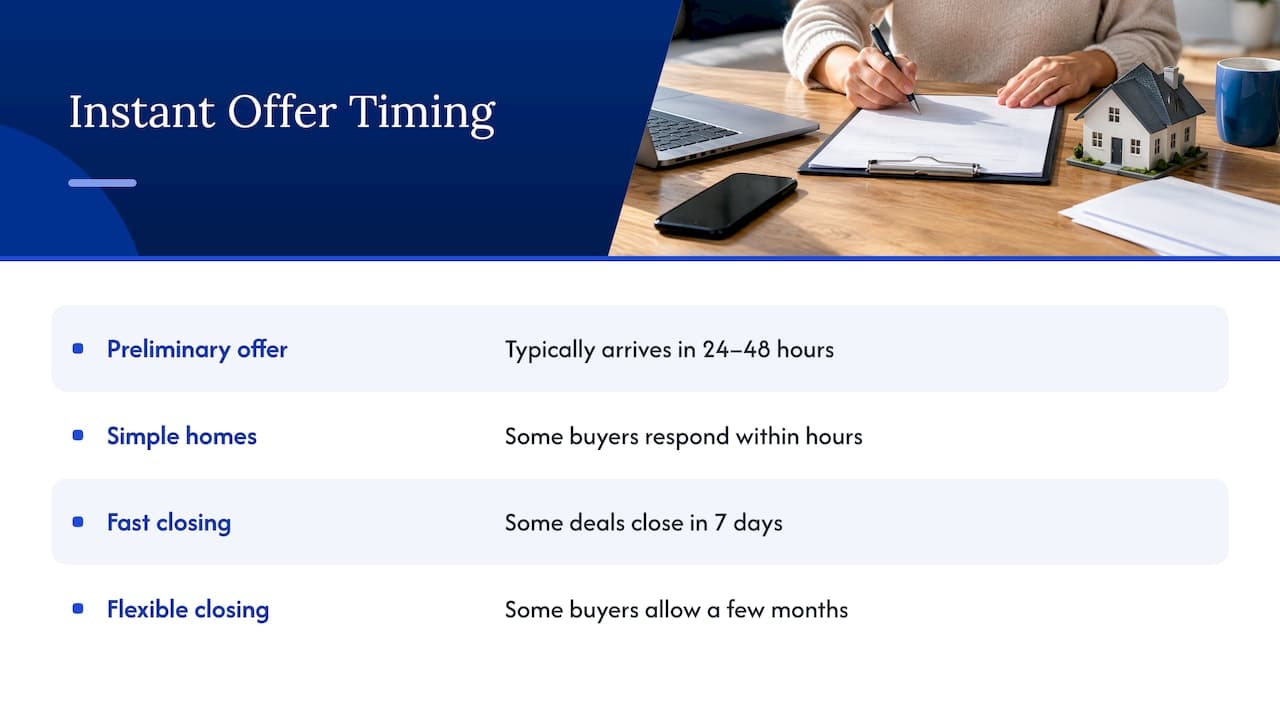
Two other phrases you will see are “same day cash offer” and “online cash offer.” They describe the same idea. Some buyers can respond within hours if the home is simple and the data is clear. Others need a phone call or a walkthrough first. Treat “instant” as “fast first number,” not “guaranteed final price.”
How the process works, step by step
- Share the address and basic facts. Realtor.com’s overview of the process says you enter your address and fill out a questionnaire, and an offer follows within about a day.
- Receive the preliminary number. This is based on your answers, public records and recent local sales.
- Verification. Many buyers send someone to look at the house before they buy. That visit is where a preliminary offer can be confirmed, lowered or withdrawn.
- Choose. You decide whether to go ahead. Realtor.com is clear that you can choose whether to proceed after seeing the offer.
- Pick a closing date and close. With no lender involved, the date is often yours to set, within reason.
At HouseGoodbye the first step is the same: you enter your address. The difference is what happens next. Instead of one buyer replying with one number, several vetted local cash buyers bid on the house, and you see the offers side by side. More on that below.
How the number is calculated
Cash buyers work backward. They estimate what the house would sell for once repaired, subtract the cost of repairs, subtract what they will spend holding and reselling it, and leave a margin for themselves. What remains is the offer.

That is why Bankrate says instant offers are very likely lower than open-market prices: the buyer is accounting for repair costs and profit. The BBB makes the same point, noting that sellers will almost always get a lower offer than from a traditional buyer, in exchange for speed.
The discount is the price of convenience. Whether it is worth paying depends on what you would otherwise spend on the traditional route: agent commissions, repairs, cleaning, staging, months of mortgage payments, taxes and utilities on a house you are not living in. With us, there are no agent commissions or listing fees, and no repairs are required, so those items drop out of your math.
What moves the offer up or down
- Condition. Roof, foundation, systems, water or fire damage, and deferred maintenance all change the repair estimate. We wrote a breakdown of how property condition affects your sale offer.
- Location and comps. A house on a street with recent renovated sales supports a higher after-repair value.
- Timeline. A faster close and fewer unknowns usually mean a stronger bid.
- Title and occupancy. Liens, probate status, code violations or tenants affect how much work the buyer has to do.
- Accuracy of your answers. This one is entirely in your hands.
Why honest disclosure matters
Realtor.com reports that most buyers of this kind send an inspector before purchase, and afterward may lower the offer or withdraw it. If you tell them about the leaking roof or the failed inspection from last year before the first number, the offer you get is far more likely to be the offer you close on. Surprises found later tend to cost you.
Offer versus market value: do the math on your net
The number to compare is never the offer against the listing price. It is what ends up in your pocket under each route.
Here is a simple way to lay it out with your own figures:
| Line item | Traditional listing | Cash offer |
|---|---|---|
| Sale price | Your estimated market price | The offer |
| Agent commissions | Yes | $0 with HouseGoodbye |
| Repairs and prep | Often needed to attract buyers | None required |
| Carrying costs while waiting | Mortgage, taxes, insurance, utilities for the whole time on market | Only for the short time to close |
| Risk the buyer’s financing falls through | Present | Low, since no lender is involved |
For timing, the National Association of Realtors’ March 2026 Confidence Index reports a median of 41 days on market and contracts typically closing in a median of 30 days. By our own figures, a typical MLS sale takes about 73 days from listing to close, while a cash sale through our marketplace can close in about 7 days. Those are different measures, but the gap in carrying costs is real either way.
If you are weighing a conventional sale seriously, a launch plan for a conventional listing shows how much preparation and marketing goes into one. That work is exactly what a cash sale skips.
One offer or several: why comparison changes the math
A single instant offer tells you what one buyer will pay. It does not tell you whether that is a good price. The only reliable test is a second and third number from buyers who have no idea what the others bid.
That is the idea behind our marketplace. We are not one investor making one offer. Several vetted Michigan cash buyers bid against each other on the same house, and you see every offer. If none work, you walk away with nothing owed. Our guides on how multiple cash offers work for home sellers and the role of competing cash offers go deeper on why competition tends to lift the top bid.
When you compare, look past the headline price:
- Closing costs and who pays them.
- Deductions after inspection. Ask whether the buyer can renegotiate and under what conditions.
- Closing date flexibility. Do you need seven days, or three months?
- Proof of funds and a written offer.
- Earnest money and contract terms you can read in full before signing.
Our overview of cash house buyers explains what verified, local cash buyers look like in practice.
Warning signs: when a cash offer is not what it seems
Most cash buyers are legitimate. But because speed creates pressure, it pays to know the patterns that cause harm.
- Pressure to sign immediately. A real offer will still be real tomorrow.
- Requests for money or sensitive information before anyone has seen the house. A buyer should not need your Social Security number or an upfront fee to give you a price.
- Vague talk about paperwork on your deed or title.
- An “as-is” promise that disappears. AARP’s 2024 warning cites state attorney general guidance that some buyers retract the as-is promise and demand repairs before accepting the deed, or take the deed without paying off your mortgage, leaving you responsible for payments and exposed to foreclosure.
- Unsolicited offers at a fraction of value. A credit union’s 2024 guide reports that unsolicited cash offers are often for 25% to 35% of market value, which may not even cover the mortgage.
Before you sign with anyone, check who they are. Our short guide on how to verify a cash home buyer in an hour covers what to confirm, and why cash buyers reduce sale risk explains what a well-run cash sale looks like. If the house has a mortgage, a lien or a pending foreclosure, have a real estate attorney or a HUD-approved housing counselor read the contract first.
How fast can it really close?
The BBB says home investors can usually close in a month or less, and some buyers close in as little as a week. What decides where you land in that range:
- Clear title. Liens, unpaid taxes or unresolved probate are the most common reasons a closing slips.
- Signatures. Co-owners, heirs or divorcing spouses all need to sign.
- Occupancy. Tenants or belongings left in the house add steps.
- Payoff statements. Your lender needs time to issue one.
If your clock is tight, such as a foreclosure sale date, start with the title and payoff questions. Our playbook for closing in 7 to 10 days and why cash sales close faster lay out the sequence. If foreclosure is the pressure, read what a cash sale means compared with a foreclosure outcome.
Situations where an instant offer fits best
- Behind on the mortgage. Selling before a foreclosure sale can protect your equity and your credit more than waiting.
- Inherited or probate homes. Heirs often live out of state and do not want to repair and manage a house. See cash buyers for estate properties, our page on selling an inherited house in Michigan and the probate guide.
- Vacant, damaged or code-violation houses. Fire, water damage and citations make traditional financing hard.
- Divorce, relocation or job loss. Certainty and timing matter more than the last few thousand dollars.
- Rental property with tenants. Some investors will buy with tenants in place.
In every one of these, the as-is part matters most. Disclosure rules still apply to sellers in many states, even for as-is sales. Indiana’s Supreme Court, for example, held in Johnson v. Wysocki that the duty to disclose known material latent defects survives an as-is addendum. Michigan has its own rules, so ask a Michigan real estate attorney what you must disclose on your house.
Our perspective
We built HouseGoodbye because most sellers who need speed are handed one number by one buyer and told it is the best they will get. That is not a market. That is a take-it-or-leave-it.
Our view is simple: an instant offer is only as good as the alternatives you can see next to it. When several vetted Michigan cash buyers bid on the same house, the seller sees every number, and no one has to guess whether the first price was fair.
We also think the honest version of fast matters. Tell us what is wrong with the house, whether it is foreclosure, probate, fire damage or just years of deferred repairs. Buyers who know the truth bid on the truth, and the offer you accept is the one you close on.
There is no cost to look, no agent commission, no repairs, no showings, and no obligation. If none of the offers work for you, you walk away.
Bryan
See what Michigan cash buyers will pay for your house
If you want real numbers instead of a single estimate, enter your address at HouseGoodbye. Vetted local cash buyers compete with as-is offers, you compare them, and you decide. We buy houses in any condition across Metro Detroit, Grand Rapids, Flint, Lansing and the rest of Michigan. You can also start from our page for cash home buyers in Michigan.

If you are in a specific city, see our pages for selling fast in Detroit or Warren.
FAQ
Is an instant cash offer really no obligation?
A legitimate offer lets you decline without cost. Realtor.com says you can decide whether to proceed once you have the offer. Read any contract before you sign, and do not pay fees or hand over sensitive information up front. On our marketplace, comparing offers carries no obligation.
Why is the cash offer lower than my home’s market value?
The buyer prices in repairs, carrying costs and profit, so the number sits below open-market value. Bankrate says instant offers are very likely to be lower. Your savings on commissions, repairs and months of carrying costs offset part of that gap, which is why comparing net proceeds matters more than the headline price.
Can the offer change after I accept it?
It can if the buyer’s inspection finds problems you did not mention. Realtor.com notes the buyer may lower or withdraw after inspecting. Describing the condition accurately at the start, and comparing several bids, is the best protection.
How fast can I get paid?
The first offer can come within 24 to 48 hours, and some cash sales close in as few as seven days. Clear title and signatures from every owner set the pace. A foreclosure sale date or a probate hold can change the timeline, so raise those early.
Do I need to repair or clean the house first?
No. We buy houses as-is in any condition, with no repairs, staging or cleaning required, and you owe no agent commissions.
Sources
- What Is an iBuyer? A Guide to iBuying, Realtor.com
- BBB Tip: Selling your home for quick cash? Not so fast!
- NAR REALTORS Confidence Index, March 2026
- Beware of ‘Let Us Buy Your Home’ Ads, AARP
- What To Know About Unsolicited Home Purchase Offers, Consumers Credit Union
- Residential Real Estate Seller Obligations, Barrett Law