A proof of funds letter proves you actually have the liquid cash to cover a down payment, closing costs, or the entire purchase price, and sellers ask for it to confirm your offer won’t collapse before closing. A bank-issued letter carries far more weight than a screenshot of your balance. If you need one this week, call your bank first; many issue letters within one to two business days.
TL;DR:
- Formal proof of funds letters are preferred over bank statements because they are issued directly by the bank and present verified, current liquid balances.
- Only cash in checking, savings, money market, or settled brokerage accounts qualifies; retirement accounts and certain restricted funds generally do not count.
- A proof of funds letter should be recent, typically issued within 30 to 90 days, and must include specific details like account holder name, verified balance, and official signature.
- To obtain a proof of funds letter quickly, gather your account details, contact your bank, and request the document through online or in-person channels, avoiding third-party services.
- Providing a verified, up-to-date proof of funds can significantly accelerate deal closure by reducing seller hesitation and increasing offer competitiveness.
Table of Contents
- What Is Proof of Funds and When Do Buyers Need One?
- Which Funds Actually Count as Proof of Funds
- POF Letter vs. Preapproval vs. Bank Statement: What Each One Proves
- How to Get a Proof of Funds Letter, Step by Step
- What a Proof of Funds Letter Should Actually Contain
- Why Sellers Ask for Proof of Funds in the First Place
- Validity, Verification, and Protecting Your Financial Data
- How Proof of Funds Differs Across Property Types
- Legal Risks and Fraud Prevention Around Proof of Funds
- Alternatives to a Bank Letter That Sellers Sometimes Accept
- How Proof of Funds Ties Into Earnest Money Deposits
- HouseGoodbye’s Take: Verified Funds Change How Fast Deals Close
- Where to Verify Proof of Funds Rules Yourself
- Sources
- FAQ
What Is Proof of Funds and When Do Buyers Need One?
A proof of funds letter is a document from a bank, credit union, or brokerage confirming you hold enough available cash to complete a specific transaction. It differs from a loan document because it verifies money you already have, not money someone might lend you.
The use case shifts depending on how you’re buying. A cash offer needs proof of funds covering the full purchase price, since there’s no lender backstopping the deal. A financed purchase only needs proof of funds for the down payment and closing costs, since the mortgage covers the rest. CNBC Select notes that sellers increasingly request a formal letter rather than accepting a bank statement at face value, particularly in competitive markets.
Three parties typically ask for this document:
- Sellers and listing agents, who want assurance an offer can actually close.
- Title companies, who need to confirm funds before scheduling settlement.
- Lenders, who verify down payment sources during underwriting even on financed deals.
Which Funds Actually Count as Proof of Funds
Not every dollar you own qualifies. Liquidity is the deciding factor, meaning the money needs to be accessible without penalties, delays, or complicated withdrawal rules. Investopedia defines proof of funds around this exact requirement: cash you can move quickly, not cash tied up somewhere.
- Qualifying liquid accounts include checking, savings, money market accounts, and cash sitting in a brokerage sweep account.
- Conditional or non-qualifying sources include retirement accounts (which trigger penalties on early withdrawal), certificates of deposit with early-withdrawal fees, and home equity that hasn’t been converted to cash through a loan or sale.
- Brokerage cash needs a settlement check. If you recently sold stock, that cash may not be usable yet. The SEC’s trade settlement guidance explains that trades typically settle two business days after execution, so ask your broker for a settlement confirmation before counting that money.
- Gifted funds require a signed gift letter from the donor stating the money isn’t a loan, plus the gift documented in the same account the POF letter covers.
- Multiple accounts or joint accounts are fine, but you may need a separate letter per institution, or you can consolidate into one account before requesting a single letter, which is usually cleaner for the seller to review.
POF Letter vs. Preapproval vs. Bank Statement: What Each One Proves
A mortgage preapproval tells a seller a lender is willing to fund your loan, based on your credit and income. It says nothing about cash you have sitting in an account right now. A proof of funds letter does the opposite: it verifies actual, current, liquid money.
- Preapproval answers “can this buyer get a loan?”
- Proof of funds answers “does this buyer have the cash on hand today?”
- Bank statements can work as a quick, informal substitute early in the process, but they show transaction history and balances that fluctuate, which is exactly why sellers often want a bank-issued letter instead.
Competitive markets and short escrow timelines are where sellers get strict and ask for both documents. A financed buyer with a strong preapproval but no POF letter for the down payment can still look shaky to a seller who’s had a deal fall apart before.
How to Get a Proof of Funds Letter, Step by Step
Getting a proof of funds letter is usually a same-week task, sometimes same-day, if you go through the right channel. Here’s the sequence that works:
- Gather your identification and account numbers. Most banks require you to verify identity before releasing any letter, even for existing customers.
- Know the exact dollar amount you need. Base it on the purchase price for a cash offer, or the down payment plus closing costs for a financed purchase. Round up slightly if your agent recommends it.
- Contact your bank through online banking, phone, or in person. Online requests are often fastest for existing customers; a branch visit helps for larger amounts or unusual account setups.
- Ask about turnaround time. Bankrate notes banks commonly issue these letters within one business day to a few business days, depending on account complexity and branch staffing.
- Consolidate funds across accounts if it simplifies things, or request separate letters from each institution if consolidation isn’t practical before your offer deadline.
- Attach a gift letter if part of the funds were gifted, and make sure the gift has already posted to the account before you request the POF letter.
- Skip third-party “proof of funds” services. Legitimate letters come from an account you actually control at a regulated institution, according to LegalClarity’s guidance on requesting POF letters. Letters from unregulated intermediaries raise red flags with experienced agents.
Pro Tip: Ask your bank for both a formal letter and a redacted statement at the same time. Some sellers only need the letter, but having the statement ready saves you a second trip if a title company wants extra backup.
What a Proof of Funds Letter Should Actually Contain
A proof of funds letter isn’t just any note from a bank employee. Sellers and their agents look for specific fields, and a letter missing any of them tends to get questioned or rejected outright.
- Bank letterhead identifying the institution issuing the letter.
- Account holder’s full name, matching the name on the offer.
- Verified account balance, stated as an exact figure, not a range.
- Date of verification, which establishes how current the information is.
- Authorized signature from a bank officer, not an automated system.
- Bank contact information, so the seller or their agent can call to confirm authenticity.
Attaching a recent statement page with the account number redacted, or a bank stamp, adds credibility without exposing sensitive details.
Freshness matters more than buyers expect. Rocket Mortgage notes that sellers typically accept letters dated within 30 to 90 days, and banks can usually turn around a new letter within a few business days when the old one expires mid escrow.
Why Sellers Ask for Proof of Funds in the First Place
Sellers want fewer surprises, not more paperwork. A financed deal can fall through at underwriting; proof of funds reduces that risk for cash buyers and reassures sellers that a financed buyer’s down payment is real. In markets tracked by the Federal Housing Finance Agency, tighter inventory and faster-moving listings tend to push sellers toward stricter verification, since they can’t afford a 30-day delay only to discover the buyer can’t close.
- Sellers demand a formal bank letter (not just a statement) for all-cash offers, short-close timelines, and contested multiple-offer situations.
- Sharing a redacted statement alongside the letter satisfies most requests without exposing full account numbers.
- Offering proof of funds before it’s requested can be the difference between your offer getting a serious look and getting passed over in a multiple-offer scenario.
Validity, Verification, and Protecting Your Financial Data
Most sellers accept a proof of funds letter dated within 30 to 90 days, so if your escrow drags past that window, request a refreshed letter rather than assuming the old one still counts.
Verification is simpler than most buyers expect. A seller’s agent or attorney may call the bank directly to confirm the signer and the amount on the letter, and federal privacy rules limit exactly what the bank can disclose beyond confirming the letter is legitimate.
- Redact your full account number before sharing any statement.
- Share documents only with your agent, the seller’s agent, or the title company, never post them anywhere public.
- Use a secure portal or encrypted email rather than a plain text message or unsecured fax.
- Keep a copy for your own records in case a second party needs it later in escrow.
Pro Tip: If your bank’s letter includes more account detail than the seller needs, ask for a version that only shows what’s required. Most banks will customize the disclosure level on request, especially for large balances. The FTC’s guidance on protecting personal financial information covers this kind of selective sharing well.
How Proof of Funds Differs Across Property Types
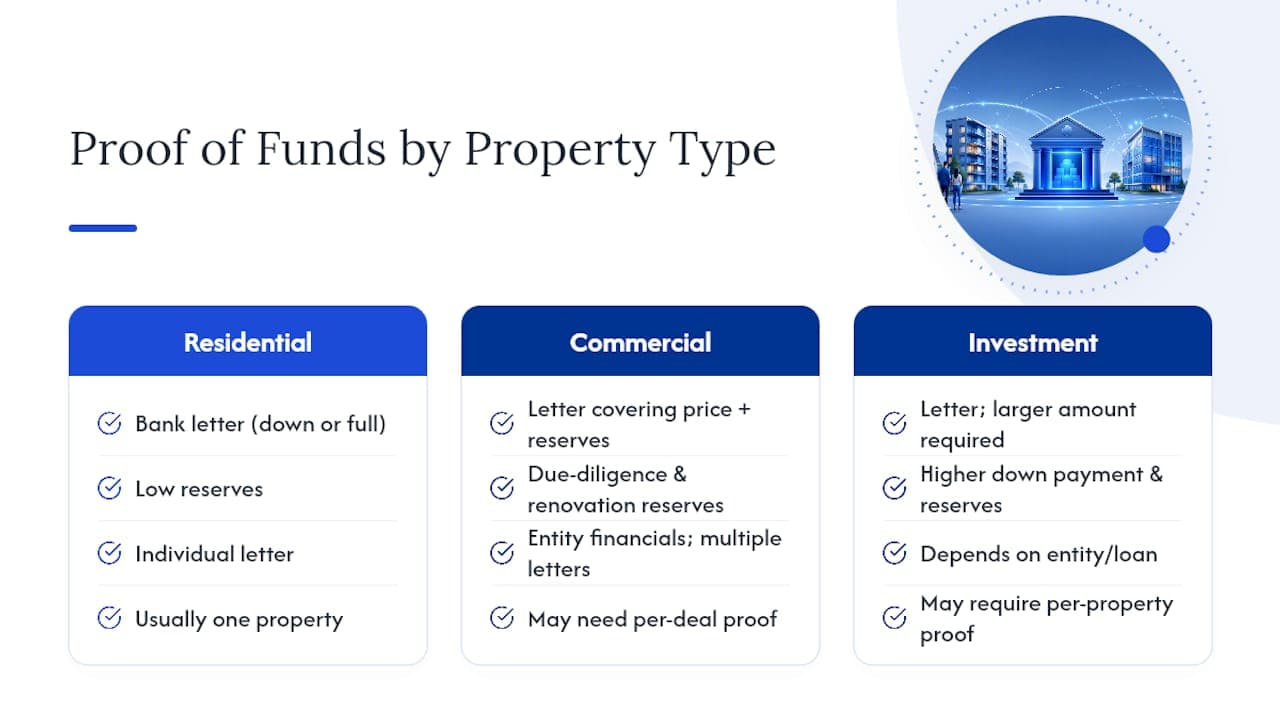
Residential purchases are the most standardized use case: a bank letter covering the down payment or full price, dated close to the offer, usually satisfies everyone involved. Sellers of single-family homes rarely ask for anything beyond the standard letter and maybe a redacted statement.
Commercial property purchases raise the bar. Sellers and their brokers often want proof of funds covering not just the purchase price but reserves for due diligence deposits, environmental assessments, or renovation escrows, since commercial deals frequently stall on financing contingencies that residential deals don’t have. A buyer might need letters from multiple entities if the purchase runs through an LLC or partnership structure, and sellers may ask for financial statements from the entity itself, not just the individual investor.
Investment property purchases sit somewhere in between. If you’re buying with a conventional investment loan, the down payment and reserve requirements are usually higher than owner-occupied purchases, so your proof of funds needs to cover a bigger number. Cash investors buying multiple properties at once sometimes need to show proof of funds for each deal separately, even when the money is coming from the same account, because sellers want assurance that one purchase won’t drain the cash intended for another. Auction purchases and off-market deals in particular tend to demand proof of funds upfront, before you’re even allowed to bid or negotiate.
Legal Risks and Fraud Prevention Around Proof of Funds
Sharing financial documents always carries some exposure, and proof of funds letters are no exception. The biggest risk isn’t the seller misusing your information. It’s fraudulent or altered letters circulating on both sides of transactions.
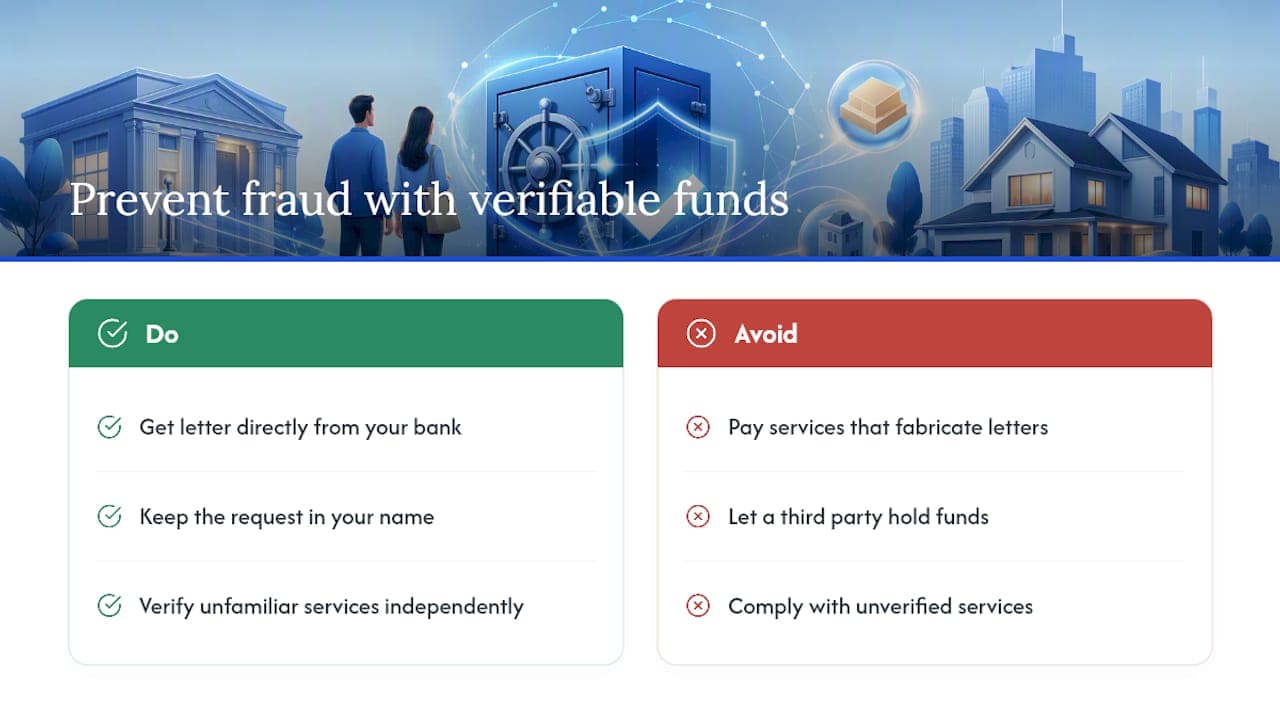
Buyers sometimes get approached by services offering to generate a proof of funds letter for a fee, without any real account backing it. These arrangements can constitute fraud, and a seller’s title company or attorney verifying the letter by calling the issuing bank will catch a fabricated document quickly, killing the deal and potentially triggering legal consequences for the buyer who submitted it.
On the seller side, forged or doctored letters have shown up in real estate fraud cases, which is exactly why verification calls to the bank have become standard practice rather than a courtesy. If you’re a legitimate buyer, this works in your favor: a real, verifiable letter from a regulated institution separates you immediately from anyone submitting fake documentation.
The safest approach is straightforward. Get your letter directly from your bank or credit union, keep the request in your own name, and never let a third party “hold” or “certify” funds on your behalf outside a regulated institution. If a seller’s agent asks you to use a specific unfamiliar verification service, verify that service’s legitimacy independently before complying, since scammers sometimes target buyers at exactly this stage of a transaction.
Alternatives to a Bank Letter That Sellers Sometimes Accept
A formal bank letter is the gold standard, but it isn’t the only document that works in every situation. Brokerage account statements showing settled cash balances, especially when accompanied by a letter from the brokerage itself, function similarly to a bank letter for buyers holding funds in investment accounts.
Certified financial statements from an accountant can work for buyers with complex holdings across multiple entities, particularly in commercial deals. A recent, unredacted bank statement (or a lightly redacted one showing only the balance and account holder name) sometimes satisfies a listing agent early in negotiations, even if a formal letter gets requested later before closing.
Escrow or attorney trust account confirmations occasionally substitute for a bank letter when funds are already sitting with a third party managing the transaction. None of these alternatives override lender-required documentation for a financed purchase. Underwriters typically want the bank letter format specifically, since it’s the version their compliance process is built around.
How Proof of Funds Ties Into Earnest Money Deposits
Earnest money and proof of funds solve two different problems, but sellers often expect both before they’ll take an offer seriously. Earnest money is a deposit, usually 1% to 3% of the purchase price, that shows you’re financially committed to the deal and gives the seller compensation if you back out without a valid contingency.
Proof of funds shows the bigger picture: that you have enough money for the earnest deposit and the rest of the purchase. A seller reviewing a cash offer wants to see that your proof of funds balance comfortably covers both the earnest money already wired and the remaining purchase price still due at closing. If those numbers look too close together, it can raise questions about whether you’ve accounted for closing costs on top of the purchase price itself.
During negotiations, a strong proof of funds letter can sometimes reduce how much earnest money a seller asks for, since the letter already demonstrates financial capacity. The reverse also happens: a seller nervous about a buyer’s documentation might ask for a larger earnest deposit as a hedge, even after receiving a proof of funds letter, particularly in a bidding war where multiple offers are competing on the same property.
HouseGoodbye’s Take: Verified Funds Change How Fast Deals Close
We watch sellers respond to strong financial verification the same way every time: faster decisions, fewer stalled negotiations, less back and forth over “what if the deal falls apart.” When buyers show up with a clean, current proof of funds letter, sellers stop worrying about financing risk and start focusing on price and timeline.
That’s part of why competing cash offers work the way they do. When multiple vetted investors bid with verified funds already in hand, a homeowner isn’t gambling on whether a buyer’s financing survives underwriting. Comparing how multiple cash offers work for sellers makes clear why verification upfront, not promises later, is what actually shortens time on market.
— Bryan
Where to Verify Proof of Funds Rules Yourself
For consumer protections during the homebuying process, check the Consumer Financial Protection Bureau. For housing market context, the FHFA tracks trends shaping seller expectations, and the FTC covers safe document sharing.
Sources
- Consumer Financial Protection Bureau — Owning a home
- CNBC Select — Proof of Funds Letter
- Investopedia — Proof of Funds
FAQ
How Do I Show Proof of Funds for Buying a House?
Request a letter directly from your bank or credit union confirming your name, account balance, and verification date on official letterhead. Most institutions issue this within one business day to a few business days.
What Documents Can I Use as Proof of Funds for a Property Purchase?
A bank-issued proof of funds letter is the standard, but a recent brokerage statement showing settled cash, a certified accountant statement, or an escrow trust confirmation can work in specific situations. Lenders reviewing a financed purchase typically require the formal bank letter format.
What Qualifies as Proof of Funds?
Liquid, accessible cash qualifies: checking, savings, money market accounts, and settled brokerage cash. Retirement accounts, CDs with early withdrawal penalties, and unrealized home equity generally don’t qualify without extra steps, according to Investopedia’s definition of proof of funds.
How Long Is a Proof of Funds Letter Valid?
Most sellers accept a letter dated within 30 to 90 days of the offer. If escrow runs longer than that window, request a refreshed letter from your bank.
Can I Use a Bank Statement Instead of a Proof of Funds Letter?
A bank statement sometimes works early in negotiations, but formal offers, especially all-cash bids or short-close deals, usually require a signed letter on bank letterhead. CNBC Select notes that sellers increasingly prefer the formal letter over a raw statement.