When several buyers bid on your house, the highest number is not automatically the best offer. The best one is the offer most likely to close, on a date that works for you, for the most money you actually keep. If you are a Michigan homeowner who needs to sell quickly, you can also create that competition on purpose: on HouseGoodbye, several vetted local cash buyers bid on the same house as-is, and you compare every number with no obligation to accept any of them.
This guide shows how to read each offer, where offers go wrong, and how cash bids fit in.
TL;DR
- Multiple offers give you leverage, but price is only one part of each offer. Financing, contingencies, closing date and earnest money decide whether the deal closes.
- Compare offers on net proceeds: price minus concessions, repairs and costs, then ask how likely each is to reach closing.
- A counteroffer cancels the original offer, so decide before you counter.
- Cash offers have no mortgage lender or appraisal, which is why they can close in days instead of months. In our marketplace, typical close is about 7 days versus roughly 73 days on the MLS.
- If your house needs repairs, is vacant, inherited or facing foreclosure, you can request competing as-is cash offers without listing it.
Table of Contents
- What multiple offers mean for you as a seller
- How to compare offers side by side
- Contingencies: every one is an exit door
- Highest and best, counteroffers and escalation clauses
- Cash offer or financed offer: what you are really trading
- Getting multiple offers when you don’t want to list
- A short checklist before you accept any offer
- FAQ
- Sources
What multiple offers mean for you as a seller
A multiple-offer situation means more than one buyer has put a purchase proposal in front of you at the same time. It usually signals that the home is priced well and in demand, and it gives you room to negotiate on price, contingencies and timing, not just one of them.
That room only helps if you use it. The National Association of Realtors (NAR), the country’s largest real estate trade association, says price is only one of several elements that vary between offers. Financial terms, contingencies, closing timeline and earnest money deposits can make an offer more or less attractive, so the strongest offer may not carry the highest price.
Two definitions help here:
- Contingency: a condition that must be met before the buyer is bound to buy, such as getting a mortgage or passing an inspection. If it isn’t met, the buyer can usually walk away and get their earnest money back.
- Earnest money: a deposit the buyer puts down to show they are serious. It is normally credited toward the purchase at closing.
How to compare offers side by side
Put every offer in one table before you react to any of them. Zillow’s seller guidance suggests laying offers out together and comparing price after seller concessions, financing, down payment, earnest money, appraisal coverage, contingencies and the closing date.
Here is a simple version you can copy:
| What to compare | Why it matters | Question to ask |
|---|---|---|
| Offer price | The starting number, not the end number | What is it before any concessions? |
| Closing help requested | Reduces what you keep | How much is the buyer asking you to cover? |
| Financing type | Decides how likely the deal is to close | Cash, mortgage, or both? Who is the lender? |
| Contingencies | Each is a way for the buyer to exit | How many, and how long do they last? |
| Earnest money | Shows commitment | How large, and when is it due? |
| Closing date | Affects your move and your carrying costs | Does it fit my plans? |
| Repairs and condition | Can cost you money or time | Does the buyer take the house as-is? |
Closing assistance can quietly shrink a high bid
Realtor.com’s negotiation guide quotes an agent explaining that every offer has five main parts: price, closing assistance, closing date, financing and contingencies. It adds that first-time buyers commonly ask sellers to cover about 2% to 3% of closing costs. On a $200,000 house, that is $4,000 to $6,000 off your bottom line. An offer $3,000 higher with a 3% credit attached is actually the lower offer.
Work out net proceeds
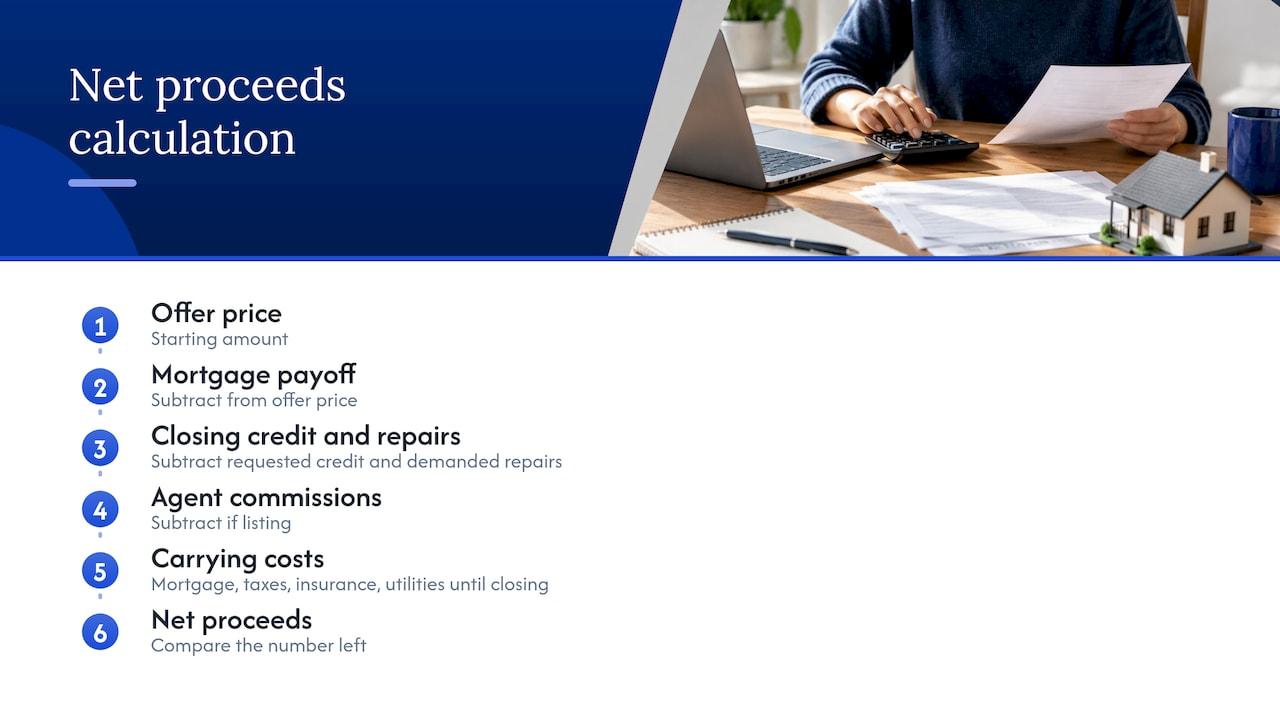
For each offer, write down: offer price, minus your mortgage payoff, minus any closing credit requested, minus repairs the buyer will demand, minus agent commissions if you are listing, and minus the cost of carrying the house (mortgage, taxes, insurance and utilities) until the closing date. The number left is the one to compare.
Contingencies: every one is an exit door
Contingencies are where a strong-looking offer turns weak. Zillow explains the common ones:
- A financing contingency typically gives the buyer 30 to 45 days to secure a mortgage.
- An inspection contingency lets the buyer ask for repairs or credits, or walk away.
- An appraisal contingency lets the buyer renegotiate or leave if the home appraises below the price.
- A home-sale contingency ties your sale to the buyer selling their own house first.
The same Zillow page cites a 2025 survey in which 85% of buyers included at least one contingency in their final offer, and 29% of sellers had an offer fall through because the buyer couldn’t secure homeowners insurance. Money and financing problems are the most common reason sellers report a deal collapsing.
HousingWire’s June 2026 offer-risk checklist notes that, per NAR data, around 18% of buyers waive the inspection contingency, a little less than a year earlier. It also advises verifying who is actually writing the buyer’s loan. A truly clean offer is worth more than it used to be.
To check financing strength, ask whether the buyer is pre-approved (a lender has reviewed their finances and documents) rather than only pre-qualified (a quick estimate). Experian suggests also asking whether the buyer could cover an appraisal gap, the difference if the home appraises below the offer price.
Highest and best, counteroffers and escalation clauses
In a hot market, sellers sometimes ask all buyers for their “highest and best” offer by a deadline. It can lift prices, but it is easy to mishandle. Three rules protect you:
- A counteroffer ends the original offer. NAR’s consumer guide warns that once you counter, you cannot go back and accept the original terms. Decide which offer you really want before you send one.
- Never let two buyers both accept at once. DocJacket, a transaction-management platform, warns that countering several offers at once can leave you bound to two contracts on one property. Spell out that acceptance isn’t final until you re-sign.
- Read escalation clauses closely. The same source says the front-page number isn’t the real price: work out the base price, the increment and the cap.
Be straightforward with the buyers you turn down. NAR’s older multiple-offer guide notes that only one offer results in a sale, and that prompt, open communication helps buyers feel they were treated fairly. It also notes that state law or regulations may limit what a broker can disclose about offers, so ask your agent or attorney what you may share.
Cash offer or financed offer: what you are really trading
If speed or simplicity matters, cash deserves a hard look. NAR says sellers who want to move quickly may prefer shorter closing timelines, and those who want a simpler process may prefer all-cash offers that eliminate mortgages and financing. Experian adds that cash offers can shorten closing by up to 60 days because there is no mortgage lender involved.
What that means in practice:
- No lender approval. There is no underwriting queue that can stall or deny the deal.
- No appraisal gap. The sale doesn’t depend on a lender’s valuation matching the price.
- Fewer exit doors. Fewer contingencies mean fewer ways for the deal to fall apart. Our guide on why cash buyers reduce sale risk goes deeper.
- A predictable date. You can plan your move, your next lease or a foreclosure deadline around it. See what happens at the table in our cash closing process explainer.
The fair comparison is net proceeds against certainty and time. A financed buyer at a higher price still has to survive the loan process. If a deal falls through after a long closing period, Realtor.com notes you must relist and wait for new offers, and the agent it quotes calls asking a seller to wait more than 30 to 60 days to go under contract “over the line.” For a homeowner with a foreclosure date, a probate deadline or a job start date, those lost weeks cost more than a few thousand dollars.
Getting multiple offers when you don’t want to list
Most advice on multiple offers assumes you list the house, clean it, stage it, host showings and hope buyers show up together. That works for a move-in-ready home in a busy season. It fits poorly if your house is vacant, damaged, inherited, behind on payments or carrying code violations, or if you simply don’t have months.
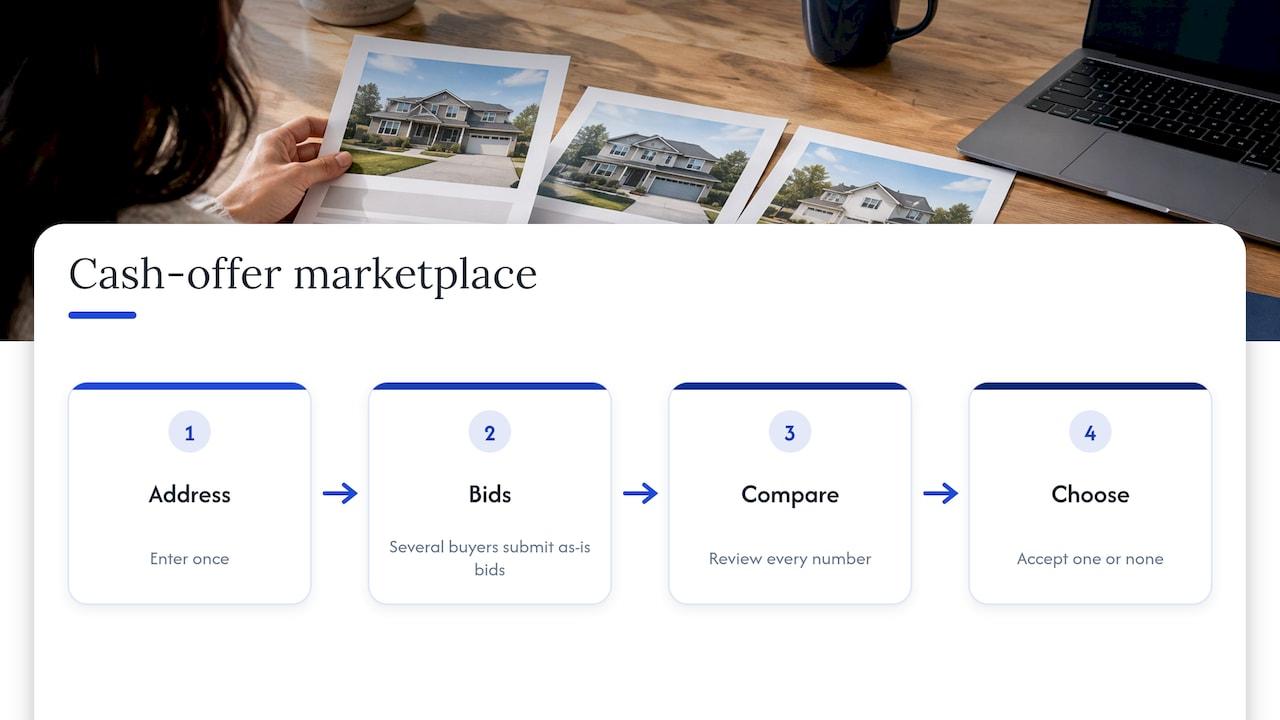
The alternative is to bring the competition to you. In a cash-offer marketplace, you enter your address once, and several buyers each submit an as-is bid. You see every number, compare them with the table above, and accept one or none. Our walkthrough on how multiple cash offers work for home sellers covers the steps, and the role of competing cash offers explains why bidding against each other matters.
Where HouseGoodbye fits
HouseGoodbye is a Michigan marketplace, not a single cash buyer. Multiple vetted local cash buyers bid on your house as-is, in any condition, across Metro Detroit, Grand Rapids, Flint, Lansing and the rest of the state. There are no listing fees, no agent commissions and no required repairs, and you are never obligated to accept. You can request competing cash offers here.

If you are in a specific situation, these pages are built for it:
- Behind on payments or facing a sale date: selling to avoid foreclosure
- Heirs handling an estate: selling an inherited house
- Short on time in general: selling your house fast for cash
If you face foreclosure, also contact your mortgage servicer, a HUD-approved housing counselor or a real estate attorney about your options and deadlines. For an estate, the probate court and an attorney decide who has the authority to sell.
A short checklist before you accept any offer
- Write down the net number for each offer, after concessions, repairs and carrying costs.
- Confirm the money. For a financed buyer, ask for a pre-approval letter and the lender’s name. For a cash buyer, ask for recent proof of funds in the buyer’s or the purchasing company’s name.
- Count the exit doors. List every contingency and how many days it runs.
- Match the closing date to your life. A date that is too early can be as awkward as one that is too late if you still need to move or clear the house.
- Check the earnest money. A larger deposit signals commitment.
- Decide on any counter before sending it. Remember that it voids the original offer.
- Get it in writing. Verbal promises on repairs, credits or timing don’t count.
If you want a closer look at speed, our seller playbook for closing in 7 to 10 days shows what has to be ready on your side.
Our view: competition should work for the seller
We built HouseGoodbye around one idea: a homeowner under pressure shouldn’t have to take the first number someone offers. When one buyer is the only voice in the room, that buyer sets the price, the timeline and the terms. When several vetted local buyers bid on the same house, the seller sees the real range and decides.
That matters most when the house isn’t easy to list. A vacant property, a fire or water-damaged home, a house with code violations or one tied up in an estate or a divorce can take months on the MLS and still need work first. Our typical close is about 7 days versus roughly 73 days on the MLS, with $0 in commissions and no repairs, showings or obligation.
Our advice is simple. Compare every offer by what you keep and how surely it closes, and let the buyers compete for your house.
Bryan
FAQ
Can I accept more than one offer on my house?
No. You can only sign one binding contract for the sale. Be careful when countering several buyers at once: if two accept, you could be bound twice, so state in writing that acceptance isn’t final until you re-sign. A real estate attorney can review the wording before you send it.
What should I look at besides the price?
Look at financing, contingencies, closing assistance, earnest money and the closing date. NAR notes that these terms can make a lower-priced offer the stronger one. Convert each offer to net proceeds so the comparison is fair.
Are cash offers better than financed offers?
Cash offers remove the lender and the appraisal, so they typically close faster and have fewer ways to fall through. If speed and certainty matter most, as with foreclosure, an inherited house or a job move, they are often the better fit. On HouseGoodbye you compare several cash bids side by side.
Can I get multiple offers without listing my house?
Yes. In Michigan you can enter your address on HouseGoodbye and receive competing as-is cash offers from vetted local buyers. There are no listing fees, agent commissions or required repairs, and you can walk away if no number works.
Sources
- NAR: Consumer Guide: Navigating Multiple Offers
- NAR: A Buyers’ and Sellers’ Guide to Multiple Offer Negotiations
- Zillow: Offers: How to Decide Which One Is Best for You
- Realtor.com: The Negotiation Process of Selling a Home
- HousingWire: Offer risk checklist for real estate agents and sellers
- Experian: How to Decide Between Multiple Offers on Your Home
- DocJacket: Multiple Offers on a House: How to Handle Them