Cash buyers reduce sale risk by removing the two biggest threats to any home sale: financing failure and time. When a buyer pays with cash, there is no mortgage to approve, no underwriter to satisfy, and no lender appraisal that can torpedo a deal at the last minute. The result is a faster, more predictable closing that keeps your home off the market and your plans on track.
Here is exactly what that means in practice:
- No financing contingency means the deal does not collapse because a lender says no
- Closings typically happen faster than the lengthy process a mortgage requires
- Fewer contingencies overall, since appraisal and financing clauses are usually waived
- Verified funds give you confidence the buyer can actually close
- No appraisal gap risk, so you avoid renegotiating price after a low appraisal
What exactly is a cash offer in real estate?
A cash offer means the buyer pays the full purchase price without a mortgage. No bank, no underwriter, no loan officer involved. Payment typically arrives via wire transfer or cashier’s check at closing, and the paperwork is considerably lighter than a financed deal.
What makes this different from a standard offer is the absence of lender involvement. With a financed buyer, the lender controls much of the timeline: ordering the appraisal, running underwriting, issuing a commitment letter. With cash, that entire layer disappears. Title work still happens, escrow still holds funds, but the process moves on the buyer’s schedule rather than a bank’s.
Cash buyers range from individual investors to institutional buyers to retirees who have sold a previous home and are buying outright. Each type has different motivations, but the core advantage to you as the seller stays the same: no third party can pull the plug on the deal.
Why cash buyers reduce sale risk more than financed buyers
Speed is the most obvious advantage, but certainty is the more valuable one. Financing contingencies cause about 40% of deal failures, according to real estate data. That is a staggering number when you consider how much time, money, and emotional energy sellers invest between accepting an offer and reaching the closing table.
- Faster closings. Cash sales can close in as little as two weeks, while mortgage-dependent transactions typically take 30–60 days.
- No financing denial. Without a lender, there is no approval to lose. The deal lives or dies on the buyer’s own funds.
- Fewer contingencies. Typical contingencies like financing, appraisal, and inspection clauses are often waived or sharply limited in cash transactions.
- No appraisal gap. Cash buyers rarely require an appraisal, so a low appraisal cannot force a price renegotiation in a rising market.
- Lower holding costs. A shorter timeline means fewer weeks of mortgage payments, utilities, insurance, and property taxes eating into your proceeds.
The math on holding costs matters more than most sellers realize. Every extra month a financed deal drags on costs you money in carrying expenses. A cash sale that closes two weeks after acceptance can easily offset a slightly lower offer price.
Sellers facing a time crunch, whether from a job relocation, a divorce, or an inherited property, often find that cash sales close faster in ways that genuinely change the financial outcome, not just the calendar.

Potential downsides of accepting a cash offer
Cash offers are not automatically the right choice for every seller. The trade-offs are real, and you should weigh them honestly before signing.
- Lower initial offer price. Research from UC San Diego found that all-cash buyers pay roughly 10% less than mortgage buyers on average. That gap can be meaningful depending on your home’s price point.
- Less competitive bidding. In a hot market with multiple financed offers, a single cash offer may not represent the ceiling of what your home could fetch.
- Reduced buyer due diligence. Some cash buyers, particularly institutional investors, move quickly and may skip inspections. That can create post-sale disputes if the buyer later claims undisclosed issues.
- Contingencies can still exist. Inexperienced or first-time cash buyers sometimes include inspection contingencies anyway, so “cash offer” does not automatically mean “no contingencies.”
- Your timeline and goals matter. If you have months of flexibility and want to maximize price, holding out for a financed buyer in a competitive market may yield more. Cash makes the most sense when speed, certainty, or simplicity outweighs the last dollar.
The net proceeds calculation often surprises sellers. Avoided holding costs such as mortgage payments, utilities, and maintenance can offset a lower sale price, especially when a financed deal stretches across two or three months.
How to vet a cash buyer and protect yourself
Not every “cash buyer” is equally reliable. Vetting matters just as much here as it does with financed buyers, just for different reasons.
- Request proof of funds immediately. A bank statement, investment account statement, or letter from a financial institution showing liquid assets equal to or greater than the purchase price. Anything less is a red flag.
- Confirm an earnest money deposit. A serious cash buyer puts money in escrow quickly. Confirming earnest money early discourages buyers who are not fully committed from stringing you along.
- Know who you are dealing with. Individual buyers and institutional investors have very different practices. An individual may be more flexible on terms; an institutional buyer may move faster but offer less.
- Check their track record. Ask how many cash purchases they have completed recently. A buyer who has closed ten deals in the past year is a different risk profile than someone buying their first investment property.
- Review the contract carefully. Even cash deals have contingencies sometimes. Read every clause before you sign.
Pro Tip: Use a platform or service that pre-screens buyers and verifies funds before presenting offers to you. That single step removes most of the vetting burden from your shoulders.
Understanding buyer types and their motives helps you customize both your vetting process and your negotiation approach. An institutional investor buying to rent will negotiate differently than an individual buying to flip.
What a typical cash closing timeline looks like
The speed of a cash closing is one of its clearest advantages over a financed transaction. Here is how the two compare:
| Stage | Cash closing | Financed closing |
|---|---|---|
| Offer to acceptance | — | — |
| Title search and escrow setup | 3–4 days | 5–7 days |
| Inspection (if included) | 3–4 days | 5–10 days |
| Appraisal | Not required | 7–14 days |
| Lender underwriting | Not required | 10–14 days |
| Final walkthrough and closing | — | — |
| Total typical timeline | 7–14 days | 30–60 days |
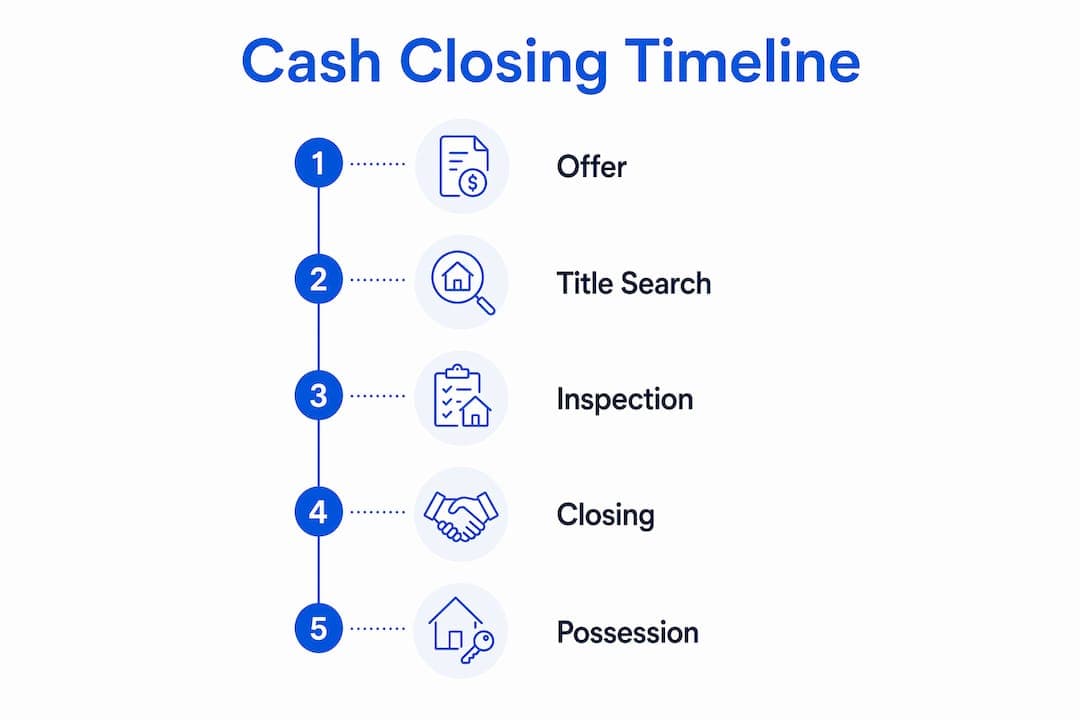
The absence of lender underwriting and appraisal is what compresses the timeline so dramatically. A title company still runs a title search and manages escrow, which protects both parties, but that work moves in parallel with other steps rather than waiting on a bank’s queue.
Paperwork is lighter too. Without a loan package, there are no lender disclosures, no Truth in Lending statements, and no last-minute conditions from an underwriter. The closing document stack shrinks considerably, and the chance of a last-minute delay drops with it.
How Housegoodbye helps sellers get fast, low-risk cash offers
Housegoodbye was built specifically for sellers who want the certainty of a cash sale without the guesswork of finding a reliable buyer on their own. The platform generates multiple competing cash offers from verified investors, which addresses the single biggest concern sellers have about cash deals: accepting a lowball offer because they had no alternatives to compare.
Key ways Housegoodbye reduces your sale risk:
- Competing offers. Multiple verified buyers bid for your property, pushing prices up and giving you real options rather than a take-it-or-leave-it scenario.
- Seven-day closing guarantee. Housegoodbye commits to closing in as little as seven days, cutting carrying costs to a minimum.
- As-is sales. You sell the home in its current condition. No repairs, no staging, no pre-sale inspection surprises. Learn more about selling as-is and what it means for your net proceeds.
- No agent fees. Traditional agent commissions typically run 5–6% of the sale price. A cash sale eliminates agent fees entirely, which can add up to tens of thousands of dollars depending on your home’s value.
- Built for urgent situations. Sellers dealing with financial hardship, relocation, divorce, or an inherited property get a process designed around their timeline, not a lender’s.
When sellers most often prefer cash buyers
Certain situations make the certainty of a cash offer worth more than a higher financed offer. These are the scenarios where sellers consistently choose cash.

Urgent relocation. A job offer in another city with a two-week start date leaves no room for a 60-day financed closing. Cash buyers are often the only realistic option. Sellers in this position frequently turn to services that handle inherited home sales and urgent relocations with equal speed.
Inherited property. Heirs who live out of state and inherit a home they do not want to maintain have strong incentives to close fast. A cash buyer removes the months of carrying costs, insurance, and maintenance that pile up while a traditional listing sits on the market.
Financial distress. Sellers facing foreclosure, mounting debt, or a divorce settlement deadline need a closing date they can count on. A financed deal that falls apart at week seven is not just inconvenient; it can be financially catastrophic. Cash buyers offer peace of mind in exactly these high-stakes situations.
Homes needing significant repairs. A property with a failing roof, outdated electrical, or foundation issues will struggle to pass a lender’s appraisal. Cash buyers who purchase as-is bypass that problem entirely, and sellers avoid the cost of pre-sale repairs that may not return their full value at closing.
Competitive markets with appraisal risk. When home prices are rising fast, financed buyers face appraisal gaps where the lender’s appraised value comes in below the agreed sale price. The buyer then has to make up the difference in cash or renegotiate. Cash buyers avoid appraisal gaps entirely, protecting the agreed price.
How cash buyers change your negotiation leverage
Accepting a cash offer does not mean surrendering your negotiating position. In many situations, it strengthens it.
When you receive a cash offer alongside financed offers, the cash offer becomes a floor. You can go back to financed buyers and ask them to match or beat it, knowing the cash deal is already on the table. That dynamic shifts pressure onto the financed buyers rather than onto you.
Cash buyers also tend to negotiate on terms rather than price. They may ask for a faster closing, a leaseback period, or specific personal property. Those are often easier concessions to make than a price reduction, and they give you room to hold firm on the number that matters most.
The common mortgage pitfalls that financed buyers face, from appraisal shortfalls to last-minute underwriting conditions, give cash buyers a structural advantage in any negotiation. Sellers who understand that dynamic can use it to their benefit rather than simply accepting the first offer that arrives.
One underappreciated point: a cash offer with a short inspection window and a 10-day close is often worth more to a seller than a financed offer that is $15,000 higher but carries a 45-day timeline and a financing contingency. The certainty has real dollar value, and experienced sellers price it accordingly.
Key Takeaways
Cash buyers reduce sale risk primarily by eliminating financing failure, cutting closing timelines to 7–14 days, and removing contingencies that derail traditional home sales.
| Point | Details |
|---|---|
| Financing failure is the top risk | Financing contingencies cause about 40% of deal failures; cash buyers eliminate this entirely. |
| Cash closings are dramatically faster | Cash deals close significantly faster than mortgage-dependent transactions. |
| Holding costs offset lower prices | Avoided carrying expenses can offset a lower cash offer compared to financed ones. |
| Vetting still matters | Always request proof of funds and a prompt earnest money deposit before proceeding. |
| Competing offers protect your price | Platforms like Housegoodbye generate multiple verified bids, preventing lowball outcomes. |
FAQ
Why do sellers prefer cash buyers?
Cash buyers eliminate financing contingencies, which cause about 40% of deal failures. Sellers prefer them because the deal is far less likely to fall apart at the last minute.
Do cash buyers close faster?
Yes. Cash sales typically close in 7–14 days, compared to 30–60 days for financed transactions, because there is no lender underwriting or appraisal process to wait on.
Are cash offers always lower than financed offers?
Research from UC San Diego found that all-cash buyers pay roughly 10% less on average, but avoided holding costs and agent fees often close that gap considerably.
How do you verify a cash buyer is legitimate?
Request a bank statement or financial institution letter showing liquid assets equal to the purchase price, and confirm an earnest money deposit into escrow promptly after acceptance.
When does accepting a cash offer make the most sense?
Cash offers make the most sense when speed, certainty, or the home’s condition makes a financed sale risky, such as urgent relocations, inherited properties, homes needing major repairs, or situations involving financial distress.