The fastest reliable way to sell a Michigan home for cash is through a vetted cash-offer marketplace that gathers competing bids from local investors. You skip repairs, skip the listing process, and can close in as little as seven days. The single biggest trade-off: cash offers typically run 10–20% below what a well-marketed MLS sale would produce. For most homeowners who need speed and certainty, that gap is worth it.
Key trade-offs to weigh before you decide:
- Speed vs. net proceeds. A cash sale closes in 7–30 days. A traditional listing takes 60–90 days or longer and usually nets more, but only if the home is in good condition and the market cooperates.
- Fees vs. commissions. Cash sales still carry Michigan transfer taxes and title fees, but you skip typical agent commission rates. Seller closing costs in Michigan average about 4.06% of the sale price before commissions.
- Certainty. A cash offer from a vetted buyer with proof of funds has no financing contingency. It either closes or it doesn’t, and you know quickly.
Next step: Submit your address on Housegoodbye to receive competing, obligation-free bids from vetted Michigan investors.
Key Takeaways
Selling your Michigan home for cash through a vetted marketplace that generates competing investor bids is the fastest, lowest-friction route for homeowners who prioritize speed and certainty over maximum net proceeds.
| Point | Details |
|---|---|
| Cash offers trade price for speed | Cash bids typically run 10–20% below a well-marketed MLS sale; acceptable when time or condition matters. |
| Closing costs still apply | Michigan transfer taxes, title fees, and prorated taxes remain; budget roughly $4,100–$4,600 on a $300,000 sale. |
| Tax exclusion protects most sellers | The IRS 2-of-5-year rule excludes up to $250,000 ($500,000 married) in gains; consult a tax professional if you don’t qualify. |
| Vetting buyers protects you | Always require proof of funds, a licensed title company, and a written contract before signing anything. |
| Housegoodbye delivers competing bids | Submit your address once to receive multiple vetted investor offers, with closings possible in as little as 7 days. |
Table of Contents
- What are your real options to sell a house for cash in Michigan?
- How does a cash sale actually work, step by step?
- What you pay and what you keep: costs, fees, and taxes on a Michigan cash sale
- How to pick the right cash-sale route for your situation
- How to vet cash buyers and avoid scams in Michigan
- Why Housegoodbye is a practical choice for fast cash sales in Michigan
- What happens after you accept a cash offer
- What the cash-sale process gets right, and what sellers miss
- Get competing cash offers on your Michigan home with Housegoodbye
- Sources
- FAQ
What are your real options to sell a house for cash in Michigan?
Three practical routes exist. Each serves a different priority.
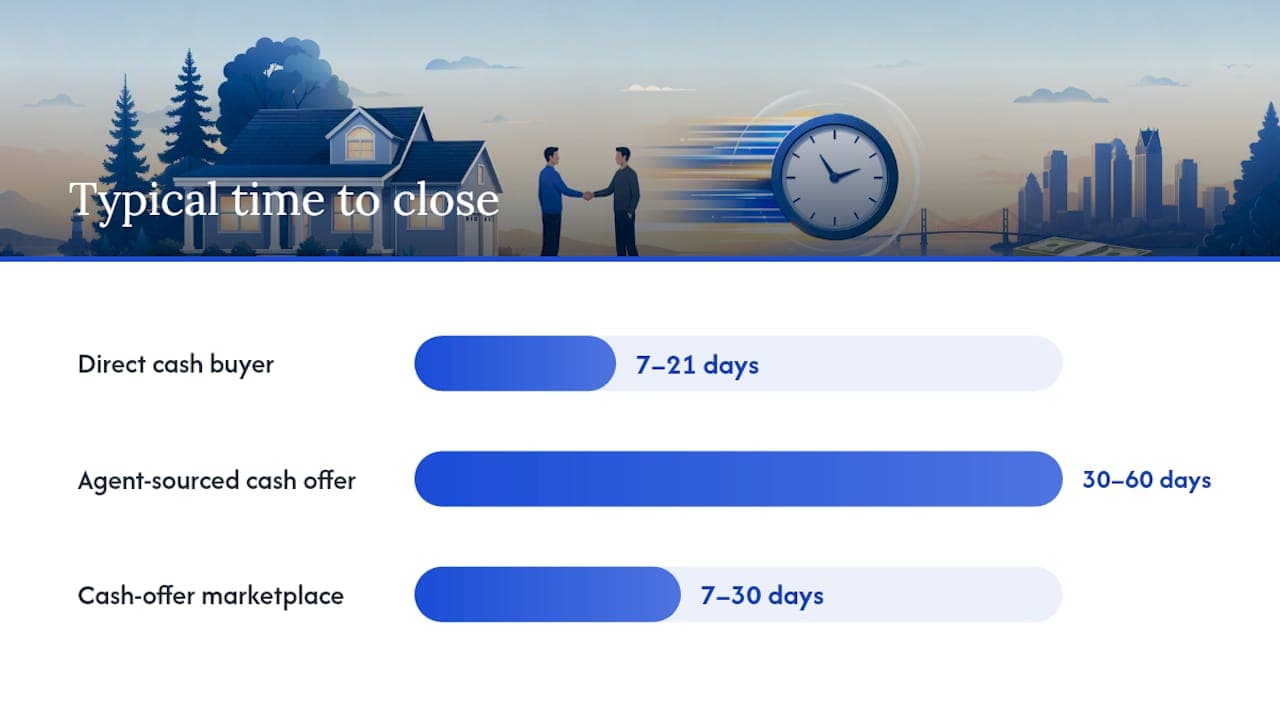
Local investor or direct cash buyer. You find a single investor or “we buy houses” operation, get one offer, and negotiate from there. Speed is real, but you have no competing bids to push the price up. The offer you get is the only offer you get.
Agent-sourced cash buyers. A real estate agent markets your home specifically to cash buyers or runs a short listing to attract investor interest. You get some market exposure, but you still pay commission and the timeline stretches to 30–60 days.
Cash-offer marketplace. You submit your property once and receive competing bids from multiple vetted local investors. The competition among buyers tends to improve your offer price compared to a single-buyer negotiation, and the platform handles vetting so you’re not screening strangers yourself.

The table below maps the main decision dimensions across these three routes.
| Dimension | Direct cash buyer | Agent-sourced cash offer | Cash-offer marketplace |
|---|---|---|---|
| Best for | Sellers who already know a buyer | Sellers who want some market exposure | Sellers who want speed and competing bids |
| Typical time to close | 7–21 days | 30–60 days | 7–30 days |
| Sell as-is | Yes | Sometimes | Yes |
| Expected net vs. market | 80–90% | 80–90% | 80–90% |
| Typical fees/commissions | None to seller | 5–6% agent commission | No listing commission |
| Certainty of closing | High (no financing contingency) | Moderate | High (vetted buyers) |
Homes with title problems, unpermitted work, probate complications, or tenants in place are often better suited to cash buyers than to financed buyers, who tend to walk away from those complications. If your home has any of those issues, a marketplace or direct investor route is worth prioritizing.
How does a cash sale actually work, step by step?
The process is shorter than most sellers expect. Here’s what happens from first contact to keys handed over.
-
Request offers. Submit your property address and basic details (condition, timeline, any known issues) to a cash-offer platform or individual investor. On a marketplace like Housegoodbye, this triggers outreach to multiple vetted local buyers simultaneously.
-
Receive bids. Competing investors review the property details and submit written offers, typically within 24–72 hours. On a single-buyer route, you get one offer and negotiate directly.
-
Review and choose an offer. Compare offers on net proceeds, closing timeline, contingencies, and who pays which closing costs. Ask every buyer for written proof of funds before you sign anything.
-
Inspection and due diligence. Most cash buyers still conduct a walkthrough or light inspection, usually within 3–7 days of acceptance. “As-is” means they won’t require you to make repairs, but they may adjust the offer price based on what they find. Expect this window.
-
Title work. A licensed title company or real estate attorney searches the title, clears any liens, and prepares the deed. This is the step most likely to extend your timeline if there are outstanding tax liens, an open mortgage, or estate issues. Budget 5–14 days for a clean title; longer if complications surface.
-
Closing. You sign the deed and closing documents, the buyer wires funds to escrow, and the title company disburses your net proceeds. You hand over the keys.
Typical timelines: A genuinely clean title with a motivated buyer can close in 7 days. More commonly, 14–21 days is realistic when you factor in the inspection window and title search. If there’s a lien to clear or a payoff to coordinate with a lender, 21–30 days is a reasonable expectation. See how selling your house for cash works for a full platform walkthrough.
Documents to have ready:
- Government-issued photo ID
- Current mortgage statement and payoff amount
- Property deed (or confirmation of where it’s recorded)
- Most recent property tax bills
- Recent utility bills (last 2–3 months)
- Any known disclosure items (lead paint, water damage, structural issues)
- HOA documents if applicable
What you pay and what you keep: costs, fees, and taxes on a Michigan cash sale
Selling for cash removes the agent commission, but several costs remain. Knowing them in advance prevents surprises at the closing table.
Costs that stay in a cash sale:
- Michigan state transfer tax
- County transfer tax
- Title search and title insurance fees
- Recording fees
- Prorated property taxes (you pay your share up to the closing date)
- Mortgage payoff wire fees (if you carry a balance)
Costs that disappear:
- Buyer’s loan origination and appraisal fees (not your problem in a cash deal)
- Agent listing commission (~6.2% on a traditional sale)
- Staging, photography, and open-house costs
Michigan transfer taxes and sample closing math
Michigan’s state transfer tax is $3.75 per $500 of sale price ($7.50 per $1,000). Most counties add $0.55 per $500 ($1.10 per $1,000). On a $300,000 sale, that math looks like this:
For a precise estimate tied to your sale price, use a Michigan seller closing-cost calculator before you accept any offer. Compare that to a traditional sale where average seller closing costs run about 4.06% of the sale price plus the ~6.2% commission, and the cash route’s fee savings become concrete.
Capital gains: the 2-of-5-year rule
IRS Section 121 lets most sellers exclude up to $250,000 of capital gain ($500,000 for married couples filing jointly) if they owned and used the home as their primary residence for at least 2 of the last 5 years. Michigan generally follows federal treatment for state taxable income, so if you qualify for the federal exclusion, you typically owe nothing at the state level either.
If your gain exceeds those limits, or if you haven’t met the 2-of-5-year test, consult a tax professional before closing. Investors selling rental properties may also want to review 1031 exchange basics as a potential tax-deferral strategy.
Pro Tip: Keep dated proof of primary residency for the full 2-year window: utility bills, official mail addressed to the property, medical or school records tied to that address. The IRS’s 2-of-5-year rule is strict, and documentation gaps can trigger an audit. A folder with 24 months of evidence is cheap insurance.
How to pick the right cash-sale route for your situation
The right route depends on your constraints, not on which option sounds best in theory.
Decision checklist — ask yourself:
- How quickly do you need to close? Under 21 days almost always means a cash route.
- What condition is the home in? Deferred maintenance, structural issues, or unpermitted work make financed buyers unlikely. Cash buyers accept these.
- Do you have title complications? Probate, liens, or a divorce decree on title can delay any sale, but cash buyers are more willing to work through them. See the guides on selling an inherited house or selling in probate for Michigan-specific steps.
- Are there tenants? Cash investors often buy with tenants in place. A traditional buyer typically won’t.
- What’s your net-proceeds floor? If you need 95%+ of market value, a cash sale probably won’t get you there. If 80–90% works given your timeline, it likely will.
- Have you run the tax math? If you’ve lived in the home fewer than 2 of the last 5 years, capital gains exposure changes the calculus.
Questions to ask every cash buyer before you sign:
- Can you provide written proof of funds today?
- Are there any financing or inspection contingencies in your offer?
- What is your inspection window, and will you adjust the price after inspection?
- Who pays which closing costs, and can you itemize them?
- Which title company or closing attorney will you use?
- What is your guaranteed closing date, and what happens if you miss it?
Red flags to walk away from:
- No escrow or title company involved
- Requests for an upfront fee or deposit from you
- Pressure to sign within hours, before you’ve reviewed the contract
- Refusal to provide proof of funds
- Vague or verbal-only answers about closing costs
How to vet cash buyers and avoid scams in Michigan
Michigan has active real estate investor communities, and most are legitimate. A small number are not. These steps protect you.
Verify funding before anything else
Ask for a bank statement or a letter from a financial institution confirming available funds equal to or greater than the offer price. A legitimate cash buyer provides this without hesitation. If they stall or offer a vague “we have funding lined up,” that’s a problem.
Confirm identity and business registration
Look up the buyer’s LLC or company name on the Michigan Department of Licensing and Regulatory Affairs (LARA) business search. A real investor operating in Michigan will have a registered entity. If the buyer is an individual, ask for a copy of their ID and confirm their name matches the purchase contract.
Insist on a licensed title company or real estate attorney
In Michigan, residential closings typically go through a title company or a licensed real estate attorney. The title company holds funds in escrow, conducts the title search, and disburses proceeds only when all conditions are met. Never wire funds directly to a buyer, and never sign a deed before the title company confirms the buyer’s funds are in escrow.
Check the contract terms carefully
Before signing, confirm: the inspection window and what triggers a price adjustment, any contingencies (there should be none in a true cash offer), the exact closing date, and who is named as the closing agent. If the contract names a title company you’ve never heard of, call that company directly to confirm they are handling the transaction.
Pro Tip: Call the title company listed on the contract before you sign, using a phone number you find independently (not one the buyer gives you). Confirm they have the file. This one step catches the most common cash-buyer fraud, where a fake title company name is used to intercept wire transfers.
The Fair Housing Act applies to all residential transactions. Sellers and buyers must avoid discriminatory language or practices during marketing and sale, regardless of whether the transaction is cash or financed.
Why Housegoodbye is a practical choice for fast cash sales in Michigan
Housegoodbye operates as a cash-offer marketplace: you submit your property once, and the platform routes your information to multiple vetted local investors who compete for your business. That competition is the structural difference between this route and calling a single investor.
What a 7–14 day closing looks like on the platform:
A Michigan homeowner submits their address and property details. Within 24–72 hours, competing bids arrive from local investors. The homeowner reviews offers, selects one, and the platform’s vetted buyer moves into the inspection window (typically 3–5 days). Title work runs concurrently. If the title is clean and the payoff is straightforward, closing happens in 7–14 days. The homeowner receives net proceeds via wire transfer at closing.
Platform features that matter to sellers:
- Multiple competing investor bids from a single submission
- Sell as-is, no repairs, cleaning, or staging required
- No listing commission or agent fees
- Buyers are vetted before they receive leads
- Regional focus on Michigan markets with local investor networks
- Obligation-free offers, no pressure to accept
What the platform guarantees vs. what varies: Housegoodbye can deliver offers quickly and connect you with vetted buyers. The exact net proceeds depend on investor bids, your home’s condition, and local market conditions, not on the platform itself. Closing in 7 days is possible on a clean title; 14–21 days is more common. The platform’s role is to maximize your options and remove friction, not to set the final price.
Sellers with rental properties or tenant complications can also review selling a rental property in Michigan for additional guidance on that specific scenario.
What happens after you accept a cash offer
Accepting an offer is the halfway point, not the finish line. Here’s what follows.
Inspection and due diligence window
Most cash buyers schedule a walkthrough within 3–5 days of acceptance. They’re assessing condition, not looking for reasons to kill the deal, but they may come back with a price adjustment if they find something significant. Respond promptly. Delays here push the closing date.
Title search and lien clearance
The title company orders a title search immediately after contract execution. They’re looking for outstanding mortgages, tax liens, judgment liens, HOA arrears, or any cloud on title. A clean search takes 5–7 business days. If a lien surfaces, it must be paid or negotiated before closing. Budget extra time if you know of any outstanding debts tied to the property.
Deed preparation and payoff coordination
The title company prepares the deed and coordinates the mortgage payoff with your lender. Your lender will issue a payoff statement valid through a specific date. The title company uses that figure to calculate your net proceeds. If the payoff expires before closing, they request an updated one.
Closing day
You sign the deed, the settlement statement, and any required Michigan disclosure documents. The buyer’s funds are already in escrow. The title company disburses your net proceeds, typically by wire transfer, the same day or the next business day.
Example timelines:
-
7-day close (best case): Day 1: contract signed. Days 2–4: inspection completed, title search ordered. Day 5: title clear, payoff confirmed. Day 6: closing documents prepared. Day 7: closing and wire transfer.
-
21-day close (typical): Day 1: contract signed. Days 2–5: inspection window. Days 3–10: title search (lien found, cleared by Day 10). Days 11–18: payoff coordination and deed preparation. Day 19: closing documents reviewed. Day 21: closing.
Moving and handoff checklist:
- Confirm the property condition agreement in writing (what stays, what goes)
- Schedule final utility meter reads for the closing date
- Transfer or cancel utilities in your name
- Complete a final walkthrough with the buyer the day before or morning of closing
- Hand over all keys, garage openers, and access codes at closing
What the cash-sale process gets right, and what sellers miss
Most sellers who regret a cash sale made the same mistake: they accepted the first offer without getting a second one. A single bid from a single investor is a negotiation with one party who has all the information and you have none. A marketplace that generates competing bids changes that dynamic entirely.
The other thing sellers consistently underestimate is the value of a clean title. Investors price title risk into their offers. If you know about a lien, an unpermitted addition, or a probate complication, address it or disclose it upfront. Buyers who find surprises during due diligence reduce their offers. Buyers who knew about the issue going in have already priced it. Transparency is a negotiating advantage, not a liability.
There’s also a version of this decision where a traditional listing is the right answer. If your home is in excellent condition, you’re not under time pressure, and the local market is active, a 60-day listing will almost certainly net you more than a cash offer. The question is whether your timeline and situation make that money worth waiting for.
Get competing cash offers on your Michigan home with Housegoodbye
Skip the listing, skip the repairs, and skip the months of uncertainty. Housegoodbye connects Michigan homeowners directly with vetted local investors who compete for your property, which means you see multiple offers from a single submission instead of negotiating blind with one buyer.

Three steps to get started: submit your address, receive competing bids within 24–72 hours, and choose the offer that works for you. No obligation to accept. No listing commission. Closing in as little as 7 days on a clean title, with 14–21 days being the more common range.
Compare real cash offers from Michigan buyers and see what your home is worth to local investors today. If you’re in a specific market, local pages like sell fast in Holland, MI show regional investor activity and timelines for your area.
Sources
Before closing, verify current rates and rules with these authoritative resources:
- Is a Cash Offer Right for Your Situation? What Michigan Sellers Should Know | The Patrick Group | The Patrick Group
- Seller Net Sheet Calculator | Michigan Closing Costs | Daryl Wizinsky
- Seller closing costs in Michigan | ListWithClever
- Hud
For complicated situations involving estate sales, divorce, tax liens, or tenants, consult a Michigan real estate attorney or a licensed CPA before accepting any offer. The rules are straightforward in simple cases and genuinely complex in others.
This article is general information, not a substitute for advice from a qualified financial advisor. Consult a qualified financial professional about your own circumstances before acting on anything here.
FAQ
Is selling a house for cash a good idea in Michigan?
It depends on your timeline and home condition. For sellers who need speed or have a property that won’t qualify for financed buyers, a cash sale is often the practical choice.
How do you avoid capital gains tax when selling a Michigan home?
Qualify for the IRS Section 121 exclusion by owning and living in the home as your primary residence for at least 2 of the last 5 years. That excludes up to $250,000 in gains ($500,000 married filing jointly), and Michigan generally follows federal treatment, so most sellers owe nothing at the state level either.
What is the best way to get a cash offer on your Michigan home?
Using a marketplace that generates competing bids from multiple vetted local investors tends to produce better offers than negotiating with a single buyer. Housegoodbye connects Michigan sellers with competing investor bids from a single submission, with no listing commission and no obligation to accept.
How much does it cost to sell a $300,000 house in Michigan for cash?
Expect roughly $4,100–$4,600 in closing costs: approximately $2,250 in state transfer tax, $330 in county transfer tax, and $1,500–$2,000 in title and recording fees.
How fast can you actually close a cash sale in Michigan?
Seven days is possible when the title is clean and the payoff is straightforward. Most cash closings in Michigan take 14–21 days once you factor in the inspection window and title search. Title complications or lien clearance can push that to 30 days.