TL;DR:
- Selling a cash sale during pre-foreclosure helps homeowners retain control, preserve equity, and protect credit. Foreclosure results in loss of ownership, significant credit damage, and potential deficiency judgments. Acting early and starting the process promptly is essential to maximize financial outcomes and avoid the long-term consequences of foreclosure.
A cash sale before foreclosure is one of the most effective ways to preserve equity and protect your credit score. The cash sale vs foreclosure outcome comparison comes down to one core fact: selling during pre-foreclosure keeps you in control, while foreclosure hands that control to your lender. Homeowners who act during the pre-foreclosure window can pay off their mortgage, retain remaining equity, and avoid a foreclosure notation on their credit report. Waiting for foreclosure to run its course typically results in equity loss, eviction, and credit damage that follows you for years.
What is the cash sale vs foreclosure outcome difference?
A cash sale during pre-foreclosure and a foreclosure outcome are not just different processes. They produce fundamentally different financial results for homeowners.
Pre-foreclosure begins when a lender files a notice of default after missed mortgage payments. The homeowner still holds legal title to the property during this period. That ownership status is the key advantage. You can list the home, accept a cash offer, pay off the mortgage, and walk away with whatever equity remains. Foreclosure, by contrast, is a court-approved legal process where the lender takes control and sells the property at auction.
A cash sale that fully pays off the mortgage generally results in far less long-term credit damage than foreclosure. Foreclosure lowers credit scores by 85–160 points and stays on your credit report for seven years. A cash sale avoids the foreclosure notation entirely, though any prior delinquencies remain on record.
The financial gap between the two outcomes is significant. Foreclosure auctions rarely generate enough to cover the full mortgage balance, which can trigger a deficiency judgment against you in many states. A cash sale, completed before auction, gives you the chance to satisfy the debt and keep any surplus.
What happens during pre-foreclosure and how does a cash sale fit in?
Pre-foreclosure is the period between a lender’s notice of default and the actual foreclosure auction. This window lasts 30 days to several months depending on your state, and it is the most valuable time you have to act.
During pre-foreclosure, you retain full legal title and the right to sell. That means you can negotiate directly with buyers, accept a cash offer, and close before the auction date. A cash buyer removes financing contingencies and appraisal delays, which are the two biggest reasons traditional sales fall apart under time pressure.
Here is what you can do during pre-foreclosure:
- Sell for cash. Accept a cash offer and use the proceeds to pay off the mortgage in full, keeping any remaining equity.
- Pursue a short sale. Sell for less than the mortgage balance with lender approval. This takes longer but still avoids full foreclosure.
- Request a loan modification. Ask your lender to restructure the loan terms to make payments manageable.
- Apply for forbearance. Temporarily pause or reduce payments while you stabilize your finances.
- Negotiate a deed in lieu. Voluntarily transfer the property to the lender to avoid the formal foreclosure process.
The pre-foreclosure vs foreclosure difference is fundamentally about timing. Every day you wait reduces your options. Once the auction date is set, a cash sale becomes harder to execute because lenders need time to process payoff requests and release the title.
Pro Tip: Contact your lender the moment you miss a payment. Federal law requires mortgage servicers to pause foreclosure proceedings if you submit a complete loss mitigation application at least 37 days before the scheduled sale date. That filing buys you time to close a cash sale.
How do foreclosure proceedings affect equity, ownership, and credit?
Foreclosure is a legal process that strips homeowners of both their property and their financial standing. Once the lender completes the foreclosure, you lose ownership, any remaining equity, and your right to remain in the home.
The financial consequences extend well beyond losing the house. At a foreclosure auction, the property often sells below market value. If the sale price does not cover the full mortgage balance, the lender can pursue a deficiency judgment against you in states that permit it. That judgment becomes a separate debt you still owe after losing the home.
The credit damage from foreclosure is severe and lasting:
- Credit score drop. Foreclosure reduces your score by 85–160 points, depending on your starting score and other factors.
- Seven-year credit record. The foreclosure notation stays on your credit report for seven years, affecting your ability to get new loans, rent an apartment, or qualify for favorable interest rates.
- Difficulty buying again. Most conventional loan programs require a waiting period of several years after foreclosure before you can qualify for a new mortgage.
- Eviction risk. After the auction, the new owner or lender can begin eviction proceedings, leaving you with little time to find alternative housing.
A cash sale avoids every item on that list. Selling your home before the auction date means no foreclosure notation, no deficiency judgment risk from an auction shortfall, and no forced eviction timeline.
Cash sale vs foreclosure: financial outcomes and timeline compared
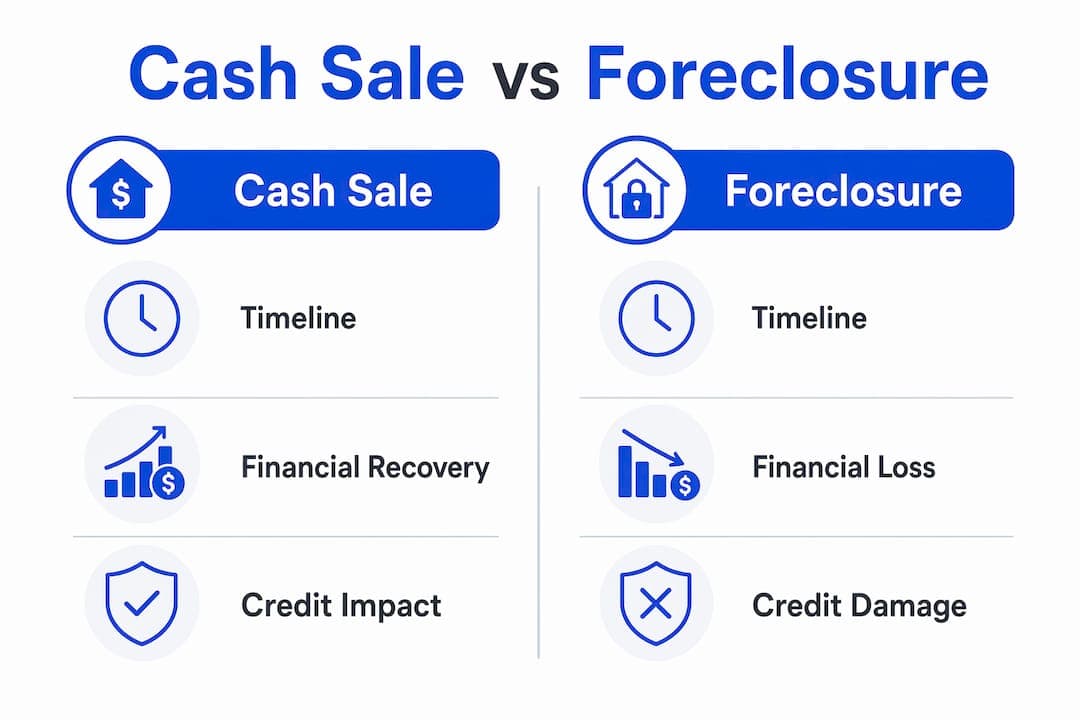
The practical difference between a cash sale and foreclosure shows up most clearly in three areas: time, money, and credit.
Timeline
Cash sales can close in as little as 7–14 days when the title is clean and the seller responds quickly. That speed matters enormously when a foreclosure auction date is approaching. Foreclosure proceedings, by contrast, can take months or even years depending on the state and whether the process is judicial or non-judicial. That extended timeline sounds like more time to act, but it also means months of accumulating fees, penalties, and interest that eat into any remaining equity.

Financial recovery
A cash sale that pays off the mortgage in full lets you keep the surplus. If your home is worth $250,000 and you owe $180,000, a cash sale could put $70,000 back in your pocket after closing costs. A foreclosure auction for the same property might sell at $190,000, with the lender taking the proceeds and leaving you with nothing, or potentially pursuing a deficiency if the sale falls short.
Credit implications
The credit comparison is not close. A cash sale that resolves the mortgage avoids the foreclosure notation entirely. Foreclosure causes lasting credit damage that affects borrowing costs for years.
Pro Tip: Title issues are the most common reason cash sales stall. Request a preliminary title report as soon as you decide to sell. Undisclosed liens or title defects can delay closing by weeks, which is time you may not have when a foreclosure date is set.
Risks to watch
Even cash sales carry risks if you are not prepared. Undisclosed liens, unresolved title defects, and lender payoff processing delays can all push a closing past the foreclosure auction date. The solution is to start the process early and work with buyers who have experience closing under time pressure. You can review the pros and cons of selling as-is to understand what to expect from a fast cash transaction.
What options do homeowners have to avoid foreclosure?
A cash sale is the fastest and most financially favorable option for most homeowners in pre-foreclosure, but it is not the only one. Understanding the full range of alternatives helps you choose the path that fits your situation.
Short sale. A short sale involves selling your home for less than the mortgage balance, with the lender’s approval to accept the reduced payoff. Short sales typically close in 30–120+ days because lenders must review and approve the sale price. The credit impact is less severe than foreclosure, but the process is slower and less certain than a cash sale. Understanding how short sale works in a foreclosure context requires patience and lender cooperation.
Deed in lieu of foreclosure. A deed in lieu lets you voluntarily transfer the property to the lender to avoid the formal foreclosure process. This process takes 2–8 weeks depending on lender review. You still lose the home and face negative credit consequences, but you avoid the public auction and potential deficiency judgment in some cases. You can read more about how a deed in lieu works before deciding if it fits your situation.
Loan modification. A loan modification restructures your mortgage terms, typically by reducing the interest rate, extending the loan term, or adding missed payments to the back end of the loan. This option keeps you in the home but requires lender approval and proof of financial hardship.
Forbearance. Forbearance temporarily pauses or reduces your mortgage payments. It does not eliminate the debt but gives you time to recover financially. Lenders typically require a repayment plan once the forbearance period ends.
Each of these options has a different timeline, credit impact, and financial outcome. A cash sale remains the strongest choice when your goal is speed, equity recovery, and minimizing credit damage.
Key Takeaways
A cash sale during pre-foreclosure protects equity and credit far better than allowing foreclosure to proceed to auction.
| Point | Details |
|---|---|
| Act during pre-foreclosure | Homeowners retain legal title and can sell for cash before the auction date. |
| Credit damage gap | Foreclosure drops credit scores by 85–160 points and stays on record for seven years. |
| Cash sale speed | Cash sales can close in 7–14 days, fast enough to beat most foreclosure timelines. |
| Get a title report early | Undisclosed liens delay closings by weeks; request a preliminary title report immediately. |
| Short sale is slower | Short sales take 30–120+ days and require lender approval, making them riskier under time pressure. |
What I’ve learned watching homeowners wait too long
The most consistent mistake I see is homeowners treating the pre-foreclosure period as a warning rather than a deadline. They assume they have more time than they do, and that assumption costs them equity, credit standing, and options.
The foreclosure auction is not a negotiating tool. Once a sale date is set, lenders are not motivated to pause proceedings for a buyer who has not yet submitted an offer. I have watched homeowners receive strong cash offers in the final weeks before auction, only to lose the deal because the lender’s payoff department could not process the request in time. That is not a hypothetical risk. It is a common outcome.
The other thing most articles skip over is the psychological cost of waiting. Homeowners in pre-foreclosure often feel paralyzed by the complexity of their options. The reality is that a cash sale is far simpler than it looks. No repairs, no agent commissions, no open houses. You accept an offer, the buyer handles the title work, and the lender gets paid at closing. The process works best when you start it early, not when you are racing the auction clock.
Proactive communication with your lender also matters more than most homeowners realize. Lenders prefer a clean payoff over a messy auction. That preference gives you real negotiating leverage during pre-foreclosure, but only if you use it before the process reaches the point of no return.
— Bryan
How Housegoodbye helps homeowners sell fast and move forward
Housegoodbye connects homeowners in pre-foreclosure with multiple competing cash investors, which drives up offers and speeds up the process. You sell as-is, with no repairs, no agent fees, and no financing contingencies that could collapse a deal at the last moment.

Housegoodbye guarantees closing in as little as seven days, which is fast enough to beat most foreclosure auction timelines. The process starts with a single request, and competing investors bid on your property, giving you real leverage. Learn exactly how selling for cash works and what to expect at each step. Homeowners across Michigan have used Housegoodbye to close quickly and walk away with equity intact. If you are in pre-foreclosure right now, get your cash offer before the auction date closes your options.
FAQ
What is the main difference between a cash sale and foreclosure?
A cash sale lets you pay off the mortgage and keep remaining equity before the lender takes control. Foreclosure is a court process where the lender sells the property at auction, typically resulting in equity loss and severe credit damage.
How much does foreclosure hurt your credit score?
Foreclosure reduces credit scores by 85–160 points and remains on your credit report for seven years. A cash sale that resolves the mortgage avoids the foreclosure notation entirely.
How long does a cash sale take compared to foreclosure?
A cash sale with a clean title can close in 7–14 days. Foreclosure proceedings take months or longer depending on the state, but the auction date creates a hard deadline that limits your selling options.
What is the pre-foreclosure vs foreclosure difference for homeowners?
During pre-foreclosure, you still own the home and can sell it, negotiate with your lender, or apply for loan modification. Once foreclosure is complete, you lose ownership, possession, and any remaining equity.
Does a short sale hurt your credit less than foreclosure?
A short sale causes less credit damage than foreclosure because it avoids the foreclosure notation, but it still reflects a mortgage settled for less than owed. A full-payoff cash sale produces the least credit damage to the three outcomes.