TL;DR:
- Property condition influences home values through appraisal adjustments, loan approvals, and buyer perceptions. Repairing critical issues offers high returns, while extensive renovations rarely pay off at resale. Selling as-is can be effective for homes with major problems or in certain market conditions, but it usually results in lower offers.
Property condition is a direct, measurable factor that determines how much buyers offer, whether financing gets approved, and how long your home sits on the market. Sellers who understand this relationship make better decisions about repairs, pricing, and timing. The industry term for this is “condition adjustment,” and appraisers apply it every time they compare your home to recent sales. Buyers apply their own version too, and theirs is almost always larger. This guide breaks down exactly how property condition affects offer price, which repairs pay off, and when selling as-is makes financial sense.
How does property condition affect buyer offers?
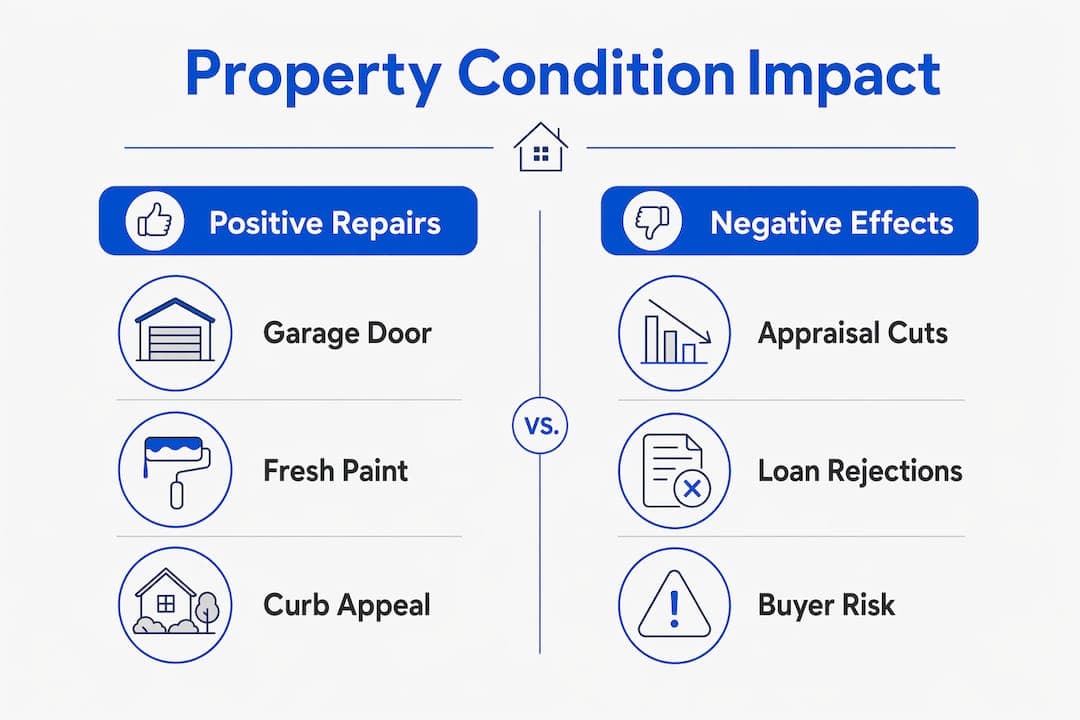
Property condition shapes offers through three separate channels: appraisal adjustments, loan eligibility, and buyer psychology. Each one can reduce what you walk away with, and they often work together.
Appraisals cut value based on deferred maintenance
Appraisers use a method called cost-to-cure to quantify condition problems. They estimate what it costs to fix a defect, then apply a market multiplier to that figure. Condition can reduce appraisal value by thousands of dollars even in desirable locations. That reduction shows up as a hard number on the appraisal report, and lenders use it to cap how much they will finance.
Loan programs reject homes with specific defects
Deferred maintenance blocks financing from FHA and VA loan programs until the problems are resolved. This matters because FHA and VA buyers represent a large share of the market, especially for moderately priced homes. When your home fails their minimum property standards, those buyers disappear from your pool entirely. Fewer buyers means less competition, and less competition means lower offers.
Pro Tip: Before listing, check your home against FHA minimum property requirements. Fixing the items on that list costs far less than losing an entire category of buyers.
Buyers price in uncertainty, not just repair costs
Buyers discount repair costs by a premium because visible defects imply unknown hidden problems. A repair that costs $10,000 typically produces a buyer discount of $15,000 or more. That gap exists because buyers cannot see inside walls, and they price the risk of what they might find. The result is that sellers who skip repairs often lose more money than the repairs would have cost.
- Visible defects signal potential hidden damage to buyers
- Condition issues reduce the number of buyers who can finance the purchase
- Homes in poor condition sit on the market longer and often require price reductions that exceed initial repair costs
- Longer market time increases carrying costs and negotiation pressure
Which repairs give you the best return before selling?
Not every repair pays off equally. The goal is to spend money where buyers notice it and appraisers credit it, not where it satisfies your personal taste.

High-return projects worth doing
Garage door replacement delivers 194% ROI, making it the single highest-return project in the 2026 Cost vs. Value Report. That number reflects the outsized impact curb appeal has on first impressions and buyer confidence. A minor kitchen remodel returns close to 96%, while a major kitchen overhaul returns roughly 60%. The lesson is clear: refresh, don’t rebuild.
Fresh paint is another high-leverage move. A $3,000–$5,000 paint job can protect $15,000–$25,000 in sale price by signaling that the home has been maintained. Landscaping, pressure washing, and updated light fixtures follow the same logic. These projects cost little but shift buyer perception from “needs work” to “move-in ready.”
For sellers who want a broader view of low-cost exterior renovations with strong returns, focusing on the front of the house consistently outperforms interior upgrades in terms of dollars spent versus value added.
Projects that rarely pay off
Major kitchen remodels, bathroom additions, and in-ground pools almost never return their full cost at resale. A $60,000 kitchen renovation in a $250,000 neighborhood does not make the home worth $310,000. Buyers in that price range have a ceiling, and no amount of granite countertops moves it. Spend to meet market expectations, not to exceed them.
Regional factors also matter. A finished basement adds real value in Michigan but minimal value in Arizona. Talk to a local agent before committing to any project over $5,000.
Pro Tip: Get a pre-listing inspection before spending on repairs. An inspector will identify the actual deal-killers so you fix what matters and skip what doesn’t.
| Project | Approximate ROI | Best for |
|---|---|---|
| Garage door replacement | ~194% | Curb appeal, all markets |
| Minor kitchen refresh | ~96% | Move-in ready positioning |
| Fresh interior paint | Very high | All homes, fast turnaround |
| Major kitchen remodel | ~60% | Rarely justified at resale |
| In-ground pool | Below cost | Almost never recommended |
What are the pros and cons of selling as-is?
Selling as-is means listing the home in its current condition without making repairs. It is a legitimate strategy, but the financial tradeoffs are real and sellers should understand them before deciding.
When as-is sales make sense
As-is sales work best in specific situations: inherited properties where the seller has no equity at risk, urgent relocations where carrying costs outweigh repair savings, and homes with major structural issues where repair costs would exceed the value gained. Selling as-is typically generates offers 15%–25% below comparable move-in ready homes. Investors and flippers often push that discount to 20%–30%.
The math can still work. If repairs cost $40,000 and the as-is discount is $30,000, selling without repairs saves $10,000 and eliminates weeks of project management. If repairs cost $10,000 and the discount is $25,000, making the repairs is the obvious choice.
- Inherited property: No repair budget and no emotional attachment to the outcome
- Urgent timeline: Closing in seven days beats waiting three months for a repaired listing
- Structural problems: Foundation issues, major roof damage, or code violations that exceed repair budgets
- Financial stress: When carrying costs and mortgage payments make a fast sale more valuable than a higher price
Pro Tip: If you’re considering an as-is sale, get the as-is sale benefits clearly laid out before you list. Understanding the full picture prevents surprises at the negotiating table.
The hidden costs of skipping repairs
Minor defects like roof leaks or faulty electrical systems cause automatic loan denials and inspection failures regardless of how good the rest of the home looks. These are deal-killers. A buyer who falls in love with your home cannot close if their lender rejects it. You lose time, momentum, and often have to relist at a lower price. Fixing deal-killers before listing is almost always worth the cost.
Extended market time adds up fast. Every month a home sits unsold costs you mortgage payments, property taxes, insurance, and utilities. A home that needs $8,000 in repairs but sits on the market for three extra months can easily cost more in carrying expenses than the repairs themselves.
How do 2026 market conditions change the equation?
The 2026 housing market gives buyers more leverage than they had in 2021 or 2022. Elevated inventory in many regions means buyers have options, and they use condition as a reason to negotiate hard or walk away entirely.
Here is how market conditions shape the condition-offer relationship right now:
- More inventory means more competition. When buyers can choose between five similar homes, they pick the one in the best condition at the same price, or they demand a discount on the one that needs work.
- Higher interest rates shrink buyer budgets. When monthly payments are already stretched, buyers have less room to absorb repair costs after closing. They price that risk into their offers upfront.
- Financing conditions tighten the buyer pool. Lenders scrutinize appraisals more carefully in uncertain markets. A condition-related appraisal reduction can kill a deal that would have closed easily two years ago.
- Pricing accuracy matters more. In a seller’s market, overpriced homes still sell. In a buyer’s market, an overpriced home with condition issues simply sits. Sellers who price to condition rather than wishful thinking sell faster and with fewer renegotiations.
Understanding how inspection negotiations cost sellers in the current market is particularly relevant. Buyers in 2026 use inspection reports as negotiation tools more aggressively than in previous years.
Key Takeaways
Property condition directly reduces offers through appraisal adjustments, loan eligibility restrictions, and buyer risk pricing, making targeted repairs the most reliable way to protect sale price.
| Point | Details |
|---|---|
| Condition drives appraisal cuts | Appraisers use cost-to-cure methods that reduce appraised value, capping what lenders will finance. |
| Buyer discounts exceed repair costs | A $10,000 repair typically prevents a $15,000 or larger buyer discount due to uncertainty pricing. |
| High-ROI repairs pay off | Garage door replacement (~194% ROI) and fresh paint protect far more value than they cost. |
| As-is sales carry real discounts | Expect offers 15%–25% below move-in ready comparable sales when selling without repairs. |
| 2026 favors prepared sellers | Elevated inventory gives buyers leverage; condition is now a primary negotiation tool. |
What I’ve learned about condition and seller decisions
Most sellers I’ve seen get this wrong in the same direction. They either spend $50,000 renovating a kitchen nobody asked for, or they list a home with a leaking roof and wonder why every offer comes in low. The answer is almost never at either extreme.
The most useful frame I’ve found is this: fix the deal-killers, skip the upgrades. Experts consistently confirm that fixing critical issues causing buyer walkaways matters far more than costly full renovations. A buyer who can’t get financing on your home is worth zero, regardless of how beautiful the new backsplash looks.
The other thing sellers consistently underestimate is carrying costs. Every week a home sits on the market costs real money. A seller who refuses to spend $6,000 on electrical repairs and then carries the home for four extra months while renegotiating twice has almost certainly lost more than $6,000. The math is not complicated, but the emotional resistance to spending money on a home you’re leaving is real.
My honest advice: get a pre-listing inspection, fix anything that will fail a lender’s minimum property standards, and spend the rest of your budget on paint and curb appeal. That combination addresses buyer psychology, protects your appraisal, and keeps your buyer pool as wide as possible. Everything beyond that is personal preference, not financial strategy.
— Bryan
Selling your home regardless of condition
If your home needs work and you don’t want to manage repairs, there’s a direct path to a fair offer without the hassle.

Housegoodbye connects homeowners with multiple competing cash investors who buy properties in any condition. No repairs, no agent fees, and no waiting. The bidding process means investors compete for your home, which pushes offers higher than a single-buyer negotiation. Housegoodbye guarantees closing in as little as seven days. Whether your home has deferred maintenance, structural issues, or code violations, you can get cash offers today and compare them side by side. For sellers who want the no-repair route clearly explained, the sell as-is option covers exactly what to expect.
FAQ
How much does poor condition reduce a home’s sale price?
Buyers typically discount $15,000 or more for every $10,000 in visible repairs needed, because visible defects imply unknown hidden problems. Appraisers apply separate cost-to-cure deductions that reduce the appraised value independently.
Can I sell a home as-is if it has FHA or VA buyers interested?
FHA and VA loan programs require homes to meet minimum property standards, so buyers using those loans cannot purchase homes with certain condition defects until repairs are made. Selling to a cash buyer bypasses this restriction entirely.
What is the single best repair to make before listing?
Garage door replacement delivers approximately 194% ROI according to the 2026 Cost vs. Value Report, making it the highest-return project available. Fresh paint is a close second and costs significantly less.
How does a buyer’s market in 2026 affect condition sensitivity?
Elevated inventory gives buyers more choices, so they use condition defects as leverage to negotiate price reductions or simply choose a competing home. Condition matters more in a buyer’s market than in a tight seller’s market.
What are “deal-killer” defects and why do they matter most?
Deal-killer defects are issues like roof leaks, faulty electrical systems, or foundation problems that cause automatic loan denials regardless of the home’s cosmetic appeal. Fixing these before listing protects your buyer pool and prevents failed closings.