You can sell a house and buy another in three ways: sell first, buy first, or line up both closings close together. Which one fits depends on how much cash you hold in your current home, whether a lender will approve you while you still own it, and how much risk you can take on if the timing slips. This guide walks through each path with its costs, the tools that make it work, and how a fast as-is cash sale can take the biggest unknown out of the plan.
TL;DR
- Sell first if you need the equity for your down payment or can’t carry two mortgages. The price is temporary housing and possibly two moves.
- Buy first if you can qualify with both homes on your books. The price is overlapping payments and the risk of a slow sale.
- Same-day or back-to-back closings work only with flexible dates, firm contracts and a backup plan, because closings slip often.
- The sale date is the hardest variable. A cash sale with a known closing window, like the ones on our Michigan marketplace, turns it into something you can plan around.
- Tools that help: home-sale contingency, bridge loan, HELOC, and a rent-back after closing.
Table of Contents
- The three ways to do it
- Option 1: Sell first, then buy
- Option 2: Buy first, then sell
- Option 3: Close both at the same time
- What it really costs
- A step-by-step plan
- When the move has a deadline
- Our perspective
- Get offers before you commit to a sequence
- FAQ
- Sources
The three ways to do it
Every plan for selling and buying together is a version of one of three sequences. Lenders and financial firms describe the same trio: negotiating same-day closings, making an offer with a home-sale contingency, or using a bridge loan to fund the new purchase before the old home sells. Because closings are commonly delayed, the same guidance recommends a backup plan such as temporary housing.
Here is how the paths compare.
| Sell first | Buy first | Close both together | |
|---|---|---|---|
| Main benefit | You know exactly how much equity you have | Flexible move, often no temporary housing | One move, no overlap |
| Main risk | Gap between homes, storage, two moves | Two sets of housing costs, harder to qualify | A delay on either side breaks the chain |
| Best for | Buyers who need sale proceeds for the down payment | Owners with strong income and cash reserves | Owners with flexible dates and a cooperative buyer and seller |
| Key tools | Rent-back, short lease, family or storage | Bridge loan, HELOC, contingency | Coordinated closing dates, contingencies, rent-back |
None of these is universally best. The honest way to choose is to answer four questions: can you carry two mortgage payments, do you need the equity from your current home, how flexible is your timeline, and do you have somewhere to stay if the dates don’t line up? Those are the same criteria a large financial firm tells homeowners to weigh.
Option 1: Sell first, then buy
Selling first is the cleanest financially. You find out how much equity will actually be available before you commit to a price range, and you never hold two mortgages. Lenders also like it: with no existing home loan on your debt-to-income ratio, qualifying for the next one is simpler.
The cost is logistics. Selling first may require temporary housing, storage, and a second move, which can mean double moving costs. A few ways to soften that:
- Ask for a rent-back. You stay in the house after closing as the buyer’s tenant. Typically this runs a maximum of 60 days, and buyers do not have to agree, so raise it when you negotiate, not after.
- Negotiate a longer closing. A buyer who isn’t in a hurry may give you 45 or 60 days, which is often enough to find and close on your next place.
- Line up a short-term landing spot early. Family, a furnished month-to-month rental, or a storage unit for the bulk of your things are all cheaper than a rushed decision.
Where a cash sale changes the math
On the open market the big question is how long your house sits. Our own figures put a typical MLS sale at about 73 days, versus about 7 days on a cash close through HouseGoodbye. That gap matters most if you are selling first, because you can set your move date around a sale you can count on instead of one you hope for. You can read how that process works in our cash closing walkthrough.
There is also a trade-off, and we’d rather you hear it from us. Cash buyers purchase as-is, so you skip repairs, staging, cleaning and showings, but the offers reflect that. Our guide to the pros and cons of selling a house as is lays out when the speed is worth it and when a traditional listing nets more.
Option 2: Buy first, then sell
Buying first gives you a more flexible move and may avoid an immediate need for temporary housing. You can paint, move over a few weekends, and list the old house empty and clean.
The catch is qualifying. You may need to qualify while carrying your current mortgage and other ownership costs, which means a lender counts both payments against your income. Add property taxes, insurance and utilities on two houses, and the monthly bill can climb quickly. Our post on the financial risk of carrying two homes helps you stress-test the number before you make an offer.
Financing tools for buying first
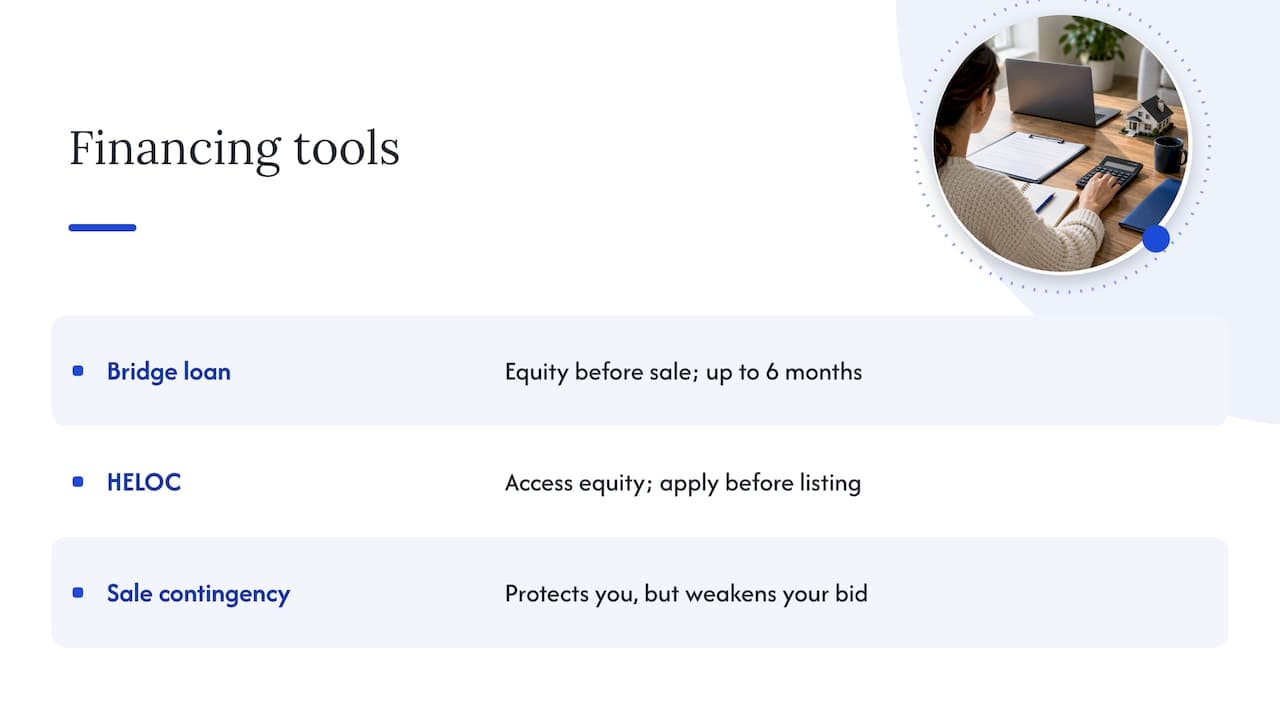
Bridge loan. A short-term loan secured by your current home. The National Association of REALTORS® reports that bridge loans let homeowners tap equity before selling, which can allow an offer without a home-sale contingency. The example in that report gave borrowers up to six months to sell. Terms, rates and fees vary by lender, so get a written quote before relying on one. One consumer-protection note: the federal appraisal-copy rule for certain higher-priced mortgages does not apply to temporary bridge loans of 12 months or less, so ask your lender what you will and won’t receive.
HELOC. A home equity line of credit lets you access equity to finance your next purchase. The practical problem: many lenders won’t open a line on a house that is about to be listed, so apply before you put the sign up, not after.
Home-sale contingency. You make your offer conditional on selling your current home. It protects you, but it weakens your bid. A home-sale contingency typically lets the seller keep marketing the house to other buyers while you try to sell yours. In a competitive market, many sellers will simply pick a cleaner offer.
Option 3: Close both at the same time
The tidy version is a same-day closing: you sign the sale in the morning and the purchase in the afternoon, and the proceeds fund the down payment. It works when both transactions are firm, but it has no slack. If your buyer’s lender is a day late, the chain stops.
If you go this way:
- Read your contingencies closely. The National Association of REALTORS® says contingencies should have clear timelines, and that unmet ones may allow cancellation without penalty when the parties act in good faith. Know every date in both contracts.
- Understand your deposit. Your mortgage contingency clause says whether your deposit is refunded if the purchase falls through because you can’t get a loan. Walking away without that protection may put your deposit at risk.
- Ask for flexibility in writing. A rent-back on your sale, or a short extension option on your purchase, is cheap insurance.
- Plan for a day or two of overlap. Have a hotel, a friend’s spare room or a storage unit ready.
One rule of thumb: the fewer moving parts on your sale side, the more realistic same-day closings get. A cash buyer without a loan to approve or an appraisal to wait on removes several of the usual causes of delay.
What it really costs
People underestimate the cost of the overlap, so list it out before choosing a path.
- Buying first: two mortgage payments, two tax and insurance bills, two sets of utilities, plus maintenance on a vacant house. The longer the old house sits, the more each month costs.
- Selling first: temporary rent, storage, double moving costs, and possibly a rushed purchase.
- Either way: closing costs on both sides. Review each Closing Disclosure carefully. You receive one at least three business days before closing, and the CFPB advises comparing it to your Loan Estimate and telling the lender or settlement agent about any mistakes.
The tax angle
If the house you’re selling is your main home, the IRS says you may generally exclude up to $250,000 of gain, or $500,000 on a joint return, if you meet the ownership and use tests. Those tests usually require that you owned and lived in the home for at least 24 months of the five years before the sale, and that you haven’t excluded gain from another home in the past two years. If you receive a Form 1099-S, or your gain exceeds the exclusion, you may have reporting obligations. Talk to a CPA or tax preparer before you close if your gain is large or you’ve moved around in the past two years.
A step-by-step plan
- Price your budget both ways. Work out what you can afford with one mortgage and with two. Be honest about the second one.
- Get a pre-approval that accounts for your current home. Ask the lender specifically how they treat your existing mortgage payment.
- Estimate your net proceeds. Subtract your mortgage payoff, closing costs and any repairs you would need to make for a conventional sale. If repairs are a deal-breaker, read our guide on costly repairs that kill home deals and how property condition affects your offer.
- Decide how you’ll sell. A traditional listing may bring a higher price but takes time, showings and open houses. If you want certainty, collect cash offers first and compare them with what a listing would net. We explain why open houses can cost sellers money.
- Choose your sequence. If your sale date is known, selling first or closing together becomes much easier. If not, you need a bridge loan, a HELOC or a lot of cash reserves to buy first.
- Build a backup. Know where you’d sleep and where your things would go if either closing slips by two weeks.
- Make offers with your timeline in mind. Offer terms, such as a rent-back request or a flexible closing date, are as important as price.
When the move has a deadline
Some sellers don’t have the luxury of waiting. A new job with a start date, a layoff, a divorce or a looming foreclosure all compress the timeline. In these cases the question changes from which sequence is optimal to which is achievable.
- Relocating for work? See how to coordinate your home sale with a job start date and how a job move affects mortgage approval.
- Lost your job? Read the mistakes that delay a home sale after a layoff.
- Behind on payments? Selling can be a way to protect your equity. Our page on how to avoid foreclosure in Michigan explains the options.
- Inherited a house and want to buy your own? Freddie Mac’s Home Possible program allows a borrower to hold a non-occupied ownership interest in another residential property in specified circumstances, including when it was inherited and shared with another party. Check with your lender how that applies to you, and see our guide to selling an inherited house in Michigan.
Our perspective
Most of the advice you’ll read about selling and buying at the same time ends with the same sentence: hire one great agent and hope the dates line up. That advice is fine, but it skips the real problem. The sale date is the one thing you can’t control in a traditional listing, and everything else in your plan hangs from it.
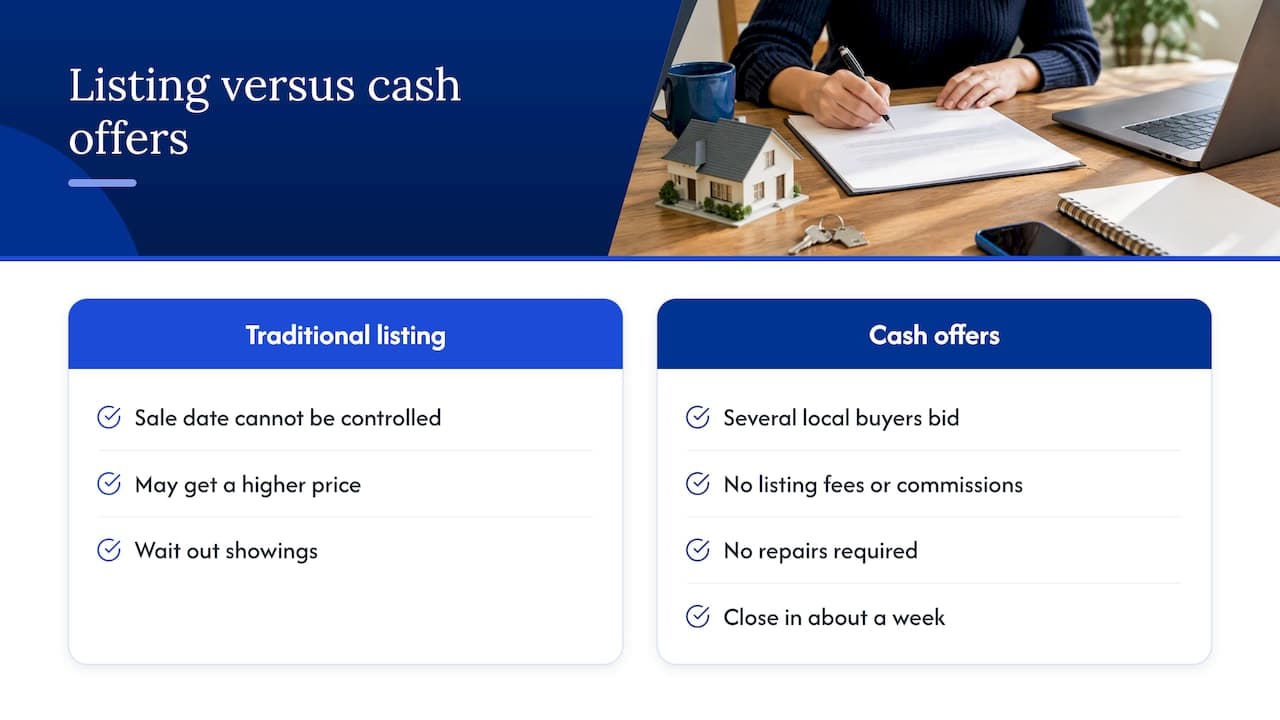
We built HouseGoodbye around that problem. A Michigan homeowner enters an address, and several vetted local cash buyers bid on the same house. You see every number, you pay no listing fees or agent commissions, and you don’t have to repair anything. If none of the offers beat what you’d expect from a listing, you walk away with nothing owed. When one does, closing can happen in about a week, so your next purchase can be built around a date you actually know.
This isn’t right for everyone. If your house is in great shape, you have no deadline and you can wait out showings, a listing may get you a higher price. We’d rather you compare honestly. But if you’re buying a home, a firm sale date can be worth more than the last few percent of price. That is the trade we want you to weigh, with real numbers in front of you. You can see how bidding pressure works in the role of competing cash offers.
— Bryan
Get offers before you commit to a sequence
If you own in Michigan and you’re deciding whether to sell first, you can get competing as-is cash offers on your current home before you make any offer on the next one. There’s no obligation, and you’ll know your likely closing window and net number. Start with our cash home buyer marketplace, or see how it works in Detroit and Warren. If you want the statewide overview, start at HouseGoodbye.
FAQ
Is it better to sell first or buy first?
Neither is better for everyone. Selling first gives certainty about your equity and avoids two mortgages, but it can mean temporary housing and two moves. Buying first is smoother to live through, but you need to qualify and pay with both homes on your books.
Can I make an offer that depends on selling my house?
Yes, that is a home-sale contingency. It makes the purchase conditional on your sale, but the seller can usually keep marketing the house to other buyers. In a competitive market, it can make your offer less attractive than one without it.
What if my sale closes before I can move into the new house?
Ask the buyer for a rent-back, which lets you stay temporarily as their tenant, often for up to about 60 days. Buyers don’t have to agree, so ask during negotiation. Otherwise, line up short-term housing and storage ahead of time.
Does a bridge loan or HELOC make sense?
They can bridge the gap by giving you access to equity before your house sells, but both add a payment and costs. Get written terms from your lender, and check how long you have to repay. A HELOC is usually easier to open before you list.
How fast can I sell a Michigan house for cash?
Through HouseGoodbye, closing can happen in about 7 days, compared with about 73 days for a typical MLS sale. The timeline depends on the buyer and the title work on your property, so confirm the closing date in writing with the offer you choose.
Sources
- How to buy and sell a house at the same time
- How to buy a house while selling yours
- Buying and Selling at the Same Time: A Survival Guide
- Selling and Buying a House at the Same Time
- Buying and Selling a Home at the Same Time: How Bridge Loans Can Help
- Consumer Guide: Real Estate Sales Contract Contingencies
- Understanding Contingency Clauses in Homebuying
- What the new TILA appraisals rule means for consumers
- At the mortgage loan closing, do I have to sign if I don’t like the terms?
- What to expect in the mortgage closing process
- Topic no. 701, Sale of your home
- Freddie Mac Bulletin 2016-23