If you need money fast or you’re staring down a sheriff’s sale date, a cash sale almost always beats a short sale because it doesn’t need anyone’s permission but yours. If you have more time and your lender is willing to cooperate, a short sale can protect you from a deficiency balance that a straight cash sale doesn’t address. The core difference: short sales require servicer approval and can take months; cash sales close in days to weeks. Groups like MSHDA and HUD-approved housing counselors can help you sort out which timeline you’re actually working with.
TL;DR:
- Short sales can take several months due to servicer approval, while cash sales generally close within a few weeks.
- A short sale may result in a deficiency balance if the sale price is less than the mortgage payoff, unless the servicer waives it in writing.
- Cash sales eliminate the risk of deficiency and tend to be faster, but often involve lower offers due to investor discounts and assignment risks.
- For homeowners with equity and more time, a traditional sale at fair market value usually yields the best financial outcome; short sales are mainly for underwater properties.
- Verifying proof of funds for cash buyers is essential, as claims without proper documentation can lead to scams or delayed closings.
Table of Contents
- Short Sale vs Cash Sale in Michigan: The Key Differences
- What Is a Short Sale and How Does It Work in Michigan?
- What Is a Cash Sale and What Should You Watch For?
- How to Choose Between a Short Sale and a Cash Sale
- Tax Differences Between a Short Sale and a Cash Sale in Michigan
- Michigan Rules That Affect Buyer Qualification and Cash Verification
- How to Negotiate With Your Lender During a Short Sale
- How to Vet a Cash Buyer or Investor in Michigan
- Credit Score Impact: Short Sale vs Cash Sale
- Documentation Checklist for a Michigan Short Sale Approval
- Publisher Perspective: Where a Cash-Offer Marketplace Fits
- Get Multiple Cash Offers From Housegoodbye
- Sources
- FAQ
Short Sale vs Cash Sale in Michigan: The Key Differences
The fastest way to see which route fits you is to line up the five factors that actually change your outcome: who’s in charge, how long it takes, what you walk away with, what happens to your credit, and whether you even need to sell at all.
- Control: In a cash sale, you set the price and the closing date. In a short sale, your lender’s loss mitigation department makes the final call on price, terms, and timing.
- Timeline: Cash sales in Michigan typically close within a few weeks. Short sales often take significantly longer because the servicer must review your hardship file and approve the sale price before you can close.
- Net proceeds and deficiency risk: A short sale sells your home for less than what you owe, which can leave a deficiency balance unless your servicer agrees in writing to waive it. A cash sale, by contrast, is a private transaction between you and the buyer, so there is no risk of deficiency if you have equity.
- Credit and foreclosure outcome: Both a short sale and a completed cash sale avoid a foreclosure judgment on your record. Foreclosure hits your credit report hardest and longest; a short sale is less damaging, and a normal sale (cash or financed) that pays off your mortgage in full doesn’t touch your credit at all.
- When a traditional sale wins: If you have real equity, the CFPB points out that a traditional sale, listed on the open market or sold directly for cash at fair value, usually beats both a short sale and foreclosure financially. Short sales and foreclosure alternatives exist for homeowners who are underwater, not for those with equity to protect.
What Is a Short Sale and How Does It Work in Michigan?
A short sale means selling your house for less than you owe on the mortgage, and it only happens with your lender’s written approval. You can’t just list it below your payoff amount and close. You have to apply.
Here’s the general sequence Michigan homeowners go through:
- Contact your servicer and request a loss mitigation application.
- Submit a hardship letter explaining why you can’t pay (job loss, medical bills, divorce).
- Provide financial documents: pay stubs, bank statements, tax returns, and a list of monthly expenses.
- Get a comparative market analysis or appraisal to establish a realistic sale price.
- List the home and accept an offer, then submit it to the servicer for approval.
- Negotiate the payoff and ask, explicitly, for a written waiver of any deficiency balance.
Timing matters more in Michigan than people realize, because MSHDA’s foreclosure guidance shows the foreclosure clock keeps running while you’re waiting on servicer paperwork. A short sale can stall foreclosure, but it doesn’t stop the sheriff’s sale date automatically. The upside is real: you avoid a foreclosure on your record, you might get a deficiency waiver, and some servicers offer modest relocation assistance. The downside is just as real: approval isn’t guaranteed, the process drags, and without a written waiver you could still owe the difference after closing.
Pro Tip: Never accept a verbal “we won’t come after you” from a loss mitigation rep. Get the deficiency waiver in writing before you sign closing documents, and have a HUD-approved counselor review it if you’re unsure what it means.
What Is a Cash Sale and What Should You Watch For?
A cash sale means an investor or buyer pays for your house outright, as-is, without a mortgage lender involved on their end. No appraisal contingency, no loan underwriting delays, no repairs required on your part.
The process usually looks like this: you share basic property details, the buyer (or a marketplace collecting multiple buyers) makes an offer, you review proof of funds, and you set a closing date that can often happen quickly.
- Speed: No lender approval needed on either side means no waiting on a loss mitigation department.
- Certainty: Cash offers rarely fall through for financing reasons, since there’s no loan to underwrite.
- Lower price: Investors buy at a discount because they’re taking on repair costs, holding costs, and resale risk.
- Assignment risk: Some buyers sign a purchase agreement, then assign the contract to a different investor before closing, which can change your terms at the last minute.
Protect yourself with three things: written proof of funds before you sign anything, a purchase agreement that either bars assignment or spells out exactly how it works, and an escrow arrangement where earnest money releases only at closing. Confirm your title is clean early, since liens or clouded title can delay a closing you were counting on happening fast.
Pro Tip: Ask any cash buyer for two references from sellers who closed in the last six months. A legitimate buyer will have them ready.
How to Choose Between a Short Sale and a Cash Sale
Start with three quick questions: Do you have equity? Are you close to a sheriff’s sale date? Do you need cash in hand within weeks, not months? Your answers point you toward one path fast.
- Check your equity. Pull your mortgage statement and compare it to your home’s likely market value. Equity usually means a traditional or cash sale beats a short sale.
- Check your foreclosure timeline. Michigan’s foreclosure process includes a common six-month redemption period after a sheriff’s sale, but the sale date itself can arrive faster than a short sale approval would.
- Call your lender. Ask directly: “Will you approve a short sale, and will you waive the deficiency in writing?” A vague answer is a red flag, not a yes.
- Get two or three competing cash offers. Comparing bids, rather than accepting the first one, is one of the most reliable ways to push your net proceeds higher.
- Gather your documents now. Mortgage statement, payoff quote, most recent tax bill, homeowners insurance, and any title paperwork.
- Watch for red flags. Upfront fees, anyone telling you to stop talking to your lender, or pressure to sign a deed transfer before closing are all warning signs the state has flagged as rescue-scam tactics.
A HUD-approved housing counselor can review your specific numbers for free, which matters more than it sounds like: many Michigan homeowners skip this step and only find out about a deficiency balance after closing.
Tax Differences Between a Short Sale and a Cash Sale in Michigan
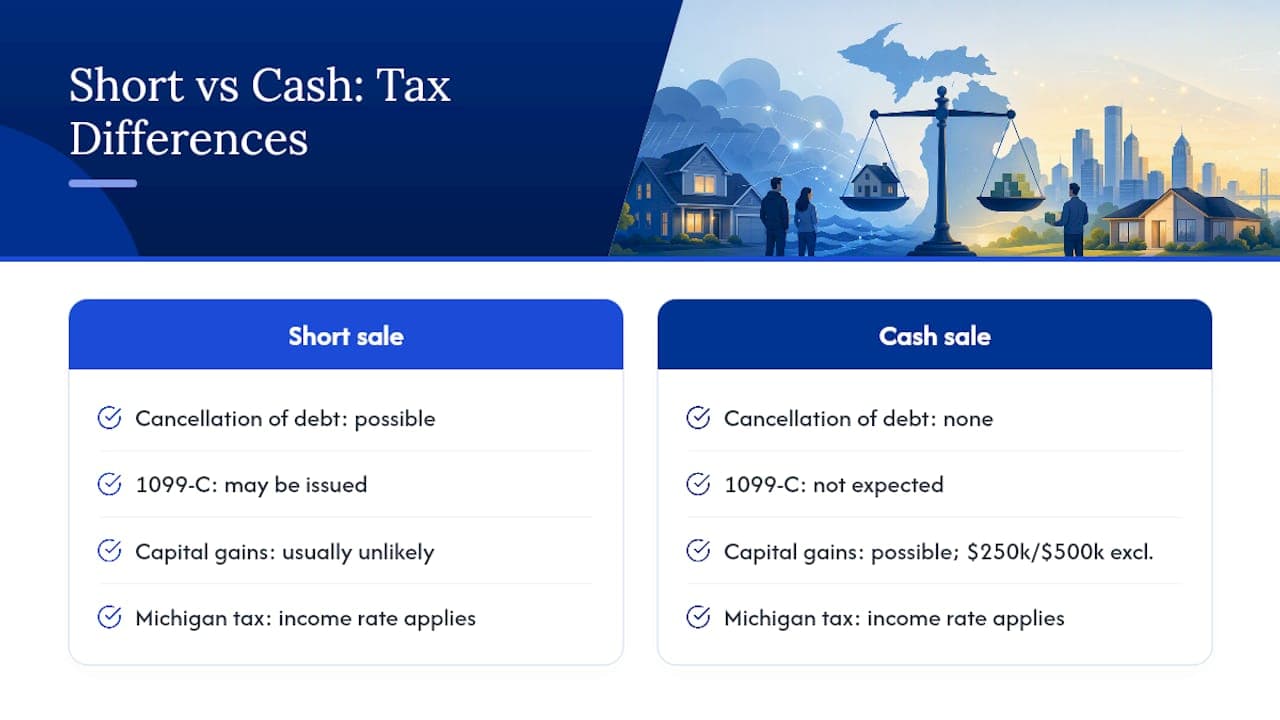
The tax picture depends less on how you sold and more on whether debt got forgiven. In a short sale, if your lender writes off part of what you owed, that forgiven amount can be treated as taxable income by the IRS unless an exclusion applies, such as insolvency or, for some homeowners, mortgage debt relief provisions tied to a primary residence. A 1099-C form from your servicer is the tip-off that forgiven debt is being reported.
A straight cash sale, where the buyer pays enough to cover your full payoff, doesn’t generate cancellation-of-debt income at all, because nothing was forgiven. What you might owe instead is capital gains tax if your sale price exceeds your cost basis by more than the federal home-sale exclusion allows ($250,000 for single filers, $500,000 for married couples filing jointly, assuming you meet the ownership and use tests). Most distressed sellers selling below or near their mortgage balance won’t trigger this at all.
Michigan doesn’t add a separate state-level capital gains tax on top of the federal rules, but the state does apply its standard income tax rate to any taxable gain or forgiven-debt income that flows through to your Michigan return. Because the tax outcome hinges on your specific payoff amount, basis, and any 1099-C, talk to a tax preparer or a HUD-approved counselor before you sign anything. This isn’t a place to guess.
Michigan Rules That Affect Buyer Qualification and Cash Verification
Michigan doesn’t require a cash buyer to hold any special state license just to purchase residential property outright, which is exactly why verification falls on you, the seller. Anyone can claim to be a cash buyer. Not everyone can prove it.
Real proof of funds looks like a recent bank statement or a letter from the buyer’s bank or title company confirming the funds are available and unencumbered, not a preapproval letter (that’s a financing document, not cash proof) and not a screenshot. If a buyer is using a business entity, ask for the entity’s formation paperwork and confirm the person signing has authority to bind that LLC.
Michigan’s title and escrow process still applies to cash deals the same way it applies to financed ones. A title company or real estate attorney should handle the closing, verify there are no outstanding liens, back taxes, or judgments attached to the property, and hold earnest money in escrow rather than letting it go directly to the buyer or a middleman. If someone offers to skip escrow and hand you cash directly outside of closing, that’s not a shortcut. That’s the same pattern Michigan’s consumer protection office warns about in foreclosure-rescue scams: informal money handoffs with no paper trail to protect you if something goes wrong later.
How to Negotiate With Your Lender During a Short Sale
Lenders aren’t negotiating out of kindness. Loss mitigation departments approve short sales because a short sale usually costs them less than carrying a house through foreclosure and resale. Use that leverage.
Open by requesting the loss mitigation application in writing, not just a phone conversation, so you have a paper trail of every date and every document submitted. When you send your hardship letter, be specific: name the event (job loss, medical bills, divorce, death of a co-borrower), the date it happened, and why it’s permanent rather than temporary. Vague hardship letters get slower responses.
Push for two things explicitly, every time: a written waiver of any deficiency balance, and a firm answer on timeline. Ask, “How many days will you take to respond to a signed purchase offer?” and get that number in writing if you can. If your servicer doesn’t commit to a deficiency waiver, ask what the alternative is, sometimes a promissory note for a reduced balance, and get every term spelled out before you accept an offer contingent on their approval.
If negotiations stall, don’t go silent. Call your servicer weekly, keep a log of who you spoke with and what they said, and loop in a HUD-approved housing counselor if you feel like you’re getting the runaround. Counselors deal with these departments constantly and often know which requests actually move a file forward.

How to Vet a Cash Buyer or Investor in Michigan
Speed is the whole appeal of a cash sale, but speed without verification is how sellers get burned. Start by asking for proof of funds before you sign anything, not after.
A legitimate buyer or marketplace will show you their offer terms clearly: purchase price, closing date, who pays closing costs, and whether the contract includes any assignment clause. If a buyer’s paperwork is vague about who’s actually purchasing the home, or the contract lets them assign your deal to someone else without your sign off, treat that as a real risk, not a formality. Ask directly whether they intend to close themselves or assign the contract, and get the answer in writing.
Comparing multiple offers side by side is the single best protection you have against a lowball bid. A marketplace model, where several vetted investors compete for your property instead of one buyer setting the price alone, tends to produce stronger offers than negotiating with a single investor cold. Check for a real business address, a working phone number tied to an actual person, and a title company they’ve closed with before, one you can call to confirm the relationship is real. If everything moves too fast to verify, that speed is working against you, not for you.
Credit Score Impact: Short Sale vs Cash Sale
A short sale typically shows up on your credit report as “settled for less than owed,” which can knock your credit score down, though usually less severely than a completed foreclosure. How much it drops depends on your starting score and your overall credit history; homeowners with higher scores going in tend to see a bigger point drop than those already struggling.
A cash sale that pays off your mortgage in full, whether at market value or at a negotiated price you agreed to, doesn’t create a settlement mark at all. Your loan shows as paid in full, and your credit score reacts the way it would to any mortgage payoff: no separate penalty for the sale itself.
The real risk to your credit isn’t the sale method. It’s the missed payments that happen while you’re deciding what to do. Every 30, 60, and 90 day late payment reported to the credit bureaus during a drawn-out short sale negotiation does more damage than the short sale itself. That’s one more reason speed matters if you’re already behind: a faster cash sale can cut off the bleeding of late payment marks that a months-long short sale approval process doesn’t stop.
Documentation Checklist for a Michigan Short Sale Approval
Servicers move faster when your file is complete the first time. Missing paperwork is the single biggest cause of short sale delays.
Expect to provide a signed hardship letter, two months of pay stubs or proof of income, two to three months of bank statements, your most recent tax return, a current mortgage statement, and a comparative market analysis or broker price opinion supporting your proposed sale price. Once you have a buyer, you’ll also submit the signed purchase agreement, the buyer’s proof of funds or loan preapproval, and an estimated closing statement (a HUD-1 or closing disclosure draft) showing exactly what the servicer will net.
The servicer reviews the file, often assigns a single negotiator, and comes back with either an approval, a counter on price, or a denial. Approval letters should state the approved sale price, the payoff amount, and, critically, whether they’re waiving the deficiency or reserving the right to collect it later. Read that clause twice. If it’s silent on deficiency, ask for clarification in writing before you close, because silence isn’t the same as a waiver.
Publisher Perspective: Where a Cash-Offer Marketplace Fits
Most short sale guides sound like the only responsible choice is patience: file the paperwork, wait for approval, hope the servicer moves fast enough to beat the sheriff’s sale date. That advice works fine if you have four months and a cooperative servicer. It falls apart the moment either of those things isn’t true, and in our experience watching Michigan sellers navigate this, that’s more common than the guides admit.
Some sellers don’t have four months, or have equity but no patience for repairs, showings, and agent commissions eating into proceeds. Getting competing cash offers instead of one lowball number is one mechanism that can make a fast sale less of a financial sacrifice: sellers comparing multiple bids may walk away with more than sellers negotiating alone with a single investor. That’s not a reason to skip the short sale conversation with your lender if you’re underwater. It’s a reason to treat “get a second and third offer” as basic due diligence, whether you go the short sale route or not.
— Bryan
Get Multiple Cash Offers From Housegoodbye
Housegoodbye is the alternative to negotiating with a single investor for Michigan sellers who want speed without giving up leverage. Instead of one lowball number, you get competing cash offers from vetted local investors, so you can compare real numbers side by side before you commit to anything.

There’s no repair list, no staging, no agent commission, and no obligation to accept any offer you receive. Homes in any condition qualify, and closings can happen in as little as seven days when you need one fast. If your situation looks anything like what’s described above, sheriff’s sale approaching, a short sale timeline that’s too slow, or simply a house you need gone without the usual hassle, request your cash offers today and see what local investors are actually willing to pay.
Sources
- What is a short sale? | Consumer Financial Protection Bureau
- For many struggling mortgage borrowers with home equity, selling their home could be an alternative to foreclosure | CFPB
- Want to sell your home for cash? Read this first | ProPublica
FAQ
What Is the Hardest Month to Sell a House in Michigan?
Winter months, particularly January and February, tend to see fewer buyers and slower traditional sales statewide. That seasonal slowdown doesn’t apply the same way to cash sales, since investors buy year round regardless of listing season.
Do I Have to Pay Cash for a Short Sale?
No. As the buyer’s agent or investor in a short sale, you don’t personally pay anything, the buyer pays the servicer-approved price, and you receive whatever proceeds are left after payoff and closing costs, which is often little to nothing. If the sale price doesn’t cover the full mortgage, you need a written deficiency waiver so you don’t owe the difference afterward.
What Is the Downside of Buying a Short Sale?
For buyers, the biggest downside is the wait: servicer approval can take weeks or months longer than a standard sale, and the deal can fall through even after an offer is accepted. For sellers, the downside is uncertain approval and potential deficiency exposure without a written waiver.
Does the Seller Get Any Money in a Short Sale?
Usually little to none, since the sale price typically doesn’t exceed what’s owed on the mortgage. Some servicers offer modest relocation assistance as part of the approval, but sellers pursuing meaningful proceeds are usually better served by a traditional or cash sale when they have equity, per CFPB guidance.
Is a Cash Sale Always Faster Than a Short Sale in Michigan?
Almost always, yes. A cash sale typically closes within one to three weeks because there’s no servicer approval required, while a short sale depends entirely on how quickly the lender’s loss mitigation department reviews and approves the file.