Before you sign anything, verify proof of funds, confirm who the actual buyer is, and get an independent title company or attorney to review the contract. Do those three things promptly: request bank statements or escrow confirmation, ask directly whether the buyer will close in their own name or assign the contract, and line up a title professional who doesn’t work for the buyer.
TL;DR:
- Verify proof of funds with recent bank statements or escrow confirmation before proceeding with any cash offer.
- Check the buyer’s business registration and transaction history to identify red flags such as recent formation or lack of verifiable deals.
- Negotiate a short, clearly defined inspection period and require explicit written approval for any contract assignment.
- Confirm that earnest money is held in neutral escrow and conduct a title search to verify payoff amounts and prevent title clouds.
- Consider multiple competing offers from vetted investors to improve your net proceeds and reduce risks compared to accepting a single offer blindly.
Table of Contents
- What to Check Before You Choose a Cash Buyer
- How Do You Verify a Cash Buyer’s Proof of Funds?
- What Contract Terms Should You Watch For?
- A Checklist for Comparing Offers Beyond the Sticker Price
- Legal Risks and How to Protect Yourself
- Weighing Speed Against Price
- A Practical Option: Comparing Cash Offers Without the Legwork
- Authoritative Resources to Verify Key Claims
- Sources
- FAQ
What to Check Before You Choose a Cash Buyer
A legitimate buyer leaves a paper trail. Before you accept any offer, dig into the buyer’s business registration through your state’s licensing database and search your county recorder’s office for their name to see actual closed transactions, not marketing claims. A company that’s flipped or bought a dozen houses in your county over three years looks very different from an LLC formed six weeks ago with no history.
Watch for these warning signs during your first conversation:
- Pressure to sign a contract same-day, before you’ve had time to check anything
- Contact information that changes between calls, or a “representative” who won’t name the actual buying entity
- Reluctance to name references or point you to closed deals you can verify independently
- Refusal to say whether they intend to close personally or assign the contract to someone else
Investigative reporting from ProPublica documents cash buyers who use aggressive solicitation and vague contract terms specifically because sellers rarely check the paper trail. Checking it is your best defense.
How Do You Verify a Cash Buyer’s Proof of Funds?
Ask for proof of funds before you go further, not after you’ve already picked a favorite offer. Acceptable documentation includes a recent bank statement (within 30 to 60 days), a letter from the bank or an institutional lender, or confirmation that funds are already sitting in escrow. Anything older than two months, or a screenshot with no bank letterhead, deserves a follow-up question.
Earnest money tells you almost as much as the funds letter. ProPublica’s reporting found deposits as low as a few hundred dollars on six-figure deals, which barely commits the buyer to anything.
- If proof of funds is vague or delayed, ask for escrowed earnest money as a substitute signal
- If a buyer resists neutral escrow, treat that as a reason to slow down, not speed up
- Verify the bank statement’s date and issuing institution before you take it at face value
Pro Tip: Call the bank listed on the proof-of-funds letter directly. A legitimate buyer won’t mind, and a fake one will suddenly go quiet.
What Contract Terms Should You Watch For?
The purchase price is the headline. The clauses underneath it decide what you actually walk away with. Three items cause the most damage when sellers skip them:
- Inspection period length. A 10 or 14 day inspection window that lets the buyer walk away or renegotiate for almost any reason isn’t really a commitment. Push for a fixed, short window with specific conditions for price changes.
- Assignment rights. Many cash buyers plan to assign your contract to another investor before closing. That’s not automatically bad, but it should require your written approval, not happen silently.
- What “as-is” actually means. Selling as-is means the buyer won’t demand repairs. It does not mean you’re free of disclosure obligations, and it doesn’t block a buyer from cutting the price after a walkthrough if the contract allows it.
Read the closing timeline the same skeptical way. “Closing in 7 days” sounds firm until you notice it’s conditioned on the buyer’s own financing contingency or a third-party inspection with no deadline. Ask for the timeline in writing, tied to specific dates, not general promises.
A Checklist for Comparing Offers Beyond the Sticker Price
The highest number on paper isn’t always the highest number in your pocket. Work through offers in this order:
- Net proceeds after liens and unpaid taxes. Order a title search early. Outstanding liens get deducted from what you actually receive, so a $220,000 offer with a $15,000 lien nets less than a clean $210,000 offer.
- Proof of funds and earnest money strength. An offer without verified funds isn’t really an offer yet, no matter how high the number.
- Assignment rights. Know whether the buyer plans to close themselves or hand the contract to someone else.
- Inspection period length. Shorter, clearly defined windows reduce your risk of a last-minute price cut.
- Realistic closing timeline. Compare stated dates against any contingencies buried in the contract.
A lower offer with clean funds, no assignment ambiguity, and a short inspection window frequently beats a higher offer loaded with conditions. The gap closes fast once you subtract liens, escrow risk, and the odds of a post-walkthrough price cut.
Legal Risks and How to Protect Yourself
Selling as-is doesn’t erase your disclosure duties. You’re still legally required to disclose known material defects, and skipping that step can lead to litigation well after closing, according to legal analyses of cash-investor transactions. Roughly 30% of home purchases now involve cash, which means legitimate investors and problem actors are competing in the same pool, and the disclosure rules don’t bend for either one.
Three protective steps matter most:
- Order a title search immediately, and verify payoff amounts on any existing liens before you rely on a closing date
- Insist the buyer’s earnest money sits in neutral escrow, not with the buyer or their affiliated closer
- Hire a real estate attorney to review the contract, particularly clauses around assignment and recorded memoranda
Some buyers record a memorandum of contract that clouds your title before closing even happens, a tactic ProPublica’s investigation traced across multiple markets. Removing that cloud later usually means negotiation or legal action, so avoid signing anything that authorizes recordation beyond a narrow, explicit purpose.
Pro Tip: Ask your attorney to specifically flag any clause that lets the buyer record something against your title before the deal closes.
A marketplace that gathers several vetted investor bids, like the model HouseGoodbye uses, can shorten this entire vetting process by putting buyers in competition rather than leaving you to check one buyer alone. Reviewing our as-is sale checklist beforehand helps you know what disclosure looks like before an offer even lands on your desk.
Weighing Speed Against Price
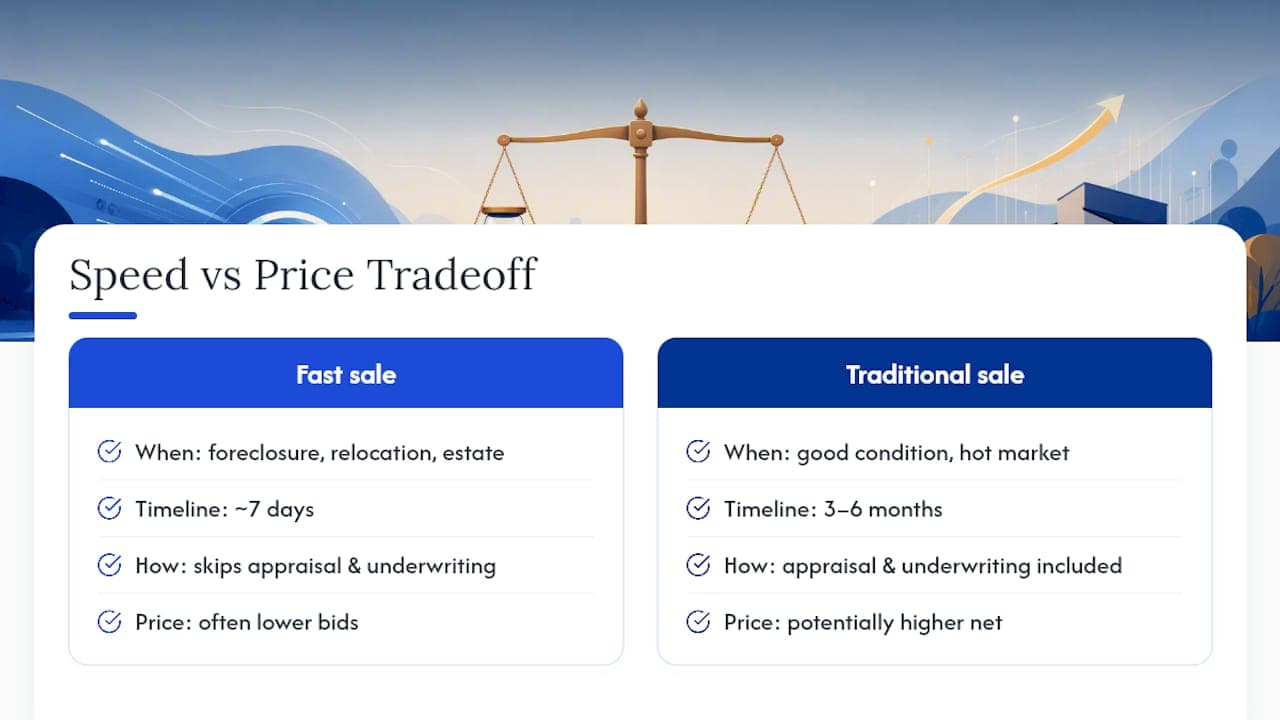
Speed earns its cost when you’re facing foreclosure, a job relocation on a deadline, or an estate that needs to close before probate drags on. In those cases, a 7 day closing is worth more than an extra few thousand dollars you might see six weeks later. Consumer guidance on cash offers is blunt about the tradeoff: cash buyers skip underwriting and appraisals, which is exactly why they close faster and sometimes bid lower.
Waiting makes more sense when your home is in strong shape, your local market is competitive, and you have three to six months of flexibility. Ask yourself three questions: What does a delay actually cost me? What’s my realistic net after repairs and agent fees on a traditional sale? And what happens if this cash deal falls through?
— Bryan
A Practical Option: Comparing Cash Offers Without the Legwork
Vetting a single buyer, chasing proof of funds, checking court records, hiring an attorney, takes real time you may not have. This service is built around the opposite approach: instead of vetting one buyer alone, you get multiple offers from vetted local investors competing for your property, which puts the verification pressure on them, not you.

When you request offers through this service, there’s no obligation to accept any bid, and you can compare terms side by side, price, closing timeline, and conditions, instead of relying on a single company’s word. Because investors are bidding against each other, the process tends to push prices up rather than let one buyer lowball you with no competition in the room. If your home is in Michigan and you want to see what real, competing offers actually look like, start by comparing cash offers on your Michigan home, or read through how the cash-offer process works before you request your first bid.
Authoritative Resources to Verify Key Claims
- ProPublica’s investigation into aggressive cash-buyer solicitation tactics
- Conventus Law’s legal primer on disclosure duties and contract review
- Zillow’s consumer guidance on weighing cash offers against traditional sales
- Mortgage tech resources for loan officers, useful background on why independent verification matters
This article is general information, not a substitute for advice from a qualified lawyer. Consult a qualified legal professional about your own circumstances before acting on anything here.
Sources
Search the buyer’s name alongside terms like “complaint” or “lawsuit,” and check your state’s consumer protection site in addition to standard reviews. A pattern of similar complaints, particularly about title issues or vanished deposits, matters more than a handful of one star reviews.
- Want to sell your home for cash? Read this first — ProPublica
- Legal considerations when selling residential property to cash investors — Conventus Law
- Should I accept a cash offer for my house? — Zillow
Then insist on an independent title company, one the buyer doesn’t own or routinely funnel business to. Legal guidance on cash-investor sales recommends this specifically to avoid conflicts of interest where the closer works for the buyer’s interests, not yours. Independent title review typically costs a few hundred dollars and can save you from a far more expensive surprise at the closing table.
FAQ
How do you know if a cash buyer is legit?
Check their business registration, search county records for prior closed deals under their name, and request proof of funds dated within the last 60 days. A legitimate buyer won’t hesitate to provide references from sellers they’ve closed with before.
How much will a cash buyer pay for a house?
It varies widely by property condition and local market, but cash offers often come in below full market financed offers because buyers price in the convenience of skipping repairs, appraisals, and underwriting delays. Getting multiple competing bids, rather than one, is the most reliable way to see what your home is actually worth to investors.
What are the risks of a cash offer on a house?
The main risks include vague contract clauses that let the buyer reduce price after inspection, assignment of your contract to an unknown third party, and title complications from recorded memoranda. An independent title company and attorney review catch most of these before they become problems.
Who is the best cash buyer for homes?
There’s no single best buyer since reliability depends on proof of funds, contract terms, and reputation, which vary company to company. A marketplace approach like Housegoodbye, where multiple vetted investors bid on your property, removes the guesswork of picking one buyer sight unseen.