No. When a buyer pays entirely in cash, no lender is involved, so no lender-required appraisal stands between you and closing. That is the main reason cash sales move faster. But “not required” does not mean “not useful.” A cash buyer may still order one, and you still need a way to tell whether the number on the table is fair. This guide explains who decides, what an appraisal costs you in time, and how Michigan sellers can judge a cash offer without one.
TL;DR
- A buyer paying all cash generally does not need an appraisal, because the appraisal is a lender step tied to financing.
- A cash buyer can still order one, or make the offer contingent on one. Read the contract for an appraisal contingency before you sign.
- Skipping the appraisal removes one delay, not the question of fair price. Compare several written offers and judge each by what you net.
- Your tax bill depends on gain, basis and selling costs, not on whether anyone appraised the house.
- Our platform gathers competing cash offers from vetted Michigan investors, so the comparison does the work an appraisal would otherwise do.
Table of Contents
- Why a cash sale usually skips the appraisal
- When a cash buyer can still ask for an appraisal
- Do you, the seller, need an appraisal?
- A better test than an appraisal: compare real offers
- What you net: the number that matters
- Seller concessions in a cash deal
- How long does a cash sale take?
- Taxes and reporting: a separate question from the appraisal
- Our perspective
- Get competing cash offers for your Michigan home
- FAQ
- Sources
Why a cash sale usually skips the appraisal
An appraisal is a written opinion of what a property is worth. In a financed purchase, the lender hires the appraiser, because the house is the collateral. If the buyer defaults, the lender wants to know how much it can recover. The CFPB explains that an appraisal describes what makes a property valuable and how it compares with others nearby.
Take the lender out and the reason for the appraisal goes with it. The National Association of REALTORS® consumer guide notes that when you finance, an appraisal is likely one of the steps between signing and closing. Cash buyers do not have that step.
That has real consequences for you as the seller:
- No appraisal gap. With a mortgage buyer, the house can appraise below the contract price, and the deal has to be renegotiated or falls apart. A cash buyer has no lender to raise that problem.
- Fewer appointments. There is no appraiser walking through your home and no waiting on a report.
- A shorter path to the closing table. What remains is mostly title work, payoff of any mortgage or liens, and signing.
The CFPB rule on providing appraisals is worth a mention because people mix it up. It requires a lender to give a loan applicant a copy of any appraisal obtained for a first-lien dwelling loan. It governs credit applications. It does not create an appraisal requirement for an all-cash purchase.
When a cash buyer can still ask for an appraisal
“Generally not required” leaves three situations where an appraisal shows up anyway.
The buyer orders one on their own. The NAR guide says a cash buyer may order one independently. In that case the buyer, not a lender, is the appraiser’s client. The buyer might want to confirm square footage, check condition details, or avoid overpaying.
The offer includes an appraisal contingency. The buyer writes into the contract that the deal depends on the house appraising at or above the price. This is the one to watch. It gives the buyer a way to renegotiate or walk away if the number comes in low. If you are comparing offers, a clean offer with no appraisal contingency is worth more than a slightly higher one that can be reopened.
The “cash” is not entirely cash. Some buyers describe an offer as cash while relying on a hard money loan or a bridge loan. Those lenders may want their own valuation. The cleanest way to find out is to ask directly how the purchase is funded and to request proof of funds before you commit.
The North Carolina Real Estate Commission, in guidance on appraisals, points out that cash buyers rarely order appraisals because none is required, but that an appraisal can still carry value for valuation and property information. That fits what we see: the appraisal is optional information, not a gate.
Do you, the seller, need an appraisal?
You are not required to get one either. But think about what you actually want to know: is this offer reasonable for a house in this condition, on this timeline?
A traditional appraisal answers a slightly different question. It estimates market value for a typical buyer using financing, usually assuming the home is in sound condition or noting the deficiencies. A cash offer on a house that needs a roof, a furnace or foundation work will often come in below that retail figure, because the buyer is taking on repairs, carrying costs and resale risk, and is giving you speed and certainty in return.
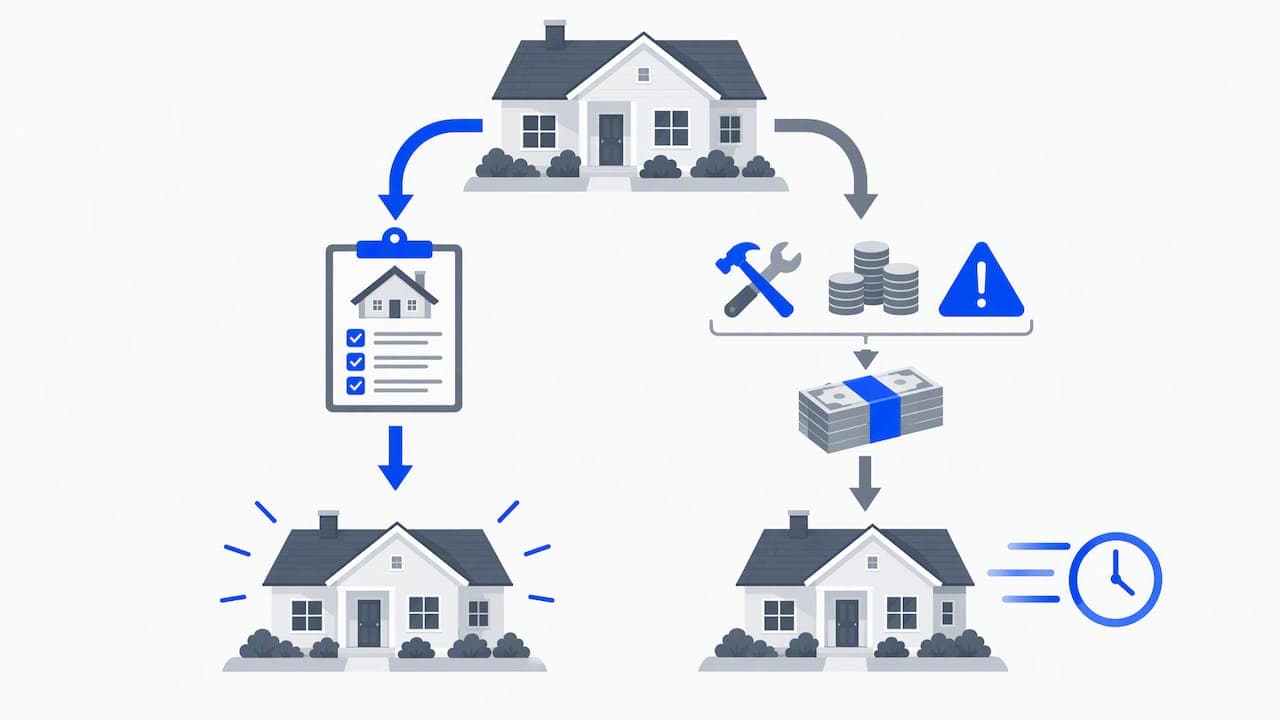
So an appraisal can be useful as a reference point, but it does not tell you what you will walk away with. The NCREC guidance is also clear that an appraisal is not an inspection and does not replace title, lien, environmental, structural or legal due diligence.
When a seller might reasonably pay for one:
- An inherited house where the estate needs a documented value. An appraisal as of the date of death is often used for tax basis, and that is a separate purpose from the sale. Talk to the estate’s attorney or a CPA.
- A single offer on the table and no way to compare it with anything else.
- A very large gap between the offer and what you believe the house is worth, and you want evidence before negotiating.
When it probably is not worth the cost or the days: when you are facing a deadline, such as a foreclosure sale date, and you have several written offers to compare.
A better test than an appraisal: compare real offers
An appraisal is one person’s opinion of value. Several competing cash bids from different buyers are the market telling you what the house is worth to people ready to pay for it today. That is the idea behind how we work, and we explain the mechanics in how multiple cash offers work for home sellers and the role of competing cash offers.
When you have two to five offers, look at these side by side:
| What to compare | Why it matters |
|---|---|
| Offer price | The headline, but not the answer |
| Appraisal or inspection contingency | A contingency lets the buyer reopen the price |
| Who pays closing costs | Moves your net by thousands |
| Closing date | A 7-day close and a 30-day close are different products |
| Proof of funds | Confirms the money exists |
| Repairs or credits requested | Should be zero for a true as-is sale |
| Earnest money | Shows how serious the buyer is |
If one bid is far below the rest, you have learned something without paying an appraiser. If they cluster, that cluster is a defensible price for the condition.
What you net: the number that matters
There is no universal dollar value for a cash offer. The meaningful figure is what you receive after everything is subtracted. Start from the offer and take away:
- Your mortgage payoff and any other liens, including unpaid taxes or judgments
- Seller-paid closing charges and title fees
- Michigan transfer taxes
- Prorated property taxes and utilities
- Any repair credits or concessions the buyer negotiates
We cover the payoff step in detail in our post on mortgage payoff in a cash sale in Michigan, and the common line-item reductions in deductions cash buyers take.
A worked example with Michigan transfer tax
Michigan charges transfer tax at the time the deed is recorded. According to the Van Buren County Register of Deeds, the state rate is $3.75 for every $500 or part of it, and the county rate there is $0.55 for every $500 or part of it. County rates can differ, so check yours with your county Register of Deeds.
Using those rates on a $200,000 sale: $200,000 divided by $500 is 400 units. Multiply by $4.30 ($3.75 plus $0.55) and the transfer tax is $1,720. That is only one line. If the same house has a $120,000 payoff, the rest of the settlement statement comes out of what is left.
Rule of thumb: ask every buyer for a written net sheet or estimated settlement statement before you accept. The final figure should match the signed statement from the title company, not a conversation.
What a cash offer does not include
In a traditional listing you would pay agent commissions, and often fund repairs, cleaning and staging. An as-is cash sale through us has none of those, which is why a lower headline number can net you more than it first appears. See why a cash sale eliminates agent fees for the arithmetic.
Seller concessions in a cash deal
Concessions are costs one side agrees to cover. In financed sales they often take the form of the seller paying part of the buyer’s closing costs. In cash sales, buyers usually do not need that help, so concessions tend to look different: a request that you leave certain items, a credit for a known repair, or a request that you pay for a survey or certain title cures.
A true as-is sale should not require you to fix anything. If an offer starts asking for repair credits after an inspection, treat it as a price reduction in disguise and compare it against the other bids. Our guide to what foreclosure sold as-is means explains what as-is does and does not cover.
How long does a cash sale take?
Without an appraisal and without lender underwriting, the timeline is set by the title work and the seller’s readiness. Closing can be as quick as seven days on our platform, and the main variables are:
- Offer acceptance. Days, not weeks, when you have competing bids.
- Title search and commitment. A clean title moves quickly. Liens, unpaid taxes or an unsettled estate slow it down.
- Payoff letters. Request them from your mortgage servicer early.
- Signing and funding. Cash buyers wire funds through a title company.
If the house is inherited, the speed also depends on who has legal authority to sign. Our posts on the role of the executor in an estate sale and cash buyers for estate properties walk through that.
If you are facing foreclosure, timing is the whole game. Read cash sale vs foreclosure outcome so you know what each path leaves you with, and contact a housing counselor or foreclosure attorney about your specific deadline.
Taxes and reporting: a separate question from the appraisal
People often ask whether skipping an appraisal helps keep a sale off the government’s radar. It does not, and the two have nothing to do with each other. Per the IRS guidance on Form 8300, businesses that receive more than $10,000 in cash in a transaction generally must file a report. Real estate sales can also be reported through Form 1099-S, generally filed by the person responsible for closing.
Your own tax result turns on your gain. The IRS explains that amount realized includes what you receive plus debt the buyer assumes or pays off, less selling expenses, and you compare that with your adjusted basis. Publication 523 covers the home sale gain exclusion and how long to keep basis records. A 1099-S can arrive even when you believe the gain is fully excludable, so keep your purchase, improvement and closing records, especially for an inherited property. A CPA can tell you what applies to your situation.
Our perspective
Here is what we see on the Michigan homeowner side. People ask about an appraisal because they are afraid of being lowballed, and that fear is reasonable. But an appraisal is a slow, indirect way to answer it. The fastest way to test a cash price is to put the house in front of several vetted investors at once and read the numbers they put in writing.
We built HouseGoodbye around that. Investors know they are competing, so the offers tend to reflect what the house is worth to them rather than a number designed to see whether you will take the first bid. You see each offer, you choose, and you owe nothing to accept or to walk away.
Our advice: do not pay for an appraisal by default. Pay for one only if an estate or a tax question needs it. Otherwise, collect offers, ask for a net sheet from each, check the contract for appraisal contingencies, and pick the highest net with the fewest strings.
— Bryan
Get competing cash offers for your Michigan home
If you want to see what your house would bring without repairs, agent commissions or an appraisal appointment, request competing cash offers from vetted local investors. Need to move quickly? See how we handle a fast sale, or read about selling as-is, in any condition. We serve homeowners in Detroit and across Michigan, including Sterling Heights, Dearborn Heights and Farmington Hills.
FAQ
Do cash buyers need an appraisal?
Not in general. Appraisals are a lender requirement, and a cash buyer has no lender. A buyer can still order one voluntarily or write an appraisal contingency into the offer, so check the contract.
Can a cash offer fall through because of a low appraisal?
Only if the offer includes an appraisal contingency or the buyer is using some form of financing that requires a valuation. A clean cash offer with proof of funds and no appraisal contingency does not depend on one. That is why we encourage sellers to compare contingencies, not just prices.
Is a cash offer usually lower than an appraised value?
Often, yes, especially for homes needing work. The buyer is paying for speed and taking on repairs, marketing time and resale risk. What matters is your net after commissions, repairs and carrying costs you avoid, which is why you should compare written net figures.
Does the IRS know about a cash home sale?
Yes, it can. Sales may be reported on Form 1099-S, and certain large cash payments to a business trigger Form 8300. Whether an appraisal was done makes no difference. Report any taxable gain and talk to a tax professional about the exclusion.
Who pays for an appraisal in a cash sale?
Whoever orders it. If the buyer orders one, the buyer pays, and the buyer is the appraiser’s client. If you order one for your own reference or for an estate, you pay.
Sources
- NAR Consumer Guide: The Appraisal Process
- CFPB: What are appraisals and why do I need to look at them?
- CFPB Regulation B, 12 CFR 1002.14
- NCREC Bulletins: Real Estate Appraisals
- Van Buren County: Michigan Real Estate Transfer Tax
- IRS Form 8300 reference guide
- IRS Instructions for Form 1099-S
- IRS: Property (basis, sale of home, etc.)
- IRS Publication 523, Selling Your Home