Most Michigan sellers of 1-4 unit residential property must hand buyers a signed Seller’s Disclosure Statement before either side signs a binding purchase agreement, under the Seller Disclosure Act. Several statutory exemptions exist, including court-ordered transfers and sales between close family members, but none of them permit hiding a known defect. Miss the deadline or skip the form entirely, and the buyer can walk away under a statutory termination window set by law.
TL;DR:
- Sellers must deliver a signed Seller’s Disclosure Statement before signing a binding purchase agreement, except in specific exempt transfers like court-ordered or family sales.
- Exemptions do not excuse sellers from disclosing known defects, and failure to provide the form on time allows buyers a legal window to terminate the deal.
- The form requires honest answers based on personal knowledge, with supporting documents encouraged; guessing is discouraged, and late disclosures can be corrected with documented communication.
- Sellers are protected if they answer truthfully and exercise ordinary care but are liable for fraud if they conceal known defects intentionally.
- Using cash or quick sale options can bypass detailed disclosures and suit properties with code violations or imminent deadlines, but full transparency remains advisable.
Table of Contents
- What Does Michigan’s Seller Disclosure Law Require?
- Which Michigan Home Sales Are Exempt From the Disclosure Form?
- What’s Actually on Michigan’s Official Disclosure Form?
- What Happens if the Disclosure Is Late or Missing?
- Can a Seller Be Sued for a Bad Disclosure in Michigan?
- A Step-by-Step Compliance Checklist for Michigan Sellers
- A Straight Take on Disclosure and Speed
- When an As-Is Cash Sale Makes More Sense Than Listing
- Sources
- FAQ
What Does Michigan’s Seller Disclosure Law Require?
The Seller Disclosure Act, Act 92 of 1993, covers sales, exchanges, installment land contracts, and lease-with-option deals involving one to four residential units, plus certain cooperative transfers. If you own a duplex, a triplex, or a single-family home and you’re transferring ownership through any of those methods, the law applies to you.
Timing matters more than most sellers realize. You must deliver the signed disclosure statement before you execute a binding purchase agreement, not after. The same rule applies before signing an installment contract or a lease-option agreement. Handing it over at closing, or worse, after an offer is already accepted, doesn’t satisfy the statute.
Delivery to a real estate agent counts as valid delivery, but only if that agent passes the disclosure along to the buyer. Real estate brokers and salespeople are required to make copies of the disclosure form available to the public, which is one reason working with a licensed agent simplifies the paperwork trail. If you’re selling without an agent, you’re responsible for getting the form directly into the buyer’s hands and documenting when that happened.
Which Michigan Home Sales Are Exempt From the Disclosure Form?
The Seller Disclosure Act carves out several transfers where the formal statement isn’t required. If your sale falls into one of these categories, you don’t need to fill out the standard form, though the exemption doesn’t erase every other legal duty you carry as a seller.
- Court-ordered transfers, including probate, bankruptcy, and foreclosure sales
- Transfers to a mortgagee following default, including deed-in-lieu-of-foreclosure situations
- Transfers between spouses or other close family members
- Transfers by a fiduciary administering an estate, guardianship, or trust
- Sales of newly constructed homes that have never been occupied, when sold by a licensed builder
- Transfers incidental to a divorce or other property settlement
- Transfers to or from a government entity
Exemption from the form is not a license to conceal. A seller unloading an inherited home through probate still can’t lie about a failing foundation and expect the exemption to shield them from a fraud claim later.
What’s Actually on Michigan’s Official Disclosure Form?
The form itself walks through the house system by system. Expect sections covering the property address and ownership dates, appliances and major systems, the basement and roof, insulation, plumbing and electrical, pest history, environmental hazards, and any known legal or land-use issues, like zoning violations or unrecorded easements. There’s also a space for additional explanations and a required seller certification at the end.
The instructions built into the statutory form are specific: answer every question based on what you actually know, and mark items “Unknown” or “Not Applicable” when that’s genuinely true. Guessing to fill a blank is worse than admitting you don’t know.
A few practical points worth internalizing before you sit down with the form:
- Attach extra pages if a section needs more room, and sign every attachment along with the main form.
- The statement is explicitly not a warranty. It reflects your knowledge on the day you sign it, not a guarantee about the home’s condition.
- Attach inspection reports, repair invoices, or contractor receipts when you have them. They back up your answers if a buyer questions something after closing.
- Keep a dated copy of everything you deliver, and note how and when you delivered it.
Pro Tip: If you replaced the roof five years ago but don’t have the invoice anymore, say so in the additional-explanations section instead of leaving the question blank. A brief written note beats silence if a dispute comes up later.
What Happens if the Disclosure Is Late or Missing?
Deliver the disclosure after the purchase agreement is already signed, and the buyer gets a specific window to back out. Under Act 92, a buyer who receives a late disclosure in person can terminate the agreement within 72 hours. If the disclosure arrives by registered mail, that window stretches to 120 hours.
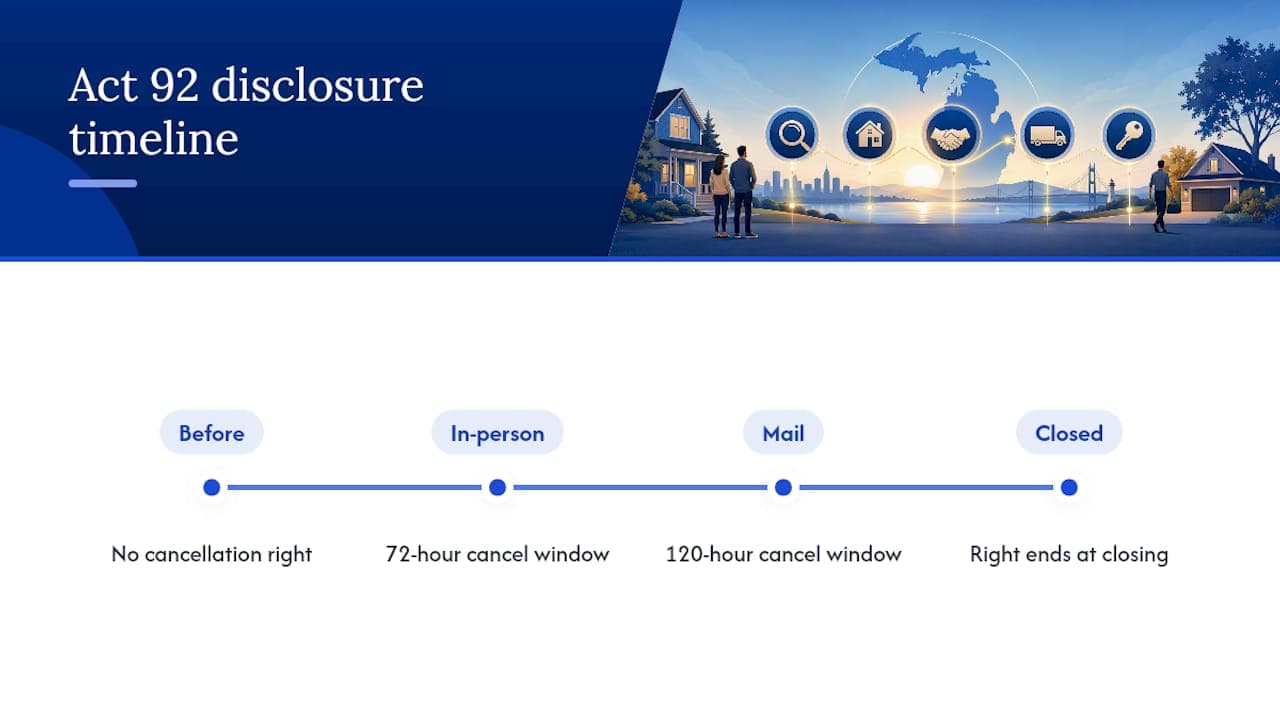
That termination right isn’t permanent. It expires once the transfer actually closes, whether by deed or by installment contract. A buyer who closes on the house and later discovers the disclosure was technically late has lost that specific statutory cancellation right, though other legal remedies (like a fraud claim) can still apply if something was actively hidden.
If you realize a disclosure went out late, or you left something off the original form, the fix is straightforward: get the corrected version to the buyer immediately, keep a written record of exactly when and how you sent it, and be ready to negotiate if the buyer raises objections. Waiting rarely helps. A prompt correction, documented in writing, tends to defuse the issue before it turns into a bigger dispute.
Can a Seller Be Sued for a Bad Disclosure in Michigan?
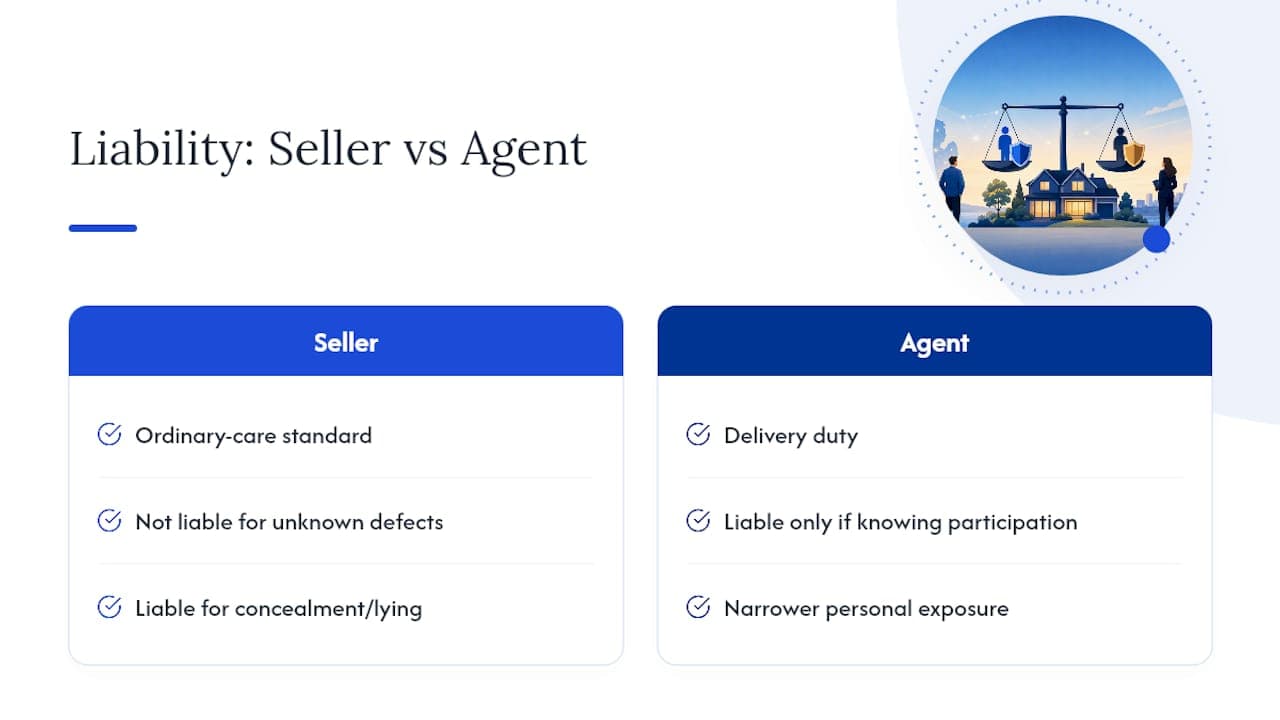
The statute gives honest sellers real protection. If you exercised ordinary care and answered based on what you actually knew, you’re generally not liable for inaccuracies about conditions outside your personal knowledge. Nobody expects you to crawl the attic with a moisture meter before signing.
That protection has a hard limit. Deliberate concealment or an affirmative lie about a known defect can expose you to a fraud or negligence claim after closing, regardless of what the exemptions cover. Real estate agents carry a narrower kind of exposure: they’re required to make sure the disclosure gets delivered, but they’re only on the hook personally if they knowingly participate in a violation, not simply because a form was late.
A Step-by-Step Compliance Checklist for Michigan Sellers
Getting this right doesn’t require a law degree. It requires following the sequence in order and keeping paper.
- Get the current official form from your broker or directly from the state. Brokers are required to make copies available.
- Answer every question honestly, based only on what you personally know about the property.
- Mark “Unknown” where that’s the truth, and attach supporting documents like inspection reports or permit records wherever you have them.
- Deliver the signed form before you sign a binding purchase agreement, and keep a dated copy of what you sent and when.
- Amend the disclosure in writing if anything changes before closing, like a burst pipe or a new roof leak discovered during the buyer’s inspection period.
Pro Tip: Build a simple folder, digital or physical, with every inspection report, repair receipt, and permit record from your time owning the home. If a question ever comes up about what you knew and when, that folder is your best evidence.
If you’re dealing with title issues, a contested estate, pending litigation, or an allegation that you concealed something, that’s the point to call a real estate attorney rather than guess your way through the form.
A Straight Take on Disclosure and Speed
Sellers who treat disclosure as a formality tend to create their own delays. The paperwork itself is not the obstacle. Vague or defensive answers are what invite a buyer’s attorney to slow things down or reopen negotiations after an inspection.
The sellers who move fastest are usually the ones who over-document rather than under-explain, especially with older homes carrying code issues or deferred maintenance. In experience working with Michigan homeowners who need a quick, as-is close, buyers who see a clear, well-documented disclosure move faster to a firm offer than buyers left guessing. Transparency isn’t just a legal safeguard. It’s what actually shortens the path to closing.
— Bryan
When an As-Is Cash Sale Makes More Sense Than Listing
If disclosure requirements, repair costs, or a tight timeline have you rethinking a traditional listing, there are services that offer a faster path: multiple cash offers from local investors, compared side by side, with no repairs, no staging, and no agent commissions to negotiate around.

This tends to fit sellers dealing with an inherited property moving through probate, a looming foreclosure deadline, a home with mold or code violations that would otherwise scare off financed buyers, or simply a relocation that can’t wait through a 60-day listing. Because the sale is as-is, the disclosure conversation gets simpler. You’re not warranting a renovated house. You’re disclosing what you know about a property being sold in its current condition, and closing can happen quickly once you accept an offer.
See how the cash-offer process works or head straight to compare real cash offers on your Michigan home to see what local investors are willing to pay.
Sources
- SELLER DISCLOSURE ACT - Act 92 of 1993 (Michigan Legislature PDF)
- Act 92 of 1993 - Seller Disclosure Act (Justia)
- What you need to know when buying or selling a house (Lachman PLC)
This article is general information, not a substitute for advice from a qualified lawyer. Consult a qualified legal professional about your own circumstances before acting on anything here.
FAQ
What Information Goes on a Michigan Seller Disclosure Form?
The form covers the property’s systems and history: roof, basement, plumbing, electrical, insulation, appliances, pest issues, environmental hazards, and known legal or land-use problems, along with a section for additional written explanations.
How Do I Get a Seller’s Disclosure Form in Michigan?
Real estate brokers and salespeople are required to make copies available to the public, or you can download the official statutory form directly from the Michigan Legislature’s site.
What Is the Michigan Disclosure Form Officially Called?
It’s the Seller’s Disclosure Statement, created under MCL 565.957 as part of the Seller Disclosure Act, Act 92 of 1993.
Who Fills Out the Seller’s Disclosure Statement?
The seller completes and signs it personally, based on their own knowledge of the property. It is not something an agent or attorney fills out on the seller’s behalf, though an agent typically helps deliver it to the buyer.
Do I Still Need to Disclose Anything if My Sale Is Exempt From the Form?
Yes. Exemptions like probate or family transfers remove the paperwork requirement, but you can still face a fraud claim if you knowingly hide a serious defect from the buyer.
Can I Sell My Michigan Home As-Is Without Filling Out the Full Disclosure Form?
You still generally need to complete the disclosure statement even for an as-is sale, since “as-is” refers to repair responsibility, not disclosure obligations. Housegoodbye works with sellers to sell as-is while keeping the required paperwork straightforward.