An executor can legally sell estate property once the probate court issues Letters Testamentary, confirming formal appointment. Being named in a will alone gives you no authority to sign contracts, accept offers, or transfer title. The moment you have those letters in hand, you can act. Until then, every sale-related step you take is premature and potentially void.
Here is what to do in the first 7–14 days:
- Secure the property. Change locks, collect keys from all parties, and document the property’s current condition.
- Obtain certified death certificates. Order multiple certified copies as needed for banks, title companies, and the probate court.
- File the original will with the probate court. Most states require this within days to weeks of death.
- Petition the court for appointment as executor (or administrator if there is no will) and request Letters Testamentary.
- Open a dedicated estate bank account. All estate income and expenses run through this account.
- Notify beneficiaries and creditors per your state’s required timelines.
- Maintain existing insurance policies on real property until sale or transfer. Let coverage lapse and you bear personal liability for any loss.
Courts and practitioners commonly expect executors to secure property, maintain insurance, and obtain appraisals before any sale proceeds. Supervised probate can also require court confirmation and allow overbids at confirmation hearings, which affects your timeline significantly.
Pro Tip: Get a professional appraisal early, especially if the property is unique, has sentimental value to beneficiaries, or could be contested. An appraisal dated close to the date of death is the single best defense against a later claim that you undersold.
Table of Contents
- What are the first steps after you are appointed executor?
- How do you prepare estate property for sale?
- How should you handle offers and keep beneficiaries informed?
- What happens at closing and how do you distribute proceeds?
- What tax obligations apply when an executor sells estate property?
- When should you hire a probate attorney, CPA, or real estate professional?
- How do competitive cash-offer marketplaces work for executors?
- Key Takeaways
- What executors actually face when the clock is running
- Housegoodbye: multiple cash offers for Michigan executors who need speed
- Useful sources for executors
- FAQ
What are the first steps after you are appointed executor?
The first two weeks set the tone for everything that follows. Probate attorneys consistently report that executors who build a clean paper trail early face far fewer disputes at closing and during final accounting. LegalZoom notes that an executor’s duties span from filing the will through final distribution, a process that often takes months.
Here is the prioritized sequence:
- Open an estate bank account — at a local bank using the Letters Testamentary and the estate’s EIN from the IRS.
Timeline reality check: Death certificates and property security happen promptly. Letters Testamentary typically take some weeks depending on the court’s docket. A full appraisal takes a few weeks after the appraiser is engaged. Court confirmation of a sale, if your state requires it, can add two to four months on top of that.
For Michigan-specific procedural steps and a probate property documentation checklist, the county probate court’s local rules are the authoritative starting point.
Executors frequently underestimate the ongoing expenses the estate must cover during probate: mortgage payments, property taxes, utilities, and insurance continue until the property transfers. Plan for those costs from day one, or a slow probate can force a rushed sale at a lower price.
How do you prepare estate property for sale?
Preparation before listing has two tracks: legal and physical. Skipping either one creates problems at closing.
Appraisal
A professional appraisal is required in supervised probate and strongly recommended in all others. Courts expect an appraisal to verify that the sale price reflects fair market value. If beneficiaries later challenge the sale, an appraisal dated near the listing date is your primary defense. For unusual assets, including art, collectibles, antique furniture, or specialized real estate, use a specialist appraiser, not a generalist. Undervaluation disputes on unique assets are among the most common sources of executor liability.
Pro Tip: Use a specialist appraiser for collectibles, art, or unusual real estate. A generalist appraiser who values a Victorian home the same way they value a ranch house will produce a number that does not hold up in court.
Title
Before listing, pull a title search to confirm the estate actually owns what you think it owns. Look for:
- Outstanding liens or mortgages that must be paid at closing
- Joint tenancy or survivorship rights that may have transferred ownership automatically at death
- Easements, encumbrances, or title clouds that could delay or kill a sale
- Any recorded judgments against the decedent
Maintenance and insurance
The estate pays for all ongoing property expenses from estate funds. That includes the mortgage, property taxes, homeowner’s insurance, utilities, and any necessary repairs to prevent deterioration. Document every payment with receipts run through the estate bank account. Appraisal fees and maintenance costs are legitimate estate expenses, reimbursable before distribution.

Documentation for listing or court filings
Gather the deed, title search results, mortgage payoff statement, property tax records, HOA documents if applicable, and any permits for recent improvements. A for-sale-as-is checklist can help you confirm nothing is missing before you engage a buyer or file a court petition.
How should you handle offers and keep beneficiaries informed?
Once offers arrive, your job is documentation and communication, in that order. Personal representatives should document offers and use appraisals when needed to defend the sale if beneficiaries object.
For every offer, retain:
- A copy of the written offer with all terms and contingencies
- Proof of the buyer’s financing (pre-approval letter or proof of funds)
- Your written response and any counter-offer
- Notes from any verbal conversations, summarized in a follow-up email
Beneficiary communication does not mean beneficiary approval. You have decision-making authority as executor. But timely, factual updates reduce the emotional temperature and the likelihood of formal objections. Send written updates when you list the property, when you receive an offer, when you accept, and at closing. Keep the tone factual, not conversational. Avoid negotiating by email without a written summary of what was agreed.
When beneficiaries object to a sale, the first question is whether the objection has legal merit. A beneficiary who simply wants more money is not a legal obstacle. A beneficiary who claims you are self-dealing or selling below market without documentation has a legitimate grievance. Executors should be prepared to petition the court or present appraisals if beneficiaries object.
Red flags that warrant immediate consultation with a probate attorney:
- An offer that is significantly below the appraised value with no clear explanation
- A buyer who is a family member, business associate, or someone who benefits you personally
- Pressure from a beneficiary to accept a specific buyer or skip the appraisal
- Side agreements between a buyer and a beneficiary that you were not part of
- Requests to close without title insurance or without proper disclosure
For guidance on common conflicts between beneficiaries during estate sales, the pattern is almost always the same: insufficient documentation and delayed communication. Both are preventable.
When siblings or co-beneficiaries disagree on whether to sell, structured negotiation techniques can help resolve disputes before they escalate to court challenges.
What happens at closing and how do you distribute proceeds?
Closing on an estate sale requires more paperwork than a standard residential transaction. The title company or escrow officer will need:
- Original or certified Letters Testamentary (some require a copy issued within 60–90 days)
- Certified death certificate
- Executor-signed deed (an executor’s deed or personal representative’s deed, not a standard warranty deed)
- Mortgage payoff statements for any liens
- Probate court order confirming the sale, if required in your jurisdiction
After closing, proceeds do not go directly to beneficiaries. The correct order of distribution is:
- Pay off liens, mortgages, and encumbrances from closing proceeds
- Pay probate costs: court fees, publication costs, appraisal fees
- Pay executor and attorney fees as approved by the court or will
- Pay valid creditor claims in the priority order your state requires
- Reserve funds for outstanding tax obligations (income tax, estate tax if applicable)
- Distribute the net balance to beneficiaries per the will or intestacy law
Pro Tip: Run all receipts and disbursements through the estate bank account. Every payment you make from a personal account, even temporarily, creates an accounting headache and a potential challenge from beneficiaries.
Track these items in your estate accounting:
| Accounting Item | Description |
|---|---|
| Gross sale proceeds | Total received at closing before deductions |
| Mortgage payoff | Balance paid to lender at closing |
| Closing costs and commissions | Agent fees, title insurance, escrow fees |
| Probate and legal fees | Attorney fees, court filing costs |
| Maintenance and repair costs | Expenses paid during probate from estate funds |
| Tax reserve | Estimated income or estate tax liability |
| Net distributable amount | Proceeds remaining after all deductions |
The final accounting goes to the probate court and all beneficiaries before the estate closes. Every line item needs a receipt or supporting document. Courts take incomplete accountings seriously, and beneficiaries can object to any disbursement that lacks documentation.
What tax obligations apply when an executor sells estate property?
Three separate tax returns may be relevant, and confusing them is a common and costly mistake.
Final individual income tax return (Form 1040): Filed for the decedent covering the period from January 1 of the year of death through the date of death. You sign as executor.
Estate income tax return (Form 1041): Required when the estate generates income during administration, including rental income, interest, dividends, or capital gains from a property sale. The estate is a separate taxpayer with its own EIN. If the estate earns more than $600 in gross income during administration, Form 1041 is required.
Estate tax return (Form 706): Required only when the gross estate exceeds the federal exemption threshold in the year of death. Most estates do not reach this threshold, but if the decedent held significant real estate, investment accounts, or business interests, confirm the total estate value with a CPA before assuming Form 706 is unnecessary.
Basis rules matter for capital gains. Assets inherited at death generally receive a stepped-up basis equal to fair market value on the date of death. That means if the estate sells property shortly after death at or near appraised value, the capital gain is often minimal. A property sold well above the date-of-death value, or one held in trust with carryover basis rules, can generate a meaningful taxable gain. Document the date-of-death value carefully.
Pro Tip: Consult a CPA experienced with estates before accepting an offer that could trigger unexpected income tax consequences. The stepped-up basis rule has nuances, and getting it wrong costs the estate money.
When should you hire a probate attorney, CPA, or real estate professional?
Not every estate needs a full professional team. But several situations make hiring non-negotiable:
- The estate is contested or a beneficiary has threatened legal action
- The will is ambiguous about the power of sale or executor authority
- The estate may owe federal estate tax (Form 706 territory)
- There are title clouds, liens, or ownership disputes on real property
- You need to petition the court for a sale order or confirmation
- The estate includes business interests, out-of-state property, or unusual assets
- You simply do not have the time or comfort to manage court filings yourself
What to ask a probate attorney:
- How many probate sales have you handled in this county in the past two years?
- Do you charge a flat fee for standard petitions or hourly for the full matter?
- What is a realistic timeline for court confirmation in this jurisdiction?
- What is your process for communicating with beneficiaries?
What to ask a real estate agent:
- Have you represented an executor in a probate sale before?
- Are you familiar with the court confirmation process in this county?
- Can you provide references from other executors you have worked with?
What to ask a CPA:
- Do you prepare Form 1041 and Form 706 returns?
- How do you handle basis documentation for inherited property?
- What is your fee structure for estate tax work?
Fee expectations vary. Probate attorneys typically charge flat fees for standard petitions and hourly rates for contested matters or litigation. Real estate agents charge standard commission (often 5–6% of sale price, split between buyer and seller agents), though some agents negotiate reduced rates for estate sales. CPAs typically charge hourly for estate tax work, with complexity driving the total.
How do competitive cash-offer marketplaces work for executors?
Cash-offer marketplaces work by soliciting bids from multiple vetted investors simultaneously and presenting those competing offers to the executor. The process typically runs like this:
- The executor submits basic property information (address, condition, timeline).
- The platform solicits bids from its investor network.
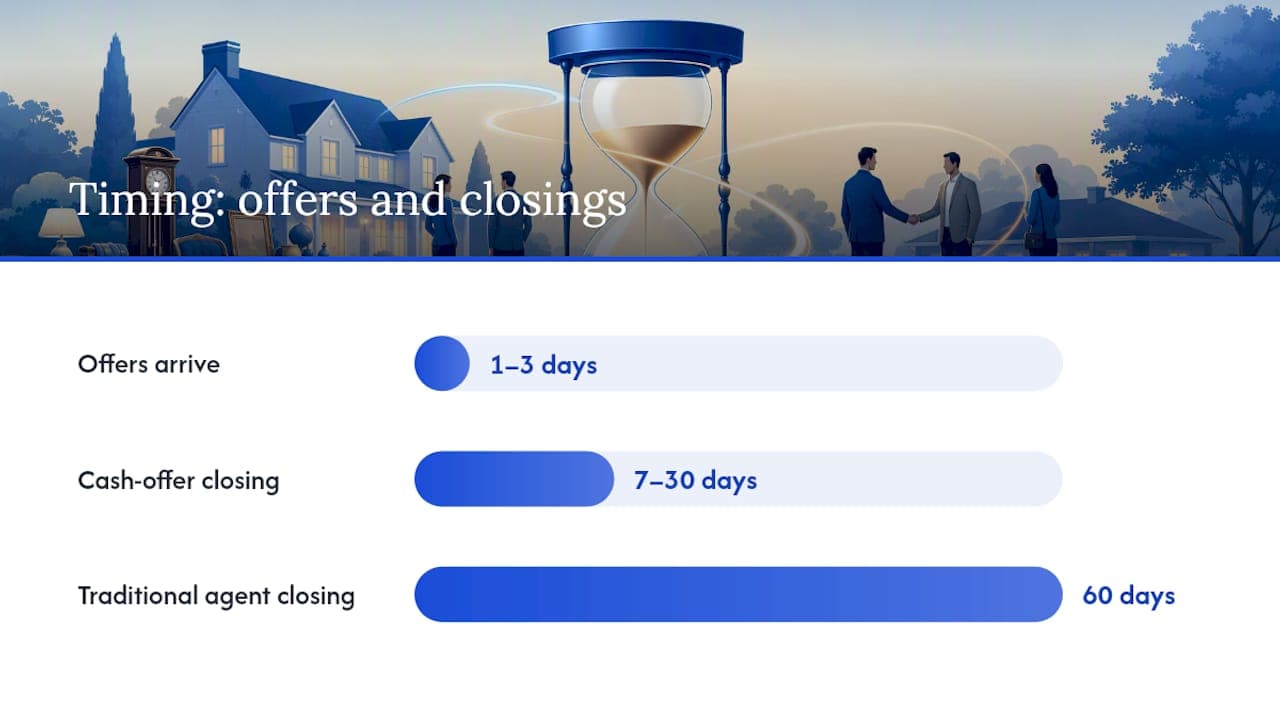
- Multiple cash offers arrive, often within 24–72 hours.
- The executor reviews and compares offers, selects the strongest, and proceeds to closing.
- Closings can occur comparatively quickly, often within a few weeks, with no repairs, staging, or agent commissions required.
Competitive cash-offer marketplaces can speed closings substantially, but executors must require proof of funds and document that the estate received fair market consideration to meet fiduciary duties.
| Factor | Cash-Offer Marketplace | Traditional Agent Listing |
|---|---|---|
| Speed to close | 7–30 days | 60 days |
| Net proceeds | Below retail; competitive among investors | Typically highest net |
| Repairs required | None | Often expected by buyers |
| Court involvement | Low (independent admin) | Low to high depending on state |
| Documentation burden | Moderate (proof of funds, appraisal) | Higher (disclosures, inspections) |
| Fiduciary risk | Requires appraisal to document fairness | Appraisal supports market listing price |
The fiduciary risk with cash offers is not the speed. It is the documentation. If you accept a cash offer without an independent appraisal on file, a beneficiary can argue you undersold the estate. With an appraisal showing the cash offer is within a reasonable range of market value given the property’s condition and the estate’s time constraints, that argument loses its footing.
Due diligence checklist for any cash buyer:
- Written proof of funds (bank statement or letter from financial institution, dated within 30 days)
- Title insurance commitment from a licensed title company
- Clear, written closing timeline with no open-ended contingencies
- No assignment clauses that allow the buyer to flip the contract to an unknown third party
- Independent appraisal on file to document fair market consideration
Pro Tip: Obtain several competing cash offers and an independent appraisal before accepting any single bid. That combination is the clearest evidence the estate acted prudently and maximized value given its time constraints.
Key Takeaways
An executor’s authority to sell estate property is real but conditional: Letters Testamentary, fiduciary compliance, and proper documentation are the three pillars that protect both the estate and the executor personally.
| Point | Details |
|---|---|
| Letters Testamentary are required | You cannot legally sign contracts or transfer title until the probate court formally appoints you. |
| Appraisals protect you | A professional appraisal dated near the listing date is the primary defense against beneficiary challenges to the sale price. |
| Court approval triggers vary by state | Supervised probate requires a court confirmation order before closing; independent administration does not, but check your state’s statute. |
| Document every transaction | Run all estate income and expenses through a dedicated estate bank account and retain receipts for the final accounting. |
| Housegoodbye offers a fast alternative | For Michigan executors who need speed or an as-is sale, Housegoodbye connects you with multiple competing cash offers and supports closings in as little as 7 days. |
What executors actually face when the clock is running
The legal framework for estate sales is well-documented. What the guides rarely say plainly is how much of this process runs on family dynamics, not just statutes.
The hardest part of managing an estate sale is usually not the paperwork. It is the moment a beneficiary calls you at 9 PM convinced you are selling the family home too cheaply, or too quickly, or to the wrong buyer. Your authority as executor is real, but exercising it without communication is a reliable way to turn a manageable probate into a contested one.
What sensible executors do is treat communication as part of the job, not a courtesy. Written updates at every milestone. Offers shared promptly. Decisions explained with reference to the appraisal, not just your judgment. That paper trail is not just good practice; it is your defense if someone files an objection.
On timelines: most executors underestimate how long probate takes. A straightforward estate with a cooperative family and a market-ready property can close in several months, while more complex or contested cases may take substantially longer. The carrying costs during that period, mortgage, taxes, insurance, utilities, add up fast and reduce what beneficiaries ultimately receive.
The case for a fast, as-is cash sale is strongest when the estate cannot afford to wait, the property needs significant work, or the family simply needs closure. It is not the right answer for every estate. But for executors in Michigan who need to move quickly, having multiple competing cash offers on the table is a better position than accepting the first bid that arrives.
Housegoodbye: multiple cash offers for Michigan executors who need speed
Selling an estate property through a traditional listing takes time most probate timelines cannot absorb. Mortgage payments, property taxes, insurance, and utilities keep running while the estate waits for the right retail buyer. For Michigan executors managing an as-is property or a tight timeline, a faster route exists.

Housegoodbye connects Michigan executors with multiple vetted cash investors who compete for the property simultaneously. That competition matters: a single cash offer is a take-it-or-leave-it proposition, but several competing bids give you documented evidence that the estate received fair market consideration, which is exactly what fiduciary duty requires. No repairs, no staging, no agent commissions, and closings in as little as 7 days.
Before you accept any offer, ask the buyer for written proof of funds, a title insurance commitment, and a fixed closing date. Housegoodbye’s process is built around those requirements.
Ready to see what multiple investors will offer for the estate property? Sell the property as-is with no repairs required, or learn how the cash-offer process works before you decide.
This article is general information, not legal or tax advice. Confirm current probate rules, tax obligations, and local court procedures with a licensed probate attorney or CPA in your state.
Useful sources for executors
- Selling Real Estate During Probate: Complete Guide for Executors and Heirs [2026] — Protecting Wealth
- Deceased taxpayers: filing the estate income tax return (Form 1041) - IRS
- Guidelines for Individual Executors & Trustees - American Bar Association
- The other side of the will: top 10 duties of an executor - LegalZoom
- Can Estate Executor Sell Property? (w/Examples) + FAQs - TaxSharkInc
- Personal Representative Selling Inherited Property - Step by Step | Inherited Property Match
- Executor of a Will: Duties and Step-by-Step Guide - Nolo
- Will executor duties FAQ - FindLaw
FAQ
What is the first thing an executor should do after appointment?
Obtain certified Letters Testamentary from the probate court. Without them, you have no legal authority to sign contracts, open estate accounts, or transfer property on the estate’s behalf.
How much authority does an executor have over estate property?
An executor has broad authority to manage, maintain, and sell estate property, but that authority is bounded by fiduciary duty, the will’s terms, and state probate law. Self-dealing, selling below fair market value without documentation, and distributing proceeds before paying creditors are all prohibited.
What should an executor never do during an estate sale?
An executor should never sell estate property to themselves or a family member at below market value without court approval, skip the creditor notice period before distributing proceeds, or accept an offer without retaining documentation that the price reflects fair market value.
Who has more authority, a beneficiary or an executor?
The executor has decision-making authority over the estate during probate, including the authority to sell property. Beneficiaries have the right to receive timely information and to object to the final accounting, but they cannot override the executor’s sale decisions unless a court finds a breach of fiduciary duty.
Does an executor need court approval to sell estate property?
It depends on the state and the will. In states with independent administration and a will that includes a power of sale clause, court approval is generally not required. In supervised probate, or when the will is silent on the power of sale, a court confirmation order is typically required before closing.