If your job starts in 10 weeks, list your home now. The count-back rule for a traditional sale is simple: allow 30–60 days from accepted offer to closing, plus 2–4 weeks of marketing time to find a buyer, which means you need at least 10–12 weeks of runway to sell comfortably. If your start date is closer than that, a cash sale can close in as little as 7–10 days and remove most of the timing risk.
Your immediate next steps:
- Call a listing agent today and ask for a comparative market analysis and a realistic days-on-market estimate for your neighborhood.
- Pull together your mortgage payoff statement, HOA documents, and last two years of tax records so you are not scrambling when a buyer’s lender asks.
- Ask your employer in writing whether the start date has any flexibility, even two to three weeks, since that window can change your entire strategy.
- Decide now whether you need sale proceeds to fund your next home purchase or whether you can close on the new side independently.
- Get at least one cash offer as a benchmark, even if you plan to list traditionally, so you know your floor price and fastest-close option.
Single biggest timing risk: A deal collapse at the 30-day mark. Buyers back out, financing falls through, or an inspection surfaces a repair the seller cannot afford to fix quickly. If that happens 30 days before your start date, you have almost no time to relist and close again. Build a contingency plan before you need it.
Key Takeaways
Coordinating a home sale with a job start date requires a count-back plan, a clear decision on speed versus price, and a confirmed backup option before the traditional listing stalls.
| Point | Details |
|---|---|
| Count-back rule | List at least 10–12 weeks before your start date for a traditional sale; cash sales need as little as 2 weeks. |
| Non-negotiable start date | A cash-offer marketplace like Housegoodbye closes in as little as 7 days with no repairs or commissions. |
| Flexible start date | A traditional listing priced for speed (at or below median comps) typically closes in 73–93 days on average. |
| Carrying costs matter | Holding costs on a $300,000 home run roughly $2,550 per month; two months often exceeds the price gap between cash and retail. |
| Housegoodbye | Submit your home, receive competing investor offers, and close on your schedule — as fast as 7 days, as-is. |
Table of Contents
- How long does a home sale actually take from listing to closing?
- What are your real options for aligning the sale with your start date?
- What risks do relocating sellers face, and how do you reduce them?
- Your count-back checklist: 90 days to move-in
- What are the real financial costs of timing your sale wrong?
- When time is non-negotiable: how Housegoodbye solves the timing problem
- What should you ask your agent, lender, and employer?
- What most relocation guides get wrong
- Michigan homeowners: get competing cash offers before your start date
- Sources
- FAQ
How long does a home sale actually take from listing to closing?
Understanding the realistic duration of each stage is the foundation of any schedule home sale timing plan. Most homeowners underestimate how long the middle stages take.
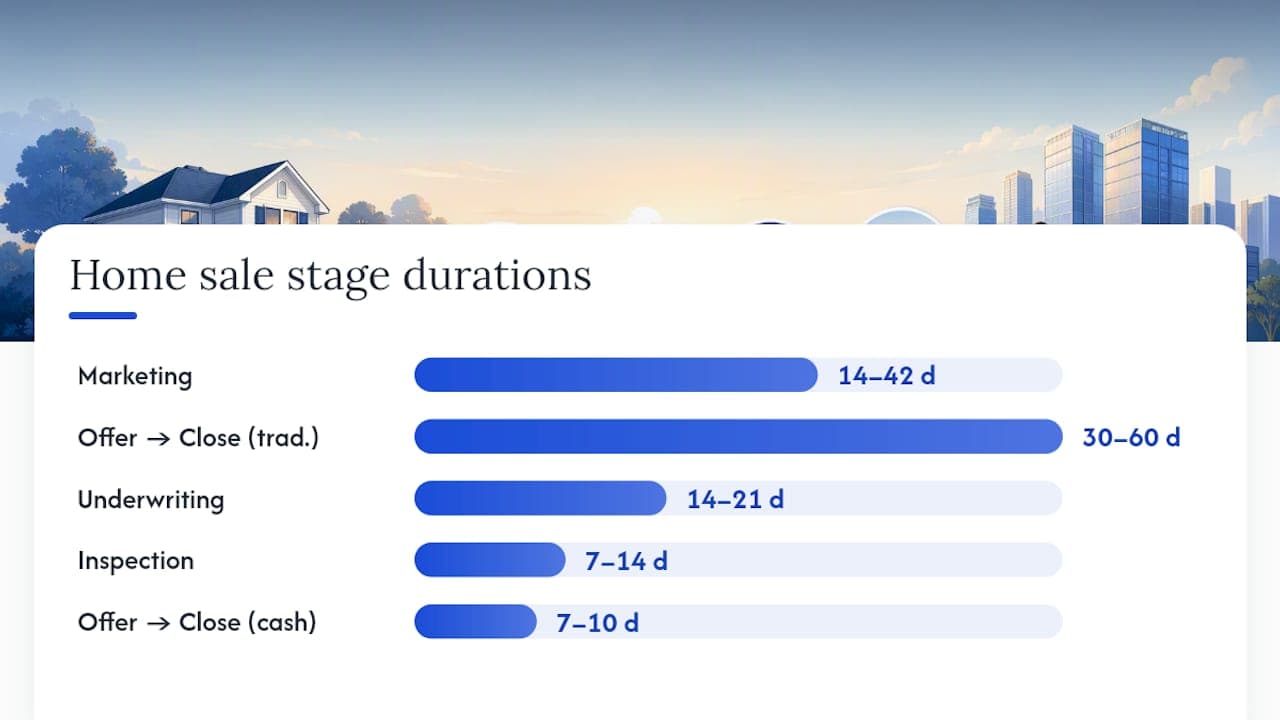
Industry summaries place full-sale timelines at roughly 73–93 days on average from listing to closing. Traditional sales commonly take 30–60 days from accepted offer alone, before you add marketing time. Cash offers compress that dramatically, typically closing in 7–10 days.
Here is how each stage breaks down:
| Stage | Typical Duration | Notes |
|---|---|---|
| Marketing (listing to accepted offer) | 2–6 weeks | Faster in hot markets; slower in winter or high-inventory areas |
| Offer negotiation and acceptance | 2–5 days | Can stretch if multiple counteroffers |
| Inspection and repair window | 7–14 days | Pre-inspection before listing cuts this to near zero |
| Appraisal | 7–14 days | Lender-ordered; can delay if appraiser backlog exists |
| Underwriting and clear-to-close | 14–21 days | Longest variable; cash buyers skip this entirely |
| Closing day | 1 day | Wire transfer, signatures, key handoff |
Count-back reference: If your job starts March 1, you need a clear-to-close by roughly February 22. Work backward: underwriting starts around February 1, appraisal ordered around January 25, inspection completed by January 18, offer accepted by January 14. That means listing by late November or early December at the latest for a traditional financed sale.

Cash sales change the math entirely. A cash buyer skips appraisal and underwriting, so the offer-to-close window shrinks to 7–14 days. If your start date is six weeks out, a cash sale is often the only route that gives you a confirmed closing date before day one at the new job.
Seasonality matters too. Spring (March through May) is historically the fastest-moving market in most U.S. regions. Listing in January or February in a cold-weather market can add two to four weeks of marketing time. Starting your preparation 60–90 days before your target listing date gives you the buffer to absorb those delays without blowing your timeline.
Pro Tip: Ask your agent for the current median days-on-market for your specific ZIP code, not the metro average. A neighborhood two miles away can move twice as fast.
What are your real options for aligning the sale with your start date?
Every job relocation home sale comes down to a speed-versus-price-versus-certainty trade-off. Here are the six viable paths, with honest pros and cons for each.
Sell first, then buy
You close on your current home before purchasing in the new city. This is the cleanest financial move because you know exactly what proceeds you have. The downside is temporary housing between closing and your new purchase, which adds cost and logistical friction. Best fit when your start date is fixed and you cannot carry two mortgages.
Buy first, then sell
You purchase in the new city before your current home closes. This requires qualifying for two mortgages simultaneously, which many buyers cannot do. If you have strong reserves and a low debt-to-income ratio, it avoids the temporary-housing gap. Risky if your current home sits on the market longer than expected.
Contingent offer
You make an offer on a new home contingent on selling your current one. Sellers in competitive markets often reject contingent offers outright, so this works best in slower buyer’s markets. It protects you from carrying two homes but can cost you the home you want.
Rent out your current home
Instead of selling, you become a landlord and rent the property while you move. Kiplinger notes that this path turns ownership into an active management role, with management fees, maintenance reserves, vacancy risk, and tax consequences that are often more complex than homeowners expect. Worth considering only if you have strong equity, a reliable property manager lined up, and no immediate need for sale proceeds.
Bridge loan
A short-term loan lets you tap your current home’s equity to fund the down payment on the new property before you sell. Bridge loans typically carry higher interest rates and fees, and lenders may scrutinize your employment situation closely if you have not yet started the new job. They buy time but add cost. Lenders often accept signed employment offer letters for mortgage pre-approval, which helps relocating buyers who have not yet received their first paycheck.
Cash sale through an investor marketplace
You submit your home to a platform like Housegoodbye, receive multiple competing cash offers, and close in as little as seven days with no repairs, no staging, and no agent commissions. The trade-off is a likely price below full retail market value. This is the right call when your start date is non-negotiable, you do not need maximum proceeds to fund the next purchase immediately, or you want a confirmed closing date on your calendar before you pack a single box.

Pro Tip: Even if you plan to list traditionally, get a cash offer first. It gives you a hard floor price and a backup close date. If your traditional listing stalls at the 30-day mark, you can pivot to the cash offer without starting over.
What risks do relocating sellers face, and how do you reduce them?
The coordination of a job move and home sale creates a specific cluster of risks that a standard home sale does not. Here is where things go wrong, and what to do about each.
- Deal collapse after acceptance: A buyer’s financing falls through or they walk after inspection. Mitigation: require pre-approval letters (not just pre-qualification) from all buyers, and price the home to attract multiple offers so you have a backup.
- Surprise repairs from inspection: An inspector flags a roof issue or HVAC problem that stalls the deal. Mitigation: pay for a pre-listing inspection ($300–$500) before you list. You fix what you choose to fix, disclose the rest, and price accordingly. No surprises mid-contract.
- Carrying two homes simultaneously: Your new job starts before your current home closes. Mitigation: negotiate a rent-back agreement with your buyer, allowing you to stay in the home for 30–60 days after closing while you get settled. Alternatively, build a temporary housing budget before you need it.
- Remote management of showings and repairs: You have already relocated when the home is still listed. Mitigation: hire a local property manager or a full-service agent who handles showings, lockboxes, and contractor coordination without requiring your physical presence. Remote closing tools are available in many states, so you can sign documents digitally from your new city.
- Overpricing in a time-constrained situation: Sellers emotionally attached to a price point sit on the market too long. Mitigation: price at or slightly below the comparable sales median from day one. A home priced right generates competing offers; a home priced high generates silence.
- Staging and cleaning from a distance: An empty or cluttered home photographs poorly and sells slowly. Mitigation: hire a local staging company before you leave, or sell as-is to a cash buyer and skip the staging entirely. Selling as-is can meaningfully reduce prep time compared to the traditional open-house cycle.
Pro Tip: Structure your purchase contract to include a 48-hour kick-out clause if you are the buyer in a contingent deal. It keeps you in the running on a new home while your current sale is pending, without locking the seller into an indefinite wait.
Your count-back checklist: 90 days to move-in
This is the plan you copy into your calendar. Every task is tied to days before your job start date.
90 days out
- Request a comparative market analysis from two or three local agents.
- Order a pre-listing home inspection and address any critical items.
- Confirm your job start date in writing and ask about flexibility.
- Research temporary housing options in the destination city (furnished apartments, extended-stay hotels, short-term rentals).
- Get at least one cash offer as a baseline.
60 days out
- Choose your listing agent and sign the listing agreement.
- Complete any repairs or cosmetic updates you decided to make after the pre-inspection.
- Hire a photographer and schedule professional photos.
- List the home at a price calibrated for speed, not optimism.
- Begin decluttering and packing non-essential items.
45 days out
- If no accepted offer yet, reassess price with your agent immediately. Do not wait.
- Activate your contingency plan: contact Housegoodbye or another cash buyer if the traditional listing is stalling.
- Confirm your moving company and lock in a date range.
- Notify your children’s schools, utilities, and subscriptions of the upcoming move.
30 days out
- You should have an accepted offer by now. If not, pivot to a cash sale.
- Schedule the buyer’s inspection and appraisal.
- Begin the mortgage payoff coordination with your lender.
- Arrange storage if closing and move-out dates do not align.
14 days out
- Confirm the closing date in writing with the title company.
- Do a final walkthrough of the home with your agent.
- Arrange the wire transfer for closing proceeds.
- Confirm your new housing arrangement is locked in.
7 days out
- Pack the remaining items and confirm the moving truck schedule.
- Transfer utilities at the current address to the buyer’s name effective closing day.
- Collect all keys, garage openers, and appliance manuals for handoff.
0 days (closing day)
- Sign documents (in person or remotely via e-closing tools).
- Confirm wire receipt.
- Hand over keys.
If the sale lags at 45 or 30 days: Do not wait for a miracle offer. Contact a cash buyer immediately, get an offer within 24–48 hours, and set a closing date that lands before your start date. The price difference between a cash offer and a retail sale is almost always smaller than two months of carrying costs plus the stress of managing a listing from another state.
What are the real financial costs of timing your sale wrong?
The financial stakes of home sale planning for relocation are higher than most people calculate upfront.
Carrying costs add up fast
Every month you hold a home after relocating, you pay mortgage principal and interest, property taxes, homeowner’s insurance, utilities, and basic maintenance. For a $300,000 home with a $1,800 monthly mortgage payment, add roughly $300 in taxes, $150 in insurance, and $200 in utilities, and you are looking at approximately $2,450 per month in holding costs. Two months of that is $4,900 out of pocket, before any unexpected repairs.
Use the Housegoodbye carrying cost calculator to run your own numbers. The math often makes a slightly lower cash offer look far more attractive than holding out for a higher retail price.
Relocation assistance from your employer
Many employers offer relocation packages, particularly for mid-level and senior roles. Domestic packages commonly range from $5,000 to $20,000, and may include temporary housing, home-sale assistance, and moving expense reimbursement. Ask your HR contact specifically whether the package covers:
- Home-sale closing costs or agent commissions
- Temporary housing in the destination city
- Moving truck or pod reimbursement
- A lump-sum payment you can apply to bridge financing
Relocation assistance paid as a lump sum is typically treated as taxable income, so factor that into your net calculation. Ask your employer whether they gross up the payment to cover the tax hit.
Bridge loan caution
Bridge loans can solve a timing gap, but they carry higher interest rates than standard mortgages and require you to qualify while potentially carrying two properties. If you have not yet started the new job, some lenders will not approve a bridge loan without a signed offer letter and documented start date. Confirm your lender’s policy before counting on this option.
Tax note: Capital gains exclusions, state transfer taxes, and deductibility of moving expenses vary by situation and state. Confirm your specific tax position with a CPA before closing.
When time is non-negotiable: how Housegoodbye solves the timing problem
When the job start date is fixed and a traditional listing carries too much timing risk, a cash-offer marketplace is the most reliable path to a confirmed closing date.
Housegoodbye’s cash-offer process works in three steps: submit your home details, receive multiple competing offers from vetted local investors, and choose the offer that fits your timeline and price needs. Closing can happen in as little as seven days. No repairs, no staging, no agent commissions, and no open houses that cost you time without guaranteeing a buyer.
The advantages for a relocating homeowner are specific:
- Confirmed closing date: You pick the date. That means you can align your move-out with your first day at the new job without guessing.
- No repair contingencies: Investors buy as-is, so a surprise inspection finding does not kill the deal or delay your timeline.
- No commission deducted at closing: Traditional agent commissions typically run 5–6% of the sale price. On a $300,000 home, that is $15,000–$18,000 you keep.
- Competing offers raise your price: Because multiple investors bid, you are not locked into a single take-it-or-leave-it offer.
The honest trade-off: cash offers typically come in below full retail market value. If maximizing sale price is your top priority and your start date has flexibility, a traditional listing with an experienced agent may net you more. But if the start date is fixed, the certainty of a confirmed close date often outweighs the price difference, especially once you subtract carrying costs, agent fees, and the cost of temporary housing from the retail-sale scenario.
To prepare for a fast-cash sale:
- Have your mortgage payoff amount ready before you request offers.
- Know your minimum acceptable price so you can evaluate offers quickly.
- Confirm your preferred closing date range so investors can structure their offers accordingly.
Pro Tip: Request offers from Housegoodbye even if you are 90 days out. Knowing your cash-offer floor changes how aggressively you price the traditional listing and gives you a confirmed exit if the market does not cooperate.
What should you ask your agent, lender, and employer?
Getting the right answers from the right people early is what separates a smooth relocation from a chaotic one. These are the questions that actually protect your timeline.
Questions for your listing agent
- What is the current median days-on-market for homes like mine in this ZIP code?
- What list price gives me the highest probability of an accepted offer within three weeks?
- Can you manage showings, inspections, and contractor access if I have already relocated?
- What is your plan if we have no accepted offer at the 30-day mark?
- Have you handled relocation sales before, and what is your average days-on-market for those listings?
Red flag: An agent who resists a price reduction conversation at 30 days or who cannot manage the property remotely is the wrong agent for a time-constrained sale.
Questions for your mortgage lender
- Will you accept a signed employment offer letter for pre-approval on the new purchase?
- How many pay stubs from the new job will you require before issuing a clear-to-close?
- What is your current average underwriting turnaround time?
- Do you offer bridge loan products, and what are the qualifying criteria?
- If I close on my current home before starting the new job, does that affect my qualification for the new mortgage?
Red flag: A lender who requires multiple pay stubs before closing will not work for a buyer who has not yet started the new job. Find a lender experienced with relocation mortgage scenarios before you need one.
Questions for your employer
- Is the start date firm, or is there a two-to-four-week window of flexibility?
- What does the relocation package cover, and is there a deadline to use the benefits?
- Is the relocation payment a lump sum or reimbursement, and how is it taxed?
- Can you provide a formal offer letter with salary, title, and start date for mortgage purposes?
- Does the company offer temporary housing or a housing allowance for the first 30–90 days?
For guidance on using a relocation package to buy a home, confirm with HR exactly which expenses are covered and whether the package can be applied toward closing costs on the new purchase.
What most relocation guides get wrong
The standard advice is to start early and stay organized. That is true but incomplete. What actually derails relocating sellers is not a lack of planning. It is the assumption that the traditional sale process will behave predictably when the seller is under a hard deadline.
The pattern that shows up repeatedly: a homeowner lists at an optimistic price, gets no offer in the first two weeks, waits another two weeks before reducing, and suddenly has 18 days until the job starts and no accepted offer. At that point, the options narrow fast and the stress compounds.
The one piece of advice worth carrying into every relocation: treat the cash offer as your insurance policy, not your last resort. Get it early, keep it on the table, and let it inform every pricing and timing decision you make on the traditional listing. The homeowners who navigate this well are not the ones who avoided the cash route. They are the ones who knew their number and their deadline, and made a clear-eyed decision about which path actually got them there.
Michigan homeowners: get competing cash offers before your start date
When the job starts on a fixed date and a traditional listing feels like a gamble, Housegoodbye gives Michigan homeowners a concrete alternative. Submit your home details, receive multiple competing offers from vetted local investors, and compare real cash offers side by side with no obligation. There are no repairs to schedule, no agent commissions deducted at closing, and no open houses that eat your weekends without producing a buyer.

Housegoodbye closes in as little as seven days, which means you can have a confirmed closing date on your calendar before you finalize your moving truck reservation. For homeowners who need to sell their Michigan house fast for a relocation, this is the path that removes the timing risk entirely. Request your offers today and know your number before you commit to any other plan.
This article is general information, not a substitute for advice from a qualified financial advisor. Consult a qualified financial professional about your own circumstances before acting on anything here.
Sources
- Selling Your House for a Job Relocation: A Complete Guide - Redfin
- Relocating for Work? 7 Tips for an Easier Move
- How to Buy and Sell a Home When Relocating for Work | EffectiveAgents®
- Should You Rent or Sell Your Home When You Move? | Kiplinger
FAQ
How far in advance should you list your home before a job start date?
List at least 10–12 weeks before your start date for a traditional financed sale, which allows 2–4 weeks of marketing time plus 30–60 days from accepted offer to closing. If your start date is closer, a cash sale can close in 7–10 days.
What is the hardest month to sell a home?
January is typically the slowest month in most U.S. markets, with lower buyer demand and longer days-on-market. If your timeline forces a winter listing, price aggressively from day one rather than testing the market at a higher number.
Can you get a mortgage before starting a new job?
Many lenders will accept a signed employment offer letter for mortgage pre-approval, which allows relocating buyers to qualify before their first paycheck. Confirm with your specific lender, as requirements vary and some will still require one or two pay stubs before issuing a clear-to-close.
What is a reasonable start date to request from a new employer?
Requesting four to six weeks from the offer acceptance date is generally considered reasonable for a homeowner who needs to sell and relocate. Many employers accommodate this, particularly for mid-level and senior roles where relocation is expected.
How does Housegoodbye help when a job start date is fixed?
Housegoodbye connects Michigan homeowners with multiple competing cash investors who can close in as little as seven days, with no repairs, staging, or agent commissions required. That gives you a confirmed closing date you can plan your move around, regardless of traditional market conditions.