
The single biggest mistake homeowners make after a layoff is waiting too long to run the numbers. Before you call an agent, before you panic, and before you miss a mortgage payment, you need to know exactly how many months of runway you have. That one calculation changes every decision that follows.
The second most common home sale obstacle after job loss is failing to contact your mortgage servicer immediately. Servicers can offer forbearance and repayment options that buy you weeks or months of breathing room, but only if you call before you miss a payment. Once you’re behind, your options narrow fast.
Here are three things to do promptly in the next few days:
- Run your numbers today. Add up your savings, any severance, and your estimated unemployment benefit. Subtract your monthly burn rate (mortgage, utilities, food, insurance). The result tells you how many months you have before a forced sale.
- Call your mortgage servicer. Tell them you’ve been laid off and ask about loss mitigation options. This call costs nothing and preserves options you’ll lose if you wait.
- Get a HUD-approved housing counselor on the phone. The U.S. Department of Housing and Urban Development (HUD) provides free referrals to certified counselors who can help you negotiate with your servicer and assess your sale options.
Pro Tip: Set a hard one-month deadline for your financial review. Sellers who give themselves an open-ended “I’ll figure it out” window almost always end up in a distressed sale at a worse price than if they had acted early.
Table of Contents
- What mistakes are actually delaying your home sale after a layoff?
- What should you do in the first 72 hours to protect your sale options?
- How does losing a job affect buyer financing and your closing timeline?
- What are your options to sell faster after a layoff?
- When should you involve your mortgage servicer, a HUD counselor, and an attorney?
- How does Housegoodbye work, and when is it the right choice?
- Key Takeaways
- Why acting in week one changes everything
- Fast, as-is sale options for Michigan homeowners
- Useful sources and where to get help now
- FAQ
What mistakes are actually delaying your home sale after a layoff?
Most delays in selling a house after job loss come from a handful of predictable errors. Each one has a fix you can execute in 48–72 hours.
Skipping the numbers check
Sellers assume they know their situation without actually calculating it. They either overestimate how long they can hold on or underestimate their equity cushion. Neither is useful.
Quick fix: Subtract your realistic sale proceeds (current market value minus 7% in selling costs) from your loan payoff balance. That gap tells you whether you have equity to work with or whether you’re heading toward a short sale.
Delaying contact with your mortgage servicer
This is the most expensive delay in the list. Servicers can offer repayment plans, forbearance, or loan modifications when you reach out before missing a payment. Once you’re 30 days late, your credit takes a hit and your negotiating position weakens.
Quick fix: Call the servicer number on your mortgage statement today. Ask specifically about loss mitigation options and request a written summary of what’s available under your loan type.
Overpricing the listing
Sellers who price based on what they need rather than what the market will bear sit on the market for weeks. Every week you wait costs you holding costs: mortgage interest, taxes, insurance, and utilities. In markets where mass layoffs have softened buyer demand, an overpriced home can go stale in days.
Quick fix: Pull recent comparable sales (comps) from your area using local Realtor association data or ask two agents for a competitive market analysis. Price at or slightly below the median comp to generate early offers.
Insisting on full repairs before selling
Spending $15,000 on a kitchen update when you’re burning through savings is rarely the right call. Buyers who want a move-in-ready home will pay more, but the timeline and out-of-pocket cost often wipe out the gain. Selling a home as-is avoids repair costs entirely and keeps the closing timeline short.
Quick fix: Get one contractor estimate for any structural or safety issues. Skip cosmetic work. Price the as-is condition into your list price and let buyers decide.
Poor listing photos and marketing
Blurry smartphone photos and a two-line description are a fast way to extend your days on market. Buyers scroll past listings that don’t grab them, and a home that lingers develops a stigma.
Quick fix: Hire a real estate photographer for a few hundred dollars or ask your agent whether professional photography is included. Write a description that leads with the home’s strongest feature, not its square footage.
Being vague about your situation with your agent
Your agent needs to know you’re under time pressure. If they don’t, they’ll run a standard 90-day listing strategy when you need a 30-day one. Hiding the layoff from your agent is one of the most common home selling mistakes that costs sellers weeks.
Quick fix: Tell your agent the truth. A good agent will adjust pricing, showing strategy, and negotiation posture accordingly.
Stopping mortgage payments to force a short sale
Some sellers believe going delinquent speeds up a short sale approval. It doesn’t. It damages your credit, limits your post-sale loan options, and can trigger foreclosure proceedings before the short sale closes. Staying current while you negotiate preserves equity and access to more favorable programs.
Quick fix: Keep paying if you can. If you genuinely cannot, call your servicer first and explore forbearance before missing a payment.
Not preparing contingency plans for buyer financing failure
Losing a job before closing can delay or cancel a buyer’s financing, but the same risk applies when your buyer’s employment situation is shaky. In a layoff-heavy market, buyer financing falls through more often.
Quick fix: Ask your agent to verify buyer pre-approval strength before accepting an offer. Prefer buyers with larger down payments or cash offers when you need certainty.
Mishandling an active contract
If you’re already under contract when the layoff hits, you have legal obligations. Failing to disclose material changes, missing deadlines, or walking away without legal advice can expose you to breach-of-contract claims.
Quick fix: Call a real estate attorney the same day. Do not assume the deal will fall apart on its own.
Ignoring faster-sale alternatives
A traditional listing takes 30–90 days on average before closing. When your burn rate is high, that timeline may not be viable. Short sales add 60–120 days on top of that and require lender approval. Cash as-is sales can close in as little as seven days.
Quick fix: Request cash offers in parallel with any traditional listing. You can always decline them, but having a number in hand gives you a real baseline for your decision.
What should you do in the first 72 hours to protect your sale options?
Speed matters here. The actions you take in the first three days after a layoff determine how much leverage you keep.
-
Calculate your financial runway. List your liquid savings, severance (if any), and estimated weekly unemployment benefit. Subtract your total monthly obligations (mortgage, property taxes, insurance, utilities, food, minimum debt payments). Divide savings by monthly shortfall to get your months of runway. If you have equity, estimate it by subtracting your loan payoff from a conservative market value estimate, then subtract 7% for selling costs.
-
Call your mortgage servicer. Have your loan number ready. Ask about forbearance, repayment plans, and loan modification. Request everything in writing. Note the name of the representative you spoke with and the date.
-
Contact a HUD-approved housing counselor. HUD’s counseling network is free and can help you understand loss mitigation options under your specific loan type (FHA, Fannie Mae, Freddie Mac, VA, USDA). Find one at hud.gov.
-
Call a real estate agent experienced with fast or distressed sales. Ask specifically about their experience with short sales, as-is sales, and compressed timelines. This is not the time for an agent who specializes in luxury listings.
-
If you’re under contract, call a real estate attorney today. Do not wait to see what happens. Understand your obligations and your exit options before you miss a deadline.
Paperwork to gather now, before any of these calls:
- Last two pay stubs and your layoff notice or severance letter
- Last two months of bank statements
- Most recent mortgage statement
- A one-page hardship letter explaining your situation (date, employer, reason for layoff, current financial status)
Having this ready cuts days off any loss mitigation or short-sale package assembly. The holding costs you avoid by moving fast are real money.
How does losing a job affect buyer financing and your closing timeline?
Job loss is one of the most disruptive events that can hit a real estate transaction, whether you’re the buyer or the seller. As a seller, the risk runs in two directions: your own financial position and your buyer’s.
On the buyer side, lenders re-verify employment and income shortly before closing. If your buyer loses their job between contract signing and closing day, the lender may pause underwriting, reduce the approved loan amount, or deny the loan entirely. In a market where layoffs are widespread, this risk is higher than it was two or three years ago. Buyers are also increasingly inserting job-loss contingencies into purchase offers, giving them a contractual exit if they lose employment before closing.
On your side as the seller, a layoff can affect your ability to close if you’re simultaneously purchasing another property, or it can create legal exposure if your financial distress leads you to miss contractual obligations.
| Scenario | Typical delay | What triggers it |
|---|---|---|
| Buyer income re-verification failure | 2–4 weeks or deal cancellation | Lender discovers job loss at final employment check |
| Short sale lender approval | 60–120 days added | Lender must review hardship, approve below-payoff price |
| Forbearance negotiation | 2–6 weeks | Servicer review of hardship documentation |
| Seller under contract, layoff occurs | Immediate legal review needed | Contractual obligations, disclosure requirements |
Practical signs your under-contract sale is at risk:
- Your buyer’s lender requests updated employment verification after contract signing
- Your buyer asks to extend the closing date without a clear reason
- AP News-documented layoff events in your buyer’s sector (federal workers, tech, manufacturing) have been widespread recently
If any of these appear, notify your agent and attorney immediately. Document every communication. Do not assume the deal will self-correct.
What are your options to sell faster after a layoff?
The right path depends on three things: how fast you need to close, how much equity you have, and how certain you need the outcome to be. Here’s how the main options compare.
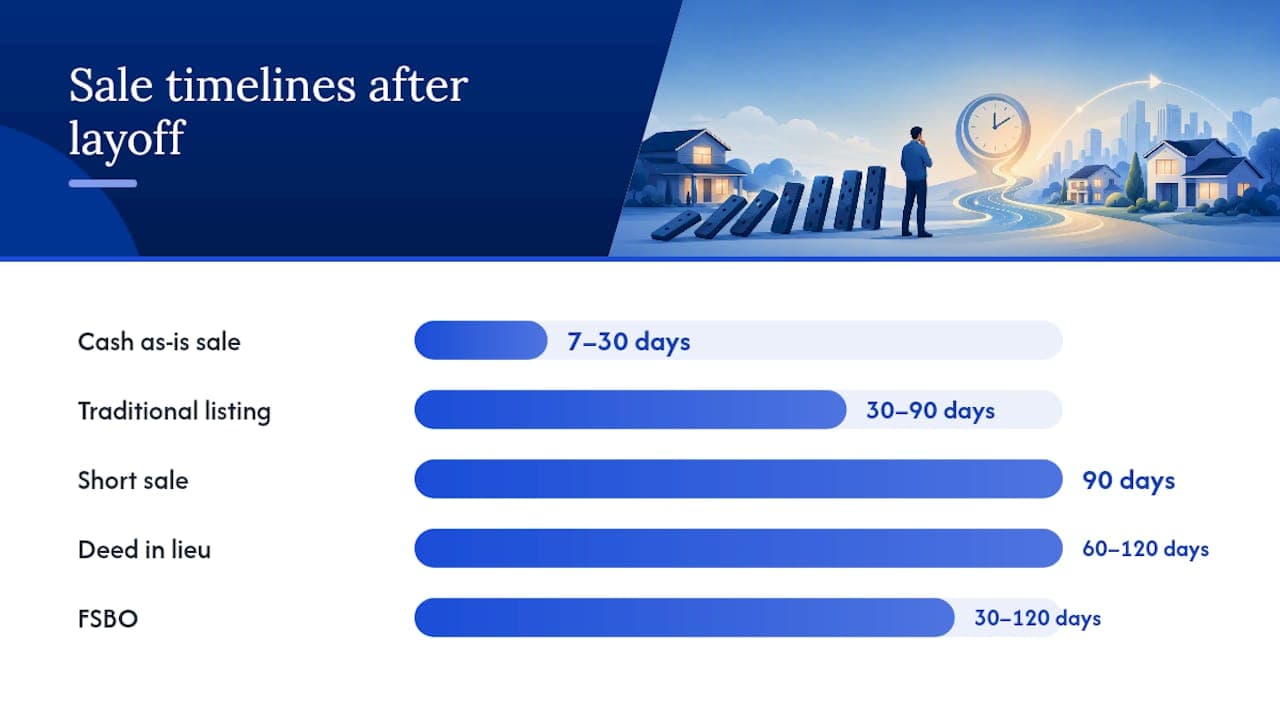
| Option | Typical timeline | Estimated net proceeds | Certainty of closing | Best when |
|---|---|---|---|---|
| Traditional listing | 30–90 days | Highest (minus 5–6% commissions) | Moderate | You have equity, time, and a strong local market |
| Cash as-is sale (marketplace) | 7–30 days | Below market, but no repairs or commissions | High | Speed and certainty matter more than top dollar |
| Short sale | 90 days | Below payoff (lender approval required) | Low to moderate | You’re underwater and want to avoid foreclosure |
| Deed in lieu of foreclosure | 60–120 days | No proceeds; avoids foreclosure on record | Moderate | You have no equity and cannot sell |
| FSBO (for sale by owner) | 30–120 days | Saves commission, but slower without agent reach | Low | You have time, skill, and a strong buyer network |
A few things worth knowing about each path:
- Cash as-is sale — trades some price for speed and certainty. When you use a marketplace like Housegoodbye that generates competing bids from multiple investors, the offers tend to be stronger than a single investor quote because buyers compete against each other.
When certainty beats price: if your monthly burn rate exceeds your savings runway by more than 60 days, prioritize a certain close over the highest possible price. A deal that falls through at day 85 costs you more than accepting a slightly lower cash offer on day 10. In layoff-heavy markets, certainty of closing is more valuable than chasing the top listing price.
For sellers in financial distress who need to understand the full range of options before foreclosure, the sell before foreclosure action plan is a practical resource worth reading alongside this guide.
When should you involve your mortgage servicer, a HUD counselor, and an attorney?
The short answer: your mortgage servicer gets a call today, a HUD counselor gets a call this week, and an attorney gets a call the moment you’re under contract or facing a short sale.
These three parties do different things, and confusing their roles costs time.
Your mortgage servicer is the company you send payments to. They don’t own your loan in most cases; they service it on behalf of the actual lender (which may be Fannie Mae, Freddie Mac, FHA, VA, or a private investor). Servicers are required to evaluate loss mitigation options before initiating foreclosure. That means forbearance, repayment plans, and loan modifications are all on the table if you call early. Loss mitigation options under agency programs vary by loan type: FHA loans have specific forbearance rules, Fannie Mae and Freddie Mac have their own modification programs, and VA loans carry additional protections for veterans.
A HUD-approved housing counselor is a free, independent resource. They don’t work for your servicer or your lender. They help you understand your options, prepare hardship documentation, and negotiate on your behalf. Find one through HUD’s official locator at hud.gov. Bring your mortgage statement, bank statements, and hardship letter to the first call.
A real estate attorney becomes necessary when you’re under contract and your financial situation changes, when a short sale involves a deficiency judgment question, or when your servicer’s terms are complex. Attorney fees are a fraction of what a contract dispute or unwaived deficiency judgment can cost.
Pro Tip: When you call your servicer, ask specifically: “What loss mitigation options are available under my loan type, and what documentation do I need to submit?” Write down the answer word for word. Servicers have an incentive to keep borrowers paying and will often open forbearance or modification options for callers who ask directly.
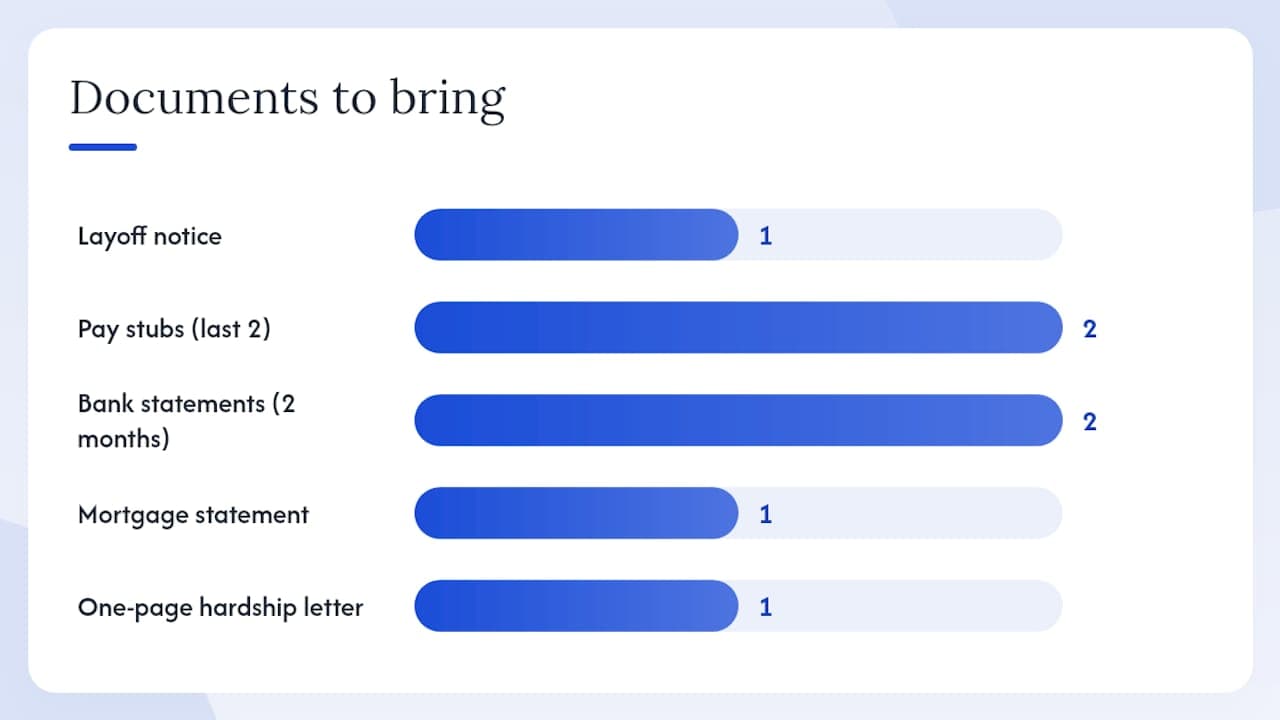
Documents to bring to every meeting:
- Layoff notice or termination letter
- Last two pay stubs
- Last two months of bank statements
- Mortgage statement with loan number
- One-page hardship letter (date of layoff, current income, monthly expenses)
Early engagement with your servicer is the single action that preserves the most options. Waiting until you’ve missed two payments narrows the field considerably.
How does Housegoodbye work, and when is it the right choice?
Housegoodbye is a cash-offer marketplace built specifically for Michigan homeowners who need to sell fast, without repairs, and without paying agent commissions. The model is straightforward: you submit your property, vetted local investors review it and submit competing bids, and you choose the offer that works best for your situation. No obligation, no pressure, and no requirement to accept any offer.
The competitive bidding structure matters. A single investor quote gives you one number with no leverage. When multiple investors bid on the same property, offers tend to be stronger because buyers know they’re competing. That’s the practical difference between a marketplace and a direct investor approach.
Cash sales close faster because there’s no mortgage underwriting, no appraisal contingency, and no lender timeline to manage. Housegoodbye can close in as little as seven days when the title is clear and documentation is in order. For a homeowner whose burn rate is eating through savings, that speed has real dollar value.
Core benefits of the Housegoodbye process:
- Sell as-is. No repairs, no cleaning, no staging. The as-is sale checklist covers what you actually need to prepare.
When does Housegoodbye make the most sense? When your runway is short, your equity is positive but not large, and the cost of a delayed traditional listing (holding costs, price reductions, potential financing failures) outweighs the price gap between a cash offer and a top-dollar listing. It’s also the right call when you want to avoid the emotional and logistical weight of showings, open houses, and repair negotiations while you’re already managing a job search.
Key Takeaways
Sellers who act in the first 72 hours after a layoff, run an honest numbers check, and contact their mortgage servicer before missing a payment consistently preserve more options than those who wait.
| Point | Details |
|---|---|
| Run the numbers first | Calculate your monthly runway before making any sale decision; equity minus 7% selling costs vs. loan payoff tells you your real position. |
| Call your servicer immediately | Forbearance, repayment plans, and loan modifications are available before you miss a payment; options narrow once you’re delinquent. |
| Price for speed, not hope | Overpricing in a softened market extends days on market and increases holding costs; comp-based pricing generates faster offers. |
| Know your timeline options | Traditional listings take several weeks to a few months; short sales add additional time; a cash as-is sale can close much faster, sometimes within a week. |
| Housegoodbye for fast certainty | Michigan homeowners can get multiple competing cash offers through Housegoodbye and close in as little as 7 days with no repairs or commissions. |
Why acting in week one changes everything
The sellers who end up in the worst positions after a layoff almost never got there because the market was bad or their home was hard to sell. They got there because they waited. They told themselves the job search would resolve quickly, that the market would hold, that they’d figure out the mortgage situation next month. By the time they acted, they had fewer options, less equity, and more pressure to accept whatever offer appeared.
What the numbers actually show is that most homeowners have more runway than they feel like they do in the first week after a layoff. The panic is real, but it’s often ahead of the actual financial timeline. The antidote isn’t optimism. It’s a spreadsheet and a phone call to your servicer.
Housegoodbye’s platform exists precisely for the moment when the numbers check reveals that speed and certainty matter more than squeezing out the last dollar. Getting multiple competing cash offers takes the guesswork out of what your home is actually worth to a motivated buyer right now, and it gives you a real number to compare against the traditional listing path.
Fast, as-is sale options for Michigan homeowners
When your timeline is short and repairs aren’t in the budget, a traditional listing isn’t always the right tool. Housegoodbye gives Michigan homeowners a faster path: submit your property, receive multiple competing cash offers from vetted local investors, and close in as little as seven days with no repairs, no commissions, and no obligation to accept any offer.

The process is straightforward. You share basic property details, investors review and bid competitively, and you choose the offer that fits your situation. Every offer is obligation-free, and your submission is private. There’s no open house, no staging, and no waiting on a buyer’s lender to approve financing.
If you’re a Michigan homeowner weighing your options right now, the clearest next step is to see how the cash sale process works and request your no-obligation offers. You can also go directly to the Michigan as-is sale page to get started.
Useful sources and where to get help now
- Laid off with a monthly mortgage payment. How do you manage? | Bankrate
- How to Get Help With Mortgage Payments If You Lose Your Job | Nolo
- What happens if you lose your job before closing on a mortgage? | Experian
- Upside Down on Your Mortgage? What To Do When You Have To Sell. | EffectiveAgents®
- Impact of Layoffs on Real Estate Market — Real Estate Today
- Fear of Layoffs Is Changing How People Buy Homes | The Wall Street Journal
- AP News coverage of layoffs and impacts on workers and markets
- California Association of Realtors (C.A.R.)
FAQ
What is the hardest month to sell a house?
December and January are historically the slowest months for home sales in most U.S. markets, with lower buyer demand and fewer active listings. If your layoff happens in late fall, factor in a slower market when setting your timeline expectations.
How many times can a closing be delayed?
There’s no legal cap on the number of times a closing can be delayed, but each extension requires agreement from both buyer and seller. Financing-related delays are the most common cause, and a buyer’s job loss discovered during final employment verification can push closing back by two to four weeks or cancel the deal entirely.
Can a seller’s layoff kill a deal that’s already under contract?
Your layoff as the seller doesn’t directly affect the buyer’s financing, but it can create legal complications if you can no longer fulfill your contractual obligations (such as completing agreed repairs or meeting a closing date). Buyers are also increasingly adding job-loss contingencies to their own offers, which means a layoff on the buyer’s side can be an explicit exit clause.
What is the fastest way to sell a house after a layoff?
A cash as-is sale through a marketplace like Housegoodbye is the fastest path, with closings possible in as little as seven days. This avoids lender underwriting timelines, repair negotiations, and the 30–90 day window of a traditional listing.
Should I stop paying my mortgage to speed up a short sale?
No. Going delinquent to force a short sale damages your credit, limits your post-sale loan options, and can accelerate foreclosure proceedings before the short sale closes. Contact your servicer about forbearance first, and review your loss mitigation options before missing any payment.
This article provides general information about home selling and mortgage options after job loss. It is not legal, financial, or tax advice. Confirm current program eligibility and terms with your mortgage servicer, a HUD-approved housing counselor, or a licensed professional before making decisions.