If your Michigan home was built before 1978, you must tell buyers what you know about lead-based paint before they are bound to a contract. You must also hand over any reports you have and give them the EPA lead pamphlet. That duty belongs to you as the seller, and it applies whether you list with an agent, sell on your own or sell as-is to a cash buyer. You can still sell a house with lead paint. You just have to do the paperwork honestly.
This guide covers who has to disclose, what goes on the form, how it fits with Michigan’s own seller disclosure statement, and what changes when you sell a rough house for cash.
TL;DR
- Federal law requires sellers of most homes built before 1978 to disclose known lead-based paint and lead hazards, share available reports and provide the EPA pamphlet. EPA explains the rule here.
- Buyers get a 10-day window to inspect for lead, unless both sides agree in writing to shorten or waive it.
- Michigan has no separate state lead form for sellers. The federal lead disclosure travels alongside the state Seller Disclosure Act statement.
- Selling as-is does not erase the duty. Painting over lead paint does not remove it either.
- A cash sale can skip repairs, but you still disclose what you know, in writing, before the contract is signed.
Table of Contents
- What the law actually requires
- How the federal form fits with Michigan’s seller disclosure
- Disclosure is your job, not your agent’s
- Why Michigan buyers care so much
- Does painting over lead paint count as fixing it?
- Step by step: disclosing lead when you sell
- Selling a house with lead paint as-is
- Our perspective
- Get competing offers on a home with lead paint
- Common mistakes sellers make
- FAQ
- Sources
What the law actually requires
The rule comes from the Residential Lead-Based Paint Hazard Reduction Act of 1992, also called Title X. Section 1018 of that law led EPA and HUD to write the disclosure rule. It applies to housing built before 1978, the year lead-based paint was banned for use in homes. EPA’s seller guidance says property owners selling this kind of housing must disclose known information about lead-based paint and lead-based paint hazards.
In practice, before the buyer is obligated under a purchase contract, you must:
- Disclose what you know about lead-based paint and lead hazards in the home, including where the paint is and what condition it is in.
- Provide records and reports you have, such as earlier inspections, risk assessments or abatement paperwork.
- Give the buyer the pamphlet called Protect Your Family from Lead in Your Home.
- Include the lead warning statement in the sales contract, with signatures from both sides confirming the disclosure happened.
- Allow a 10-day inspection period, which the buyer can waive or shorten by mutual written agreement.
Keep the signed acknowledgments. The federal rule asks sellers to hold on to them for three years after the sale, per EPA’s summary of the disclosure rule.
What counts as known
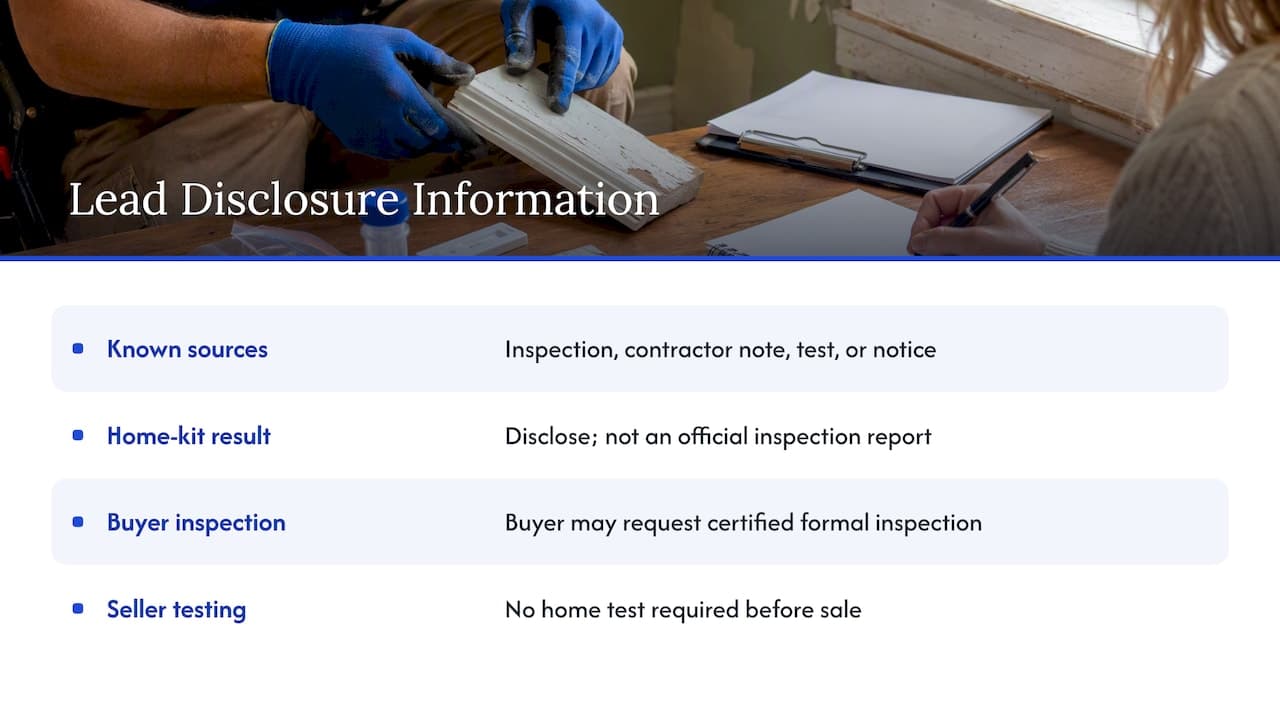
You are not required to test your home for lead before selling. The duty covers what you know and what documents you hold. That includes a past inspection, a contractor’s note, a test result, or a notice you received from a landlord or a previous owner. EPA’s guidance also makes clear that a result from a home test kit is still information you have, so you disclose it however it was gathered. A kit result is not an official inspection report, and it does not take away the buyer’s right to request a formal inspection by a certified professional.
The practical rule: if you would be uncomfortable explaining later why you did not mention something, write it down on the form.
Exemptions
Some sales fall outside the rule. EPA’s lead disclosure fact sheet lists two that matter here: housing where painted surfaces were tested and found lead-based paint free, and foreclosure sales. Do not assume a quick sale to an investor to avoid foreclosure counts as a foreclosure sale. If you sell voluntarily before the foreclosure happens, treat the disclosure as required unless you have confirmed an exemption in writing.
How the federal form fits with Michigan’s seller disclosure
Michigan’s Seller Disclosure Act, MCL 565.951 and following, covers residential property of one to four units. A Michigan Court of Appeals opinion describes it as imposing a legal duty on sellers to disclose certain known conditions affecting the house. A seller who does not provide the statement gives the buyer a right to terminate the purchase agreement.
The two documents are separate obligations that usually get signed in the same packet:
| Federal lead disclosure | Michigan Seller Disclosure Statement | |
|---|---|---|
| Applies to | Most housing built before 1978 | Residential property, one to four units |
| Covers | Known lead-based paint and lead hazards, reports, pamphlet | Known condition of the property, systems and defects |
| Buyer’s remedy | Federal liability for the seller if skipped | Right to terminate the agreement if no statement is given |
| Inspection window | 10 days for lead, waivable in writing | Set by the purchase agreement |
For the rest of the state form, see our breakdown of Michigan’s seller disclosure rules. Filling out one form does not satisfy the other, so check that both are in the signed packet.
Disclosure is your job, not your agent’s
A common mistake is assuming the agent or buyer will handle it. EPA’s frequently asked questions on lead-based paint explain how the obligations work for people buying and renting older homes. The seller stays personally responsible for disclosing, with or without an agent. If you sell on your own, or to an investor who never asks, the duty is still yours.
That matters most when a house is in poor condition. Peeling paint in a back bedroom or a crumbling porch is not a reason to skip the form. It is a reason to describe what you have seen, honestly and specifically.
Why Michigan buyers care so much
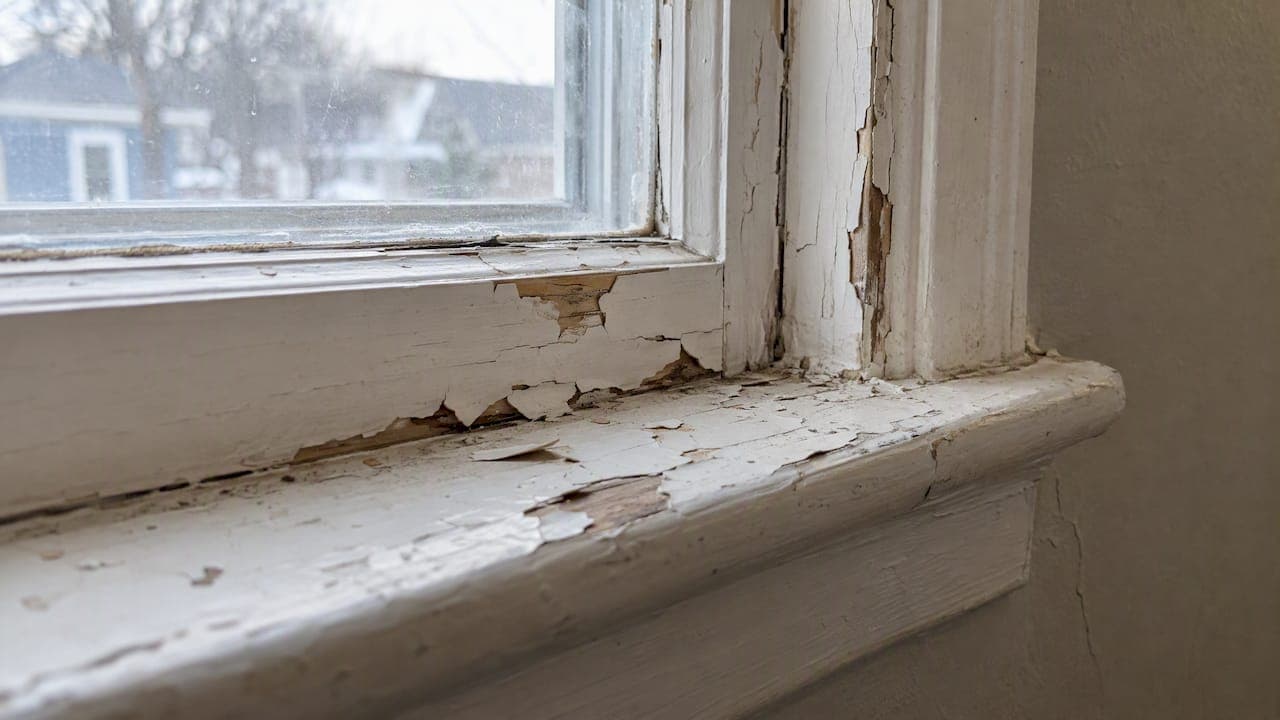
Lead disclosure is about children’s health. Michigan’s lead safety site notes that homes built before 1978 are more likely to have lead-based paint, and that the older the home, the more likely it is. EPA adds that lead paint is usually not a hazard when it is in good condition, but deteriorating paint (peeling, chipping, chalking, cracking) can be.
The state also tracks it through testing. Under Michigan’s blood lead testing rules, children are tested at 12 and 24 months, or by 72 months if there is no earlier test. Living in housing built before 1978 is one of the listed risk factors. A buyer with a toddler or a pregnancy in the family will read your disclosure closely, and they will ask follow-up questions.
Does painting over lead paint count as fixing it?
No, and it affects what you write on the form. Michigan’s guidance states that painted-over surfaces still count as lead-based paint when the layers underneath are lead-based. Opening and closing windows and doors can wear those layers down over time and create lead dust. If you repainted, the honest disclosure is that you believe the home was built before 1978, that older layers may contain lead, and what you did.
The same goes for terminology. EPA draws a line between renovation and abatement:
- Renovation with lead-safe work practices limits dust during a project but does not remove the lead paint.
- Abatement is permanent elimination, such as removal or encapsulation, followed by independent clearance testing.
If you had work done, describe it by its real name and attach any paperwork. Calling a repaint an abatement could create a problem for you after closing.
Step by step: disclosing lead when you sell
- Confirm the build year. Check your deed, tax record or prior closing papers. If it is 1978 or earlier, the rule applies. If you are unsure, assume it does.
- Gather what you have. Look for old inspection reports, remodeling invoices, notices from earlier owners or tenants, and any test results.
- Walk the house. Note peeling or chipping paint on windows, doors, trim, porches and exterior siding. Record what you see in plain words.
- Fill out the lead disclosure form. State whether lead is known, suspected or unknown, and attach any records. A state or title company packet usually includes a copy. One Michigan for-sale-by-owner forms guide reproduces the lead warning statement and disclosure language.
- Provide the pamphlet and have the buyer sign that they received it.
- Offer the 10-day window, or document the written waiver if both sides agree.
- Keep copies. File the signed form with your closing documents.
Selling a house with lead paint as-is
Most sellers who search for how to sell with lead paint worry that it kills the sale. It does not, but it changes who buys. Many conventional buyers walk away from older homes with visibly deteriorating paint, or they ask for repairs and credits. A buyer who purchases as-is already expects the home to need work, so lead paint is one more line item in their math rather than a reason to cancel.
Two points to keep straight:
- As-is covers repairs, not honesty. You are not obligated to remove lead or pay for a cleanup before selling. You are obligated to disclose what you know.
- Investors price what they find. Disclosed lead, plus peeling windows, plus an old roof gets reflected in the number. Hiding it only moves the conflict to after closing, when you are the one with liability.
Lead rarely travels alone in a distressed house. If yours also has mold, open permits or code problems, see our guides on selling a house with mold in Michigan, selling with code violations and our as-is sale checklist.
Should you test first?
You do not have to. Testing makes sense when it helps you: for example, a certified inspection that shows the paint is in better shape than buyers fear, or a clean result that could qualify the home for the tested-and-found-free exemption. If time is short, or the house needs more than paint work, disclosing honestly and letting buyers inspect during the 10-day period is usually simpler. Know that a hardware-store kit does not replace a professional report.
Help with the cost of making a home lead safe
If you decide to keep the house, or to fix it before listing, Michigan has programs worth checking. One regional page on lead-based paint safety and financing in northern Michigan was listed in search results describing a Lead Poisoning Prevention Fund with free inspections and cost sharing for abatement. Eligibility and funding vary by program and county, so confirm current terms with your local health department or the state’s lead safety office before relying on them.
Our perspective
We work with Michigan homeowners who need to sell fast: inherited houses, homes behind on payments, properties that have not been touched in decades. Lead paint comes up often because the houses we see tend to be old. Here is what we tell people.
First, do not let lead paint talk you into a bad sale. Sellers sometimes assume it makes the house unsellable, then accept the first lowball offer they get. It is a condition of the property, like an old furnace. The right response is to get more than one buyer looking at the real house.
Second, disclose in writing, early and plainly. The cleanest sales we see are the ones where the seller says what they know up front. Buyers price in a known issue. They fight about a surprise.
Third, do not spend money on lead work just to sell. Abatement and certified testing can cost real money, and an as-is investor is already planning for repairs. Spend it only if you have a specific reason, such as a family member living in the house.
That is why our process asks several vetted local investors to bid on your home as it stands, so you can compare actual offers instead of guessing what lead does to the price.
— Bryan
Get competing offers on a home with lead paint
If your house is old, rough and you would rather not repair, clean or stage it, HouseGoodbye lets you request competing cash offers from vetted local Michigan investors. You sell as-is, with no agent commissions and no obligation to accept a bid. Our site says closings can happen in as little as seven days. You can read how it works on our page about how selling your house for cash works, and compare what you would keep with our guide to closing costs for Michigan sellers. When you are ready, you can also start from our Sell Your House Fast page.
Tell buyers about the lead paint when you submit your property details. Doing so keeps offers realistic and the paperwork clean.
Common mistakes sellers make
- Assuming as-is means no disclosure. It does not. As-is limits repair obligations only.
- Treating a repaint as a fix. Paint over lead is still lead-based paint underneath.
- Skipping the pamphlet. It is a required piece of the packet, with a signed acknowledgment.
- Relying on a test kit as proof. Disclose the result, but expect buyers to want a certified inspection if they ask.
- Assuming a foreclosure-avoidance sale is exempt. The exemption is for foreclosure sales themselves. Confirm your case before skipping any form.
- Not keeping records. Hold your signed acknowledgments for at least three years.
FAQ
Is a seller disclosure required in Michigan?
Yes, for residential property of one to four units. The Seller Disclosure Act, MCL 565.951 and following, requires sellers to disclose known conditions, and a buyer can terminate if the statement is not provided. The federal lead form is a separate requirement for homes built before 1978.
How can I tell if a property has lead paint?
Age is the first clue: homes built before 1978 are more likely to contain it, and Michigan’s lead safety site says the older the home, the greater the chance. Only testing by a certified professional confirms it. A kit result is useful information to disclose, but it is not an official inspection.
Is lead paint still an issue if it is painted over?
Yes. Lead-based paint stays lead-based paint under newer coats, and friction on windows and doors can wear the layers and create dust. If the paint is intact it may pose less risk, but you should still disclose what you know. Abatement is the permanent approach.
Can I sell my house with lead paint?
Yes. Federal law requires disclosure, not removal. Give buyers your known information, any reports and the EPA pamphlet, and allow the 10-day inspection period unless both sides waive it in writing. Selling as-is to a cash buyer is a common way to avoid pre-sale repairs.
What are Michigan’s blood lead testing rules for children?
State rules call for testing at 12 and 24 months, or by 72 months if there is no prior test. A level of 3.5 micrograms per deciliter or higher requires follow-up venous testing. Ask your child’s pediatrician or local health department about your family’s situation.
Sources
- EPA: Lead-Based Paint Disclosure Rule (Section 1018 of Title X)
- EPA: What am I required to do if I am selling target housing?
- EPA: Real Estate Disclosures about Potential Lead Hazards
- EPA: Lead-Based Paint Disclosure Rule Fact Sheet
- EPA: Lead-Based Paint Program Frequent Questions
- Michigan Court of Appeals opinion on the Seller Disclosure Act
- Michigan Lead Safe: Paint and Dust
- Michigan Lead Safe: Blood Lead Testing
- Michigan for-sale-by-owner forms guide
- Michigan Lead Safe home page