When you inherit a house, your cost basis is generally not what the previous owner paid. It is the home’s fair market value on the date the owner died. That reset, called the stepped-up basis, means that only the growth in value after the death is usually taxed when you sell. If you sell quickly and close near that value, your taxable gain is often small. It is also why heirs who sell an inherited house as-is for cash often owe little or no federal capital gains tax. Your own numbers and any filings still belong with a CPA or tax preparer.
Here is how the rule works, where the number comes from, what changes it and what to keep on file.
TL;DR
- Under federal tax law, an inherited home’s basis is generally its fair market value at the date of death, not the original purchase price.
- Your taxable gain is the sale price, minus selling costs, minus that basis. Only value gained after the death is normally taxed.
- The basis can also step down if the home was worth less at death than the owner’s adjusted basis.
- With no appraisal on file, you can build the value from a retrospective appraisal, an estate-tax return or a state inheritance-tax valuation.
- Keep the valuation, closing statement and improvement receipts. Michigan heirs who want a fast as-is sale can compare cash offers on HouseGoodbye.
Table of Contents
- What cost basis means for a house you inherited
- Which date and which value count
- When the basis steps down instead of up
- What if nobody appraised the house at the date of death?
- Jointly owned homes and spouses
- Adjusting your basis before you sell
- A worked example
- Has the step-up rule changed?
- Selling an inherited house from out of state
- Records to keep
- Why a fast, as-is sale often keeps the tax picture simple
- Compare competing cash offers on your inherited house
- Our perspective
- FAQ
- Sources
What cost basis means for a house you inherited
Cost basis is the dollar figure the IRS subtracts from your sale proceeds to decide whether you made a profit. For a house you bought, it starts with the price you paid and certain closing costs, then moves up with improvements. For a house you inherited, the starting point is different.
The tax code sets it in 26 U.S.C. § 1014: property acquired from a decedent generally takes a basis equal to its fair market value (FMV) at the date of death. FMV is what a willing buyer and a willing seller would agree on, both knowing the facts. IRS Publication 523, the guide on selling your home, says the same for an inherited home.
So a house your mother bought in 1988 for $60,000 does not hand you a $60,000 basis. If it was worth $210,000 the day she died, your basis is generally $210,000. The decades of appreciation before her death are, in the words of the Congressional Research Service, generally not subject to capital gains tax. Growth after her death is taxed when the heir sells.
Which date and which value count
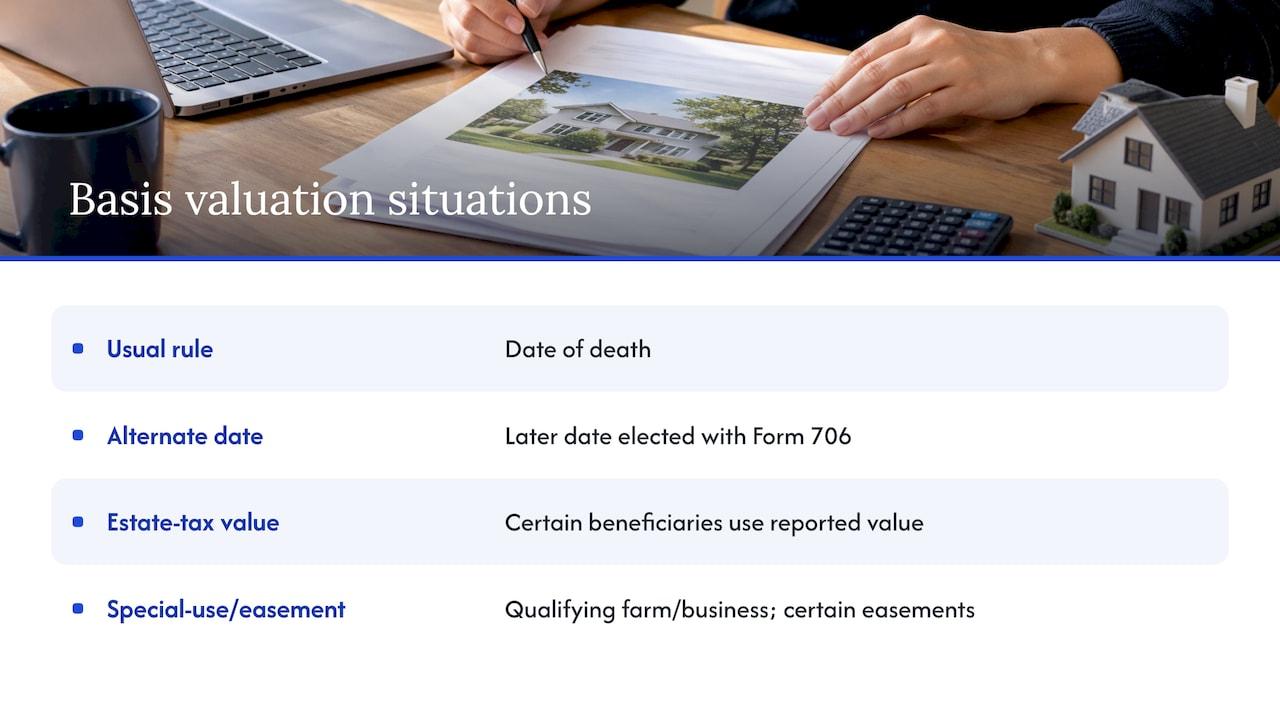
Most of the time the answer is simple: the date of death. There are three variations worth knowing.
Alternate valuation date. The estate’s personal representative (the executor or administrator) can sometimes choose a later valuation date. Publication 523 describes this as the later alternate valuation date selected by the personal representative. The IRS Gifts and Inheritances FAQ notes it applies only when the executor files an estate tax return, Form 706, and elects it. Most family estates never file a Form 706, so most heirs use the date of death.
The estate tax return value. When an estate does file Form 706, IRS Publication 551 says beneficiaries generally receive a Schedule A to Form 8971 showing the reported value. Certain beneficiaries must use that reported estate-tax value as their starting basis. If you receive one, it controls, so use it.
Special-use and easement cases. Publication 551 also lists special-use valuation for qualifying farm or business real property and certain conservation-easement situations. These are uncommon for a typical family house. If the property was a working farm, ask the estate’s attorney whether either applies.
When the basis steps down instead of up
The rule resets basis to fair market value, and the code does not care which direction that moves. If the house was worth less at death than the owner’s adjusted basis, your basis is lower than theirs. Section 1014 generally resets to FMV whether it is higher or lower.
This is most likely when the owner paid a high price near a market peak, or put a lot of money into improvements, and the home then lost value or deteriorated before death. Suppose the owner’s adjusted basis was $250,000 and the house was worth $190,000 at death. Your basis is $190,000, and the difference does not carry over to you.
A house with serious damage or years of neglect can also have a lower date-of-death value than you expect. Its condition on that date is what the valuation reflects.
What if nobody appraised the house at the date of death?
This is the most common problem, and the top search results are full of heirs asking about it. Most estates never get a formal appraisal. You still have options, and you can usually work through them in this order:
- Ask the executor. The IRS Gifts and Inheritances FAQ tells taxpayers who need the date-of-death value to contact the executor of the estate. If a federal estate-tax value was reported, the consistent-basis rules may require you to use it.
- Check for a state valuation. Publication 551 says that when you did not receive a Schedule A with an estate-tax value, basis may be based on the property’s appraised value at the date of death for state inheritance or transmission-tax purposes.
- Order a retrospective appraisal. A qualified appraiser can value the home as of a past date using comparable sales from that period, public records and the home’s condition then. Kiplinger’s explanation of how the IRS values an inherited home cautions that tax assessments, online estimates and agent price opinions are not equivalent to a formal appraisal. A retrospective valuation is the same idea applied to an estate: a professional looks back to what the house was worth on a set day. A guide to valuing an estate property shows how that looks in practice.
If you plan to sell within months of the death, the sale itself becomes strong evidence of value, but an appraisal as of the death date is what makes the basis defensible. Ask your tax preparer whether the cost of one is worth it for your situation. The fee is usually small compared with the gain it protects you from overstating.
Jointly owned homes and spouses
Who owned the house changes how much of it steps up.
- Surviving spouse, joint ownership. Publication 523 explains that the survivor’s basis commonly combines two pieces: the survivor’s own share at its unchanged basis, plus the deceased spouse’s share revalued to FMV.
- Community property states. Where the statutory conditions are met, the entire community property can receive a new FMV basis. Michigan is not a community property state, but if the decedent lived elsewhere, this can apply.
- Siblings and other co-heirs. Each heir takes a basis in their share. A 25% beneficiary uses 25% of the stepped-up value, and sale proceeds are divided the same way.
If the title was held in an unusual way, such as a parent adding a child to the deed years earlier, get a tax professional to confirm which rule applies before you file.
Adjusting your basis before you sell
The stepped-up value is your starting basis. Publication 551 says adjusted basis increases for properly capitalized improvements and decreases for items such as depreciation or casualty-loss deductions. Publication 544 puts the improvement test at a useful life of more than one year.
What that means in practice:
- Improvements you pay for after the death that add to the home’s value or extend its life, such as a new roof, a furnace or a kitchen remodel, can increase your basis. Routine cleaning and ordinary repairs generally do not.
- Depreciation lowers basis. It matters if the house was a rental, before or after the death.
- Casualty losses, such as an insurance-covered fire, reduce basis by what you deducted or recovered.
Selling costs work differently. They do not change your basis. They reduce what you received. Publication 523 calculates gain as the selling price minus selling expenses, which gives the amount realized, minus the adjusted basis. A positive result is a gain. A negative one is a loss.
A worked example
These figures are illustrative.
| Item | Amount |
|---|---|
| Original purchase price (1988) | $60,000 |
| Fair market value at date of death | $210,000 |
| Your basis (stepped up) | $210,000 |
| Sale price, five months later | $225,000 |
| Selling costs (title, closing and similar fees) | $3,000 |
| Amount realized ($225,000 − $3,000) | $222,000 |
| Taxable gain ($222,000 − $210,000) | $12,000 |
Without the step-up, the gain would have been $162,000 ($222,000 minus $60,000). Because of the reset, tax is figured on $12,000. The Congressional Budget Office also notes that inherited property generally gets long-term capital gains treatment no matter how long the heir holds it, so you do not have to wait a year to get the lower long-term rates.
Now the other direction. If the home sold for $205,000 with $3,000 in costs, the amount realized would be $202,000, which is below the $210,000 basis. Your tax preparer can tell you how a loss on an inherited house is treated for your return.
Reporting follows the sale. The IRS FAQ says a sale for more than basis produces taxable gain and points filers to Form 8949 and Schedule D. Publication 523 adds that if you receive a Form 1099-S for the sale, you generally report it on Form 8949 even when no taxable gain remains.
Has the step-up rule changed?
As of the 2025 IRS publications, the inherited-home rule still runs through the date-of-death value, with the Form 706 alternate-valuation option and the consistent-basis rules for estates that report. Publication 523 (2025) applies it to home sales. Congress has debated changing how gains at death are taxed for years, and the CRS and CBO describe the step-up as the current treatment. Because legislation and IRS guidance can change, confirm the rule for the year you sell with a CPA or enrolled agent.
This article covers federal tax. State rules differ, so ask the estate’s attorney or your tax preparer about Michigan’s treatment before you file.
Selling an inherited house from out of state
Many heirs live far from the house, and the basis question often comes up while they are managing a sale remotely. The practical order is:
- Confirm who can sign. In a probate estate it is usually the court-appointed personal representative. For trust property it is usually the successor trustee. If title has already passed to you, it is you. The title company handling the closing makes the final call on what it will accept.
- Gather authority documents. Typically that means the court’s letters of authority or a trust certification, plus the death certificate.
- Get the value documented now. This is the moment to secure the date-of-death appraisal or other valuation evidence, while comparable sales from that period are easy to find.
- Plan the signing. Ask the title company whether it accepts e-signatures, remote notarization or a power of attorney in your state.
In Michigan, our guide to the probate home sale process walks through the executor’s steps, and the role of the executor in an estate sale explains who has authority to act.
Records to keep
Publication 551 requires you to keep accurate records to support your basis. Publication 523 generally advises keeping home-basis records until three years after the due date of the return for the year of the sale. Keep:
- the death certificate and the probate or trust authority papers
- Form 706 and Schedule A to Form 8971, if the estate filed them
- the date-of-death appraisal or other valuation evidence
- the deed and title records
- receipts for improvements, and any depreciation or casualty records
- the closing disclosure or settlement statement
- receipts for selling expenses
- your filed Form 8949 and Schedule D
Scan everything into one folder as you go. A basis that you cannot document is a basis you may have to rebuild later.
Why a fast, as-is sale often keeps the tax picture simple
Because your basis is the value at death, the longer you hold the house, the more room there is for post-death gain, plus months of taxes, insurance and utilities on a property that may sit empty. A house that closes soon after the death generally sells near the value on which your basis rests. That is the case for a short timeline. It is also the reason heirs selling a Michigan house in poor condition often look at cash offers.
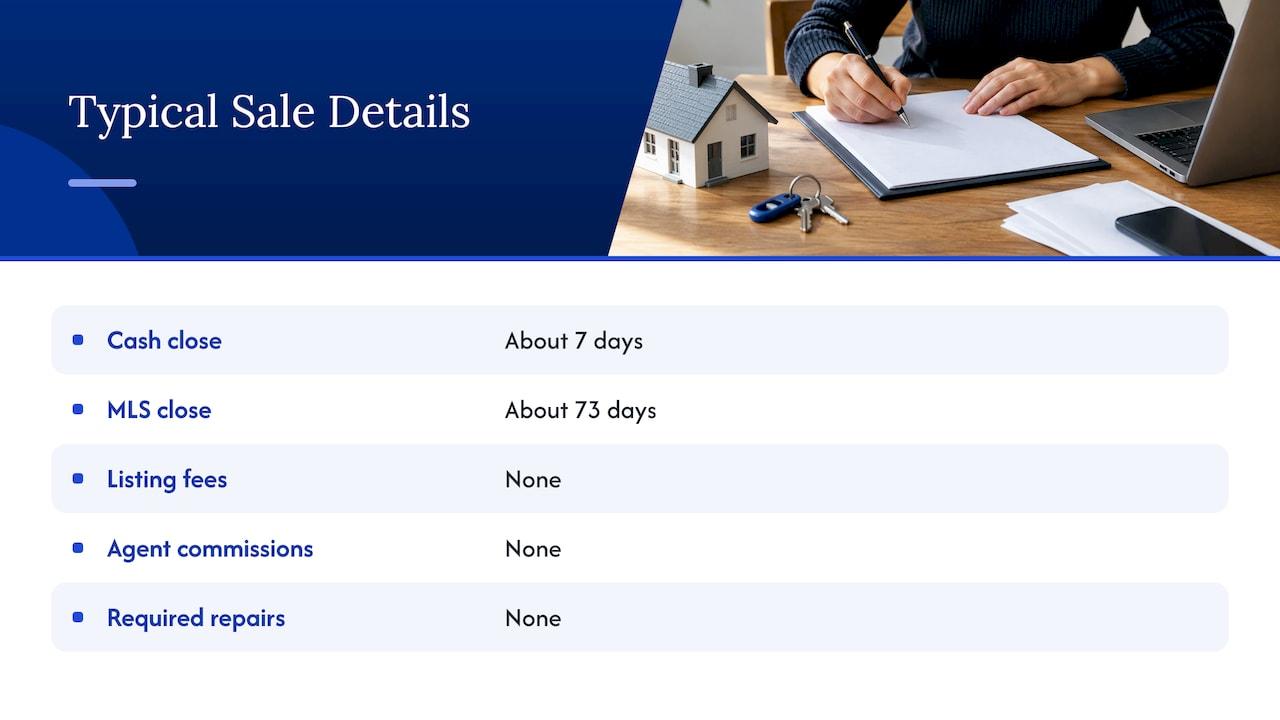
HouseGoodbye is a Michigan marketplace where vetted local cash buyers compete with as-is offers on your house. There are no listing fees, no agent commissions and no required repairs, and the typical close is about 7 days, compared with about 73 days on the MLS. You enter the address, see every offer and can walk away if none work. Our page for selling an inherited house in Michigan explains the process for heirs. Our guide to the as-is cash sale of an inherited home covers what happens after you accept an offer. For the carrying costs that add up while the house waits, see what it costs to maintain an inherited vacant home.
Compare competing cash offers on your inherited house
If the house in Michigan is yours to sell, HouseGoodbye puts several vetted local cash buyers in competition for it. You compare real numbers, with $0 in commissions and no repairs, showings or obligation. Enter the address on our competing cash offers page to see what buyers will bid.

If you are also deciding between a traditional estate sale and an investor sale, the estate sale versus cash investor comparison lays out the trade-offs. You can also read about common mistakes when selling inherited properties.
Our perspective
Heirs call us after the funeral, not after the tax return. By then the house has a date-of-death value, a stack of carrying costs and a family that wants it settled. The step-up rule is the reason timing matters so much: your basis is anchored to the date of death, and every month the house sits is a month of expenses and market risk.
That is why we built HouseGoodbye as a marketplace and not as one buyer. Several vetted Michigan cash buyers bid on the same house, you see every offer, and you decide. There are no commissions, no repairs and no showings, and a close in about a week is typical. For an inherited house that needs work, or one you cannot visit often, that is a calmer way to turn it into cash.
Get the date-of-death value documented, keep your receipts, and talk to a tax professional about your return. Then let the buyers compete for the house.
Bryan
FAQ
Do I pay capital gains tax when I sell an inherited house?
Only on gain above your stepped-up basis. If you sell for the date-of-death value plus selling costs or less, there is generally no taxable gain. If you sell for more, the difference is taxed, generally as a long-term gain regardless of how long you held the house.
What is the stepped-up basis on an inherited house?
It is the fair market value of the house on the date the owner died, which replaces the owner’s original cost as your basis. An executor who files Form 706 can elect a later alternate valuation date. If the house was worth less at death than the owner’s adjusted basis, the basis steps down.
How do I prove the value if there was no appraisal?
Start with the executor and any estate-tax or state inheritance-tax valuation. If none exists, a qualified appraiser can do a retrospective appraisal as of the date of death. Online estimates and agent price opinions are not equivalent to an appraisal.
How long should I keep the basis records?
Publication 523 generally advises keeping home-basis records until three years after the due date of the return for the year you sold. Keep the valuation, the closing statement and improvement receipts together.
Sources
- 26 U.S.C. § 1014: Basis of property acquired from a decedent
- IRS Publication 523 (2025), Selling Your Home
- IRS Publication 523 (2025), Form 1099-S reporting
- IRS Publication 551 (December 2025), PDF
- IRS Publication 551, Basis of Assets
- IRS Publication 544 (2025)
- IRS Gifts and Inheritances FAQ
- Congressional Research Service: Tax Treatment of Capital Gains at Death
- Congressional Budget Office: Capital gains from sales of inherited assets
- Kiplinger: How the IRS values an inherited home