
Yes, you can sell a house in another state, and you don’t have to fly back for it. You have two realistic paths. You can list with a local agent and manage showings, repairs and a closing at a distance. Or you can sell as-is to a cash buyer and skip most of that work. This guide walks through both, with the paperwork, remote-closing options and tax questions that catch out-of-state sellers, written for owners of Michigan property.
TL;DR
- You can sell from anywhere. The title company or closing attorney does the on-the-ground work, and many closings can be handled by mail, local notary or remote online notarization (RON), depending on state and provider.
- A traditional listing means a local agent, a prepared home, remote showings and weeks of carrying costs. A cash sale removes repairs, showings and agent commissions.
- On HouseGoodbye, vetted Michigan cash buyers bid on your house as-is. You compare the numbers and can walk away if none work.
- Gather the deed, mortgage statement and tax records first, and ask the settlement agent for your seller-side figures early.
- Check the IRS home-sale exclusion rules before you assume the gain is tax-free.
Table of Contents
- What actually changes when you sell from far away
- Path one: list with a local agent
- Path two: sell as-is to a cash buyer
- Start with the paperwork, whichever path you choose
- How to close without traveling
- Know your numbers before you accept an offer
- Check the tax question before you sell
- Timing: what makes an out-of-state sale slow
- Perspective: why we built the process around distance sellers
- Ready to compare offers?
- A practical checklist for distance sellers
- FAQ
- Sources
What actually changes when you sell from far away
The sale itself is the same as any other. A buyer, a price, a title search, a closing. What changes is everything that normally depends on you being nearby: handing over keys, letting buyers in, meeting a contractor, signing in a title office, and noticing when something goes wrong at the house.
That is why most advice for distance sellers comes down to building a small local team. Realtor.com’s guidance describes out-of-state sales as manageable when you have a local real estate team and an agent who can coordinate the sale while you are away. The question is how much of that team you actually need, and that depends on the condition of the house and how quickly you have to be done.
Four things decide your path:
- Condition. A clean, updated house can sell on the open market with little drama. A house with deferred repairs, water damage, a dated kitchen or a roof near the end of its life needs someone on the ground to manage work.
- Occupancy. A vacant house costs money every month (utilities, insurance, taxes, lawn and snow) and invites problems. A tenant-occupied house adds lease and access questions.
- Timeline. Starting a job, closing on a new house or settling an estate puts a date on the sale. The open market gives you no guarantee on timing.
- Your role. Owners who inherited a house they have never lived in face different paperwork than owners who relocated.
Path one: list with a local agent
This is the conventional route and it works. Realtor.com advises choosing a flexible closing attorney or title company and asking whether you can sign the closing documents before a local notary. The agent coordinates photos, pricing, showings and offers. You approve decisions from your phone.
What you will need to arrange
- A local agent. Ask each candidate how they handle out-of-state clients and what they charge. NAR tells consumers that agent compensation is fully negotiable, so ask about it directly and get the terms in writing.
- Someone to prepare the house. Cleaning, decluttering, small repairs and lawn care. If you can’t be there, a local handyman or the agent’s vendor network does it, and you pay for it up front.
- Remote presentation. Photos and video carry a lot of weight. NAR’s 2025 staging survey found that 88% of sellers’ agents rated photos as much or more important to clients, versus 47% for video and 43% for physical staging. The same report puts the median spend on a staging service at $1,500, against $500 when the agent staged the home personally.
- A virtual tour. NAR says professional 360-degree tours typically cost $200 to $500, often bundled with high-resolution photos and floor plans, and a scan session can take one to two hours depending on the size of the property.
- A plan for live virtual showings. HousingWire’s guide suggests preparing as you would for an in-person open house (clean, declutter, lights on, blinds open) and having answers ready on roof and system ages, updates, utility costs, lot lines, timing and offer deadlines. CRMLS recommends labeling a showing clearly as virtual so nobody travels to the property by mistake, and testing your setup with a friend first.
A rule change worth knowing
Since August 17, 2024, NAR says an MLS-using agent generally needs a written buyer agreement before touring a home, in person or live virtual, with objective compensation terms. For you as a seller, that means buyer-side compensation is now a conversation to have openly with your listing agent, not something assumed.
Where the open market gets hard at a distance
Every step above has a cost or a delay. The house sits empty while you prep it. You pay the mortgage, taxes, insurance and utilities during the listing period. Repair requests after a buyer’s inspection have to be negotiated by phone. If your next purchase depends on this sale, you may carry two housing payments at once. For a house in good shape and a flexible schedule, that is a fair trade. For a house that needs work or a move date you can’t miss, it is where sellers get stuck.
Path two: sell as-is to a cash buyer
The second path removes the steps that need you present. In a cash sale to an investor, there is no staging, no showings and no repair negotiation, because the buyer prices the house in its current condition. The buyer does their own walkthrough, and you don’t prepare for it.
The risk with cash buyers is getting one offer from one company and having no way to judge it. That is the problem HouseGoodbye is built around. We are a Michigan marketplace, not a single buyer. You enter the address, and several vetted local cash buyers compete with as-is offers. You see the numbers side by side, there is no obligation, and you can walk away if none work for you. Our typical close is about a week, compared with roughly 73 days on the MLS, and there are no listing fees, agent commissions or required repairs.
This tends to suit owners who:
- inherited a Michigan house from a distance and want to settle the estate;
- relocated for work and own a house they can’t maintain;
- hold a vacant or damaged property, including fire or water damage or code violations;
- manage a rental with tenants from another state;
- are behind on the mortgage and need to sell before the situation gets worse.
If you are moving for a job, our guide on coordinating a home sale with a job start date covers the timing side, and our relocation page explains how the process works for owners who are already gone.
Open market vs. cash offers for a distance seller
| Question | Local agent listing | Cash offers on HouseGoodbye |
|---|---|---|
| Who handles showings? | Agent and you, often virtually | None needed |
| Repairs before sale | Usually expected, arranged by you remotely | None required |
| Agent commission | Negotiated with your agent | $0 in commissions |
| Typical time to close | About 73 days on the MLS, per our figures | About 7 days |
| Offer certainty | Depends on buyer financing and inspection | Cash buyers bidding as-is |
| Your presence | Little, but frequent decisions | Sign documents remotely where the closing provider allows |
The fees matter more than people expect. Our guides on why agent fees reduce home profits and avoiding agent commission show how to compare an offer against a listing net of costs, which is the number that counts.
Start with the paperwork, whichever path you choose
Out-of-state sales stall most often on documents, not buyers. Before anyone makes an offer, collect:
- the deed and any trust or estate documents;
- your latest mortgage statement and the lender’s contact details;
- property-tax records;
- permits and invoices for improvements you have made.
That list comes from LegalClarity’s seller guide, which also notes that seller-disclosure requirements vary by state and that, if you haven’t lived in the property recently, you should say so instead of guessing about its condition. Honest disclosure protects you after closing.
If you inherited the house
Contact the mortgage servicer first if there is a loan. The CFPB explains that the servicer may ask for proof of your right to the home, such as an executed will and death certificate or a letter from the executor, and that what counts can vary by state. If foreclosure is imminent or you have been served with legal papers, the CFPB says you may need an attorney. For Michigan estates, our probate selling guide explains how a sale fits into that process.
If the mortgage is behind
Call the servicer, get a written payoff figure and understand your timeline before you accept any offer. Our article on mortgage payoff in a cash sale explains how to avoid being short at closing. If you are already missing payments, speed matters, and several competing bids can show you what the house can realistically bring.
How to close without traveling
You have three common options, and your title company or closing attorney decides which are available.
- Mail-away closing. The closing agent sends documents to you, you sign in front of a local notary, and you return them by overnight courier. Realtor.com recommends asking whether you can sign before a local notary.
- Hybrid closing. Some documents are signed electronically and others on paper.
- Remote online notarization (RON). First American describes RON as a fully digital process: documents are e-signed and e-notarized after a remote notary verifies your identity by webcam. Its state guide shows that RON laws vary by state.
Redfin adds that availability depends on state rules, lender policies and the closing provider, so ask early which options your transaction supports. Don’t assume.
Protect yourself from wire fraud and surprises
Remote closings run on email and phone, which is where scammers operate. Redfin’s advice is to review the settlement statement and other documents in advance, follow the closing team’s instructions for notarization, and verify wire instructions directly with your title company or lender. Call a number you already trust, not one in an email. If you want proceeds wired to you, confirm the details the same way.
Power of attorney
If you can’t sign at all, for example because of travel, illness or deployment, a power of attorney can let someone sign for you. The title company will have rules about what it accepts, and a Michigan attorney can draft it correctly. Have the title company review the document before you rely on it.
Know your numbers before you accept an offer
The offer is not what you receive. Between the price and your bank account sit loan payoffs, closing costs, tax adjustments and any seller credits. The CFPB’s sample seller Closing Disclosure shows how these line up: sale price, closing costs, payoffs, credits, adjustments and the total due to or from the seller. The CFPB’s TILA-RESPA guide says the Closing Disclosure must generally reach the consumer three business days before closing on a covered mortgage loan.
In practice, a distance seller should ask the settlement agent for seller-side figures early, not on closing day. Then compare each offer on net proceeds, not headline price. A higher bid with a long timeline and repair demands can net less than a lower cash bid that closes quickly. Our Michigan closing costs guide shows what to expect on the seller side.
If you are also lining up your next purchase in the new state, it helps to know your credit and mortgage position before the sale closes. Resources on homebuyer credit preparation can help you get ready for the loan on the next house, so the proceeds from this sale go further.
Check the tax question before you sell
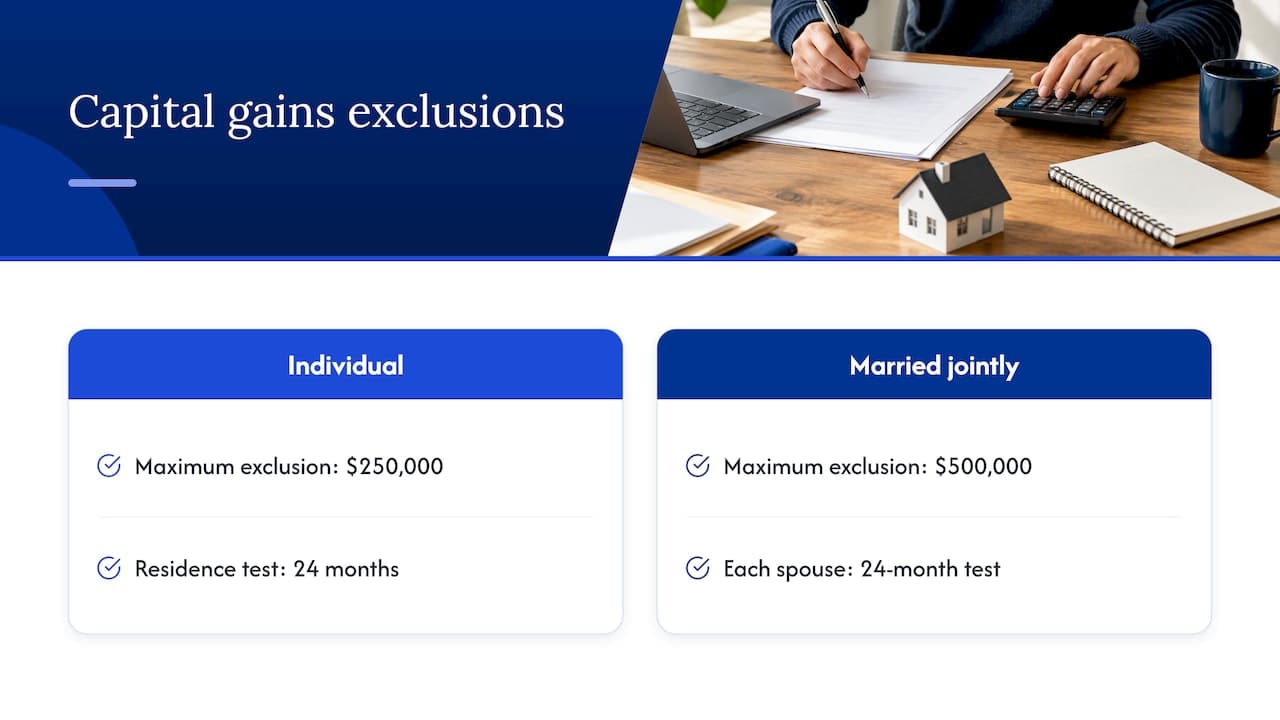
Many owners ask how to avoid capital gains tax. The federal answer starts with the IRS. Publication 523 explains that you subtract your adjusted basis from the amount realized (selling price minus selling expenses). To exclude the gain, the home generally must be your principal residence, and you must have owned and lived in it for at least 24 months during the five years ending on the closing date. The months need not be consecutive.
The maximum exclusion is $250,000, or $500,000 for qualifying married couples filing jointly, and for the joint amount each spouse must meet the 24-month residence test (730 days). Rental use matters too: the IRS says you may not exclude the part of your gain equal to depreciation allowed or allowable for business or rental use after May 6, 1997.
That has a practical consequence. If you moved out of state more than three years ago and rented the house, or inherited a property you never lived in, you may not qualify for the full exclusion. A tax professional can run your numbers before you accept an offer. We can’t give tax advice, but we can say that this check takes an afternoon and can change which offer is best.
Timing: what makes an out-of-state sale slow
The delays are predictable:
- Preparation. Finding vendors and waiting for work to finish.
- Marketing time. Waiting for the right buyer on the open market.
- Inspection and financing. Buyer loans and repair requests can reopen negotiations.
- Document logistics. Mailing, notarizing and returning paper.
- Carrying costs. Each month adds mortgage, tax, insurance and utilities.
Cash buyers shorten the first four. With a vacant house, the carrying costs are the point: our guide on selling a vacant house in Michigan explains how to get multiple bids in a day or two, and our vacant house page outlines the process.
Perspective: why we built the process around distance sellers
We hear the same story from owners who live in Texas, Florida, Arizona or North Carolina and own a house in Detroit, Flint or Grand Rapids. It’s not that they can’t sell. It’s that the house keeps costing them money while they work out who will clean it, who will meet the agent, and whether the repairs are worth it.
Our view is that a distance seller shouldn’t have to manage a project from a phone. That is why HouseGoodbye is a marketplace and not a single buyer. Several vetted Michigan cash buyers bid on the same house as-is, and you see every offer. You aren’t asked to repair, stage or show anything, and you pay no agent commission.
Compare what each bid nets you after payoffs and closing costs. Choose one if the number works. Walk away if it doesn’t. The decision stays with you, and so does the timeline.
Bryan
Ready to compare offers?
If your Michigan house is sitting while you live somewhere else, you can see what cash buyers would pay without scheduling a single showing. Enter the address at HouseGoodbye and let vetted local buyers compete. You can also read how our as-is cash sale process works before you decide.

If the house is in a specific city, we have pages for owners in Detroit and Warren, and a statewide page for selling fast in Michigan. Our as-is sale checklist lists the documents and steps to have ready.
A practical checklist for distance sellers
- Decide your priority. Highest possible price over many weeks, or a fast, certain close with no prep.
- Collect documents. Deed, mortgage statement, tax records and improvement invoices.
- Get a payoff figure. Ask the servicer in writing.
- Choose a closing provider. Ask about mail-away, hybrid and RON closings.
- Compare offers on net proceeds. Use seller-side figures from the settlement agent.
- Check taxes. Review IRS Publication 523 or speak with a tax professional.
- Secure the house. Until closing, make sure the property is locked, insured and monitored by someone local.
- Verify wire instructions by phone. Use a number you already trust.
FAQ
Can I sell my house if I live in another state?
Yes. You don’t have to be present for any part of the sale. A local agent, or a cash buyer plus a title company, handles the work in Michigan, and your closing can usually be completed by mail, with a local notary or online notarization, depending on the closing provider and state rules.
Do I need a power of attorney to sell from out of state?
Not always. If you can sign documents before a notary where you live, or through remote online notarization, you can sign for yourself. A power of attorney is for situations where you can’t sign at all, and the title company must accept the document, so ask them before you rely on it.
How long does it take to sell a house from out of state?
On the open market, our figure is about 73 days on the MLS, before you add preparation time. With cash offers through HouseGoodbye, closing can happen in about 7 days, though the actual date depends on title work, payoff details and the buyer you choose.
Will I owe capital gains tax if I sold my home from another state?
It depends on your situation. Under IRS Publication 523, you may exclude up to $250,000 of gain, or $500,000 for qualifying joint filers, if you owned and used the house as your main home for at least 24 months of the five years before the sale. Rental use, depreciation and time away can limit that, so check with a tax professional.
Sources
- Selling a Home Out of State: 5 Secrets for Streamlining (Realtor.com)
- 2025 Profile of Home Staging (NAR)
- Your Virtual Tour Playbook Is Here (NAR)
- How to Host a Virtual Open House (HousingWire)
- Virtual Showings and Virtual Open Houses (CRMLS)
- What the NAR Settlement Means for Home Buyers and Sellers (NAR)
- How to Sell a House While Living in Another State (LegalClarity)
- How do I get mortgage information about a home I inherited? (CFPB)
- eClosing (First American)
- Can You Close on a House Remotely? (Redfin)
- Closing Disclosure, seller sample (CFPB)
- TILA-RESPA Integrated Disclosure guide (CFPB)
- Publication 523, Selling Your Home (IRS)
- Sales, Trades, Exchanges 3 (IRS)