For most Michigan homeowners with a vacant house who need speed and low effort, the fastest realistic route is an as-is sale to vetted local investors through a competing-offer marketplace like Housegoodbye. Direct investor sales and agent listings both work too, but they trade speed for either lower certainty or a longer timeline. Expect a close window measured in days to a few weeks rather than months, and remember Michigan still requires a signed disclosure statement before any binding agreement.
TL;DR:
- A competing-offer marketplace like Housegoodbye is the fastest way to sell a vacant house in Michigan, usually closing within one to three weeks with multiple vetted investors competing.
- Cash offers from direct investors or marketplaces often come with a discount but eliminate the need for repairs, staging, and commissions, reducing the closing time significantly.
- Traditional agent listings or FSBO approaches can fetch higher net proceeds but typically require 30 to 90 days and involve additional effort and costs, which may not be practical if the house is in poor condition or time-constrained.
- Michigan law mandates a signed seller disclosure statement before binding agreements, and vacant properties face higher insurance costs and municipal regulation, increasing ongoing expenses and legal compliance needs.
- Rapid sales routes are especially advantageous when vacancy costs, such as taxes, utilities, and insurance premiums, outweigh potential higher sale prices achieved through longer negotiations or renovations.
Table of Contents
- Quick Overview of Realistic Ways to Sell a Vacant House in Michigan
- Pros and Cons: As-Is Cash Sale vs. Listing vs. FSBO for Vacant Properties
- How to Sell a Vacant House Fast in Michigan: A Step-by-Step Checklist
- Michigan-Specific Legal Musts and Vacancy Risks You Cannot Skip
- What It Typically Costs and How Fast You Can Close
- Why a Competing-Offer Marketplace Fits Vacant Michigan Homes
- When I’d Recommend an As-Is Sale vs. Listing or FSBO
- How Housegoodbye Helps Michigan Sellers of Vacant Houses
- Sources
- FAQ
Quick Overview of Realistic Ways to Sell a Vacant House in Michigan
Vacant houses don’t sell like occupied ones. Buyers assume something is wrong the moment they hear “empty,” and lenders get nervous about deferred maintenance nobody has been around to catch. That perception gap is why so many Michigan sellers with vacant property gravitate toward as-is cash routes instead of a traditional listing.
There are four practical paths worth weighing:
- Competing-offer marketplace (Housegoodbye): You submit basic property details once and receive multiple cash bids from vetted local investors who compete against each other, which tends to push net offers higher than a single buyer’s first number.
- Direct investor or cash buyer: You contact one investor group directly. It’s fast, but with only one bidder, you have no leverage to push the price up.
- Listing with a local agent (as-is): An agent markets the home, often to owner-occupant buyers, which can mean a higher sale price but a slower process and financing contingencies.
- For-sale-by-owner (FSBO): You handle marketing, showings, and negotiation yourself, saving on commission but taking on legal and logistical risk without professional backup.
Speed, net proceeds, and effort move in opposite directions across these four options. The marketplace and direct-investor routes close fastest and require the least prep. Agent listings and FSBO can net more money on paper, but only if the house shows well empty and the buyer pool has patience for a vacant property’s unknowns. A local resource on selling a house in Michigan covers the paperwork basics that apply no matter which path you pick.
Pros and Cons: As-Is Cash Sale vs. Listing vs. FSBO for Vacant Properties
The right choice depends on what you’re optimizing for: speed, total dollars, or control over the process. Here’s how the three main paths stack up on the factors that matter most once a house sits empty.
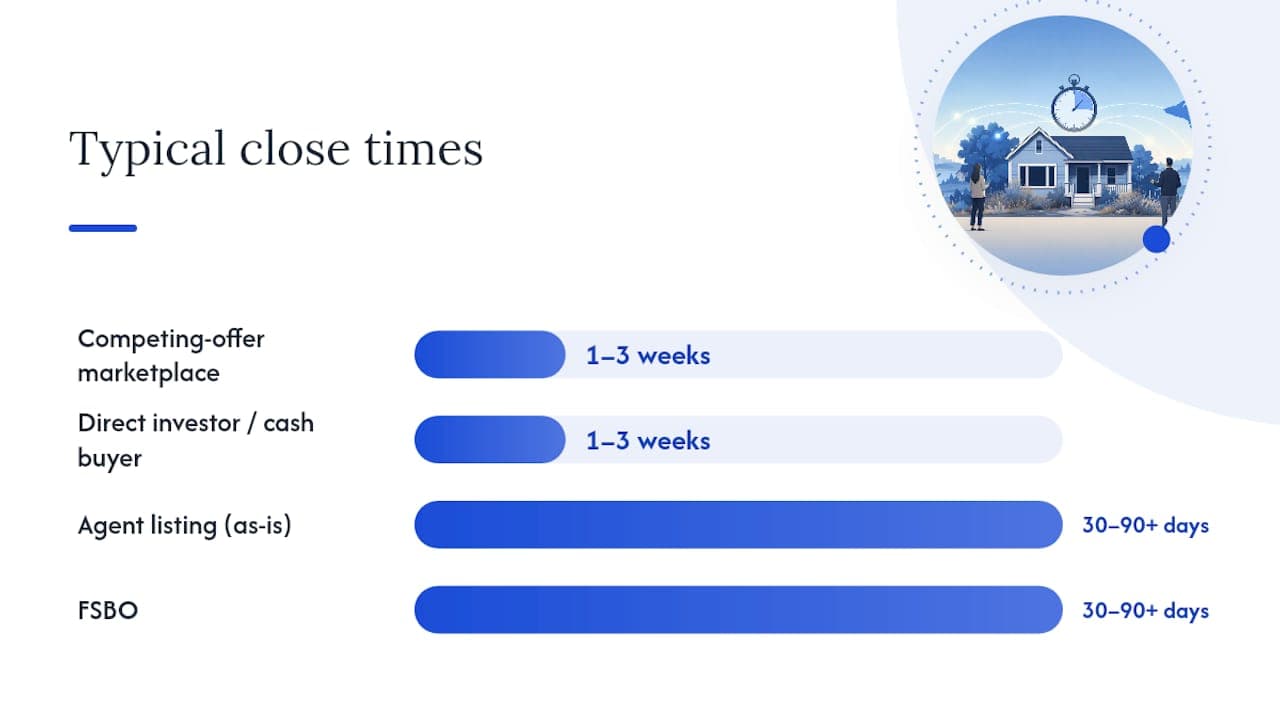
- Speed to close. Competing-offer and direct-investor sales typically move in one to three weeks because there’s no mortgage underwriting to wait on. Agent-listed sales depend on finding a financed buyer, and financed deals routinely take 30 to 60 days just to clear underwriting once an offer is accepted.
- Net proceeds after fees. Cash buyers usually offer below full retail value to account for the risk and speed they’re providing, but you skip agent commissions, repair costs, and months of carrying costs. Agent sales can fetch a higher sticker price, minus a standard commission split and any repair concessions.
- Effort and negotiation complexity. Cash sales involve minimal back and forth. FSBO puts you in the driver’s seat for pricing, marketing, contract negotiation, and disclosure compliance, with no agent to catch mistakes.
Vacancy changes the math on all three. An empty house often fails a buyer’s lender-required inspection over something minor that would never have surfaced if someone were living there, like a slow leak behind a wall. That’s one reason financed offers on vacant homes have a higher fall-through rate, since lenders can require repairs cash buyers simply waive.
Watch for red flags regardless of path: an investor who won’t put a number in writing, a listing that sits for 90-plus days with no showings, or a lapse in insurance coverage while you wait for the “right” buyer.
Pro Tip: Ask any cash buyer for their offer in writing within 24 hours of viewing photos or walking the property. A legitimate investor doesn’t need weeks to underwrite a straightforward as-is deal.
How to Sell a Vacant House Fast in Michigan: A Step-by-Step Checklist
Getting from “empty house, no plan” to a closed sale usually takes five concrete moves.
- Secure the property and document its condition. Change the locks, confirm the property is winterized if it’s cold season, and walk through with your phone recording a date-stamped video. This protects you if a buyer later disputes the home’s condition and supports the disclosures you’ll need to sign.
- Gather your paperwork. Pull the deed or title info, get a payoff quote from your mortgage servicer, collect the last two years of property tax statements, and note any municipal notices tied to the address. Missing documents are the single biggest reason closings slip past their target date.
- Request offers from multiple buyers. Whether you go through a competing-offer marketplace or contact investors directly, be ready to share clear photos, confirm access or a lockbox code, and flag any major known defects (roof age, foundation issues, old mechanicals). Getting more than one bid is the only way to know if a number is fair.
- Compare net proceeds, not just headline price. A $185,000 offer with a $6,000 buyer credit and a 45-day close nets less, sooner or later, than a $172,000 all-cash offer closing in 10 days with no contingencies. Do the math before you sign.
- Line up closing logistics. Choose a title or escrow company, agree on an inspection window if the buyer wants one, and plan how keys will change hands if you’ve already relocated out of state.
Pro Tip: If you’ve already moved, ask your title company about a mail-away closing. You can sign and notarize documents wherever you are and never set foot back in Michigan for the closing itself.
Michigan-Specific Legal Musts and Vacancy Risks You Cannot Skip
Michigan’s Seller Disclosure Act isn’t optional paperwork you can skip because the house is empty. Under MCL 565.957, sellers must deliver a signed, truthful disclosure statement before a binding purchase agreement, and if you don’t, the buyer can gain the right to terminate the deal even after signing. That single provision has unwound more than a few rushed cash closings.
Local vacancy rules matter just as much:
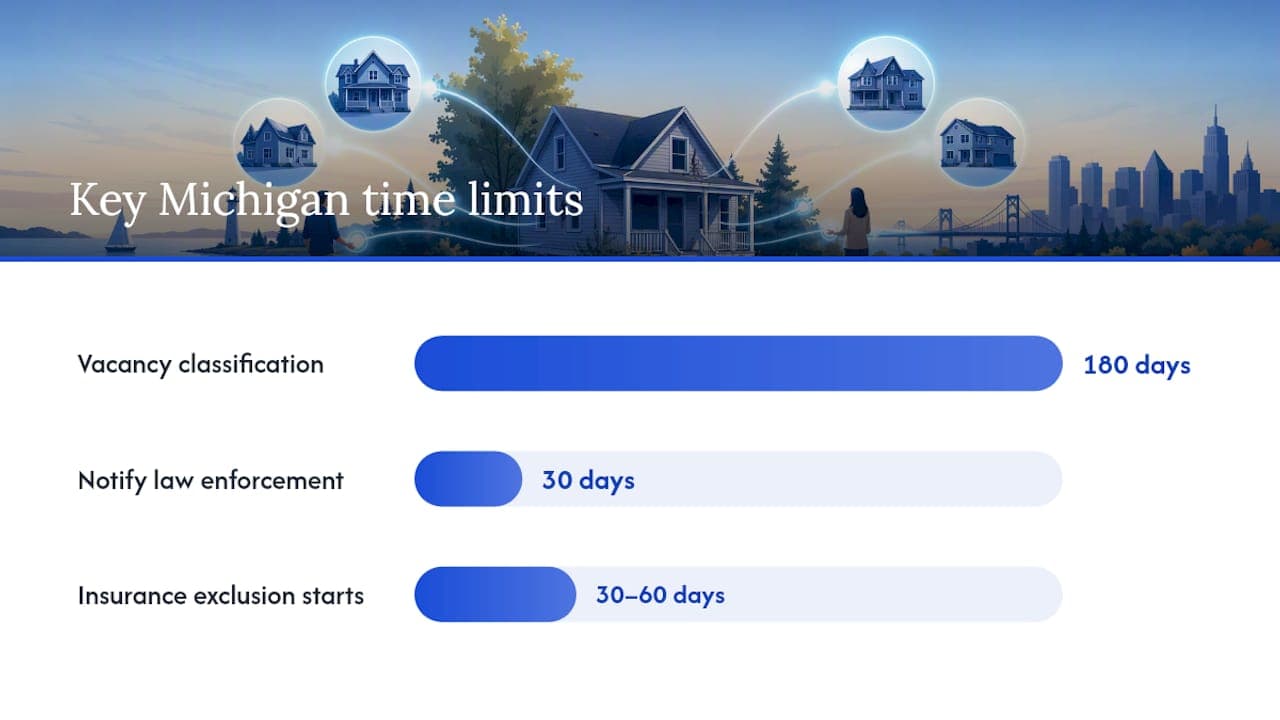
- Under MCL 125.539 (https://legislature.mi.gov/printDocument.aspx?objectName=mcl-125-539&version=txt), municipalities can classify a property as vacant after 180 consecutive days without an active listing for sale or rent.
- Notifying local law enforcement of the vacancy within 30 days can help you avoid code enforcement penalties tied to that classification.
- Some cities layer on their own vacant-property registration fees or inspection requirements, so it’s worth a call to your local building department before you list.
Insurance is the piece sellers underestimate most. Standard homeowner policies frequently exclude coverage for burst pipes, vandalism, or fire damage once a property has sat empty for 30 to 60 days, and vacant-home policies typically cost 50% to 100% more than standard coverage because insurers see empty houses as fundamentally riskier. The reason is simple: nobody’s around to catch a small leak before it becomes a collapsed ceiling. Call your carrier the day the house goes empty, not the week before closing. A Michigan seller disclosure guide walks through exactly what the state form requires line by line.
What It Typically Costs and How Fast You Can Close
Every month a vacant house sits unsold, it costs you money whether or not anyone’s living there. Property tax keeps accruing, a vacant-specific insurance premium runs higher than standard coverage, utilities to prevent freeze damage keep the lights on, and someone still needs to mow the lawn or plow the driveway. Add occasional security or boarding costs for houses in higher-risk areas, and carrying an empty house for even three extra months can run into thousands of dollars in costs that never show up on a listing sheet.
Closing speed varies sharply by route, and so does what comes out of your proceeds before you see a check.
| Selling route | Typical close window | Typical cost to seller |
|---|---|---|
| Competing-offer marketplace | one to three weeks | Investor discount reflected in offer price, no commission |
| Direct investor/cash buyer | one to three weeks | Investor discount, no commission |
| Agent listing (as-is) | 30 to 90+ days | Standard commission split, possible repair credits |
| FSBO | Variable, often 30 to 90+ days | No commission, but seller covers marketing and legal review |
The fastest routes trade a lower gross price for eliminated carrying costs and no commission. Whether that trade makes sense depends on how much longer you can afford to keep paying taxes, insurance, and utilities on a house nobody’s living in.
Why a Competing-Offer Marketplace Fits Vacant Michigan Homes
A single investor has no incentive to offer you their best number. A competing-offer model flips that dynamic by putting your property in front of multiple vetted investors at once, and that competition tends to push net offers higher than what you’d get from one buyer working alone.
For a vacant house specifically, this matters more than it might for an occupied one, because:
- You skip repairs, staging, and cleaning entirely, which matters when nobody’s living in the house to maintain it anyway.
- Difficult properties, including ones with deferred maintenance or code issues, still qualify for offers.
- Closings can happen in as little as seven days, cutting the carrying-cost bleed dramatically.
- You see multiple real numbers side by side instead of guessing whether one offer is fair.
Pro Tip: Request offers as soon as the house goes empty rather than waiting to see if it “sells itself” on the open market first. Every week of vacancy adds insurance and holding costs that eat into whatever price you eventually accept.
When I’d Recommend an As-Is Sale vs. Listing or FSBO
An as-is competing-offer sale makes the most sense when time is the scarce resource: an estate that needs to close before probate deadlines, an owner who already relocated for a job, or someone facing carrying costs they can no longer absorb. If the house needs work you can’t fund and every month of vacancy is bleeding cash, waiting for a retail buyer rarely pays off once you subtract insurance, taxes, and utilities from the eventual sale price.
Listing or FSBO can beat a cash sale when the house has had recent updates, sits in a neighborhood with genuine buyer demand, and you can afford to wait 60 to 90 days without financial strain. A freshly renovated kitchen or a hot local market changes the math. Vacant houses in rough shape, in slower markets, or under time pressure rarely benefit from that wait.
— Bryan
How Housegoodbye Helps Michigan Sellers of Vacant Houses
A competing-offer marketplace can help sell a vacant Michigan house without repairs, staging, or a drawn-out listing process. You submit your property once, and vetted local investors compete for it with real cash offers, no lowball single-bid tactics, no agent commissions, and no obligation to accept anything you don’t want.

Getting started takes a few basic details: the property address, current condition, and any known issues like an aging roof or deferred maintenance. From there, offers typically come back within a day or two, and closings can happen quickly once you accept. If you’re weighing whether a fast as-is sale fits your situation, start by requesting competing cash offers directly through the marketplace, or check out the vacant house page for details specific to empty properties. If speed is the priority, the sell your house fast option walks through exactly what to expect timeline-wise.
Sources
The legal and insurance claims in this guide draw on Michigan’s own statutes and industry insurance guidance: the Seller Disclosure Act governing required disclosures, the municipal vacancy statute (https://legislature.mi.gov/printDocument.aspx?objectName=mcl-125-539&version=txt) covering vacant-building classification, and insurance guidance on vacant-policy costs. Laws and insurance terms change; talk to a Michigan real estate attorney or licensed insurance agent for guidance specific to your property.
- MCL 565.957 — Seller’s disclosure statement (official statute text)
- Why are vacant policies so expensive? — StreetSmart Insurance
- Considerations before selling a house in Michigan — Lawyers.com
FAQ
Is it harder to sell a vacant house?
Yes. Vacant homes make buyers and lenders more cautious about hidden defects, and financed buyers often require additional inspections that cash buyers waive, which slows down and sometimes derails a sale.
What is the 3-3-3 rule in real estate?
Definitions vary depending on who’s using the term, and it’s not a formal Michigan legal standard, so treat any specific version you encounter with caution rather than as an official rule.
How do I sell my house without a realtor in Michigan?
You can sell FSBO by handling your own marketing, negotiating directly with buyers, and completing the required Seller Disclosure Act paperwork yourself, or you can request offers through a competing-offer marketplace like Housegoodbye, which removes the need for an agent entirely.
What is the hardest month to sell a house?
Winter months, particularly December and January, typically see the fewest buyers actively shopping in Michigan, which can extend time on market for listed or FSBO vacant homes during that stretch.
Do I still need a disclosure statement if the house is vacant?
Yes. Michigan’s Seller Disclosure Act applies regardless of occupancy status, and a signed disclosure must be delivered before a binding purchase agreement under MCL 565.957.