
“As-is” in real estate means the seller is offering the home in its current condition and has decided in advance not to make repairs, whatever a buyer’s inspection turns up. It does not mean the seller can hide problems, and it does not stop the buyer from inspecting. This guide explains what the phrase does and does not do, what Michigan sellers still have to disclose, and how to decide whether an as-is sale fits your situation.
TL;DR
- An as-is sale means the seller will not repair the property or credit the buyer for repairs. The seller decides this before collecting offers.
- Buyers can still inspect. As-is changes who pays for problems, not whether problems can be found.
- As-is never cancels the duty to be honest. Knowingly hiding a material defect is not protected by the label.
- Selling as-is is a trade: you give up some price in exchange for speed, certainty and no repair bills. The right call depends on the home’s condition and your timeline.
- If you need to sell fast, comparing several cash offers is the safest way to keep the trade fair.
Table of Contents
- What “as-is” actually means
- What as-is does not mean
- As-is for sellers: what you gain and what you give up
- When selling as-is makes sense
- As-is and foreclosure in Michigan
- Perspective: how we see as-is sales
- How to prepare for an as-is sale
- Compare cash offers before you accept
- FAQ
- Sources
What “as-is” actually means
The plain definition: the seller is telling every prospective buyer, before offers come in, that the price reflects the home as it stands today. If the furnace is old, the roof leaks or the basement floods, the seller will not fix it and will not discount the price later because of it.
The North Carolina Real Estate Commission puts it in similar terms. In its bulletin on the topic, it explains that “as is” means the seller has decided before soliciting offers not to make repairs, and that saying so puts buyers on notice. The bulletin is from North Carolina, so treat it as a clear explanation of the concept rather than Michigan law, but the concept is the same across the country.
Three things follow from that definition:
- The price carries the condition. A buyer who accepts an as-is home is pricing in the repairs they expect to make.
- Repairs are off the table, not information. The buyer still learns what is wrong. The seller simply declines to act on it.
- The label shifts risk, it does not erase responsibility. More on that below.
You may also see phrases like “as is, where is” or “sold in present condition.” Agents use them interchangeably. What matters is the language in the purchase agreement you sign, not the wording on a listing.
What as-is does not mean
Most confusion comes from assuming the label does more than it does.
It does not stop the buyer from inspecting
A buyer can order a home inspection, an appraisal or a sewer scope on an as-is property. The NCREC bulletin notes that as-is does not prohibit buyers from doing their due diligence. What changes is the next step: if the inspection finds a problem, the buyer’s options are to accept the home, try to renegotiate the price, or walk away within the contract’s deadlines. The seller is not obliged to fix anything.
It does not let a seller conceal known defects
This is the part that matters most for sellers. An as-is clause generally protects a seller from claims about problems they did not know about. It does not protect a seller who knew about a serious defect and kept quiet or lied. The same bulletin explains that the true red flag is discouraging inspections or hiding known material defects, not the as-is status.
In Michigan, sellers of most residential property are expected to complete a disclosure statement under the Seller Disclosure Act (Act 92 of 1993). The statement asks about the condition of things like the roof, basement, plumbing, electrical systems and known environmental issues, based on what the seller actually knows. The form states that it is not a warranty, so you are describing what you know, not guaranteeing the home. Selling as-is does not remove the sense behind that form: tell the truth about what you know.
If your home has special circumstances, such as an estate sale or a bank-owned property, the disclosure rules and exemptions can differ. A Michigan real estate attorney can tell you which apply to you.
It does not mean “no negotiation”
As-is sellers still negotiate price, closing date, occupancy and what stays with the house. They just do not negotiate repairs or repair credits.
It does not make the home a bad deal
Is selling as-is a red flag? Not in itself. Industry guidance treats it as a common tool for sellers who want to avoid the cost and stress of repair negotiations. Plenty of perfectly sound homes sell as-is because the owner is moving quickly, settling an estate or simply tired of projects.
As-is for sellers: what you gain and what you give up
The decision is a trade, and it helps to look at both columns honestly.
| What you gain | What you give up | |
|---|---|---|
| Money | No repair bills, no staging, no pre-sale cleaning | A lower price than a fully repaired home might fetch |
| Time | No contractor scheduling, no waiting on permits | Less room to wait for the single highest bidder |
| Stress | No repair negotiations after an inspection | Buyers may still walk during their inspection window |
| Certainty | A clear message to buyers up front | Pool of buyers shifts toward investors and renovators |
We go deeper on this trade in our posts on the pros and cons of selling a house as-is and how much you might lose selling as-is. The short version: the discount is real, but so are the costs you avoid, and the gap between them depends on how much work your house needs. Property condition affects the offers you receive in ways that are easy to underestimate, especially with foundations, roofs and water damage.
A worked way to think about it
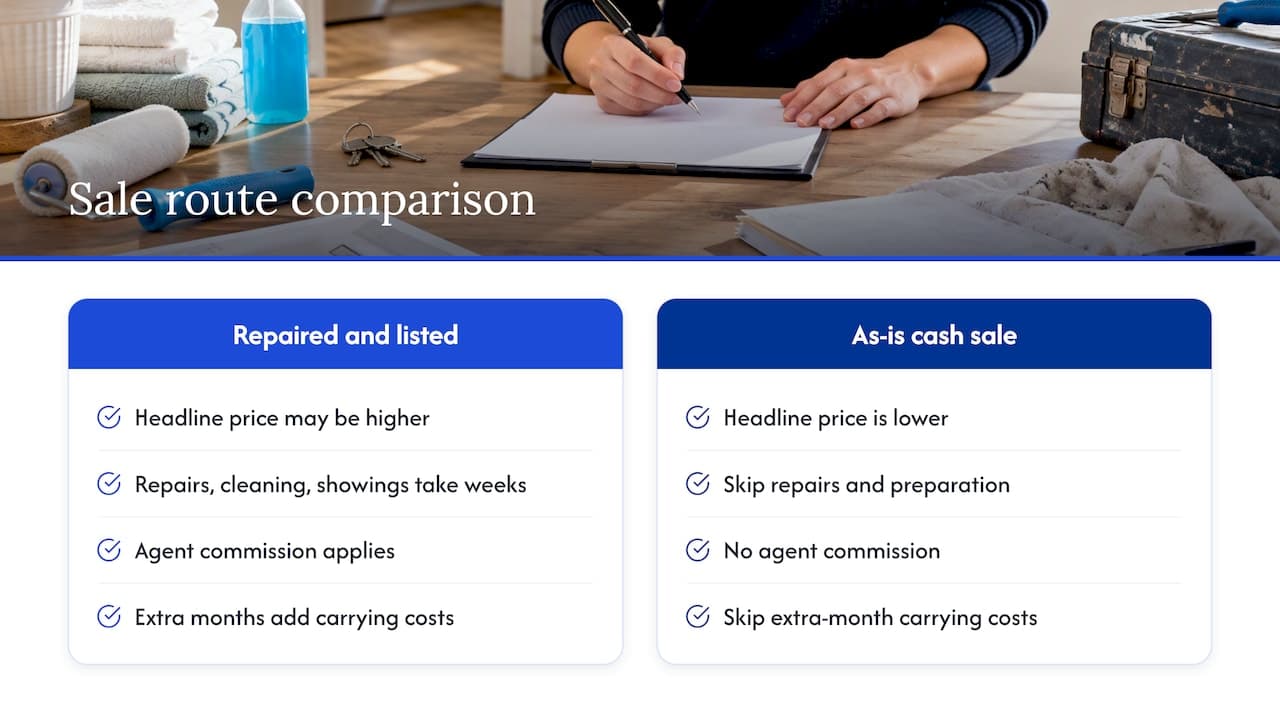
Take a hypothetical Michigan house. Repaired and listed with an agent, it might sell for more, but it needs several weeks of repairs, cleaning and showings, then a commission, then possibly a buyer’s repair request after inspection. Sold as-is to a cash buyer, the headline price is lower, but you skip the repair spend, the commission, the carrying costs of each extra month (mortgage, taxes, insurance, utilities) and the risk that a financed buyer’s deal falls apart. Put your own numbers on each side before deciding. The honest comparison is net proceeds and timeline, not headline price.
When selling as-is makes sense
As-is tends to fit best in these situations:
- The home needs major work. Foundation cracks, a failing roof, fire or water damage, or years of deferred maintenance can cost more to fix than you will recover. Foundation problems in particular deter many traditional buyers.
- You inherited the property. Families settling an estate often live far away, do not want to manage contractors and need to divide proceeds.
- You are relocating or have lost income. Speed matters more than the last few thousand dollars. See how selling as-is saves time when you need out fast.
- You want to avoid agent commissions and showings. Selling directly to a buyer removes both.
- You are behind on your mortgage. Time becomes the main constraint, which is covered next.
As-is fits less well when your home is in good shape, you have months to spare and your market is strong. In that case, a conventional listing with light preparation may net more, and you should price that option fairly against any cash offer.
As-is and foreclosure in Michigan
If you are behind on payments, the as-is question has a deadline attached, so it is worth knowing the timeline.
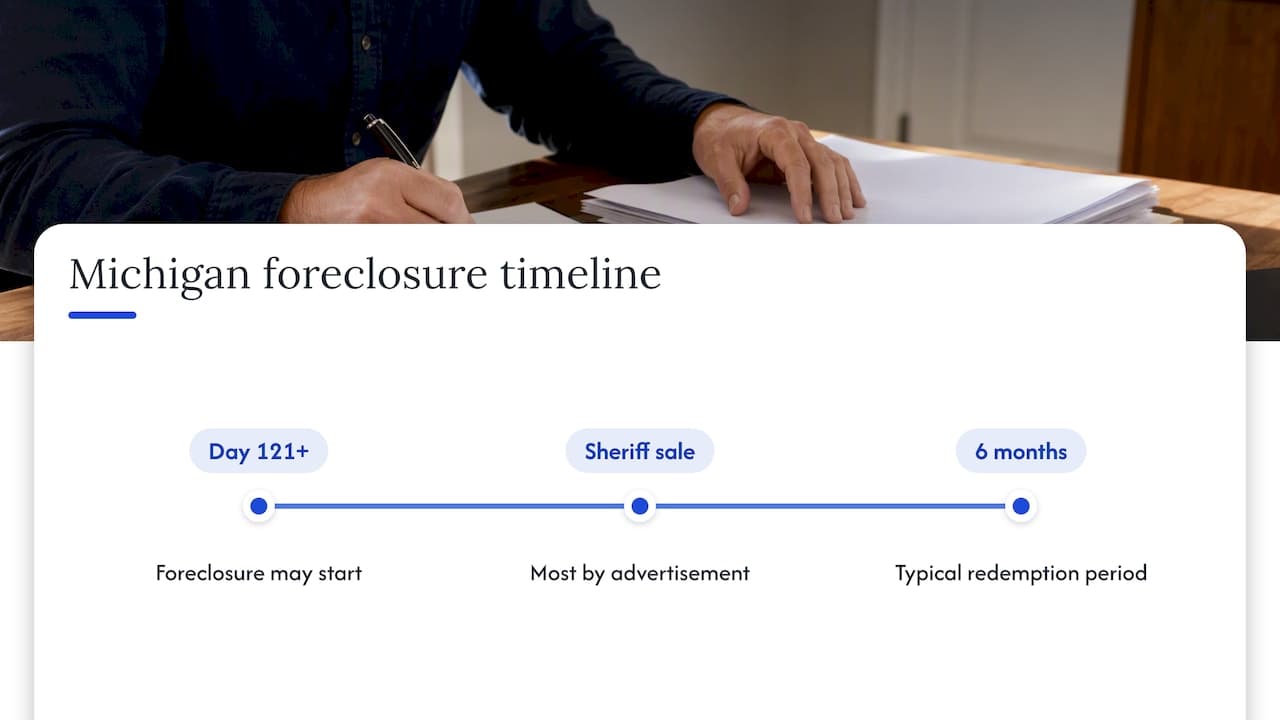
According to the Consumer Financial Protection Bureau, a mortgage servicer generally cannot start the foreclosure process until you are more than 120 days delinquent. Use that window. Contact your servicer and ask about loss mitigation options, which can include alternatives to foreclosure. Federal rules govern how servicers must handle a complete loss mitigation application, and the CFPB explains what happens after you apply. We cover the practical side in how to negotiate with your lender to avoid foreclosure.
Most Michigan foreclosures happen by advertisement, meaning a sheriff’s sale rather than a court case, as the state’s home foreclosure guide explains. After that sale there is generally a redemption period, commonly six months for a typical owner-occupied home, during which you can still sell or buy the property back. The MSHDA foreclosure timeline advises owners in that period to keep maintaining the property, utilities and insurance. The exact length depends on the property and the debt, so confirm yours with a HUD-approved housing counselor or an attorney.
A related term you may see: a home “sold as-is” at foreclosure. That is a different situation from yours as the seller, and we explain it in what foreclosure sold as-is means.
Watch for rescue scams
Distressed owners attract bad actors. The Federal Trade Commission warns that mortgage relief companies cannot collect fees before a written offer from your lender under the MARS Rule. A legitimate buyer of an as-is home does not charge the seller to buy it. Walk away from anyone who:
- asks for money up front to “save” your home
- claims government affiliation
- wants to control your communication with your lender
- pushes a rent-to-own arrangement that sounds too good to be true. The FTC explains the risks of rent-to-own deals.
Perspective: how we see as-is sales
We built Housegoodbye for Michigan homeowners who are not in a position to spend months and thousands of dollars getting a house ready for the market. That includes people facing foreclosure, heirs handling an estate, owners with a home in rough shape and people who just lost a job and need to relocate.
Our view is simple. As-is is not a trick and it is not a punishment. It is a clear statement: this is the house, this is the price, no repair games. The risk for sellers is not the label. The risk is accepting a single lowball offer because you were in a hurry and had nothing to compare it to. Investors price repairs differently, some specialize in certain neighborhoods or conditions, and the spread between offers can be large.
That is why we gather multiple cash offers from vetted local investors, so you can see real numbers side by side, with no obligation to accept any of them. You keep the as-is benefits (no repairs, no cleaning, no agent commissions, no open houses) and you keep the leverage. Our stated aim is closings in as little as seven days when you need that speed, though your own timeline can be slower.
One piece of advice we give everyone: be upfront about the condition of your house. Investors expect problems, and they price them in. Surprises are what slow or kill deals.
— Bryan
How to prepare for an as-is sale
You do not need to fix anything, but you do need to be organized. Our as-is sale checklist for sellers has the full list. The essentials:
- Write down what you know. Roof age, past leaks, foundation cracks, old repairs, known plumbing or electrical problems. Michigan’s disclosure form asks about exactly these things.
- Gather documents. Mortgage statement, property tax bill, any permits, warranties, and for inherited homes, the paperwork showing who has authority to sell.
- Get more than one offer. Comparing bids is the only reliable way to know whether a number is fair.
- Read the purchase agreement for deadlines. Missed notice deadlines can have consequences. In one Michigan Court of Appeals case, a party’s failure to give timely termination notice meant the property was deemed accepted as-is. Your contract’s exact terms will govern.
- Ask about costs. Confirm who pays closing costs, whether there are any fees to you, and the exact closing date.
- Think about taxes. If you have owned and lived in the home for long enough, part of your gain may be excluded. The IRS explains the rules in Publication 523. A tax professional can apply them to your case.
Compare cash offers before you accept
If you want to see what your home would fetch as-is, our as-is selling page explains the process for Michigan homeowners, and you can request competing cash offers directly. You get bids from vetted local investors, you can compare them side by side, and you decide with no obligation. If speed is your priority, see how we sell houses fast, or read how selling your house for cash works first.
We work with homeowners across Michigan, including Detroit, Sterling Heights, Madison Heights, Dearborn Heights, Farmington Hills and Clarkston.
FAQ
What does it mean when a seller says “as-is”?
It means the seller will not make repairs or give credits for repairs, and the price reflects the home’s current condition. Buyers can still inspect and decide whether to proceed. The seller must still be honest about known material defects.
Is selling a house as-is a red flag?
Not by itself. Sellers choose it to avoid the cost and stress of repair negotiations. The warning sign is a seller who discourages inspections or conceals known defects, which is a problem regardless of what the contract says.
Do I still have to disclose problems if I sell as-is in Michigan?
Yes, in most cases. Michigan’s Seller Disclosure Act asks sellers to report known conditions on a standard form. As-is language generally covers what you did not know, not what you knew and hid. Ask a Michigan real estate attorney about your specific situation, especially for estates or foreclosures.
Can a buyer still negotiate or back out on an as-is home?
Yes. A buyer can usually inspect and, within the contract’s deadlines, renegotiate price or cancel, depending on the terms. What an as-is seller does not do is take on repairs. Read the purchase agreement closely, since terms vary.
Can I sell my house to my son for $1?
You can transfer a home for a nominal sum, but the IRS generally treats the gap between fair market value and the price as a gift, which may require a gift tax return. Talk to a tax professional and an attorney before you do it. The IRS explains the rules on gifted property basis.
Sources
- NCREC Bulletins: What Does “As Is” Really Mean?
- Michigan Legislature: Seller Disclosure Act, MCL 565.957
- CFPB: How long before I face foreclosure?
- CFPB: Loss mitigation procedures, 12 CFR 1024.41
- CFPB: What happens after I complete an application
- State of Michigan: Home Foreclosure
- FTC: The lesson of the MARS Rule
- FTC: Rent-to-own home deals
- Michigan Court of Appeals: Coosard v Tarrant
- IRS: Publication 523
- IRS: Property basis and sale of home