TL;DR:
- Holding costs are the monthly expenses incurred while owning an unsold home, including mortgage, taxes, insurance, utilities, and maintenance. These costs can quickly add up, often exceeding the potential premium from waiting for a higher offer, making cash sales more financially advantageous when holding costs or urgency are high. Housegoodbye offers a quick, competitive cash sale process, typically closing in seven days, which can reduce both costs and stress for sellers facing financial or timing pressures.
Holding cost is the monthly cash you burn owning a home that hasn’t sold yet. Add up your mortgage interest, property taxes, insurance, utilities, HOA fees, maintenance, and any vacancy-related expenses, and that total is your monthly holding cost. Multiply it by the number of months you expect to wait, and you have your total holding cost for the sale period. The formula: monthly holding cost × expected months on market = total holding cost. If that number plus typical selling expenses (commissions, repairs, closing costs) exceeds the premium you’d earn by waiting for a higher offer, a fast cash sale is usually the smarter financial move.
Table of Contents
- What are holding costs when selling a home?
- How do you calculate your monthly and total holding cost?
- Worked examples: 1, 3, and 6 months of holding costs
- Why opportunity cost belongs in your holding-cost math
- Cash sale vs. traditional listing: what do you actually net?
- Signs that holding costs justify taking a cash offer
- Alternatives to a cash sale that can reduce holding costs
- How fast-cash offer services work in practice
- A 3-step checklist: should you accept a cash offer?
- Key Takeaways
- The math most sellers never run
- Housegoodbye: skip the holding-cost clock entirely
- FAQ
What are holding costs when selling a home?
Holding costs are every recurring expense you pay while a property sits unsold. They are separate from one-time selling costs like agent commissions or closing fees. Think of them as the meter running in the background from the day you list to the day you close.
Standard line items in the U.S.:
- Mortgage principal and interest — the interest portion is the real cost; principal reduces your loan balance but is still cash out of pocket each month. On a loan amount at typical interest rates, the monthly interest portion of the mortgage can be a significant component of holding costs.
- Property taxes — divide your annual tax bill by 12. Property tax amounts vary by assessment rates and home value but are a consistent monthly holding cost.
- Homeowner’s insurance — typically $100–$200/month depending on location and coverage.
- Utilities — electric, gas, water, and trash don’t stop because the house is empty. Utility costs continue even when a home is vacant and should be budgeted accordingly.
- HOA fees — if applicable, these continue regardless of occupancy. Ranges vary widely, from $50 to over $500/month.
- Routine maintenance — lawn care, snow removal, pest control, and minor repairs. Expect $100–$300/month.
- Vacancy costs — security monitoring, periodic walkthroughs, and liability exposure from an unoccupied property.
- Property management fees — relevant if you hire someone to manage showings or oversee the property during the listing period.
Commissions and closing costs are real expenses, but they belong in your net-proceeds comparison, not your monthly holding-cost line. That distinction matters when you’re calculating how long you can afford to wait.
How do you calculate your monthly and total holding cost?
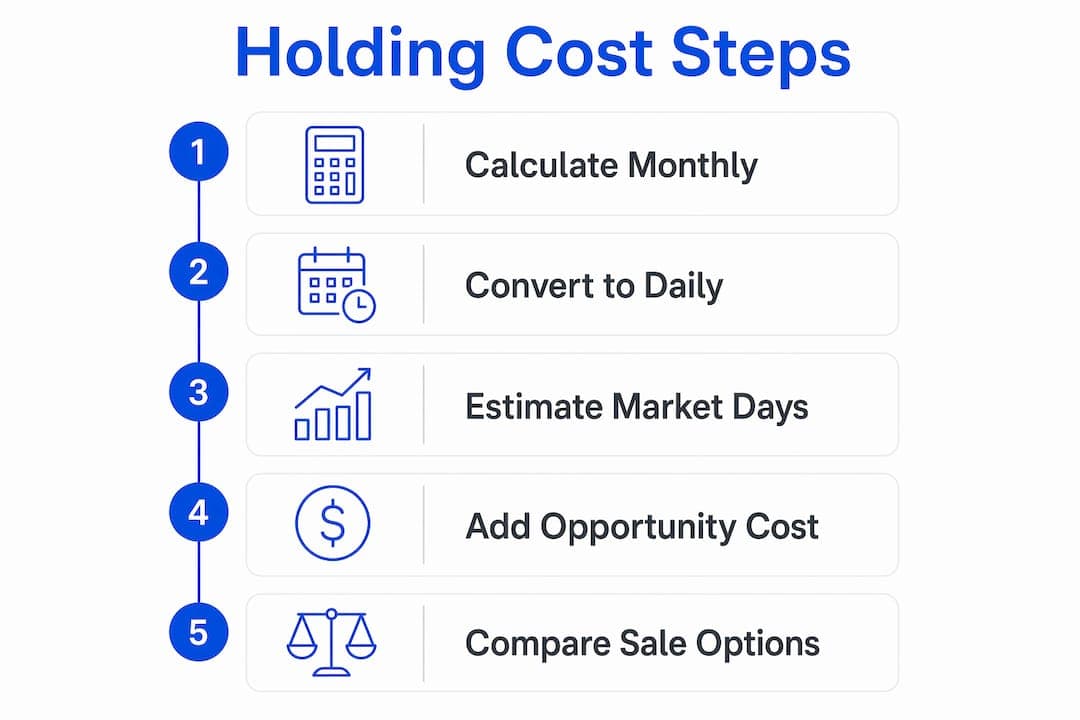
The calculation method is straightforward: convert every annual item to a monthly equivalent, add all recurring monthly items, then multiply by your expected holding period. The Housegoodbye carrying cost calculator makes this fast if you’d rather plug in numbers than do it by hand.
| Input | How to convert to monthly |
|---|---|
| Annual property taxes | Divide by 12 |
| Annual insurance premium | Divide by 12 |
| Monthly mortgage payment | Use as-is |
| Utilities (monthly average) | Use as-is |
| HOA fees (monthly) | Use as-is |
| Maintenance estimate | Use as-is or divide annual by 12 |
| Vacancy buffer (10% of monthly) | Add as a line item |
Once you have a monthly total, divide by 30 to get your daily burn rate. That single number, say $83/day, makes abstract monthly figures feel real and helps you prioritize repairs or pricing decisions quickly.
To estimate your expected holding period, check your county or zip code’s median days on market. In April 2025, homes spent an average of 16 days on market before going under contract in fast markets, though slower or higher-priced markets can run 62–64 days or longer. Use the local median as your baseline, then add a buffer for negotiation and closing.

Worked examples: 1, 3, and 6 months of holding costs
An illustrative breakdown: for a $400,000 home, holding costs can easily add up to $1,500–$3,500 per month, depending on expenses like mortgage, taxes, insurance, utilities, and maintenance. Over three to six months, this can total $4,500 to $21,000 or more before commissions or closing costs are paid. A worked example from FinToolSuite’s days-on-market calculator puts a $400,000 property with $1,500/month in holding costs at roughly $4,500 in direct holding costs over 90 days. Add opportunity cost at a 7% alternative return, and the combined impact exceeds $11,000 for that same 90-day window.
Sensitivity check: Bump the mortgage rate by 1% or extend the vacancy by 30 days, and total holding cost on a $400,000 home with similar assumptions can jump by $1,000–$2,000 more than the base scenario above. The math moves fast.
Why opportunity cost belongs in your holding-cost math
Direct holding costs are only part of the picture. Every month your equity sits locked in an unsold home, it isn’t earning a return elsewhere. Financial experts model this alternative return at roughly 4–7% annually to put a real dollar value on tied-up equity.
The formula: property value × alternative return rate × (days on market ÷ 365)
For a $400,000 home at a 7% alternative return held for 90 days: $400,000 × 0.07 × (90 ÷ 365) = $6,904 in opportunity cost. That’s on top of direct holding costs. Tools like the opportunity-cost calculator from Megan Micco let you test different return assumptions against your own numbers.
Pro Tip: Convert your monthly holding cost to a daily burn rate (monthly total ÷ 30). Post that number somewhere visible. It reframes every delay, every contractor no-show, every price-reduction hesitation as a concrete dollar amount leaving your pocket.
Cash sale vs. traditional listing: what do you actually net?
The headline discount on a cash offer looks significant until you subtract what a traditional sale actually costs. Industry professionals consistently find that a 10–20% headline gap between a cash offer and a list price often narrows once commissions, repairs, staging, closing costs, and holding costs are counted.
| Cost category | Traditional listing | Cash sale |
|---|---|---|
| Agent commissions (6%) | — | $0 |
| Closing costs (3%) | — | $0 |
| Repairs and staging | — | $0 |
| Holding costs (3 months) | -$10,500 | $0 |
| Net proceeds | — | — |
In this scenario, the cash offer actually nets more. The total cost of selling a home typically runs 10%–15% of the sale price according to Freddie Mac, and that’s before holding costs. Skipping agent commissions and repair bills changes the math fast.
Non-financial trade-offs matter too:
- Speed and certainty — a cash close removes financing contingencies and appraisal risk.
- Coordination burden — managing contractors, inspectors, and showings takes real time and energy.
- Price-reduction risk — every week on market increases the odds of a price cut that erodes the premium you were waiting for.
Signs that holding costs justify taking a cash offer
Not every seller should rush to a cash buyer. But these signals suggest the math has already shifted:
- Your monthly holding cost exceeds 30% of your mortgage payment.
- You’re relocating for work and can’t manage the property from a distance.
- Job loss or income disruption makes the monthly burn unsustainable.
- The home has been vacant for 60+ days with no serious offers.
- A major repair (roof, HVAC, foundation) would consume the premium you’re holding out for.
- Foreclosure risk is on the horizon and a cash sale vs. foreclosure comparison shows cash wins clearly.
- Your projected total holding cost already exceeds the expected premium from waiting.
Speed becomes the priority even when net proceeds are close. The stress of managing a vacant property, coordinating showings, and waiting on financing approvals has a real cost that doesn’t show up in any spreadsheet.
Alternatives to a cash sale that can reduce holding costs
A cash sale isn’t the only lever. Depending on your situation, these options can cut costs without giving up the listing:
- Expedited listing with a price reduction — dropping the price by 3%–5% early often shortens days on market more than it costs in proceeds. Best when the home is priced above comparable sales.
- Short-term rental — renting month-to-month covers holding costs and keeps the home occupied. Works well in high-demand rental markets; less useful where vacancy rates are high or tenant turnover is risky.
- Bridge loan or HELOC — lets you access equity to cover holding costs or fund a new purchase before the sale closes. Adds interest expense, so run the numbers carefully. Reviewing property disposition strategies can help you frame which path fits your timeline.
- Cosmetic fixes only — fresh paint, deep cleaning, and landscaping can shorten time on market without the cost of major repairs. Skip anything structural unless a buyer’s inspection will flag it as a deal-breaker.
- Professional staging and photography — homes with professional photos sell faster. Faster sales mean fewer months of holding costs, which often makes the staging fee pay for itself.
Avoid indefinite rent-out in a weak rental market or flipping without a solid contractor budget and timeline. Both can extend your holding period and increase total costs beyond what a clean cash sale would have cost.
How fast-cash offer services work in practice
The process is simpler than most sellers expect:
- Submit your property details (address, condition, timeline) online.
- Receive multiple competing cash offers, typically within 24–48 hours.
- Review offers with no obligation to accept.
- Sign the purchase agreement and choose your closing date.
- Close in as little as seven days, with no repairs, no showings, and no agent fees.
Housegoodbye facilitates multiple competing cash offers from investors, which means sellers aren’t locked into a single lowball bid. The bidding process creates upward pressure on the offer price, and the as-is model eliminates repair negotiations entirely. Closing in as few as seven days is a stated guarantee, directly addressing the urgency of sellers facing mounting holding costs.
Cash-sale platforms work best for owners who need speed, want to avoid the repair-and-show cycle, or are watching holding costs compound on a vacant property. The cash sales close faster because there’s no lender underwriting, no appraisal contingency, and no chain of buyers to manage.
A 3-step checklist: should you accept a cash offer?
- Calculate your monthly holding cost and project it forward. Use the table in this article or the Housegoodbye carrying cost calculator. Multiply by the realistic months-on-market for your area. That’s your holding-cost exposure.
- Estimate the net-proceeds gap. Take a realistic cash offer, subtract nothing (no commissions, no repairs, no closing costs). Take your expected list price, subtract 6% commission, 1%–3% closing costs, repair and staging estimates, and your projected holding costs. Compare the two net figures, not the headline prices.
- Apply your decision triggers. If you’re facing financial distress, relocation, vacancy, or foreclosure risk, and the net-proceeds gap is under 5%, the speed and certainty of a cash sale almost always wins.
Key Takeaways
Holding costs accumulate every month a home sits unsold, and once commissions, repairs, and closing costs are included, the net-proceeds gap between a cash offer and a traditional sale is often far smaller than the headline price difference suggests.
| Point | Details |
|---|---|
| Holding cost formula | Monthly holding cost × months on market = total holding cost exposure. |
| Monthly cost range | A $400,000 home can easily carry $3,500/month in holding costs across mortgage, taxes, insurance, and utilities. |
| Opportunity cost adds up | Opportunity cost from alternative returns on equity can significantly add to holding costs over a typical sale period. |
| Net proceeds often converge | After commissions, repairs, and holding costs, the gap between a cash offer and a listed sale frequently narrows to a few percent. |
| Housegoodbye | Facilitates multiple competing cash offers with an as-is, no-commission process and a seven-day closing guarantee. |
The math most sellers never run
Most sellers fixate on the headline offer price. That’s the wrong number to anchor on. The number that actually matters is what lands in your bank account after every cost is paid, including the months of mortgage, taxes, and insurance you paid while waiting for a “better” offer.
What surprises sellers most is how quickly the holding-cost total overtakes the premium they were holding out for. A $10,000 higher list price sounds meaningful until you’ve spent $10,500 in holding costs over three months to get there. At that point, you haven’t won anything.
The other thing worth saying plainly: the stress of managing a vacant property, coordinating contractors, and refreshing the listing every two weeks has a cost that doesn’t appear in any net-proceeds spreadsheet. For sellers facing relocation, financial pressure, or a home that needs work, the certainty of a clean cash close is worth more than the math alone shows. Housegoodbye’s model, with competing offers and a seven-day close, is specifically built for that situation.
Housegoodbye: skip the holding-cost clock entirely
Every day your home sits listed is another $117 (or more) off your bottom line. Housegoodbye connects you with multiple competing cash investors who bid on your property as-is, no repairs required, no agent commissions, no open houses. The result is a real offer, often within 24–48 hours, and a closing timeline as short as seven days.

Before you submit, have these ready: your property address, a rough sense of the home’s condition, your mortgage payoff amount, and your preferred closing timeline. That’s all it takes to get competing offers in front of you fast.
If you’re in Michigan, Housegoodbye serves homeowners across the state, including St. Joseph, Holland, and Wayland. Ready to see what your home is worth in cash? Visit housegoodbye.com to get started.
FAQ
What exactly counts as a holding cost when selling a home?
Holding costs include every recurring expense you pay while the home is on the market: mortgage payments, property taxes, insurance, utilities, HOA fees, maintenance, and vacancy-related costs. One-time selling expenses like agent commissions are separate.
How much do holding costs typically run per month?
It varies by home value and location, but a $400,000 home can easily carry $3,500/month or more in combined mortgage, taxes, insurance, and utilities. The daily burn rate (monthly total ÷ 30) is a useful way to feel the real pace of accumulation.
Does a cash offer really net more than a traditional listing?
Often, yes. Once you subtract a 6% commission, 1%–3% closing costs, repair and staging expenses, and several months of holding costs from a traditional sale, the net proceeds can fall below what a cash buyer offers with none of those deductions.
When does a fast cash sale make the most financial sense?
When your projected total holding cost plus selling expenses exceeds the premium you’d earn by waiting, or when financial distress, relocation, or vacancy makes the monthly burn unsustainable.
How fast can Housegoodbye close on a home?
Housegoodbye guarantees closing in as little as seven days. The process involves submitting property details, receiving multiple competing cash offers, and signing with no repairs or agent fees required.