You can sell a duplex for cash in Michigan in a few weeks, sometimes in as little as seven days, if you sell as-is to an investor who has the funds. The catch is price. Investors value a duplex by its income, not just by what the house next door sold for, so a single offer can land far below what the property is worth. The way to protect yourself is to get several offers, check each buyer’s proof of funds, and understand how tenants, taxes and title affect your net.
TL;DR
- A cash sale skips repairs, showings and agent commissions, but you pay for that speed through a lower price. Cash buyers are common now: all-cash purchases reached 26% of home sales in 2025.
- Investors price duplexes on rent roll and vacancy. Gather leases, rent amounts and expenses before you ask for offers.
- Tenants, security deposits and, for inherited or long-held rentals, depreciation recapture all change what you walk away with.
- Compare at least three written offers from buyers who show proof of funds, and close through an independent title company.
- If you are behind on taxes or a mortgage, deadlines matter more than price. Act before auction.
Table of Contents
- Why a duplex sells differently from a single-family house
- What a cash buyer will actually pay
- Prepare your rent roll before you ask for offers
- Tenants, leases and security deposits
- Taxes that change your net proceeds
- When you are behind on taxes or the mortgage
- Avoid scams and bad deals
- Our perspective on selling a duplex for cash
- Get competing offers on your Michigan duplex
- A step-by-step plan
- FAQ
- Sources
Why a duplex sells differently from a single-family house
A single-family home is priced mostly from comparable sales. A duplex has two jobs: it is a home and it is an income stream. Investors, who are the main cash buyers of two-unit properties, run the numbers on the income.
Freddie Mac’s multifamily guidance says appraisers should not model rental income at 100% of market rents; they should support an as-is market value from what the property actually produces. Investors think the same way. If your units rent below the market, or one has sat empty, they discount for the gap between current and potential rent and for the work needed to close it.
That is why two duplexes with the same square footage and the same street can draw very different offers. It is also why the keyword “sell rental property cash” and “multifamily cash buyers” lead to the same place: the buyers are investors, and they underwrite.
What a cash buyer will actually pay
Be realistic about the discount. The National Association of REALTORS explains that direct cash buyers use algorithms that set offers intentionally below what a traditional listing would achieve. That gap is the price of certainty, no repairs and no showings. NAR also notes that the first number can move after an inspection, because the algorithm has not seen the inside of the property.
Smaller local investors work differently. They walk the property, check the rents and the roof, and give a number they can commit to. Their offers also vary a lot from one buyer to the next. One may want a stable, fully rented duplex; another prefers a vacant, tired one to renovate. That spread is the reason to collect more than one bid.
A simple way to think about the math
Suppose a duplex would list at a price you would be happy with after months of repairs, showings and an agent’s commission. A cash offer will come in below that, but you also avoid the commission, the repair bill, carrying costs (taxes, insurance, utilities, debt payments) while it sits, and the risk of a buyer’s loan falling through. Compare net proceeds, not headline prices. Write both columns down:
| Cost or risk | Traditional listing | As-is cash sale |
|---|---|---|
| Agent commission | Yes | No |
| Repairs and cleanout | Usually | No |
| Showings with tenants in place | Many | Few, often one walkthrough |
| Time to close | Often months | Days to a few weeks |
| Buyer financing risk | Yes | Low with proven funds |
| Sale price | Typically higher | Typically lower |
The honest answer is that the best choice depends on your property’s condition and your deadline. Some NAR-cited practitioners argue that modest repairs can raise net profit on a conventional sale. If your duplex is in decent shape and you have six months, that is worth pricing out. If the building needs a roof, has a bad tenant, or you are on a clock, cash usually wins on net.
Prepare your rent roll before you ask for offers
An investor’s first questions are about income. Having answers ready gets you a firmer first bid and fewer reductions later.
- Rent roll: each unit, current rent, lease end date and whether the tenant pays on time.
- Leases and security deposits: copies of each lease and the amount held for each tenant.
- Expenses: 12 months of taxes, insurance, water, trash, lawn and snow care, plus repair history.
- Utilities: whether the units are separately metered. It affects what an investor thinks the property earns.
- Condition notes: roof age, furnace and water heater age, anything you know is failing. Disclose it. Surprises found later get priced into a cut, or a cancelled deal.
- Photos of both units: it helps investors give a real number without a first visit.
Tenants, leases and security deposits
In most cash sales the tenants stay. The buyer takes over the lease, and rent keeps flowing. That is a plus for investors who want income from day one, and it is a plus for you, because you do not need to evict anyone or clean out a unit.
Security deposits need care. A Michigan guide to selling with renters describes an assignment of leases and deposits at closing, plus a written notice to tenants naming the new holder, under Michigan’s deposit-transfer statute (MCL 554.614). Ask your title company or a Michigan real estate attorney how to document that transfer, and have the deposits shown as a credit to the buyer on the closing statement.
If a tenant has stopped paying, say so up front. Many investors will still buy, but they will price in the time and legal cost of dealing with it. Do not hide it.
Taxes that change your net proceeds
A cash price is not what you keep. Three items surprise duplex owners most.
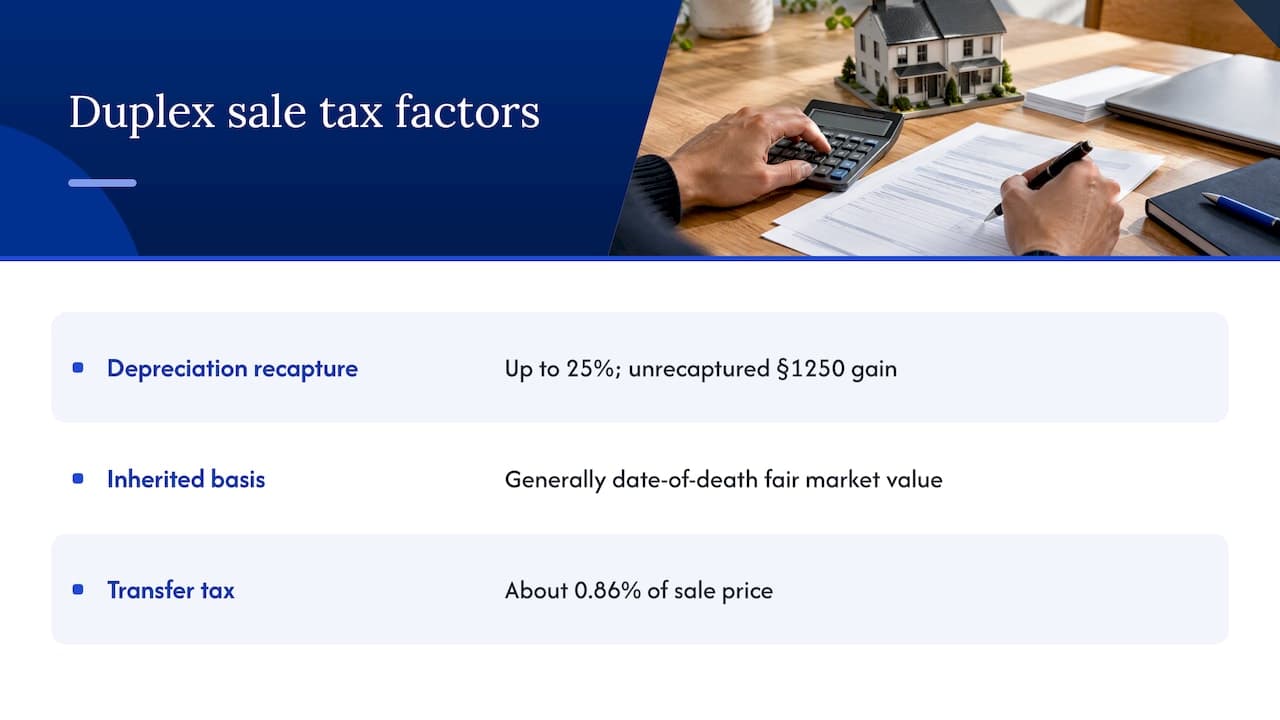
Depreciation recapture. If you rented the duplex and claimed depreciation, or could have, the IRS requires you to reduce your basis by it. The gain from that depreciation can be taxed at up to 25% as unrecaptured Section 1250 gain, as explained in the IRS guidance on property basis. Rules on how a sale is reported are in IRS Publication 544.
Inherited duplexes. For inherited property, your basis is generally the fair market value on the date of the owner’s death, per the same IRS page. That often shrinks the taxable gain, but if the property was a rental, depreciation adjustments can still apply. Get a date-of-death appraisal if you do not have one.
Transfer tax. One calculator summarizing Michigan’s rates puts the combined state and county transfer tax at about 0.86% of the price in a typical county, paid by the seller by default. Some localities differ, so confirm the figure on your closing estimate.
A CPA who handles rental property should run your numbers before you accept any offer. That one hour can matter more than a few thousand dollars of difference between bids.
If the duplex is part of a divorce, ownership and buyout questions come first, and they are legal questions. A Texas family law firm’s explanation of how a house buyout works in divorce is a useful primer on the concepts, but Michigan law governs your case, so talk to a Michigan family law attorney before you list or sign anything.
When you are behind on taxes or the mortgage
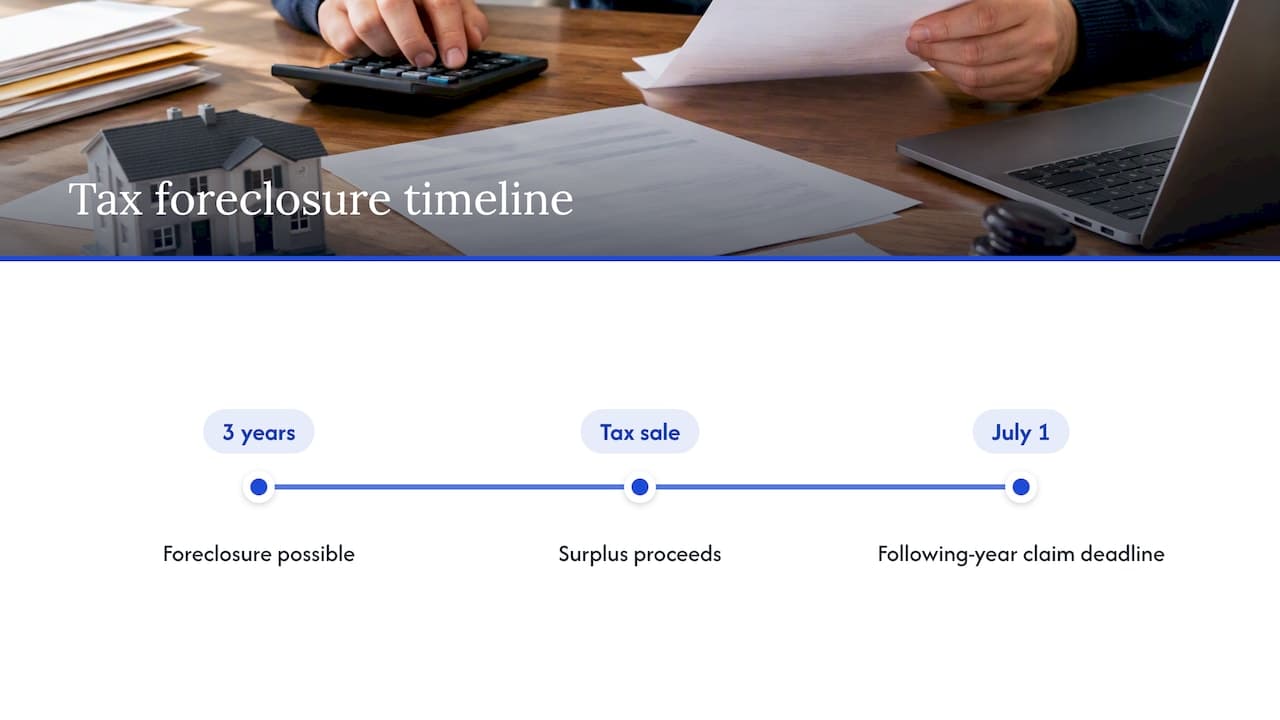
Cash sales are most useful when a deadline is close. In Michigan, delinquent property taxes can lead to foreclosure after three years, and former owners may claim surplus proceeds from a tax-foreclosure sale only by filing Form 5743 by July 1 of the following year, according to the Michigan Department of Treasury. Selling before that point usually leaves you far more than waiting for an auction does, because the sale pays off the liens and you keep the rest.
If the problem is a mortgage, HUD describes loss mitigation options for FHA loans, including a home disposition path when you cannot keep paying. Call your servicer and a HUD-approved housing counselor before you decide. We have Michigan-specific guides on selling a house with back taxes or tax liens, selling before a foreclosure auction and pre-foreclosure sales.
Avoid scams and bad deals
Distressed and vacant duplexes attract bad actors. Three protections cover most of the risk:
- Verify proof of funds. Ask for a bank or lender letter showing the buyer can close in cash, and check that the name on it matches the buyer on the contract.
- Use an independent title company. NAR reports that vacant properties are prime targets for title fraud, and advises never signing with a notary that a stranger arranges for you. Pick your own title company and closing location.
- Beware of rescue pitches. The CFPB has warned that homeowners in distress are targeted with fee-based rescue promises and contract-for-deed arrangements that can strip equity without fixing the debt. Never sign over the deed without being paid at closing.
Have a Michigan real estate attorney read any purchase agreement before you sign, particularly if it includes an assignment clause, a long inspection period, or a deposit you are expected to return.
Our perspective on selling a duplex for cash
We built HouseGoodbye around a simple observation: the biggest risk in a cash sale is having just one buyer. One offer is a take-it-or-leave-it number. When vetted local investors compete for the same property, you see real figures side by side and can choose on price, timing and certainty.
For duplexes, this matters even more, because investors disagree about income properties. One buyer wants stabilized rentals, another wants a fixer. The same building can earn very different bids depending on who is looking at it. We would rather you see that spread than guess at it.
Our advice to owners: know your net number first, decide your real deadline, ask each buyer for proof of funds and a written offer, and do not let urgency push you into the first yes. A good cash buyer will still be there tomorrow.
— Bryan
Get competing offers on your Michigan duplex
HouseGoodbye lets Michigan homeowners receive and compare multiple no-obligation cash offers from vetted local investors. You sell as-is, with no repairs, staging, cleaning or agent commissions, and closings can happen in as little as seven days. You can start on our home page, see how selling as-is works, or read about selling fast. For the mechanics, see how multiple cash offers work.
A step-by-step plan
- Set your deadline and your floor. Know the date you must close and the minimum net you can accept after the mortgage payoff, taxes and any liens.
- Pull your documents. Rent roll, leases, deposits, expenses and the repair history.
- Talk to a CPA. Estimate depreciation recapture and capital gains so you can compare offers on net.
- Request multiple offers. Ask for written bids with the closing timeline, any inspection period and who pays closing costs.
- Verify the buyers. Proof of funds, a track record, and a name that matches the contract.
- Choose your title company. Confirm the payoff figures and how tenant deposits will be credited.
- Close and notify tenants. Give them the new owner’s details and where to send rent.
FAQ
How hard is it to sell a duplex?
It takes longer than a single-family home on the open market, because the buyer pool is smaller and most buyers need financing and an appraisal on rental income. Selling to a cash investor shortens that. The tradeoff is a lower price, so compare offers before you commit.
Do I need to fix up the duplex before a cash sale?
No. Cash buyers purchase as-is, and the repair costs are part of how they set the price. If the building is in fair shape and you are not rushed, price a few modest repairs against the likely gain, as some practitioners recommend for conventional sales.
Can I sell a duplex with tenants still living in it?
Yes. Most investors prefer to keep good tenants and take over the leases. You transfer the security deposits at closing and give tenants written notice of the new owner. Check the details with your title company or a Michigan attorney.
What taxes will I owe when I sell a rental duplex?
Expect capital gains tax on your profit, plus possible tax on depreciation, which can reach 25% as unrecaptured Section 1250 gain. Michigan sellers also usually pay transfer tax at closing. A CPA can give you a net figure based on your records.
Sources
- NAR 2025 Profile of Home Buyers and Sellers
- NAR: Direct Buying
- NAR: concessions and getting to closing
- NAR: Title pirates and vacant properties
- Freddie Mac: Modeling potential rental income
- IRS: Property basis
- IRS Publication 544
- Michigan Treasury: Foreclosure process
- HUD: FHA loss mitigation
- CFPB: Contract for deed report
- Selling a house with renters in Michigan
- Michigan transfer tax summary