Before you list anything or field a single cash offer, you need one thing: legal authority. If the house was in the deceased’s name alone, that means opening probate and getting Letters of Authority from the county probate court. If it passed through a trust, joint tenancy, or a beneficiary deed, you likely skip probate entirely. Either way, confirm your authority first, then choose your sale route.
TL;DR:
- Selling an inherited house in Michigan requires confirming legal authority, either through probate or direct title transfer based on how the property was held.
- Probate sales involve court authorization, documentation, and potential delays, while non-probate transfers like trusts or joint tenancy can simplify the process.
- The sale route impacts timing and price, with listing offering higher prices over months, and cash sales completing in as little as one to three weeks.
- Proper documentation, including death certificates, estate papers, and a title search, is crucial to avoid delays and resolve liens or title issues efficiently.
- Most heirs benefit from securing multiple vetted cash offers before deciding, especially when carrying costs and estate costs make speed more valuable than maximum price.
Table of Contents
- How Do You Confirm You Can Sell Inherited House Michigan Property?
- What Are Your Options for Selling an Inherited Home in Michigan?
- What Documents Do You Need to Sell an Inherited House?
- What Taxes Apply When You Sell an Inherited Property?
- What Problems Commonly Slow Down an Inherited Home Sale?
- How Long Does It Take to Sell an Inherited House in Michigan?
- How Does a Multi-Offer Cash Marketplace Help Michigan Estates?
- A Priority Order Worth Following
- Get Multiple Cash Offers on Your Inherited Michigan House
- Where to Verify These Rules Yourself
- Sources
- FAQ
How Do You Confirm You Can Sell Inherited House Michigan Property?
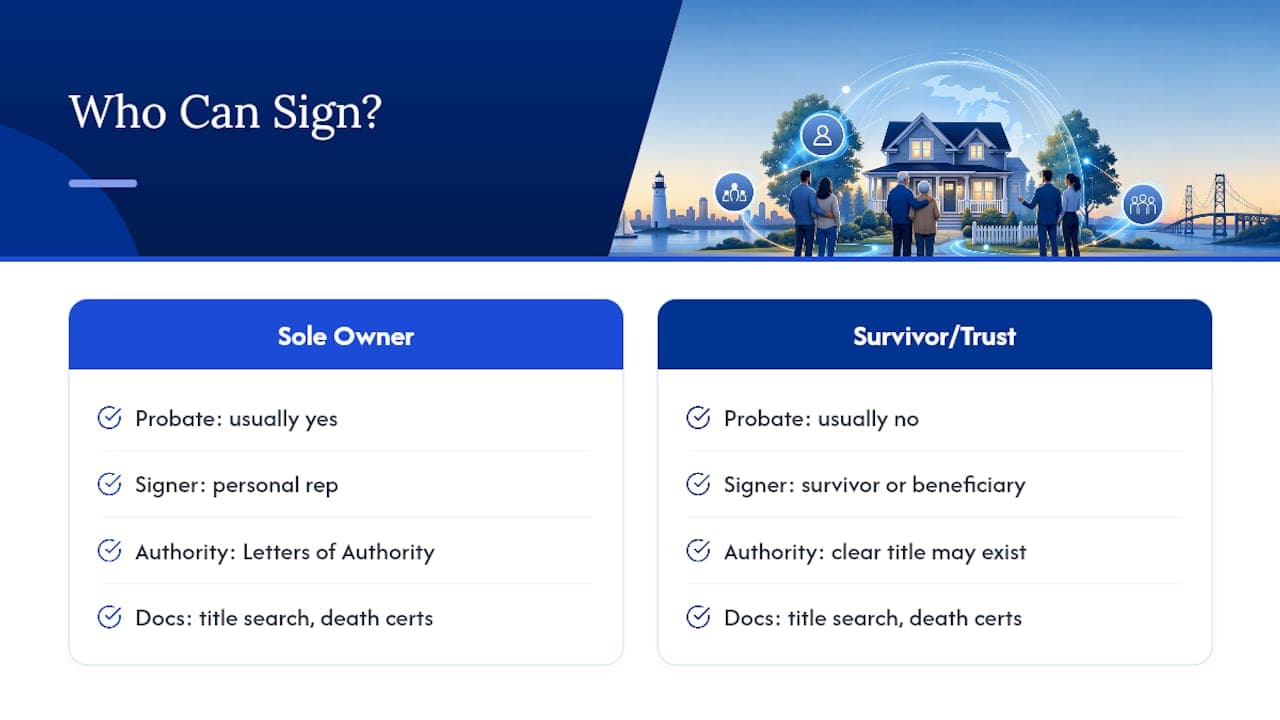
The first real question isn’t “how do I sell inherited property in Michigan,” it’s “who actually has the legal right to sign the deed?” That answer depends entirely on how the house was titled when the owner died.
Start by pulling the deed. If the deceased owned the house solely in their own name, the property almost always has to pass through probate before anyone can sell it. If it was held in joint tenancy with right of survivorship, a living trust, or transferred through a Lady Bird deed (Michigan’s enhanced life estate deed), the surviving owner or beneficiary may already hold clear title with no court involvement required.
For probate property, you’ll petition the county probate court where the deceased lived to open an estate and get appointed personal representative. Once the court issues Letters of Authority, you have the legal power to manage and sell estate real estate. Michigan’s probate code spells out how this works: under MCL 700.3711, a personal representative in most informal, independent administrations can sell estate real property without going back to court for approval on every transaction. Supervised administration, or restrictions written into the will, can change that and require a judge to sign off.
That authority comes with strings attached. MCL 700.3715 and related fiduciary duty rules require a personal representative to act reasonably for the benefit of beneficiaries and creditors, which means keeping a defensible paper trail: an appraisal, a proper inventory, and records showing the sale price was fair. A thin file invites a challenge from an heir later.
Practical checklist before you go further: order a title search, get several certified copies of the death certificate, gather the will or trust document, and read your Letters of Authority closely for any court-imposed limits. If you or a relative wants to buy the house yourselves, know that Michigan law treats that as a presumed conflict of interest, and you’ll generally need court approval or explicit will authorization to keep the sale from being challenged later.
What Are Your Options for Selling an Inherited Home in Michigan?
Once you have legal authority sorted out, you’re choosing among three realistic paths, and each one trades speed for money differently.
Listing on the open market through an agent typically nets the highest sale price, but it comes loaded with estate-specific friction. You’ll need a professional appraisal that lines up with the 91-day inventory the personal representative must file with the court, plus staging, repairs, showings, and standard commission costs of about 5 to 6 percent. For a probate estate paying property taxes, insurance, and utilities on an empty house every month, a four-to-six-month listing timeline adds up fast.
Selling FSBO (for sale by owner) can save the commission, but it shifts all the legal and negotiation risk onto you. Buyers’ agents may hesitate to bring offers on a probate sale handled without professional representation, and any documentation mistake with title or disclosures can delay or unwind the deal.
Selling as-is to a cash buyer or investor trades top-dollar price for speed and simplicity. There are no repairs, no staging, no rounds of showings strangers tramp through a grieving family’s memories over. This is why so many estates lean this direction: carrying costs on a vacant probate property often erase whatever premium a slower listing might have earned.
Whichever route you pick, vet the other side of the table with a few direct questions:
- Can the buyer or their title company show proof of funds or lending approval?
- Has the title company handled sales under Letters of Authority before?
- What closing timeline are they proposing, and is it flexible around court deadlines?
- Are there conditions attached to the offer beyond price?
What Documents Do You Need to Sell an Inherited House?
Title companies and buyers will ask for the same core packet almost every time, so assemble it before you list or negotiate.
You’ll need: the certified death certificate, the will or trust document, your Letters of Authority from probate court, the recorded deed showing chain of title, current mortgage statements, property tax records, and either a formal appraisal or a comparative market analysis.
Title checks matter more here than in a typical sale. Pull a title search early to catch liens, an unpaid reverse mortgage, tax liens, or old judgments against the deceased before they surface at closing and blow up your timeline. Most of these can be resolved by paying them off from sale proceeds at closing, negotiating a payoff with the creditor, or in some cases arranging subordination. Package everything into one clean file for the title company and buyer’s side. A well-organized documents packet is often the single biggest lever you have for cutting days off closing.
What Taxes Apply When You Sell an Inherited Property?
Here’s the good news most heirs don’t expect: you probably owe far less capital gains tax than you’d guess, because of a rule called stepped-up basis.
Under federal law, an inherited property’s cost basis resets to its fair market value as of the date of death, not what the original owner paid decades ago. If the house was worth $220,000 when the owner died and you sell it for $225,000 a few months later, you’re only looking at taxable gain on that $5,000 difference, not on the full appreciation since the original purchase. That’s why getting a solid date-of-death appraisal matters. It’s your evidence for the basis calculation, and it protects you if the IRS ever questions the number.
Note that the primary-residence exclusion that shelters a significant amount of gain for individuals and married couples doesn’t apply the same way to heirs who didn’t live in the house, so don’t assume that break covers you.
Michigan taxes capital gains as ordinary income rather than at a separate capital gains rate, meaning any taxable gain flows into your state income tax return. Michigan also charges a State Real Estate Transfer Tax on the sale itself, which sellers typically pay unless the purchase agreement says otherwise.
Keep every receipt: the estate inventory, the appraisal, closing statements, and any money spent on repairs or improvements before the sale. Those numbers all factor into your final tax picture. Given how estate-specific this gets, loop in a CPA or tax attorney before you file, and the IRS’s own estate guidance is worth a look for anyone dealing with a larger estate.
What Problems Commonly Slow Down an Inherited Home Sale?
The fix is usually procedural, not emotional: get an independent valuation everyone can see, put buyout offers in writing if one heir wants to keep the house, and use mediation before anyone files a court petition over the dispute.
Title surprises show up more often than people expect on estates. Order that title search the moment you’re appointed, not after you’ve accepted an offer, so liens or tax problems don’t torpedo a closing date at the last minute.
Lady Bird deed complications trip up a lot of sellers who assumed avoiding probate meant avoiding paperwork entirely. Even though a Lady Bird deed transfers property outside probate, title companies frequently ask for beneficiary signatures or a corrective deed before insuring the sale, especially when multiple beneficiaries are named or the original deed language is ambiguous.
- Get a written valuation before any buyout conversation starts.
- Order title work in week one, not week six.
- Confirm with the title company early whether a Lady Bird deed needs extra signatures.
- Track every insurance, tax, and utility payment on the vacant property.
Pro Tip: Ask the title company handling your closing to review your Letters of Authority and deed history before you accept any offer. A five-minute phone call now can save you weeks of delay later.
For a house tied up in heir disputes, unclear title, or a complicated deed history, a probate attorney earns their fee. For a straightforward estate sale, a probate-savvy real estate agent or a direct cash buyer may be all you need.
How Long Does It Take to Sell an Inherited House in Michigan?
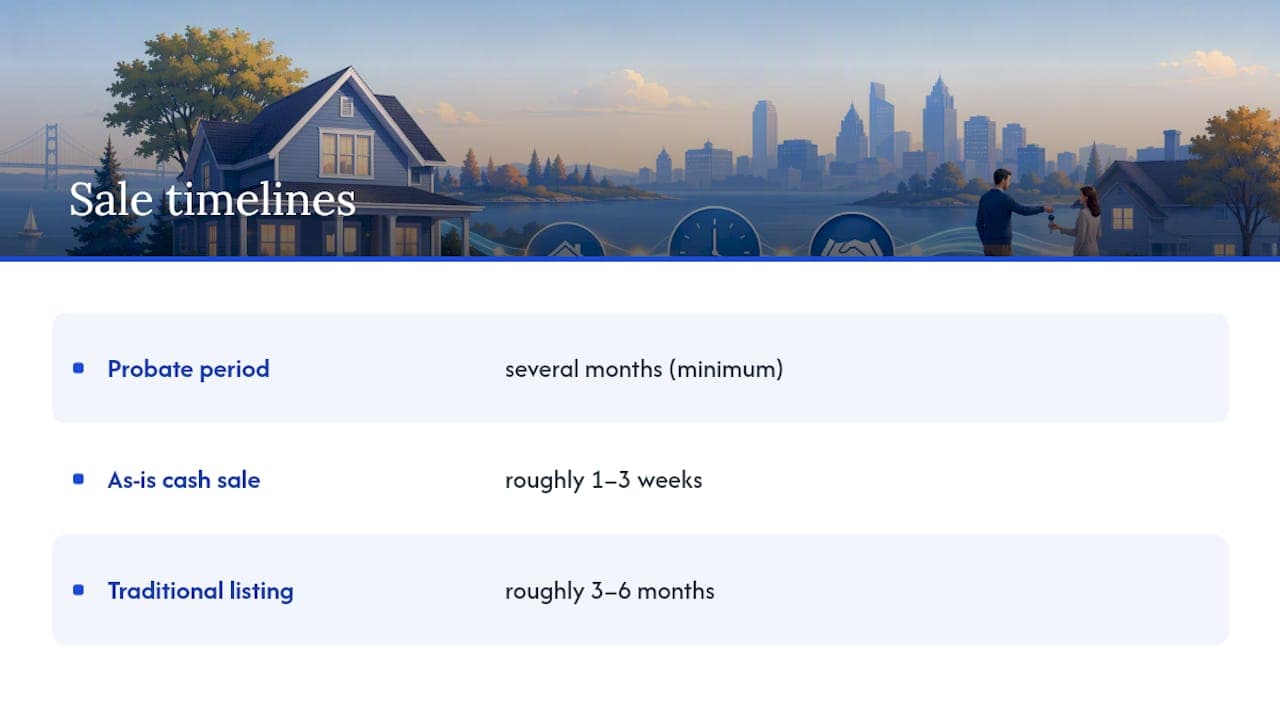
Expect probate itself to run several months at minimum. Independent administration moves faster than supervised administration, but either way, the personal representative must complete an inventory within 91 days of appointment, and multiple heirs, title issues, and court scheduling routinely stretch things further.
Once you have authority to sell, the routes diverge sharply. An as-is cash sale can close in roughly one to three weeks. A traditional market listing, from prep through closing, often takes three to six months once you factor in showings, negotiations, and buyer financing timelines.
Budget for the costs either way: agent commissions in the typical range for a listing, standard closing costs, the State Real Estate Transfer Tax, an appraisal fee, and cleanout or repair costs if the house needs work before it shows well. Running your own carrying-cost estimate against each timeline is the clearest way to decide whether speed or a higher list price actually serves the estate better.
How Does a Multi-Offer Cash Marketplace Help Michigan Estates?
For estates carrying a vacant house, mounting property taxes, and heirs scattered across different states, a platform that surfaces multiple vetted cash offers at once solves a real logistics problem. Some platforms connect Michigan sellers with competing local investors who bid on the property as-is, which means no repairs, no staging, and no agent commissions potentially impacting estate proceeds.
Before accepting any offer through a service like this, a personal representative should still verify the basics: does the investor show proof of funds, is the title company comfortable closing under Letters of Authority, and are the fees and timeline stated plainly upfront rather than buried in fine print. A transparent, multi-offer process gives the PR leverage to compare bids side by side instead of negotiating blind with a single buyer, which matters when the fiduciary duty to beneficiaries requires showing the estate got a fair deal.
A Priority Order Worth Following
If there’s one thing executors get backwards, it’s chasing a fast sale before they’ve locked down legal authority. Confirm you have the right to sell first. Then protect estate value with a clean valuation and documentation trail. After that, control carrying costs, because every extra month of taxes and insurance on an empty house quietly erodes what heirs actually receive. Document every decision along the way. That order rarely fails, even when the family dynamics or the house itself are a mess.
— Bryan
Get Multiple Cash Offers on Your Inherited Michigan House
Housegoodbye works differently from a single buyer showing up with a take-it-or-leave-it number. Once you have your Letters of Authority or trust paperwork in hand, you submit basic details about the property, and vetted local investors compete for it, bidding against each other for the right to buy your inherited house as-is.

That competition is the real advantage over selling to the first investor who calls you: instead of accepting one lowball offer out of desperation, you compare several side by side and pick the terms that fit your estate’s timeline. This route makes the most sense when the estate is carrying real costs while sitting vacant, when heirs live out of state and can’t manage repairs or showings, or when the house needs work nobody wants to fund before selling. Have your Letters of Authority, deed or title information, and a few photos ready, and you can start comparing cash offers on your Michigan property within days, with closings possible in as little as seven days once you accept a bid.
Where to Verify These Rules Yourself
- Michigan Bar — Probate public resources
- IRS — Estate tax guidance
- How to Sell a House in Probate in Michigan
- Selling real estate from a decedent’s estate in Michigan: a PR’s guide
Sources
- Selling real estate from a decedent’s estate in Michigan: a PR’s guide
- Michigan step up in basis
- Does Michigan Tax You When Selling a Home in 2023?
- How to Sell a House in Probate in Michigan
FAQ
How Do You Avoid Capital Gains Tax When Selling an Inherited House?
The stepped-up basis rule already does most of the work: your taxable gain is calculated from the property’s fair market value at the date of death, not the original purchase price, so selling soon after inheriting usually means little to no taxable gain.
How Do You Avoid Capital Gains Tax in Michigan When Selling a House?
You can’t fully avoid it if the sale produces a real gain, since Michigan taxes that gain as ordinary income, but pairing a solid date-of-death appraisal with the federal stepped-up basis often shrinks the taxable amount close to zero.
What Are the Disadvantages of a Lady Bird Deed in Michigan?
A Lady Bird deed skips probate but can create headaches at sale time. Title companies often require beneficiary signatures or a corrective deed before insuring the title, especially with multiple named beneficiaries.
Why Is It So Hard to Sell a House You Inherited?
The difficulty usually isn’t the house itself, it’s the legal layer stacked on top: confirming authority through probate, completing the required 91-day inventory, clearing title issues, and getting multiple heirs to agree on price and timing.
Should You Sell an Inherited House As-Is or List It Traditionally?
It depends on how much the estate is losing to carrying costs each month. A traditional listing often nets more money but takes three to six months, while an as-is cash sale through a platform like Housegoodbye can close in roughly one to three weeks once you accept an offer.