Call your mortgage servicer today, submit one complete loss-mitigation application, and contact a HUD-approved housing counselor — those three moves give you the best realistic shot at stopping or delaying a foreclosure. Under CFPB mortgage servicing rules, a servicer generally cannot move a foreclosure forward while your complete application is under review. That protection is real, but it only kicks in when the application is complete. A stack of partial documents does nothing.
Here is what to do right now, before you read another word:
- Call your mortgage servicer. The number is on your monthly mortgage statement. Ask specifically for the loss-mitigation or homeowner-assistance department, not general customer service.
- Request the loss-mitigation application packet and ask what documents are required to mark it complete.
- Contact a HUD-approved housing counselor at (800) 569-4287. Counseling is free, and a counselor can help you assemble a complete packet and contact the servicer on your behalf.
- Stop sending partial documents. Servicers generally consider only one complete application per delinquency period. Repeated incomplete submissions do not pause foreclosure timelines.
Pro Tip: Ask the servicer’s loss-mitigation specialist to confirm in writing exactly which documents are still missing. One missing page can keep your application “incomplete” and leave you unprotected.
The CFPB’s 120-day rule means servicers generally cannot make the first foreclosure filing until you are more than 120 days delinquent. That window is your negotiating runway. Use it.
Key Takeaways
Submitting one complete loss-mitigation application to your servicer is the single most important step a homeowner can take to trigger federal protections and pause foreclosure proceedings.
| Point | Details |
|---|---|
| Submit a complete application | One complete loss-mitigation packet triggers CFPB dual-tracking protections and pauses most foreclosure actions. |
| The 120-day rule matters | Servicers generally cannot make the first foreclosure filing until you are more than 120 days delinquent — that is your negotiating window. |
| Free help is available | HUD-approved counselors at (800) 569-4287 can assemble your application and contact your servicer at no cost. |
| Alternatives exist if negotiation fails | Short sale, deed-in-lieu, and fast cash sales each carry tradeoffs on price and credit impact — compare net proceeds before deciding. |
| Housegoodbye for urgent situations | Michigan homeowners can receive multiple competing cash offers, sell as-is with no repairs, and close in as little as seven days through Housegoodbye. |
Table of Contents
- Why lenders often prefer to negotiate rather than foreclose
- What to gather before you call your servicer
- Loss-mitigation options you can request from your servicer
- How to negotiate with your servicer, step by step
- What federal protections cover you and when
- When to bring in a HUD-approved counselor or an attorney
- What to do if the servicer won’t cooperate
- How selling fast for cash works and when it makes sense
- Selling fast for cash when time is running out
- Useful resources to consult now
- Sources
- FAQ
Why lenders often prefer to negotiate rather than foreclose
Foreclosure is not a win for your lender. It is slow, expensive, and rarely recovers the full loan balance. Understanding that dynamic is the foundation of every effective foreclosure negotiation strategy.
When a servicer forecloses, it absorbs legal fees, property maintenance costs, insurance, property taxes, and the carrying costs of holding a vacant home until it sells. Then it sells the property as a bank-owned (REO) asset, often at a discount, through an internal review process that Zillow notes tends to move slowly because of layered institutional approvals. The net recovery is almost always lower than what a negotiated repayment plan or short sale would have produced.
Servicers also have a contractual obligation to the investors who own the mortgage-backed securities behind your loan. Those investors expect servicers to demonstrate they pursued every reasonable loss-mitigation option before filing. HUD guidance confirms that servicers and investors frequently prefer repayment plans, forbearances, and short sales over the foreclosure route.
The costs a lender typically absorbs in a foreclosure:
- Attorney and court filing fees
- Property preservation and maintenance
- Homeowner association dues and utility bills on vacant properties
- Real estate agent commissions on the REO sale
- Holding costs during the months between filing and final sale
- Potential price discounts buyers demand for distressed properties
That said, lenders do sometimes push forward with foreclosure. If a property is severely underwater and the investor’s guidelines prohibit modification, or if a borrower has repeatedly defaulted after prior modifications, the servicer may have limited flexibility. Knowing this helps you frame your proposal realistically.
What to gather before you call your servicer
Preparation is what separates a homeowner who gets a modification from one who gets a denial. Fannie Mae advises early contact and using HUD-approved counselors to help assemble loss-mitigation requests — partly because a counselor knows exactly what “complete” means to a given servicer.
Documents to assemble first
- Mortgage statement with your loan/account number and servicer contact information
- Payment history for the past 12 months (request from the servicer if you don’t have it)
- Recent pay stubs or, if self-employed, two years of tax returns and a year-to-date profit-and-loss statement
- Two to three months of bank statements for all accounts
- Monthly expense list covering housing, utilities, food, transportation, medical, and minimum debt payments
- Recent servicer correspondence including any notices of default or intent to foreclose
- Authorization letter if a counselor or attorney will contact the servicer on your behalf
How to find your servicer
Your servicer is the company that sends your monthly statement and collects your payment. It may not be the lender who originally issued the loan. If you are unsure, check your most recent mortgage statement or use the MERS (Mortgage Electronic Registration Systems) lookup tool at mbsonline.org to trace the current servicer. Contact the servicer directly — not the original lender, not a third-party company that cold-called you.
Understanding mortgage default mechanics can also help you frame your situation accurately when you call, particularly if you are self-employed or have irregular income.
Writing an effective hardship letter
The hardship letter is not a plea. It is a factual document that explains what changed, when it changed, and what your current financial picture looks like. Keep it to one page. Cover:
- The specific hardship event (job loss, medical emergency, divorce, income reduction) and the date it occurred
- Your current monthly income and expenses
- What you are asking for (forbearance, modification, repayment plan) and why you can sustain payments under that arrangement
- A brief statement that you want to keep the home and are committed to resolving the delinquency
Common pitfalls: being vague about dates, omitting income figures, or writing emotionally without stating a concrete ask. Servicers route hardship letters to analysts who work from checklists. Give them the facts they need to check the boxes.
Pro Tip: Attach a cover sheet listing every document in your packet and your contact information. A servicer analyst who can quickly confirm the packet is complete is far more likely to mark it as such and trigger the review protections.
Loss-mitigation options you can request from your servicer
Not every option fits every situation. Here is a plain-language breakdown of what each one is, when it makes sense, and what it costs you in the long run.
Repayment plan: You catch up on missed payments by adding a portion of the arrears to your regular monthly payment over a set period, typically three to twelve months. Works best when your hardship was temporary and your income has stabilized.
Forbearance: The servicer temporarily reduces or suspends your payments, usually for three to twelve months. You still owe the missed amounts afterward, either as a lump sum or through a repayment plan. Useful when you need breathing room during a short-term crisis.
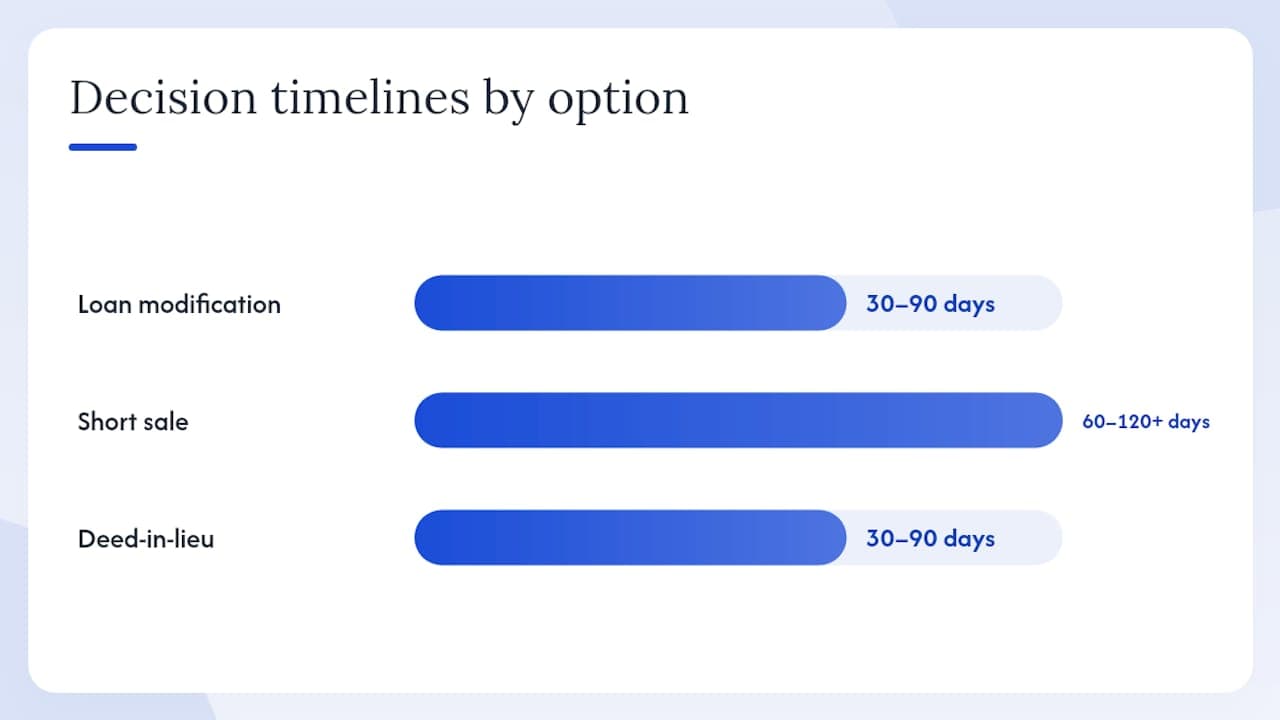
Loan modification: A permanent change to your loan terms — interest rate, loan term, or principal balance — that lowers your monthly payment to an affordable level. This is the most powerful tool for homeowners with a long-term income reduction. It takes the longest to process, often 30–90 days after submitting a complete application.
Loan reinstatement: You pay the full amount of arrears in one lump sum to bring the loan current. Requires access to a significant amount of cash, but it is the fastest way to stop foreclosure if you have it.
Refinance: Replacing your existing loan with a new one at better terms. Only viable if you have enough equity and your credit has not been severely damaged. Explore refinancing options early — once foreclosure proceedings begin, qualifying becomes much harder.
Short sale: You sell the home for less than the outstanding loan balance, and the lender agrees to accept the proceeds as full or partial satisfaction of the debt. Requires lender approval and a complete short-sale package. Typically takes 60–120 days or longer.
Deed-in-lieu of foreclosure: You voluntarily transfer the deed to the lender in exchange for release from the mortgage obligation. Faster than foreclosure, but the lender must agree, and you must have clear title (no junior liens).
Bankruptcy: Chapter 13 bankruptcy allows you to restructure debt and catch up on mortgage arrears through a court-approved repayment plan. It triggers an automatic stay that immediately halts foreclosure. Chapter 7 may delay foreclosure but does not cure the arrears. Consult an attorney before filing.
A quick comparison of the three most commonly requested options:
| Option | Best for | Typical decision timeline | Credit impact |
|---|---|---|---|
| Loan modification | Long-term income reduction | 30–90 days after complete application | Moderate; better than foreclosure |
| Short sale | Homeowner cannot sustain payments, has equity gap | 60–120+ days, lender approval required | Significant; less severe than foreclosure |
| Deed-in-lieu | Clear title, lender willing, no junior liens | 30–90 days | Significant; similar to short sale |
Pro Tip: Once you submit a complete loss-mitigation application, ask the servicer in writing whether it triggers a pause on any pending foreclosure action. Under CFPB dual-tracking rules, it generally should — but get that confirmation documented.
Servicers will generally consider only one complete application per delinquency period. Submitting multiple incomplete packets resets nothing and wastes the time you have.
How to negotiate with your servicer, step by step
The negotiation itself is less dramatic than most homeowners expect. It is a documented, procedural process. Your job is to follow it precisely and keep records of everything.
The step sequence
- Assemble your complete document packet (see the preparation section above).
- Call the servicer’s loss-mitigation line and ask to speak with a loss-mitigation specialist, not a general customer service representative.
- Request the official loss-mitigation application and confirm the exact document checklist.
- Submit the complete application by certified mail or the servicer’s secure online portal — never by fax alone if you can avoid it.
- Follow up in writing within five business days to confirm receipt and ask for a written acknowledgment.
- If you receive no acknowledgment within two weeks, escalate.
Sample phone script for the first call
Once connected: “I want to submit a complete loss-mitigation application. Can you confirm the full list of documents I need to include so the application is marked complete on receipt?”
Escalation when the servicer is unresponsive
- Ask to speak with a supervisor or a dedicated relationship manager.
- Send a written follow-up by certified mail to the servicer’s loss-mitigation address (listed on their website or in your default notice).
- File a complaint with the CFPB complaint portal if the servicer fails to acknowledge receipt or respond within the required timeframes.
- Contact a HUD-approved housing counselor to intervene directly with the servicer on your behalf.
What to record after every contact
- Date and time of the call
- Name and employee ID of the representative
- Summary of what was discussed and any commitments made
- Confirmation or reference number provided
- Next steps the servicer said to expect and by when
Store copies of every document you submit, every letter you receive, and every written confirmation. A paper trail is your protection if the servicer later claims your application was incomplete or never received.
Pro Tip: Ask explicitly: “Will submitting this complete application pause any foreclosure sale that has been scheduled?” Under CFPB restricted dual-tracking rules, the answer should be yes — but you want that confirmed in writing, with a name attached.
What federal protections cover you and when
The timeline matters more than most homeowners realize. Federal rules give you specific windows, and state law can extend or compress them further.
CFPB rules establish two core protections. First, servicers generally cannot initiate the first foreclosure filing until you are more than 120 days delinquent. Second, restricted dual-tracking rules prevent a servicer from moving a foreclosure forward while a complete loss-mitigation application is pending review.
The general timeline looks like this:
| Stage | Approximate timing | What happens |
|---|---|---|
| Missed payment | Day 1 | Late fee assessed; servicer may call |
| 30 days delinquent | ~Day 30 | Servicer required to provide written notice of loss-mitigation options |
| 90 days delinquent | ~Day 90 | Servicer may send a breach/demand letter; loss-mitigation outreach intensifies |
| 120 days delinquent | ~Day 120 | Earliest point servicer can generally make the first foreclosure filing |
| Foreclosure filing to sale | Varies by state | Judicial states: 6–18+ months; non-judicial states: 2–6 months |
State laws vary significantly. This table is a general guide; your actual timeline depends on your state’s foreclosure process and your servicer’s practices.
Once you submit a complete application, the servicer must evaluate it before proceeding with a sale. If a sale is already scheduled and you submit a complete application more than 37 days before the sale date, the servicer must pause the sale while reviewing your application.
After submitting, expect the servicer to send a written acknowledgment within five business days. They then have 30 days to evaluate a complete application and notify you of their decision. If you disagree with the decision, you typically have 14 days to appeal.
What to do immediately after submitting:
- Confirm receipt in writing
- Note the 30-day review clock starting date
- Continue making any payments you can afford (partial payments may be accepted and can demonstrate good faith)
- Check your mail and email daily for servicer correspondence
- Do not ignore any notices, even if you believe the application is being reviewed
When to bring in a HUD-approved counselor or an attorney
Most homeowners wait too long to ask for help. A HUD-approved housing counselor should be your first call, ideally before you even contact the servicer. An attorney comes in when the situation involves legal complexity.
The CFPB confirms that HUD-approved counselors can help prepare loss-mitigation applications and contact servicers directly on your behalf. That assistance meaningfully increases the chance the servicer treats your packet as complete.
To find a counselor: call HUD’s referral line at (800) 569-4287, visit hud.gov, or use the CFPB’s housing counselor search tool at consumerfinance.gov. Expect a counseling appointment to last 60–90 minutes. The counselor will review your finances, explain your options, and help you prepare the application packet.
Situations that require an attorney, not just a counselor:
- You believe the wrong party is foreclosing (servicer cannot prove ownership of the note)
- There are title disputes, junior liens, or complex ownership issues
- You are considering Chapter 13 bankruptcy to stop foreclosure
- You received a foreclosure notice and the timeline is extremely short
- You suspect servicing errors (payments misapplied, escrow miscalculations, illegal fees)
- You want to challenge the foreclosure in court
An attorney who handles foreclosure defense can identify procedural errors that may slow or stop a foreclosure. That is not a guarantee, but in states with judicial foreclosure processes, procedural defenses can buy significant time.
What to do if the servicer won’t cooperate
Not every negotiation succeeds. If the servicer denies your application or refuses to engage, you still have options — but the window to act narrows fast.
Short sale: The lender agrees to accept less than the full payoff. You list and sell the home, and the lender approves the sale price. Requires a complete short-sale package including a payoff letter, proof of buyer funds, and a hardship letter. Lenders typically require full documentation before approving any short-sale offer, and the process can take 60–120 days or more.
Deed-in-lieu: You hand the deed back to the lender voluntarily. Faster than foreclosure, avoids a public sale, but requires clear title. Junior liens (second mortgages, HELOCs, tax liens) must be resolved first, or the lender will typically decline.
Selling as-is for cash: A fast cash sale through a marketplace can close in days rather than months, avoid the credit damage of a completed foreclosure, and eliminate repair and listing costs. This is a legitimate option, not a last resort for the desperate. The tradeoffs of selling as-is are real — you will likely receive less than market value — but compared to a foreclosure on your credit report and a potential deficiency judgment, the math often favors the cash sale.
Bankruptcy: Chapter 13 triggers an automatic stay and halts foreclosure immediately. It requires a court-approved repayment plan and consistent payments over three to five years. It is not a permanent solution on its own, but it can buy time to negotiate or sell.
Credit and deficiency judgment considerations:
- A completed foreclosure typically stays on your credit report for seven years and can drop your score significantly.
- A short sale or deed-in-lieu generally has a less severe impact than foreclosure, though both are negative marks.
- Some states allow lenders to pursue a deficiency judgment for the difference between the loan balance and the sale price. Check your state’s laws or consult an attorney.
Preparing for a fast sale (practical checklist):
- Get a payoff statement from your servicer (valid for 30 days)
- Order a title search to identify any junior liens
- Gather the deed, survey, and any HOA documents
- Confirm the auction date if one has been set — this is your hard deadline
Spotting foreclosure rescue scams
The OCC warns that predatory companies target homeowners in distress with promises of guaranteed loan modifications, upfront fees, and “stop foreclosure” schemes. Red flags:
- Any company that asks for upfront fees before delivering results
- Promises to “guarantee” a modification or stop foreclosure
- Requests to sign over your deed or make payments to someone other than your servicer
- High-pressure tactics urging you to stop communicating with your servicer
Use only HUD-approved counselors and verified servicer channels. Free help is available.
Pro Tip: Before accepting any cash offer, ask for a written net proceeds estimate that accounts for your payoff balance, any liens, and closing costs. Compare that number to what you would net in a short sale or deed-in-lieu before signing anything.
How selling fast for cash works and when it makes sense
A fast cash sale is not a scam. It is a real alternative that works well in specific situations, and understanding how it works helps you evaluate whether it fits yours.
Bankrate notes that selling as-is through a rapid cash process can be a practical alternative to foreclosure for homeowners who need a fast exit, avoiding some foreclosure credit damage and eliminating repair costs. The key is knowing what you are trading: speed and certainty in exchange for a price that is typically below what a fully marketed listing would achieve.
When a cash sale makes sense:
- An auction date is set and you have fewer than 30 days
- You cannot assemble the documents for a short sale in time
- The home needs significant repairs you cannot fund
- You need relocation funds quickly and cannot wait for a traditional sale
- You want to avoid the public record of a foreclosure sale
How a marketplace like Housegoodbye works:
Instead of negotiating with a single buyer, you submit your property details and receive multiple competing cash offers from vetted local investors. No repairs, no staging, no agent commissions. You compare the offers, ask questions, and choose the one that fits your timeline and net proceeds target. Closing can happen quickly. There is no obligation to accept any offer.
The as-is sale process eliminates the friction that makes traditional listings impractical when time is short. You do not need to clean, fix, or show the property. The investor handles that after closing.
A practical scenario: a homeowner with an auction date 21 days out, a roof that needs $18,000 in repairs, and no time to list traditionally. A short sale would take 60–90 days minimum. A cash marketplace offer, accepted within 48 hours, closes before the auction date and produces a net check rather than a foreclosure on the credit report.
Before accepting any offer, verify the buyer’s proof of funds, confirm the closing timeline in writing, and compare the net proceeds to your payoff balance. Use the as-is sale checklist to make sure nothing is missed before signing.
Pro Tip: Ask any cash buyer for a specific closing date in the purchase agreement, not just “as soon as possible.” If your auction date is fixed, the closing date must be before it — get that in writing before you sign.

What Housegoodbye tells homeowners who call in crisis
The most common call goes something like this: the homeowner has missed three or four payments, received a notice of default, and is not sure whether to call the servicer, hire an attorney, or just sell and move on. The honest answer is usually: do all three things in parallel, starting with the servicer call today.
The first question most callers ask is how much time they have. The answer depends on the state and how far along the servicer is in the process. In many cases, there is more time than the homeowner assumes — but that time disappears fast once a sale date is set.
The second question is whether a cash offer will cover the mortgage balance. Sometimes it does, sometimes it does not. That is why getting a payoff statement from the servicer is step one before evaluating any offer. Housegoodbye’s process — multiple competing bids from vetted investors, no repairs required, closing in as little as seven days — gives homeowners a real number to compare against their payoff balance and against what a short sale or modification might produce. No one should accept an offer without running that comparison.
The third thing callers want to know is whether selling fast will hurt their credit less than a foreclosure. Generally, yes. A voluntary sale, even at a discount, typically carries less long-term credit damage than a completed foreclosure. But that is a conversation worth having with a HUD-approved counselor who can look at the full picture.
Selling fast for cash when time is running out
When negotiation stalls and the auction date is close, a fast cash sale through Housegoodbye is a concrete, no-obligation way to get real numbers in front of you quickly.

Housegoodbye connects Michigan homeowners with multiple vetted cash investors who compete for your property. You receive real offers on a home sold as-is — no repairs, no agent commissions, no listing delays. Closing can happen in as little as seven days, which matters when a foreclosure sale is scheduled and every day counts.
To get started, visit the sell your house as-is page and submit your property details. You will receive competing offers you can compare at no cost and with no obligation. For a full walkthrough of what to expect, the how selling for cash works page covers the process, timelines, and what sellers typically net after payoff.
One honest note: a cash sale will usually produce a lower sale price than a fully marketed listing. The tradeoff is speed, certainty, and avoiding the credit and legal consequences of a completed foreclosure. Compare your net proceeds to your payoff balance and to what a short sale or deed-in-lieu would produce before you decide. A HUD-approved counselor can help you run those numbers for free.
Useful resources to consult now
These are the authoritative sources and hotlines to bookmark before your next call:
- HUD housing counseling hotline: (800) 569-4287 — connects you with a HUD-approved counselor who can help with paperwork and servicer contact at no cost.
- CFPB mortgage help center: consumerfinance.gov/housing — explains servicer rules and your rights, and hosts the complaint portal if your servicer is unresponsive.
- Fannie Mae homeowner resources: Yourhome — guidance on loss-mitigation options and how to work with your servicer if Fannie Mae owns your loan.
- OCC foreclosure prevention resources: Occ — federal guidance on avoiding scams and finding verified help.
- CFPB complaint portal: consumerfinance.gov/complaint — file a complaint if your servicer violates dual-tracking rules or fails to respond to a complete application.
Print or bookmark these pages now. If an auction date has been set, call the HUD counseling line before that date — not after.
This article is general information, not a substitute for advice from a qualified financial advisor. Consult a qualified financial professional about your own circumstances before acting on anything here.
Sources
- Hud
- How to work with your servicer | Consumer Financial Protection Bureau
- CFPB rules establish strong protections for homeowners facing foreclosure | Consumer Financial Protection Bureau
- How To Buy A Foreclosed Home: Tips, Tricks, and Financing | Bankrate
- How to avoid foreclosure | Fannie Mae
- Foreclosure prevention | Office of the Comptroller of the Currency (OCC)
- Buying a bank-owned property | Zillow
FAQ
What is the 120-day foreclosure rule?
Under CFPB mortgage servicing rules, servicers generally cannot make the first foreclosure filing until a borrower is more than 120 days delinquent, giving homeowners a window to pursue loss-mitigation options before legal proceedings begin.
Is it easier to negotiate on a foreclosed home?
Negotiating before foreclosure is completed is generally more effective than after — once a property becomes bank-owned (REO), the lender’s internal review process slows decisions and reduces flexibility, as Zillow notes for REO transactions. Act during the pre-foreclosure period when servicers still have loss-mitigation authority.
How much lower can you offer on a foreclosure or short sale?
There is no fixed discount, and any figure you see online is a generalization. Short-sale prices depend on the lender’s minimum acceptable net, the property’s condition, and local market values. Your best move is to get a payoff statement and compare any offer against that number, not against a generic percentage.
How do you fight foreclosure and win?
Submit a complete loss-mitigation application immediately to trigger CFPB dual-tracking protections, contact a HUD-approved counselor at (800) 569-4287, and consult a foreclosure defense attorney if you suspect servicing errors or procedural violations. Winning usually means stopping the sale through a modification, reinstatement, or voluntary sale — not a courtroom victory.
How do you avoid foreclosure scams when seeking help?
Use only HUD-approved counselors and verified servicer channels; avoid any company that charges upfront fees, guarantees a modification, or asks you to sign over your deed or redirect payments away from your servicer.