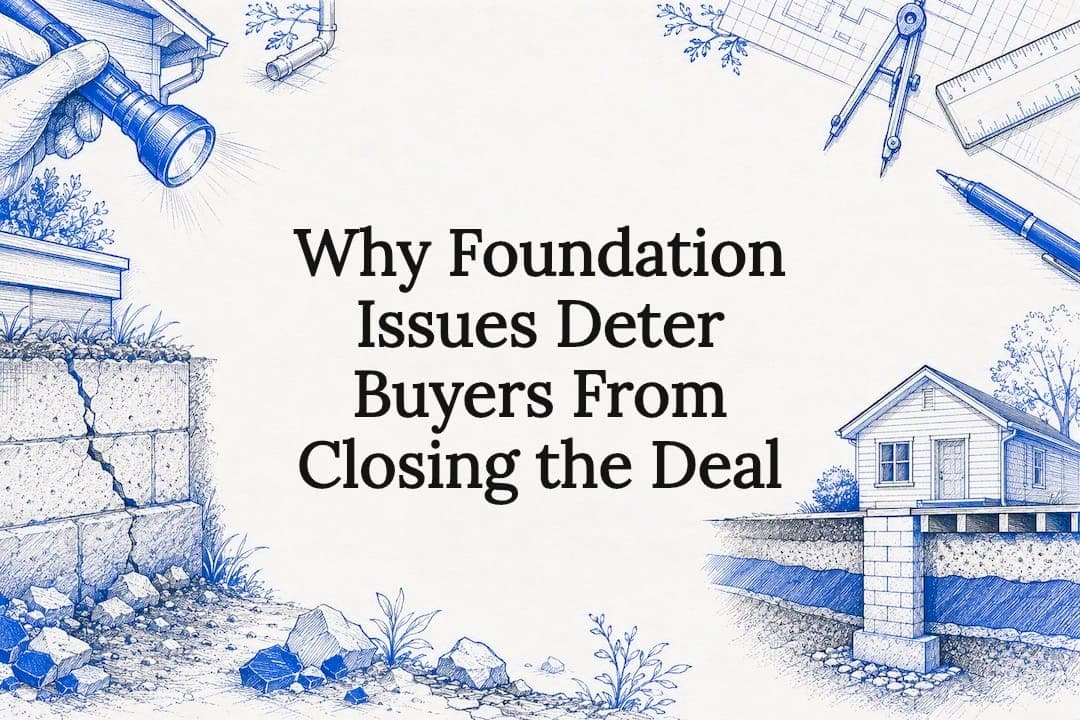
Foundation issues deter buyers because they threaten three things at once: the cost to fix them is hard to pin down, mortgage financing can stall or fall apart, and resale value takes a hit even after repairs. That combination scares off traditional buyers faster than almost any other defect a home inspection turns up.
Here’s what actually happens once a buyer spots foundation trouble:
- The buyer pool shrinks. Conventional buyers relying on FHA, VA, or USDA financing often can’t close until repairs are certified, leaving mostly cash buyers and investors willing to make an offer.
- Loan approval stalls or dies. Appraisers flag structural deficiencies, and lenders frequently condition or deny financing until a licensed professional signs off on the fix.
- Offers drop, sometimes by a lot. Buyers who do stick around usually demand a discount that’s larger than the actual repair cost, because they’re pricing in uncertainty, not just the fix.
Pro Tip: If you’re a seller, get a licensed structural engineer’s report and two to three contractor bids before you list. If you’re a buyer, never waive your inspection contingency on a house with visible cracking or sloping floors, no matter how good the price looks.
Key Takeaways
Foundation issues deter buyers because they combine unpredictable repair costs with real financing risk, and both factors compound to shrink offers and buyer pools alike.
| Point | Details |
|---|---|
| Cost uncertainty drives discounts | Buyers price in worst-case repair scenarios, often discounting more than the actual fix costs. |
| Financing can stall or fail | FHA, VA, and USDA loans may require engineer certification before lenders will close. |
| Documentation changes buyer psychology | Permitted repairs with warranties turn an open risk into a closed, acceptable issue. |
| Decision math beats guesswork | Compare repair bids plus a buffer against the discount needed before you negotiate or walk. |
| Cash sale bypasses financing risk | Housegoodbye lets Michigan sellers get competing as-is cash offers without repairs or appraisal contingencies. |
This article is general information, not a substitute for advice from a qualified financial advisor. Consult a qualified financial professional about your own circumstances before acting on anything here.
Table of Contents
- Why Foundation Issues Deter Buyers More Than Other Defects
- Red Flags to Spot on a Showing
- How Foundation Problems Change Buyer Behavior and Financing
- Typical Repairs, Realistic Costs, and Timelines
- How to Decide: Walk Away, Negotiate, or Buy As-Is
- Inspection and Documentation Checklist Before You Commit
- Selling As-Is or for Cash When Repairs Aren’t an Option
- Sources
- FAQ
Why Foundation Issues Deter Buyers More Than Other Defects
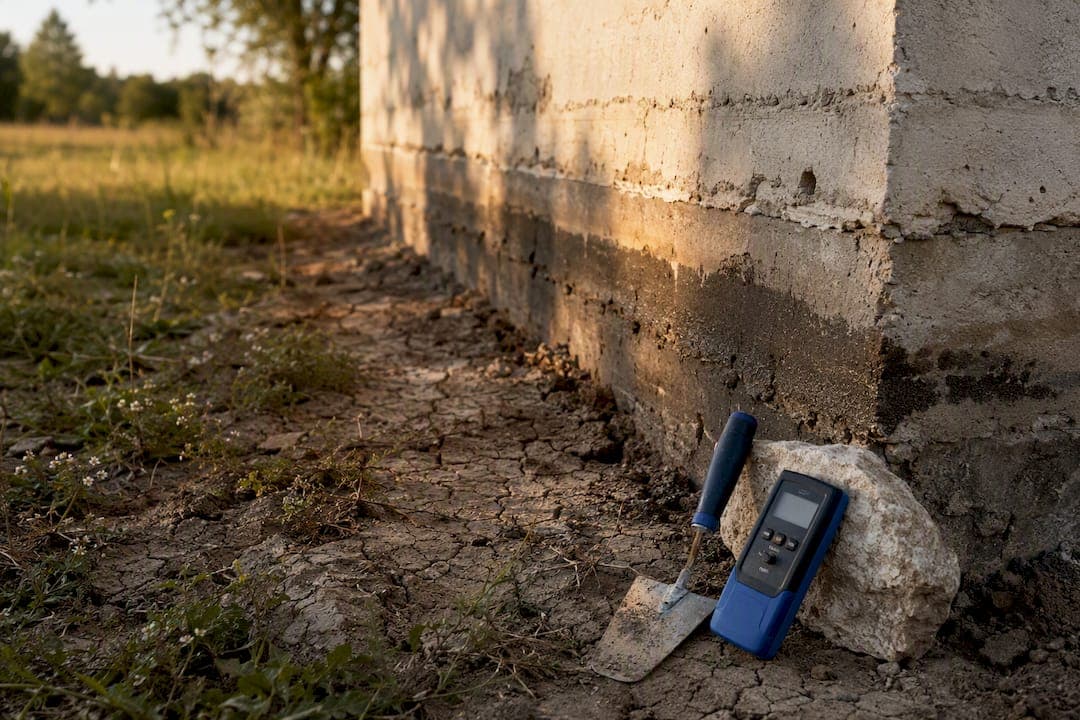
A foundation isn’t just concrete in the ground. It’s the system that keeps the entire structure level, dry, and load-bearing, and buyers instinctively understand that a failure here isn’t like a leaky faucet. Four foundation types show up most often in resale homes, and each carries different risk.
Slab-on-grade foundations are a single concrete pour directly on the ground, common in warmer climates and simpler to build, but cracks here often mean the slab itself has shifted. Basement foundations give homes the most usable space but also the most exposure to water intrusion and wall pressure from soil. Crawlspace foundations sit a few feet off the ground on footings, which makes them cheaper to inspect but vulnerable to moisture and pier settlement. Pier-and-beam systems rest on individual posts, which makes leveling repairs more targeted but can mean more posts need attention over time.
Soil matters as much as the foundation type. Expansive clay swells and contracts with moisture, pushing on foundation walls, while poor grading sends rainwater straight toward the house instead of away from it. Homes on basements or slabs in expansive-clay regions typically face the priciest repairs and usually require a geotechnical or structural engineer’s input before anyone can put a real number on the fix.
Red Flags to Spot on a Showing
Not every crack is a dealbreaker, but some signs mean you should stop, ask questions, and possibly call in a specialist before you write an offer.
- Horizontal cracks in foundation walls. These are almost always structural, caused by soil or water pressure pushing the wall inward. Get an engineer’s opinion before proceeding.
- Stair-step cracks in brick or block. These follow the mortar joints in a zigzag pattern and usually signal uneven settling. Ask for seller disclosures and consider a foundation-specific inspection.
- Doors and windows that stick or won’t latch. This can be cosmetic (humidity, old hinges) or structural (frame racking from a shifting foundation). Test several doors on different sides of the house; if more than one sticks, dig deeper.
- Sloping or uneven floors. A marble or ball placed on the floor that rolls noticeably points to settlement. This is one of the clearest signs an engineer report is worth the money.
- Bowing or bulging basement walls. This is a structural emergency in most cases, often requiring wall anchors or carbon-fiber reinforcement before a lender will touch the loan.
- Standing water or dampness in the crawlspace or basement. Under NSPIRE standards, water infiltration is treated as a failing condition, not a minor note. It also opens the door to mold and pest issues, which compound buyer hesitation.
- Exposed rebar or spalling concrete. Chipped, flaking concrete that reveals the steel reinforcement inside is a red flag federal inspection standards specifically call out as a deficiency requiring correction.
Beyond the visible list, pay attention to secondary clues: a musty smell in the basement, damp drywall near the foundation line, or gutters that dump water right next to the house instead of away from it. None of these alone confirms a structural problem, but stacked together they’re reason enough to request a licensed inspection before you go further, and a floor condition assessment can add useful context if flooring shows related settlement wear.
How Foundation Problems Change Buyer Behavior and Financing
The moment a buyer sees a foundation red flag, a predictable chain reaction starts. First comes fear of the unknown: is this a $2,000 crack seal or a $30,000 underpinning job? Since most buyers can’t answer that on their own, they either walk away entirely or drop their offer far enough to cover the worst-case scenario, plus a cushion for surprises. Industry data backs this up: unrepaired foundation problems typically shave 10% to 15% off a home’s market value, and in more severe cases the hit can run as high as 25%.
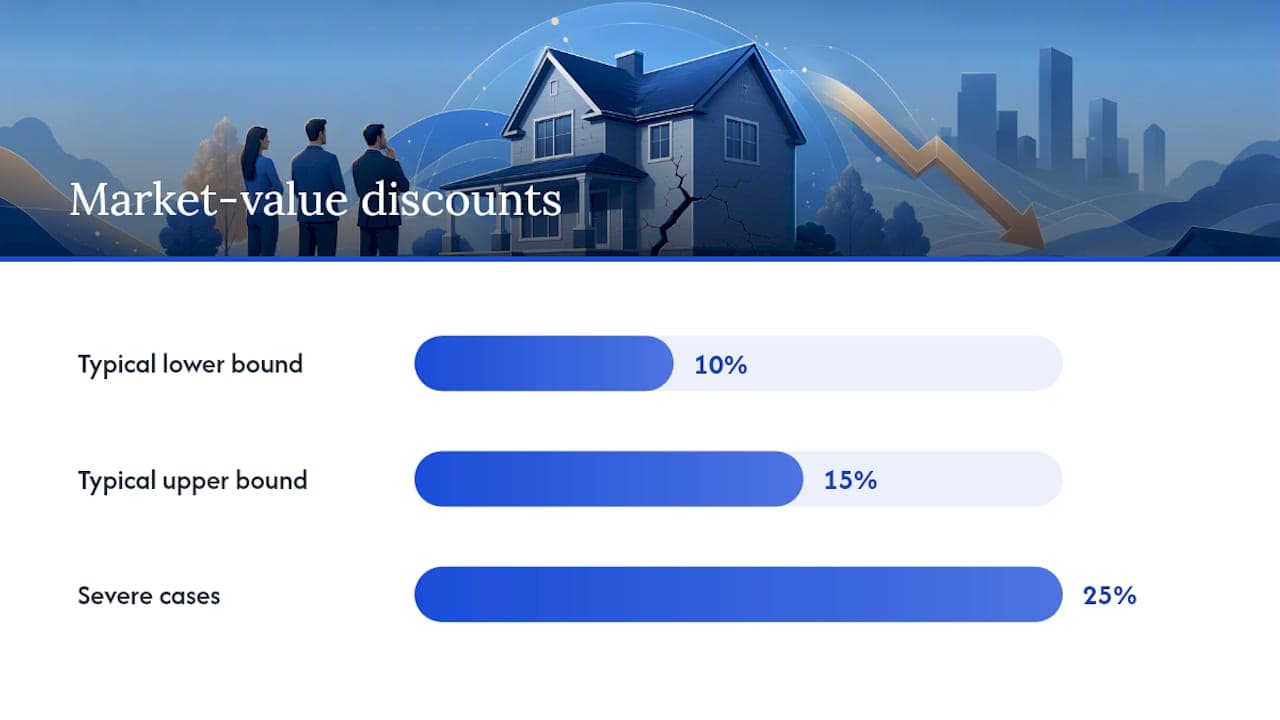
That’s a meaningful gap, and it explains why sellers with visible foundation issues often end up fielding offers almost exclusively from investors and cash buyers rather than owner-occupants.
Appraisals make the problem concrete. HUD guidance directs appraisers to flag foundation deficiencies under site acceptability criteria, and if the issue threatens structural soundness, the appraisal gets prepared “as-repaired,” meaning the lender won’t fund the loan until the work is done and verified. USDA underwriting works similarly: if an appraiser notes dampness or a foundation-related deficiency, the loan can be conditioned on certification from a qualified engineer or architect. FHA loans follow a comparable pattern, since the FHA’s underwriting standards require the property to meet minimum safety and soundness thresholds before closing.
Here’s how a typical visible sign maps to a real-world consequence:
- Water stains in the basement → appraiser flags the property → lender requires a moisture or drainage inspection before clearing the loan.
- Visible wall cracking → appraiser marks it under structural deficiency → FHA, VA, or USDA underwriting halts until an engineer certifies the repair.
- Sloping floors during a walkthrough → buyer’s inspector notes settlement → buyer either requests a price cut equal to the estimated repair cost or exits the contract during the inspection contingency period.
Pro Tip: Sellers can often prevent a financing collapse by getting engineer certification and repair documentation before listing, rather than waiting for a buyer’s lender to demand it mid-contract. It turns a scary unknown into a fixed, provable number, which is usually cheaper than losing a buyer three weeks before closing.
Typical Repairs, Realistic Costs, and Timelines
Repair scope varies enormously depending on cause and severity, but most foundation work falls into a handful of categories buyers and sellers should recognize by name.
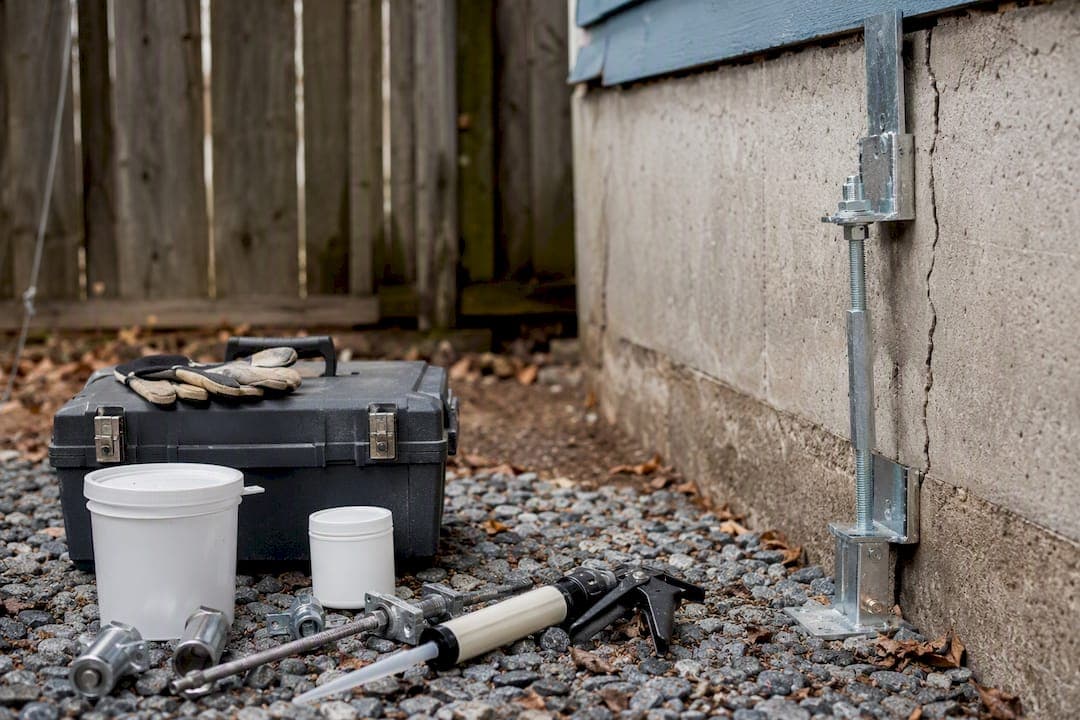
Crack sealing addresses minor, non-structural cracks with epoxy or polyurethane injection, usually the cheapest and fastest fix. Underpinning or piering involves installing steel or concrete piers beneath the foundation to stop or reverse settlement, typically the most expensive category. Wall anchors counteract bowing basement walls by tying them back to stable soil outside the home. Drainage and grading correction redirects water away from the foundation, often paired with waterproofing membranes or interior drainage systems. Beam or post replacement addresses failing support structures in pier-and-beam or crawlspace homes.
Cost bands vary widely by region and severity, but general patterns hold:
- Minor repairs (crack sealing, small drainage fixes): typically a few hundred to a couple of thousand dollars, completed in a day or two.
- Moderate repairs (wall anchors, partial underpinning, waterproofing systems): often several thousand to over $10,000, with work spanning one to three weeks.
- Major repairs (full underpinning, extensive piering, structural rebuild): can run well into five figures, sometimes taking several weeks to a few months when engineering review and permitting are involved.
Permits and engineer oversight aren’t bureaucratic hoops. A documented, permitted repair with a transferable warranty changes how buyers perceive the whole situation. It converts a scary open question into a closed, provable event, and buyers typically accept that with a much smaller discount than an unpermitted DIY patch job. Unpermitted repairs, by contrast, tend to reduce buyer confidence and invite renegotiation even when the work itself looks fine.
How to Decide: Walk Away, Negotiate, or Buy As-Is
Uncertainty is what makes foundation issues so paralyzing. A structured process turns that uncertainty into a number you can actually work with.
- Get a licensed inspection and engineer report. This establishes whether the issue is cosmetic or structural.
- Collect two to three contractor bids. Bids should include scope of work, materials, and permit requirements.
- Estimate the worst-case cost, then add a buffer. Foundation jobs routinely uncover added scope once work begins.
- Check your financing limits. FHA, VA, and USDA loans have specific structural soundness thresholds that can block your loan entirely.
- Compare repair cost to the discount you’d need. If the seller’s asking price minus the repair estimate still beats comparable homes, it may be worth pursuing.
- Factor in time and disruption. Major underpinning can take months and may not be compatible with your move-in timeline.
- Make the call: walk away, negotiate, or proceed as-is.
Say a home is listed at $310,000 and contractor bids for full underpinning come in at $35,000, plus a $5,000 buffer for surprises. That’s $40,000 in repair exposure. If comparable, foundation-free homes in the area sell for $330,000 or more, there’s still room to negotiate a fair deal. If comparables sit closer to $300,000, you’re now overpaying even after repairs.
| Negotiation Path | Best Fit When |
|---|---|
| Seller completes repairs before closing | Seller has time, cash, and wants to reach conventional buyers |
| Price reduction equal to repair estimate | Buyer wants control over which contractor does the work |
| Escrow holdback for repairs | Repairs can’t be finished before closing but funds are set aside |
| Seller credit at closing | Buyer prefers cash flexibility over a specific contractor |
| Sell to a cash, as-is buyer | Seller can’t fund repairs or needs a fast, guaranteed close |
For a deeper look at how these negotiations actually play out at the table, inspection-driven negotiations tend to follow patterns that repeat across markets.
Inspection and Documentation Checklist Before You Commit
Paperwork is what separates a buyer’s guess from a buyer’s decision. Before waiving any contingency, gather these documents:
- Licensed home inspector’s report, covering visible signs like cracking, moisture, and door/window fit.
- Licensed structural engineer’s letter, specifically addressing whether the foundation issue is active or stabilized.
- Contractor bids that itemize scope, materials, and required permits, not just a lump-sum number.
- Permit history and warranty paperwork for any prior foundation work on the property.
- Drainage and grading photos, ideally taken during or after rainfall.
- Soil or subsurface water test, if the engineer recommends one based on site conditions.
When you request the engineer’s letter, ask for specific, measurable language, such as “foundation movement has stabilized, verified by [monitoring method], with no further settlement expected under normal conditions.” Vague language like “appears stable” rarely satisfies underwriters.
Pro Tip: Order the engineer review before you waive your inspection or financing contingency, not after. Once those contingencies are gone, you’ve lost your legal leverage to renegotiate or exit if the report comes back worse than expected.
Selling As-Is or for Cash When Repairs Aren’t an Option
Not every seller can afford $30,000 in underpinning, and not every seller has months to spare for permits and contractor schedules. Three realistic paths exist: repair and list on the open market, list as-is and accept a smaller buyer pool, or sell directly to investors through a competitive cash marketplace.
Selling as-is tends to make the most sense when the cost to repair outweighs the value you’d recover, when you’re facing an urgent relocation or financial deadline, or when you simply don’t want to manage contractors and permits. Selling to an investor as-is sidesteps the appraisal and financing conditions that stall conventional sales entirely, since cash buyers aren’t relying on FHA, VA, or USDA underwriting rules.
Housegoodbye connects Michigan sellers with multiple competing cash offers from vetted local investors, with closings possible in as little as seven days and no repairs, staging, or agent commissions required.
Pro Tip: Before accepting any cash offer, verify proof of funds, get the closing timeline in writing, and confirm there are no hidden fees buried in the contract.
What Buyers and Sellers Commonly Miss
Buyers routinely underestimate secondary damage: a foundation crack that’s let moisture in for years often means mold or plumbing issues nobody’s mentioned yet. Sellers, meanwhile, often assume an unpermitted DIY patch will pass unnoticed, when in fact it usually raises more red flags than the original crack. One recurring pattern: a homeowner patches a bowing wall themselves, skips the permit, and years later a buyer’s inspector catches it, forcing a far more expensive redo and a lower final price than a permitted repair would have brought.
A Fast Alternative for Sellers Who Can’t or Won’t Fund Repairs
If the numbers on repair bids and buyer discounts don’t work in your favor, there’s a faster path than waiting on the traditional market to find a buyer willing to take on the risk. Housegoodbye puts your home in front of multiple vetted local investors who compete for it, which tends to push offers higher than a single lowball bid, and you skip repairs, staging, and agent commissions entirely.

Closings can happen in as little as seven days once you accept an offer, which matters if you’re facing a financial deadline or relocation you can’t push back. Before signing anything, confirm proof of funds and get the closing terms in writing. If you’re ready to see what your home could bring, get your cash offer comparison started and compare bids without any obligation to accept.
Sources
- USDA appraisal and underwriting guidance (exhibit)
- How foundation problems affect home value (FoundationCosts guide)
- Foundation repair and home value (AAA Foundation Service)
FAQ
Is It Bad to Buy a House With Foundation Issues?
It depends on severity and documentation. A minor, professionally repaired issue with permits and a warranty carries far less risk than an active, undiagnosed problem, so get an engineer’s opinion before deciding.
Is It Hard to Sell a House With Foundation Issues?
Yes, it typically shrinks your buyer pool to cash buyers and investors, since conventional financing often requires repairs to be certified first. Selling as-is to a cash marketplace like Housegoodbye is one way to avoid that bottleneck.
Will Foundation Issues Affect the Appraisal?
Almost certainly. Appraisers are required to flag foundation deficiencies, and if the issue threatens structural soundness, the appraisal is often prepared “as-repaired,” which conditions the loan on completed fixes.
What State Has the Worst Foundation Issues?
Foundation risk correlates more with soil type and climate than any single state, with expansive clay soils and high water tables (common across parts of Texas, and clay-heavy regions of the Midwest and South) driving the most frequent and costly problems.