Yes, you can sell a house with termite damage in Michigan. You have three realistic routes: treat and repair before listing, list it and negotiate with buyers, or sell as-is to a cash buyer. Which one fits depends on whether the termites are still active, how much wood is damaged, and how much time and cash you have. Whatever you choose, you have to disclose what you know.
TL;DR
- Termite damage is a condition you can sell around. It limits who can buy and how, but it does not make a house unsellable.
- Michigan sellers must disclose known infestation history in good faith. Hiding it creates more risk than any price cut.
- Mortgage buyers often can’t close on a house with active termites until it is treated. Cash buyers don’t face that lender hurdle.
- Treatment stops the insects but does not replace chewed wood, so treated is not the same as structurally sound.
- With HouseGoodbye, several vetted Michigan cash buyers bid on your house as-is, and you can compare offers and walk away if none work.
Table of Contents
- Can you sell a house with termite damage?
- What Michigan law says you must disclose
- How termites affect buyers, lenders and your timeline
- Should you get a termite inspection before you sell?
- What treatment and repairs involve
- Your three ways to sell
- When selling as-is for cash makes sense
- Our perspective
- Get competing offers on your termite-damaged house
- A practical order of operations
- FAQ
- Sources
Can you sell a house with termite damage?
You can. Selling with a termite history is possible, and most states require sellers to disclose known termite damage and infestations on a disclosure statement. What changes is the path to the closing table.
Three things decide how hard the sale will be:
- Active or past. A documented, treated infestation from years ago worries buyers far less than live termites today.
- Structural or cosmetic. Damage to a baseboard or deck is a different conversation than damage to floor joists, sill plates or support beams.
- Buyer type. A buyer using a mortgage brings an appraiser and lender requirements. A cash buyer brings their own contractors and their own risk tolerance.
A sale with termite history is also shaped by the contract, the lender and any safety or repair issues. As one Florida pest control company points out, an as-is sale does not erase disclosure duties or guarantee that a lender will accept the property. That holds in Michigan too.
What Michigan law says you must disclose
Michigan’s Seller Disclosure Act, MCL 565.951 and following, puts a legal duty on sellers to disclose known conditions affecting the property in good faith, according to a 2021 Michigan Court of Appeals opinion.
The statutory form is specific about pests. It asks whether you know of a property infestation history, including termites and carpenter ants. It also requires you to update the disclosures if structural or mechanical conditions change before closing. So if you find new damage after the buyer signs, you can’t stay quiet.
Two points from Michigan case law are worth knowing:
- Sellers are generally not liable for errors in a disclosure about things they had no personal knowledge of and would not have discovered with ordinary care, provided they acted in good faith. Honest ignorance is treated differently from concealment.
- In one older case, buyers could not show reasonable reliance on a seller’s statements because their own independent inspections gave them the means to find the alleged defects. That is not a license to hide anything. It shows why a clear paper trail on both sides matters.
If you have seen termites, paid for treatment, or had a contractor point out damaged wood, you know. Write it down. Failing to disclose known termite issues can lead to fraud claims, reversed sales or other costly consequences, and real estate professionals commonly advise over-disclosing rather than under-disclosing. For a plain-English walkthrough of the Michigan form, see our guide to Michigan seller disclosure rules.
If you’re unsure what your specific situation requires, for example when you inherited the house and never lived in it, ask a Michigan real estate attorney before you sign anything.
How termites affect buyers, lenders and your timeline
Termite damage hits a traditional sale in three places: the buyer’s inspection, the lender’s rules and the negotiation.
The inspection
A buyer’s home inspector or a pest specialist who finds active insects or damage can set off a chain of requests. Rocket Mortgage notes that evidence of active pests or damage can reasonably lead a buyer to ask for a specialist pest inspection, treatment, structural repairs or a credit. When the damage is extensive and the contract has an inspection contingency, the buyer may be able to cancel.
That last point is the one sellers fear most. A deal can fall apart late, after you have already packed, scheduled movers or lined up your next place. Severe infestations or structural problems found during inspection can stop a closing, and a buyer may back out because of the scale of repairs.
The lender
Financing is where termite problems become mechanical rather than emotional. Government-backed loans have written rules:
- FHA. HUD’s pest-control reference says a wood-destroying insect inspection is required if there is evidence of active infestation, if state or local law requires it, if it is customary in the area, or at the lender’s discretion. Where a clear report is required, the inspected improvements must be free of active infestation.
- VA. The VA publishes local requirements by state. Wood-destroying-insect information is required throughout many listed states, while in states not listed it is generally unnecessary unless the appraisal identifies specific issues. When a report is required, identified minimum-property-requirement repairs must be completed before the guaranty, and veterans are encouraged to negotiate inspection and repair costs with sellers.
The practical result: if your buyer uses an FHA or VA loan and the house has active termites or damage that affects the property, you may have to treat and repair before the loan can fund. Conventional lenders have their own standards and can be just as firm. Check the current rules for the specific loan type with the buyer’s lender.
The negotiation
Even when a buyer can finance the house, termite findings give them leverage. Damage may prompt price discounts or negotiations, while treatment and repair documentation can reassure buyers. Seller credits are common: buyers may ask for credits or price reductions to handle remediation after closing, if the mortgage type permits it. Those adjustments are negotiable rather than automatic, which is why early inspection helps: you see the problem before the buyer does.
Should you get a termite inspection before you sell?
If you suspect termites, or you’ve seen mud tubes, hollow-sounding wood, discarded wings or sagging floors, an inspection by a licensed professional gives you facts instead of guesses. You then know whether you’re dealing with a small treated issue or a structural one, and you can choose your route with real numbers.
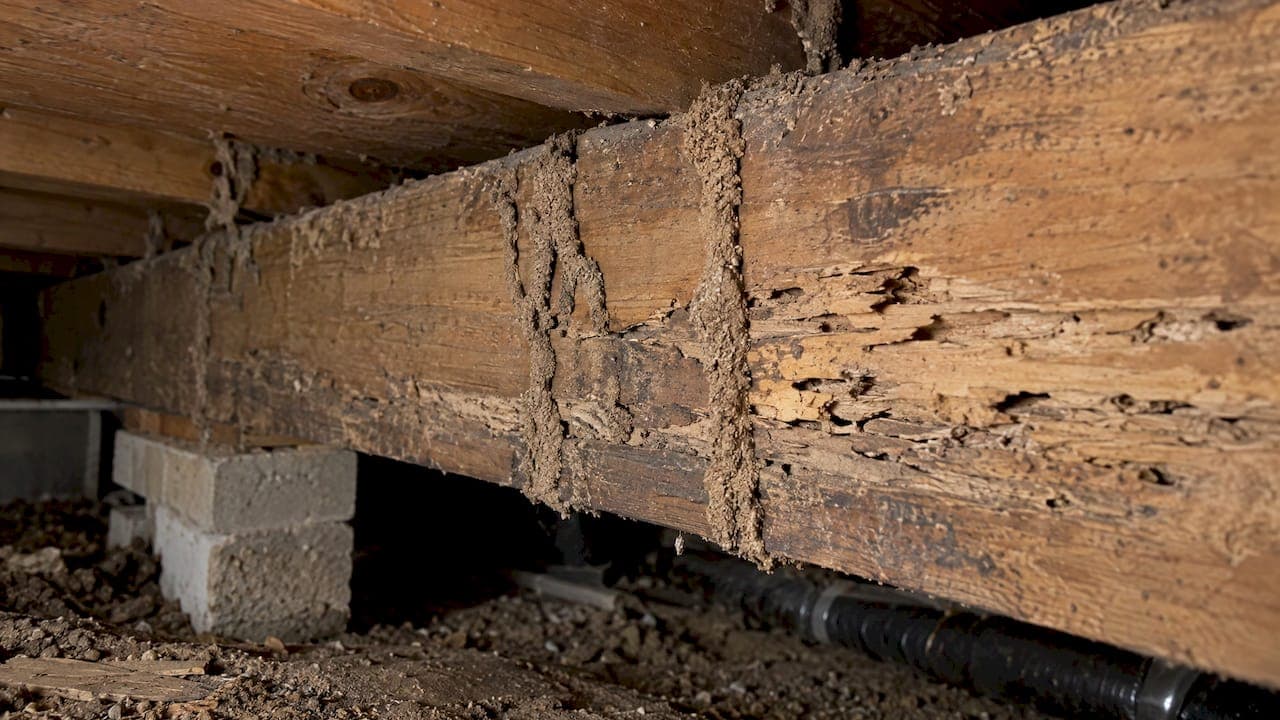
The standard document is the NPMA-33 Wood Destroying Insect Inspection Report, which HUD hosts. It documents visual evidence of wood-destroying insects and visible damage for mortgage or property-transfer use. It records what the inspector could see. It is not a guarantee that nothing is hidden behind drywall or under flooring, so read it as a snapshot.
A report with a treatment record can help in two situations: when you list on the open market and want to head off buyer fear, and when you sell to a cash buyer who wants to understand what they’re taking on. If you don’t want to pay for an inspection first, a cash buyer will assess the house themselves, which is one reason as-is sales move faster.
What treatment and repairs involve
Treatment and repair are two separate jobs, and sellers often blur them.
- Treatment deals with the insects. In the United States, firms offering termite services must be licensed by the state, and the EPA stresses that proper, licensed treatment matters for the safety of the people living in the home as well as for the structure.
- Repair replaces or reinforces what the termites damaged. Treatment controls pests but does not replace damaged wood, so you shouldn’t describe a treated house as structurally sound just because treatment happened. Get a separate repair assessment.
Pricing varies widely with the severity, the foundation type and how far the damage has spread. We won’t quote a single number, because any figure that fits every house would be wrong for yours. The EPA’s advice is the useful part: get multiple estimates and verify the company’s state license, and be wary of high-pressure sales tactics. It also notes that guarantee periods for termite control work typically run from one to five years, depending on the service contract, so ask what a warranty covers and whether it transfers to the next owner.
Damage from termites often travels with other moisture-related problems. If you find rot, softened framing or standing water issues, read about selling a water-damaged house in Michigan and what foundation issues do to buyer interest. Mold alongside termites is also common enough that our page on selling a house with mold in Michigan may apply.
Your three ways to sell
| Route | Best when | What to expect | Main risk |
|---|---|---|---|
| Treat, repair, then list | Damage is minor, you have time and cash, and you can live with showings | Widest buyer pool, documentation to show | Repair costs and delays can grow once walls are opened |
| List as-is or with a credit | Damage is moderate and you can tolerate negotiation | Buyers inspect and then ask for price cuts or credits | Deals can fall apart at inspection or at the lender |
| Sell as-is to a cash buyer | Damage is significant, the house is vacant or inherited, or you need certainty and speed | Offers that already price in the work, no repairs, no showings | Offers reflect the repair burden, so compare several |
We’ve written more about why repairs cost sellers more than they expect, the repairs that kill home deals and the mistakes people make fixing a home before selling. The pattern is consistent: a partial or rushed repair can cost money without raising the offer by as much, and buyers often discount for what they can’t verify.
Sellers can choose a traditional sale after repairs, or sell as-is to cash buyers, often at a lower price point that accounts for the remediation. That tradeoff is real, and it’s the reason to compare. How much condition affects an offer is covered in how property condition affects your home sale offer.
When selling as-is for cash makes sense
Selling as-is is usually the stronger fit when one or more of these is true:
- The damage is structural, or you don’t yet know how far it goes.
- You inherited the house and live elsewhere. Our pages on selling an inherited house and selling through probate cover that case.
- The house is vacant. Empty houses are where termite and moisture problems often go unnoticed for longer.
- You are behind on the mortgage and the clock matters. See selling before foreclosure auction.
- You don’t want to manage contractors, showings or an inspection that could end the deal.
Cash buyers typically don’t depend on a mortgage appraisal, so the lender requirements described above don’t apply to them in the same way. They also price in their own repair costs. That’s why one offer alone tells you little. Another buyer may have a crew on hand, a different renovation plan or a lower margin, and bid more for the same house.
Our perspective
Most termite stories we hear start the same way. An owner finds damage, gets a quote for repairs, realizes the quote is only a first step, and then sits on the house for months while the worry grows.
We think the real cost of a termite-damaged house is often the uncertainty, not just the wood. A traditional sale asks you to fix the problem, stage the house, host showings and hope the buyer’s inspector and lender agree with your contractor. For many Michigan owners, especially heirs and people with vacant houses, that’s a lot of risk for a house they’d rather not hold.
That’s why we built HouseGoodbye as a marketplace instead of a single buyer. When one investor makes one offer, you have to take it on trust. When several vetted local cash buyers bid on the same house, the seller sees every number and decides. If none work, you walk away with no obligation.
We buy as-is, so no repairs, no showings and no commissions. Closing can happen in about a week when the seller is ready, compared with the roughly 73 days we see for a typical MLS sale. For a house with termite damage, that speed means fewer months of carrying costs and fewer chances for the damage to grow.
Be honest about the condition up front, include any inspection or treatment records you have, and let buyers compete for the house. That is the most reliable way we know to turn a termite problem into a clean exit.
Bryan
Get competing offers on your termite-damaged house
If you’d rather not treat, rebuild and wait, enter your address on HouseGoodbye. Vetted Michigan cash buyers bid on your house in its current condition, with no listing fees, agent commissions or required repairs. You see every offer, compare them and decide.

Start on our page for cash home buyers in Michigan, or see how competing cash offers work before you share anything.
A practical order of operations
- Confirm what you have. Hire a state-licensed pest professional to inspect, and get the written report. The EPA recommends comparing estimates, so ask more than one firm if you plan to treat.
- Gather paperwork. Collect past treatment records, warranties, receipts and earlier inspection reports. They support your disclosure and help buyers price risk.
- Complete your disclosure honestly. Answer the infestation question based on what you actually know, and update it if something changes before closing.
- Decide how much work you want to do. Compare the cost and time of repairs against an as-is offer, not against a perfect-condition sale price you won’t get.
- Compare more than one offer. Whether you list or sell for cash, a single number gives you nothing to measure against.
- Get legal advice for complex situations. For probate, divorce or a house in foreclosure, a Michigan attorney can tell you who has authority to sign and what must be disclosed.
FAQ
How much does termite damage reduce a house’s value?
There’s no fixed percentage. The effect depends on whether the infestation is active, how much structural wood is affected and who the buyer is. Documented treatment and repairs can reassure buyers, while severe damage can lead them to cut their offer or walk away. Competing as-is offers show you what buyers in your area will actually pay.
Do I have to tell buyers about termites if they were treated years ago?
If you know about the infestation history, yes. Michigan’s statutory disclosure form asks about a property’s infestation history, including termites and carpenter ants. Include the treatment dates, the company and any warranty paperwork, because documentation of past treatment is generally less alarming to buyers than an unexplained history.
Can a buyer with an FHA or VA loan buy a house with termites?
Sometimes, but it depends on the findings. FHA rules require a wood-destroying insect inspection when there’s evidence of active infestation, and clear-report situations require no active infestation. VA requirements vary by state and by what the appraisal finds. Ask the buyer’s lender what applies, since active infestations may need treatment before funding.
Is it better to fix termite damage first or sell as-is?
Fix first if the damage is minor, you have time and you want the widest buyer pool. Sell as-is if the damage is significant, unknown or you want certainty and speed. Treatment alone doesn’t repair damaged wood, so a fix that stops at treatment may still leave buyers discounting.
Will a cash buyer pay anything for a house with termite damage?
Yes. Cash buyers regularly buy houses with pest, water, fire and structural problems, because they plan for the repairs. The offer will reflect the work needed, so compare several bids. On HouseGoodbye, multiple vetted buyers bid on your address and you can decline them all.
Sources
- Selling a Home With Termite Damage, On Demand Pest Control
- Selling a House With Termite History, Redfin
- Michigan Court of Appeals, Jadan v Neville (2021)
- Michigan Court of Appeals, Cervone v Western Real Estate (2021)
- Michigan Court of Appeals, Timmons v Devoll (2004)
- MCL 565.957, Michigan Legislature
- Reasonable requests after home inspection, Rocket Mortgage
- Closing Issues and Risks, CRES Insurance
- HUD Archives: Pest Control reference guide
- Local Requirements, VA Home Loans
- Veterans Benefits Administration Circular 26-22-11
- Termite Inspections for Home Buyers, AmeriSave
- NPMA-33 Wood Destroying Insect Inspection Report, HUD
- Termites: How to Identify and Control Them, U.S. EPA
- Tips for Selecting a Pest Control Service, U.S. EPA