Repairs usually cost sellers more than they return. Market leverage, contractor premiums, holding costs, and the gap between negotiated credits and real invoices all push final losses past the sticker price of any single repair. If you’re weighing whether to fix up your home before listing, the math rarely works out the way sellers hope.
The core cost drivers are:
- Market leverage: In a buyer’s market, repairs rarely close the price gap buyers demand. In a seller’s market, buyers often overlook condition entirely.
- Contractor premiums: Small, rushed, or one-off jobs carry mobilization fees and overhead markups that inflate quotes fast.
- Holding costs: Every week spent waiting on contractors adds mortgage, taxes, insurance, and utilities to your tab.
- Over-improvement risk: Upgrades that exceed neighborhood price ceilings return cents on the dollar, per the 2026 Cost vs Value Report.
- Credit vs. holdback risk: When sellers concede a repair credit, they often pay an inflated buyer-estimated figure rather than the competitive price a seller-controlled process could have delivered, according to Fix It Homestead.
Housegoodbye’s as-is cash offer process exists precisely because these forces compound. Understanding them is step one.
Table of Contents
- Why repairs cost sellers more: the main cost drivers
- How market conditions change whether repairs are worth it
- Why small, rushed repairs end up costing you more per dollar
- What repairs actually add value before a sale
- Realistic cost ranges and what sellers typically recover
- What are your alternatives to paying for repairs?
- How Housegoodbye’s as-is cash offer process works
- How to decide: a quick checklist before committing to repairs
- Key Takeaways
- The case for skipping repairs is stronger than most agents admit
- Skip the repairs and get competing cash offers
- Sources and further reading
- FAQ
Why repairs cost sellers more: the main cost drivers
Market leverage and contractor inflation
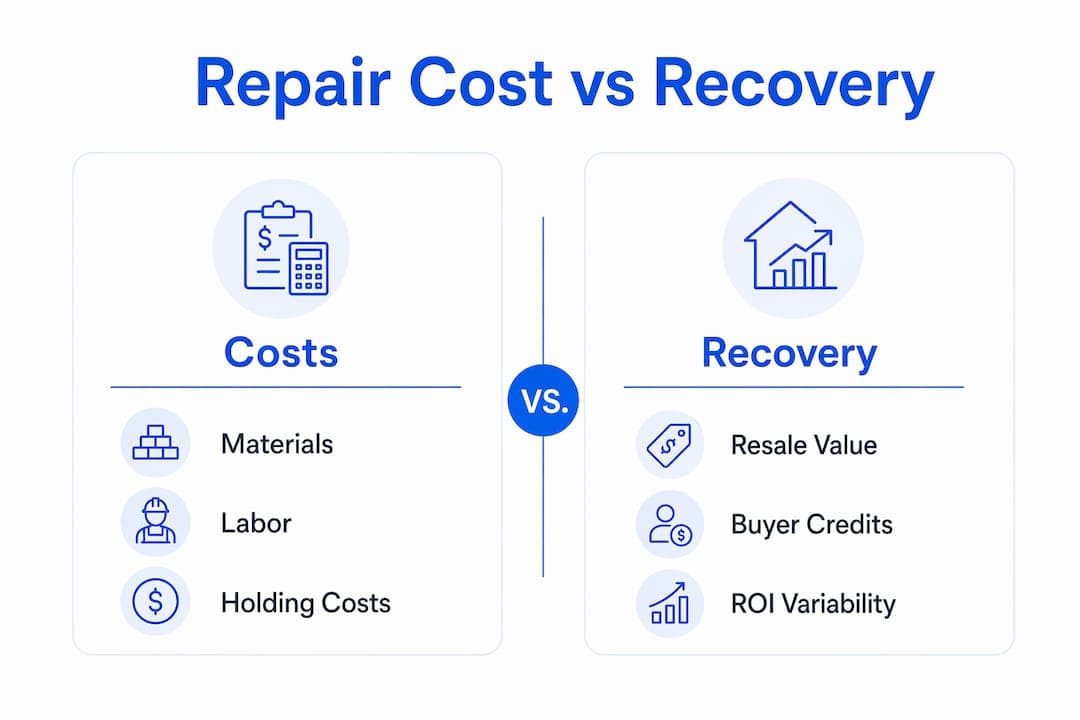
Repair costs impact sellers differently depending on who holds negotiating power. In a seller’s market, buyers compete and often overlook minor condition issues. In a buyer’s market, a seller who spends $15,000 on repairs may still face buyers who demand a credit on top of it, or who simply offer less because they’ve already priced in the work.

Materials and labor inflation has pushed renovation budgets roughly 10–15% higher compared with pre-pandemic averages. That gap shows up directly in contractor quotes, and it means credits negotiated months ago no longer cover the actual invoices buyers receive.
Holding costs eat the margin
Delaying your listing by four to eight weeks for repairs isn’t free. Mortgage interest, property taxes, homeowner’s insurance, and utilities accumulate daily. A $10,000 repair job that takes six weeks to complete can easily cost an additional $3,000–$5,000 in carrying costs alone, depending on your loan balance and local tax rate.
The credit vs. holdback trap
Sellers often prefer credits because they receive full proceeds at closing. But escrow holdbacks are typically sized at 125–150% of the estimated repair cost, and credits should be sized to the high-end contractor estimate multiplied by 1.10, as industry guidance recommends. Either way, the seller absorbs an inflated number. Lender and settlement rules can also constrain how buyers apply credits post-close, reducing their practical value while the seller still pays the full amount.
Pro Tip: Before agreeing to any repair credit, get two written bids first. The bids anchor the negotiation to real numbers rather than buyer-estimated figures, which almost always run higher.
- Deep cleaning, decluttering, and staging consistently outperform major repairs on cost-effectiveness.
- Curb appeal improvements (fresh paint, landscaping, garage door) return more per dollar than interior remodels.
- Avoid any upgrade that exceeds your neighborhood’s price ceiling — you won’t recover it.
How market conditions change whether repairs are worth it
Repairs help more in a seller’s market and hurt more in a buyer’s market. That’s the short version, and it holds up across most local markets.
In a hot seller’s market, buyers compete on price and timeline. A home with deferred maintenance still attracts multiple offers, and buyers mentally absorb condition issues because inventory is tight. Spending $20,000 on a kitchen refresh in that environment often adds less to your final sale price than the cost itself.
Flip the market. In a buyer’s market, stalled listings force sellers into credits or price reductions regardless of what they’ve already spent on repairs. A buyer who sees a home that needed work, got partially fixed, and still has issues will negotiate harder, not less.
The 2026 Cost vs Value Report consistently shows exterior and curb-appeal projects at the top of ROI rankings. A garage door replacement can recoup well above its cost in perceived value because buyers form first impressions at the curb. Large interior remodels, by contrast, often return a smaller percentage of their cost, and that percentage drops further if the home sits on the market longer than 12 months post-renovation.
Pro Tip: Check your local days-on-market average, the listing-to-sale price ratio, and recent comps before committing to any repair spend. If homes in your zip code are selling within two weeks at or above asking, you’re likely in a market where condition matters less than you think.
Why small, rushed repairs end up costing you more per dollar
Small or last-minute jobs often carry premiums because contractors price for overhead, travel, minimums, and scheduling risk. A contractor who runs a crew of four isn’t going to rearrange a full week of work for a $400 drywall patch without charging for the disruption.
Common pricing factors that inflate small-job costs:
- Per-job minimums: Many contractors set a floor of $500–$800 regardless of actual labor time.
- Expedited fees: Rush scheduling, especially within two weeks of a listing date, can add 20–40% to a base quote.
- Subcontractor gaps: Specialty work (electrical, plumbing) often requires a separate sub, adding a second mobilization cost.
- Materials markups: Contractors typically mark up materials 15–30% above retail.
A repair quoted at $500 can realistically land at $1,200 once minimums, parts markups, and a rush fee are included. Sellers under time pressure have little leverage to push back.
Practical consequences for sellers:
- Timelines slip when contractors reschedule or work runs long
- Incomplete work can trigger buyer re-inspection demands
- Competitive bids are hard to get when your listing date is two weeks out
- Inflated invoices reduce net proceeds even when the repair “succeeds”
What repairs actually add value before a sale
Prioritize low-cost, high-ROI items and skip large discretionary remodels. That’s the consistent finding across renovation ROI data.
High-ROI repairs worth doing:
- Garage door replacement (strong recoup percentage, low cost relative to perceived value)
- Steel entry door replacement
- Manufactured stone veneer on the exterior
- Interior paint, whole house
- Hardwood floor refinishing (not replacement)
Low-ROI repairs to skip before listing:
- Major kitchen remodel above $50,000 (returns roughly 48% of cost per NAR data)
- Inground pool installation (25% recoup nationally, negative in cold-climate states)
- Upscale master suite addition (27% recoup)
- High-end smart home packages
- New flooring when existing floors are functional
Defensive repairs you should never skip: Roof leaks, failing HVAC, hazardous wiring, and active water intrusion. These kill deals outright or trigger lender-required repairs that delay closing anyway. Fixing them upfront is cheaper than losing a buyer at inspection.
Pro Tip: If a buyer flags a major system issue during inspection, get your own written bid before agreeing to a credit. Accepting a buyer’s repair estimate without a competing bid almost always means paying more than the actual repair cost.
Realistic cost ranges and what sellers typically recover
Repair costs for sellers vary widely, but the gap between what sellers spend and what they recover is the real story.
| Repair | Typical Cost Range | Typical Resale Payoff |
|---|---|---|
| Roof patch (minor) | $500 | Prevents deal loss; limited price gain |
| Full roof replacement | — | About 50% recoup |
| Water heater replacement | $1,200 | Often nearly full recoup; often lender-required |
| Fogged window replacement | — | Modest; prevents buyer objections |
| Bathroom refresh (cosmetic) | $3,000 | Moderate; market-dependent |
| Major kitchen remodel | $50,000 | ~48% recoup |
Materials and labor inflation has pushed renovation budgets roughly 10–15% higher compared with pre-pandemic averages, which directly widens the gap between what sellers spend and what credits actually cover.
When a home needs $40,000 or more in repairs, buyers often pull that money from their down payment. That shift raises their loan-to-value ratio, increases monthly payments by $700–$1,000, and can eliminate otherwise qualified offers entirely. Sellers who skip repairs don’t just face lower offers; they face a smaller pool of buyers who can actually close. Buyers who need renovation financing may be an option, but that adds complexity and time to the transaction.
What are your alternatives to paying for repairs?
Four practical paths exist, each with real trade-offs:
- Self-manage repairs: Full control over contractor selection and cost, but requires time, cash upfront, and project management.
- Contractor-managed pre-sale fixes: Faster execution, but you pay a premium for coordination and often lose competitive bidding.
- Offer a buyer credit or price reduction: Clean at closing, but credits are sized to inflated buyer estimates and shift execution risk to the buyer (who may come back with complaints).
- Sell as-is to a cash buyer: No repairs, no contractor management, no holding costs. Trade-off is a potentially lower nominal sale price, though net proceeds often compare favorably once repair and carrying costs are subtracted.
| Path | Time to Close | Out-of-Pocket Spend | Seller Cost Control | Net Proceed Impact |
|---|---|---|---|---|
| Self-manage repairs | 6–12 weeks | High | High | Variable |
| Contractor-managed | 4 weeks | High | Medium | Variable |
| Buyer credit / price cut | Standard (30–60 days) | Medium (at closing) | Low | Often negative |
| As-is cash sale | 7–30 days | None | Full | Often competitive net |
A seller with a $15,000 roof issue, a six-week contractor timeline, and a $3,500/month carrying cost can easily spend $24,000+ to “fix” a $15,000 problem. An as-is cash offer that comes in $12,000 lower than list price nets more in that scenario. The as-is sale pros and cons depend heavily on your specific numbers, not on a general rule.
How Housegoodbye’s as-is cash offer process works
When time, certainty, and avoiding contractor premiums matter, Housegoodbye’s multiple-cash-offer process can produce cleaner net proceeds than paying for repairs.
How it works:
- Submit your property details to Housegoodbye
- Housegoodbye sources competing cash offers from multiple investors
- You review offers with no obligation to accept
- Choose your offer and close, with closing in as little as seven days where applicable
Honest trade-offs:
- Faster close, no contractor management, no holding costs, no agent fees
- Nominal sale price may be lower than a fully repaired retail listing
- Net proceeds often compare favorably once repair costs, contractor premiums, and carrying costs are subtracted from the retail scenario
Housegoodbye’s bidding process means multiple investors compete for your property, which pushes offers higher than a single-buyer negotiation. For sellers dealing with inherited properties, financial pressure, or major system failures, that competition matters. Learn more about how property condition affects offers and what to expect from the process.
Pro Tip: Request your as-is cash offers before committing to any repair spend. The offer gives you a real baseline to compare against the net-proceeds math on repairs, not a hypothetical.
How to decide: a quick checklist before committing to repairs
If projected net proceeds after repair costs, holding costs, and contractor premiums are lower than a fast-cash as-is offer, skip the repairs. Run this checklist first:
- Get two written bids on every repair over $1,000. One quote is not a market price.
- Calculate carrying costs for the expected delay. Multiply your monthly PITI (principal, interest, taxes, insurance) plus utilities by the number of weeks you’ll wait.
- Request as-is cash offers from Housegoodbye before you start any work. Compare net proceeds, not gross sale price.
- Check local market strength. Pull days-on-market and listing-to-sale price ratios for your zip code in the last 60 days.
- Assess buyer financing risk. If your home needs $40,000+ in work, consider how that affects buyer down payment and loan approval.
- Identify red flags for selling as-is: tight timeline, major system failures (roof, HVAC, foundation), inability to get competitive bids, or a buyer’s market with falling comps.
Questions to ask your contractor: What is your start date? Do you warranty the work? Is your quote fixed-price or time-and-materials? Questions to ask your agent: How will this repair affect days on market? What do comps show for repaired vs. unrepaired homes in this price range?
Key Takeaways
Repairs cost sellers more than expected because contractor premiums, holding costs, and inflated credits compound beyond the sticker price of any single fix. Sellers who compare real as-is offers against net-proceed math on repairs consistently find the gap is smaller than assumed.
| Point | Details |
|---|---|
| Curb appeal beats interior remodels | Exterior projects return more per dollar; major kitchen and suite remodels often recoup less than half their cost. |
| Holding costs add up fast | Six weeks of carrying costs can add $3,000–$5,000 to the true cost of a repair project. |
| Credits favor buyers, not sellers | Repair credits are often sized to high-end buyer estimates; sellers pay more than a competitive bid would have cost. |
| Renovation budgets are higher now | Materials and labor inflation has pushed costs 10–15% above pre-pandemic averages, widening the credit gap. |
| Housegoodbye offers a direct alternative | Competing cash offers, no repairs, no agent fees, and closing in as little as seven days. |
The case for skipping repairs is stronger than most agents admit
The conventional advice is to fix up your home before listing. Agents say it, staging guides say it, and renovation shows make it look easy. But that advice was written for a market where contractor quotes were predictable, materials were cheap, and buyers had room in their budgets to absorb a slightly higher price.
None of those conditions reliably hold today. Renovation budgets are up 10–15% from pre-pandemic levels. Contractors price small jobs to cover overhead that has nothing to do with your repair. And buyers stretched thin by 7% mortgage rates can’t absorb a $40,000 repair bill without it affecting what they can offer you.
The sellers who come out ahead are the ones who run the actual numbers: two written bids, carrying costs calculated by the week, and a real as-is offer on the table for comparison. Most of the time, the gap between a repaired retail sale and a clean as-is cash sale is smaller than the repair cost itself. Sometimes the as-is route nets more. That’s not a sales pitch. It’s arithmetic.
Skip the repairs and get competing cash offers
Avoid repairs, skip agent fees, and let multiple investors compete for your property. Housegoodbye connects you with competing cash offers so you can compare real numbers before committing to a single dollar of repair spend.

The process is straightforward:
- Submit your property details at Housegoodbye
- Receive multiple competing cash offers within days
- Choose your offer and close in as little as seven days
This works best for sellers on a tight timeline, owners of inherited or distressed properties, and anyone who has priced out repairs and found the math doesn’t work. No contractor management, no holding costs, no agent commissions. Find out how the cash sale process works and what to expect from your first offer.
Sources and further reading
- 2026 Cost vs Value Report: Home Improvement ROI Ranked | HomeCostLab
- The homebuyer surprise that keeps showing up: repair credits don’t go as far as they used to | Fix It Homestead
- The Two Ways Sellers Lose When They Skip Repairs | HomesByElevate
- Escrow holdbacks and repair credits | Botway Docs
- What not to fix when selling a house | Investopedia
- Home Renovation ROI 2026 | Hammer.io / NAR Data
- How property condition affects your home sale offer | Housegoodbye Blog
- As-Is sale checklist for sellers | Housegoodbye Blog
FAQ
Why do repairs usually cost sellers more than they gain?
Contractor premiums, holding costs, and inflated repair credits compound beyond the sticker price of any single fix, often pushing total seller losses past what a lower as-is offer would have cost.
What repairs are worth making before selling a house?
Defensive repairs (roof leaks, failing HVAC, hazardous wiring) and low-cost curb-appeal improvements return the most value. Major interior remodels, pools, and upscale additions typically recoup less than half their cost.
How does selling as-is compare to making repairs on net proceeds?
Once repair costs, contractor premiums, and carrying costs are subtracted from a retail sale price, the net-proceed gap between a repaired listing and an as-is cash offer is often smaller than sellers expect, and sometimes the as-is route nets more.
How fast can I close with a cash buyer through Housegoodbye?
Housegoodbye can close in as little as seven days, with competing cash offers typically arriving within days of submitting your property details.
Should I accept a repair credit or do the work myself?
Doing the work yourself with competitive bids gives you cost control. Accepting a buyer’s repair credit means paying an inflated buyer-estimated figure, which almost always runs higher than a seller-managed contractor process would have cost.