
A Michigan sheriff sale usually happens a few months after you miss your first payment, and it is not the end of the line. Foreclosure by advertisement generally starts once a loan is more than 120 days past due. The sale date must then be advertised for four consecutive weeks. After the auction, most homeowners get a six-month redemption period during which they can still live in the home. This guide walks through each stage in order, so you can see where you are and what you can still do.
TL;DR
- Foreclosure by advertisement generally begins around day 121 of delinquency. Notice runs in a county newspaper for four consecutive weeks and is posted on the property.
- The sheriff sale is not a move-out date. For most residential homes, the redemption period that follows lasts 6 months.
- The period can be 12 months in some cases, and as short as 30 days if a court finds the home abandoned.
- Eviction can only start after redemption ends, and a court order typically gives you about 10 days to leave.
- Selling before the auction, or during redemption, can keep more equity in your pocket than letting the sale run its course.
Table of Contents
- The big picture: how Michigan foreclosures work
- Before the sale: day 1 to day 121
- Day 121 and after: notice of the sheriff sale
- What the sheriff sale itself looks like
- The redemption period: the part most people miss
- After redemption: eviction
- A worked timeline for a typical Michigan homeowner
- The Detroit angle
- What you can do at each stage
- Our perspective
- Sell before the auction with competing cash offers
- FAQ
- Sources
The big picture: how Michigan foreclosures work
Michigan lenders can foreclose in two ways. Judicial foreclosure means going through court, and it is uncommon. Almost every residential case is a foreclosure by advertisement: the lender follows a statutory schedule of notices and sells the home at a public auction run by the county sheriff.
That is why the process feels fast on paper. There is no judge reviewing the case along the way. The deadlines come from the statute, and the lender’s attorney keeps them. Your protection is knowing the dates and acting inside them.
A rough map of the whole path:
| Stage | What happens | Typical timing |
|---|---|---|
| Missed payments | Payment is late, fees accrue, servicer begins contacting you | From the day after the due date |
| Foreclosure begins | Lender can start foreclosure by advertisement | After about 120 days past due (day 121) |
| Notice period | Sale advertised in a county newspaper, notice posted on the home | Four consecutive weeks |
| Sheriff sale | Public auction, highest bid wins | After the publication period |
| Redemption | You can stay and can reclaim the home by paying what is owed | Usually 6 months |
| Eviction | Buyer files in court if you remain after redemption ends | After redemption expires |
Before the sale: day 1 to day 121
The clock starts when a payment is missed. A payment due on the first is generally treated as late on the second, and the servicer adds late charges. In the first months, the pressure comes from phone calls and letters rather than court filings.
This is the stretch with the most room to move. According to Michigan State University Extension, the options available depend on your finances and on where you are on the timeline. They include a loan modification, a short sale, or simply redeeming later. MSHDA also advises that if you cannot afford the home, selling it is a realistic choice, and a short sale needs your lender’s approval if you owe more than the home is worth.
If you want to dig into lender negotiation, we cover it in how to negotiate with your lender to avoid foreclosure, and our page for homeowners behind on mortgage payments lays out the options in Michigan.
Day 121 and after: notice of the sheriff sale
Once the loan passes roughly 120 days of delinquency, the lender can begin foreclosure by advertisement. Two things then happen:
- The sale date is set and published in a local newspaper for four consecutive weeks.
- A notice is posted on the property within two weeks of the first publication.
The four-week publication is the shortest part of the schedule you can count on. In practice, that means that once you see a notice taped to your door or find your address in the legal notices, the auction is weeks away, not days. Check the exact sale date on the notice. Sales can also be adjourned, so a posted date is not always the final one.
The auction happens in the county where the home sits. For a Detroit address that means Wayne County, for Sterling Heights it is Macomb County, and for Farmington Hills or the Village of Clarkston it is Oakland County. Washtenaw County describes its sale as a weekly auction on the courthouse steps that is open to the public. Other counties set their own schedules and locations, so confirm yours through the sheriff’s office or the notice itself.
One thing worth separating: the county auctions advertised by treasurers, such as Wayne County’s treasurer auctions, come from property tax foreclosure. That is a different process with different deadlines from a mortgage sheriff sale. This article covers mortgage foreclosure.
What the sheriff sale itself looks like
The sheriff’s office holds a public auction, and the property goes to the highest bidder. Most owners picture a crowd of bidders. In reality, the lender is usually the party with the most at stake, and the sale is a short legal event rather than a market test of what your house is worth.
That last point matters. A foreclosure sale is a distressed sale. Local assessors, such as Livonia’s, note that these sales do not reflect the usual selling price of a home, and so they are generally left out of standard market value calculations. A low auction price does not mean your home is worth that little. It means the sale was forced.
You do not have to attend. Your rights after the sale are what count.
The redemption period: the part most people miss
The sheriff sale starts the redemption period, it does not end your time in the house. The period begins right after the sale, and its length depends on the situation:
| Situation | Redemption period |
|---|---|
| Most residential properties | 6 months |
| Amount claimed due is less than 2/3 of the original indebtedness | 12 months |
| Agricultural property larger than three acres | 12 months |
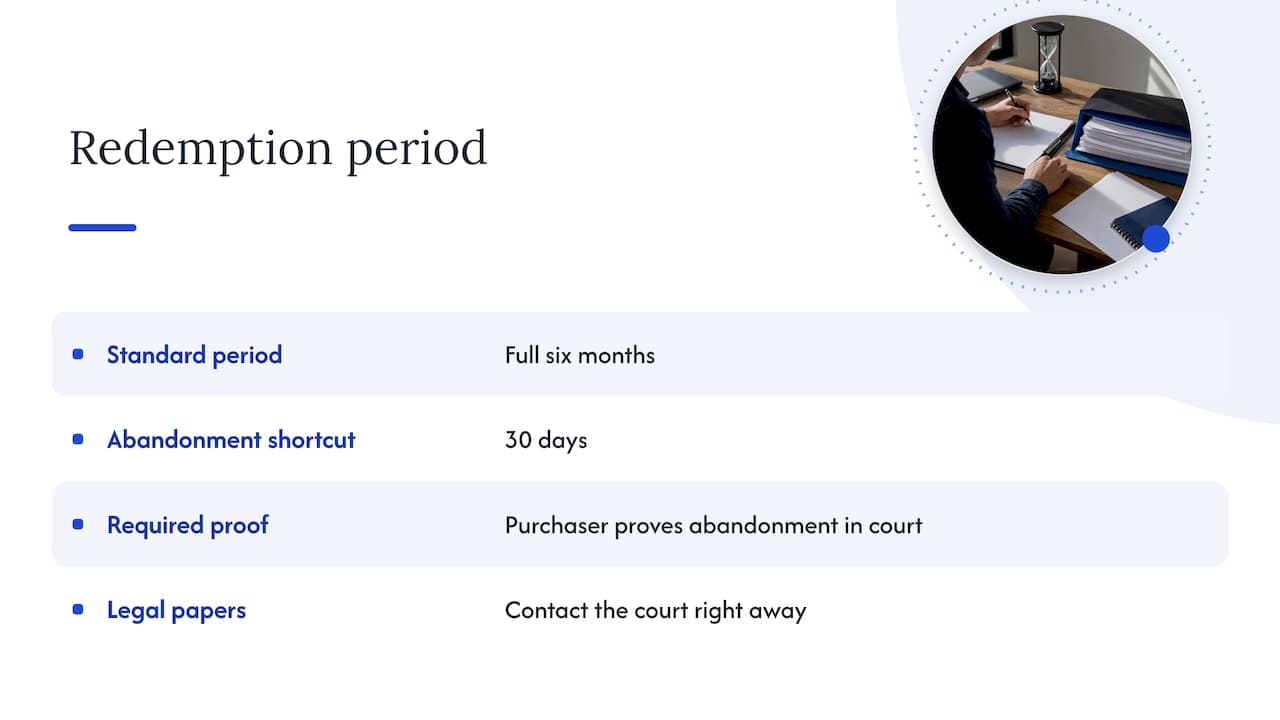
| Property found abandoned by a court | As short as 30 days |
During this time, the homeowner keeps the legal right to live in the home without making mortgage payments. Michigan’s own guidance is blunt about the common mistake: the sheriff sale date is not a move-out date. The same guidance ties the right to stay to keeping up the property, utilities and insurance.
Protect yourself from an abandonment claim
The 30-day shortcut is the one to watch. If a purchaser proves in court that the home is abandoned, they can petition to shorten your redemption period and you lose the right to stay for the full six months. If you get legal papers mentioning abandonment, contact the court right away.
MSU Extension suggests simple habits that show the home is lived in: mowing the grass and shoveling snow. In a Michigan winter, that last one is more than a courtesy.
If you plan to leave early
Moving out before redemption ends is allowed, but there is a rule. Michigan law says you must give the purchaser at least 10 days’ notice of your move-out date. Skipping it may expose you to liability for damage to the property during the rest of the period.
Some buyers offer money to leave sooner, often called cash for keys. Legal experts describe it as a legitimate negotiation, but you should not feel pressured to go before redemption ends. If you are weighing an offer, talk to a housing counselor or a legal aid office first.
After redemption: eviction
If redemption ends and you have not redeemed or left, the buyer holds the right to the property and can file an eviction case. Eviction proceedings start only after the redemption period expires. Once a court orders it, residents typically have 10 days to leave before the sheriff may physically remove them.
A worked timeline for a typical Michigan homeowner
Here is an illustration with round numbers. It is a sketch built from the statutory steps above, not a promise about any particular county or lender.
- Month 0: You miss the first payment.
- Around month 4: The loan passes 120 days past due and the lender can begin foreclosure by advertisement.
- Weeks after: The sale is published for four consecutive weeks and posted on the door.
- Sheriff sale: The home is auctioned. Redemption starts the same day.
- Six months later: Redemption ends for a typical residential home.
- Then: The buyer can file for eviction. After a court order, you generally have 10 days.
Add it up and a standard case can give you more than a year between the first missed payment and a forced move. Do not treat that as a plan to wait. Interest and fees grow, your credit takes hits, and the home’s value to you shrinks with every step.
The Detroit angle
Searches about the Detroit sheriff sale timeline come down to the same statute. The state process does not change because the home is in Detroit. What changes is the venue: the sale is run by the sheriff in Wayne County, and the notice will name the date and place. Neighborhood-level realities such as vacancy matter for the abandonment risk above, which is one more reason to keep the property visibly occupied and maintained, and to keep utilities on.
What you can do at each stage
| When | Practical move |
|---|---|
| Before day 121 | Ask the servicer about a modification or repayment plan. Call a HUD-approved housing counselor. Compare selling options. |
| During the four-week notice | Decide quickly. A sale before the auction can pay off the loan and keep any remaining equity. |
| After the sale, during redemption | Stay if you can, keep the home maintained, and consider selling to a buyer who will close on your schedule. |
| After redemption | Seek legal aid. Negotiate a move-out date rather than waiting for a court order. |
A traditional listing needs repairs, photos, showings and often 30 to 60 days or more, and that may not fit inside a four-week notice window. That is where a fast as-is sale comes in. We walk through the tradeoffs in short sale versus cash sale in Michigan, and in our guide to selling during pre-foreclosure. If you are trying to buy time first, read how to stop foreclosure in Michigan. Our foreclosure timeline tool also helps you place yourself in the process.
Our perspective
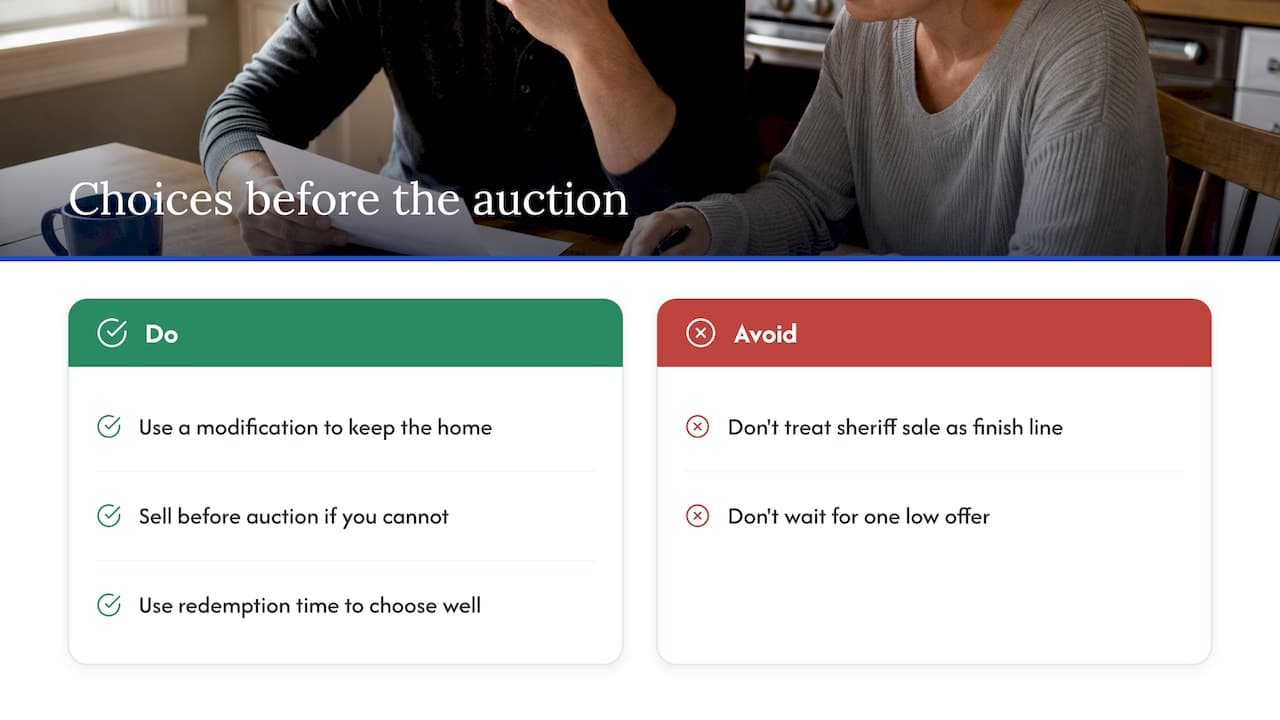
We talk with Michigan homeowners who are caught in this timeline, and the pattern is consistent. People rarely run out of options. They run out of time to use them, because they believed the sheriff sale was the finish line, or because they waited for a single offer that came in low.
We built HouseGoodbye around that problem. Instead of one investor setting the price, vetted local investors compete, so you can compare real cash offers and pick the highest one. You sell as-is, with no repairs, cleaning, staging or agent commissions, and offers carry no obligation. Our closings can happen in as little as seven days, which matters when a notice has a date on it.
Our honest advice: if you can keep the home with a modification, do that. If you cannot, sell on your terms before the auction rather than after, because every stage after it narrows your choices. And if the sale has already happened, remember that redemption gives you time to choose well.
— Bryan
Sell before the auction with competing cash offers
If a sheriff sale date is on your calendar, you can request competing cash offers from local investors and compare them side by side, with no repairs and no agent fees. Start on our page about how to avoid foreclosure and sell before auction, or go straight to competing cash offers. You can also read how selling your house for cash works and check how a mortgage payoff works in a cash sale so there are no surprises at closing.
FAQ
How long do you have to move after a sheriff sale in Michigan?
For most residential homes you have the six-month redemption period that begins at the sale. It can be 12 months in some cases, and as short as 30 days if a court finds the property abandoned. If you leave early, give the purchaser at least 10 days’ notice.
How long before foreclosure starts in Michigan?
Foreclosure by advertisement generally begins once the loan is more than 120 days past due, around day 121. Before then you will get calls and letters, and you can usually still explore loan modification or a sale.
How does a sheriff sale work in Michigan?
The sale is advertised in a county newspaper for four consecutive weeks and posted on the property. Then the county sheriff’s office auctions the home to the highest bidder. The sale starts your redemption period rather than ending your right to live there.
Can I sell my house during the redemption period?
Yes, in many cases you can still redeem or sell during redemption, but the payoff amount and costs matter, so confirm the figures with the purchaser, a housing counselor or an attorney. A fast as-is sale only works if the offer covers what you owe. Talk to a Michigan legal aid office if you are unsure of your rights.
Sources
- Stages of Foreclosure, MSHDA
- Home Foreclosure, State of Michigan
- Foreclosure and Eviction for Homeowners, Michigan Legal Help
- Foreclosure, MI Money Health, MSU Extension
- What the foreclosure jargon really means, MSU Extension
- Options in Foreclosure, Washtenaw County
- Understanding Proposal A, City of Livonia
- Claims & Auctions, Wayne County Treasurer