
Yes, you can sell a house with well problems in Michigan. You have three realistic paths. You can fix the well and list the house. You can disclose the problem and negotiate with a buyer whose lender allows it. Or you can sell as-is to a cash buyer who prices the well into the offer and doesn’t need a lender’s sign-off. Which one fits depends on your county’s rules, your budget and how fast you need to close.
This guide covers what Michigan sellers must disclose, how county inspections work, what repairs may involve, and how to sell when you would rather not fix anything.
TL;DR
- Michigan’s seller disclosure form asks about your well, including its testing history and repair history, so a known problem has to be reported honestly.
- Time-of-transfer well rules are set locally. Some counties let a sale move forward before repairs are done, if a repair plan and an escrow are in place.
- Mortgage buyers can run into trouble with a failed water test, because lenders may want treatment or repairs first. Cash buyers can work around that.
- A repair is not your only way out. You can sell as-is, and competing cash offers show you what the house is worth with the well problem included.
- Selling “as is” does not cancel your duty to disclose what you know.
Table of Contents
- What counts as a well problem
- What you must disclose in Michigan
- How county rules change the process
- Testing: what to find out before you decide
- Repairs and treatment options
- How a well problem affects buyers and financing
- Your options, side by side
- Perspective
- Selling to a cash buyer: what to expect
- Get cash offers for your house with a well problem
- When the well problem comes with other problems
- A checklist before you sell
- FAQ
- Sources
What counts as a well problem
Well problems fall into a few groups, and each affects a sale differently.
- Water quality: bacteria, high nitrates, arsenic, iron bacteria, staining, odor or cloudiness.
- Mechanical failure: a dead pump, a failed pressure tank, a collapsed casing, or a well that runs dry.
- Construction and location: a well too close to a septic system, a missing or damaged cap, an improperly sealed casing, or an old unused well that was never capped.
- Paperwork: no well record, no permit history, or a past failed test that was never followed up.
The last two matter more than most sellers expect. Local health departments in Michigan look closely at how a well is built. The Ottawa County program, for example, puts its focus on well construction, such as isolation distances and proper components, rather than relying on a water-quality snapshot alone. Construction is often a better predictor of long-term contamination risk. So a well that tests clean on one day can still fail an evaluation if it is built or sited wrong.
What you must disclose in Michigan
Michigan’s Seller’s Disclosure Statement is set out in state law, MCL 565.957. It asks you to report the well’s type, depth and diameter, age and repair history, as far as you know them. It also asks whether the water has been tested, and the date and results of the last report.
Two practical points follow from that.
- Answer from what you actually know. If you had a failed bacteria test two years ago, or a pump replaced last spring, that belongs on the form. A buyer who later finds a documented problem you left out is a buyer with a claim.
- “As-is” is not a shield. Minnesota REALTORS® guidance makes the general point that selling a property as is does not remove a seller’s obligation to make required material-fact or other disclosures. That reasoning applies just as well to a seller in Michigan. As-is changes who pays for repairs. It does not change what you have to say.
We go deeper on the form itself in our guide to Michigan seller disclosure rules. If your situation is complicated, a Michigan real estate attorney is the right person to check your answers before you sign.
How county rules change the process
Michigan has no single statewide time-of-sale well program. Your county or district health department decides whether a well evaluation is needed when a property transfers, and what it covers. Some require nothing at all. Others run a formal program.
Ingham County is a useful example. Its transfer inspection brochure explains that a seller or agent can receive approval to transfer before repairs are completed if Environmental Health approves a corrective-action plan or replacement permit. The seller must also show proof of a contractor contract and an escrow agreement covering 1.5 times the required repair cost.
That tells you something useful whatever county you live in. A failed well does not always freeze a sale. It can turn into a repair obligation that follows the money at closing. If you are in Ingham County, see how a sale works locally on our Ingham County page.
What to do first: call your county health department’s environmental health office. Ask three questions:
- Is a well evaluation required or recommended when a property is sold here?
- Who is allowed to do it (the county, or a licensed contractor)?
- What happens if the well fails: can the sale close with a repair plan, or must repairs come first?
Write down the answers and the name of the person you spoke with. They will shape every offer you get.
Testing: what to find out before you decide
You do not have to test before selling in most cases. But knowing what is wrong lets you choose between repairing and selling as-is, rather than guessing.
A useful order:
- Pull what you already have. Old test results, the well driller’s record, pump invoices and any county paperwork.
- Ask the health department what it would look at. Because local programs weigh construction heavily, an evaluation may check the casing, cap, grout seal and distances to septic, not only the water.
- Get a water test from a certified lab if you suspect a quality problem. Bacteria and nitrates are the usual starting point. Your county can tell you what else is relevant in your area, such as arsenic.
- Get a written quote from a licensed well contractor for any fix. A real number lets you compare repair-and-list against an as-is offer.
Keep every report. Handing a buyer a complete file, even one with a bad result in it, tends to go better than having them discover it during inspection.
Repairs and treatment options
The fix depends on the cause, and a licensed well contractor should diagnose it. Here are the common ones.
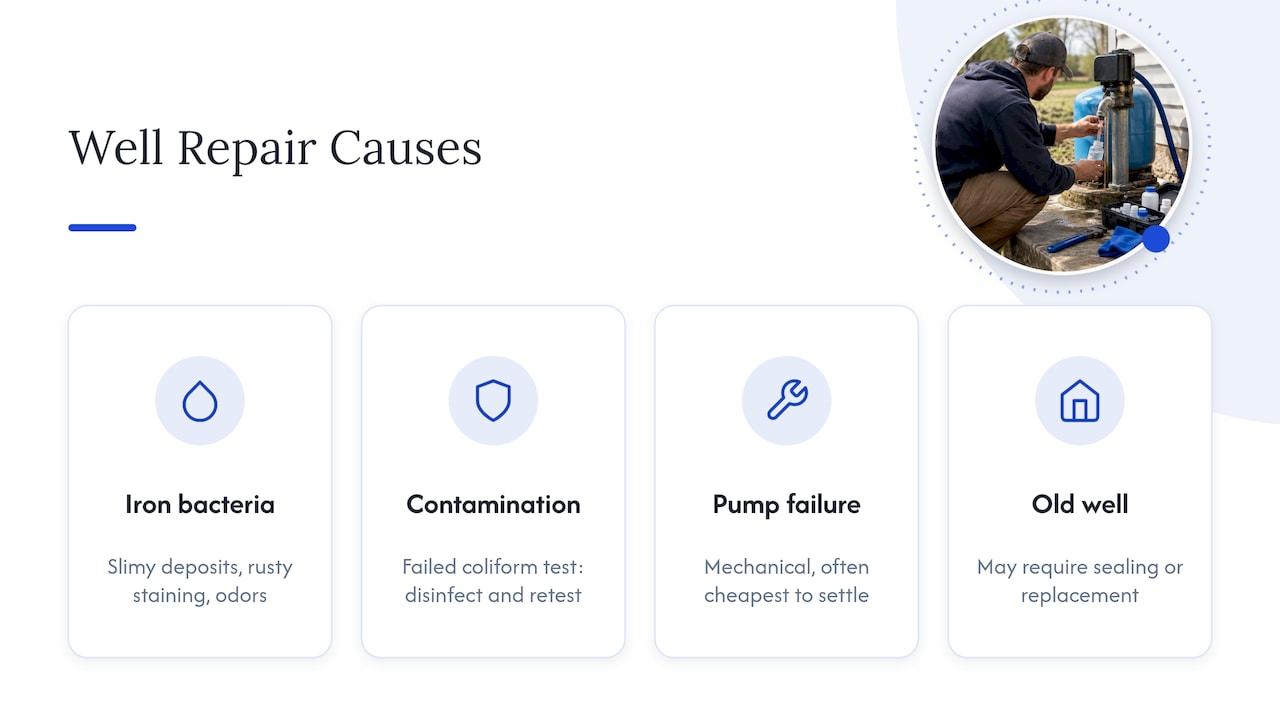
Iron bacteria. These cause slimy deposits, rusty staining and odors. The Minnesota Department of Health explains that a licensed contractor may physically clean the pumping equipment and well casing, usually followed by chemical treatment. Options include disinfectants, surfactants, acids or pasteurization. If your main symptom is discolored water, this overview of rusty tap water causes explains what the staining can mean.
Bacterial contamination. A well that fails a coliform test is usually disinfected and retested. If it fails again, the contractor looks for the entry point, such as a bad cap, a cracked casing or a nearby septic source.
Pump or pressure tank failure. These are mechanical, and often the cheapest to settle. They are also easy to quote.
Poor construction or an old well. This can mean sealing or replacing the well. It is the most expensive path, and it is where the escrow rule described above, 1.5 times the repair cost in Ingham County, becomes relevant.
Get two quotes where you can. Costs vary a lot with depth, geology and access, so treat any number you read online as a rough guide and rely on written estimates for your property.
How a well problem affects buyers and financing
For most buyers, the well is a financing question first and a price question second. Mortgage lenders generally want a safe, working water supply before approving a property. VA-backed purchases, for example, require a continuous supply of safe water. If a test fails, the lender may ask for treatment, disinfection, repairs or more testing before approving the loan. FHA and conventional lenders can have their own requirements, and so can local authorities.
That is why a well issue can turn a signed contract into a stalled one. The buyer’s inspection flags the problem, the lender asks for a fix, and the seller is suddenly negotiating repairs on a deadline. Buyers using cash are not held to a lender’s checklist, so the same house may move quickly.
Your options, side by side
| Option | Best when | What you handle | Typical timeline |
|---|---|---|---|
| Repair, then list | The fix is modest and you have time and cash | Contractors, retesting, showings, agent fees | Weeks to months, plus market time |
| List as-is with disclosure | The well issue is minor or well documented | Disclosure, buyer’s inspection, lender requirements | Depends on buyer financing |
| Sell with a county repair plan and escrow | Your county allows transfer before repairs | Plan approval, contractor contract, escrow | Depends on county approval |
| Sell as-is for cash | You want no repairs, no showings and speed | Disclosure, choosing an offer | About 7 days is possible |
None of these is wrong. The best one is the one that matches your cash, your deadline and your county.
Perspective
We see well problems come up when a seller is already under pressure: an inherited house, a vacant property, a mortgage that has fallen behind. Nobody in those situations wants to spend weeks chasing a driller and a lender.
Our view is simple. A well problem is a pricing question, not a dead end. Different buyers value it differently. One investor may see a repair they handle every month. Another may not want it at all. That is why we built HouseGoodbye as a marketplace rather than a single buyer: several vetted local cash buyers bid on the same house, you see every offer, and you can walk away if none of them work.
You do not need to fix the well, clean the house or host a showing. You do still need to be honest about what you know, because that protects you. Disclose the issue, let the buyers compete, and compare the numbers.
Bryan
Selling to a cash buyer: what to expect
A cash sale removes the two things that most often break a well-problem deal: the lender’s water requirements and the repair negotiation. Here is how it works with us.
- Enter your address. Tell us about the house, including the well issue as you know it.
- Receive competing offers. Vetted local cash buyers bid on the property as-is. The offers are free and carry no obligation.
- Compare and choose. You see each number side by side. If none work, you walk away.
- Close on your timeline. Closing can happen in about a week, versus roughly 73 days on the MLS, with $0 in commissions and no listing fees.
Tell the buyers what you know. A seller who is open about a failed test or a dead pump gets cleaner offers, because the buyer is not pricing in surprises.
Get cash offers for your house with a well problem
HouseGoodbye is a Michigan cash-offer marketplace. We buy houses in any condition, including vacant, inherited, water-damaged and foreclosure properties, across Metro Detroit, Grand Rapids, Flint, Lansing and the rest of the state. There are no repairs, no showings and no agent commissions.

If you want to see what buyers will pay for your house as it stands, start on our Michigan cash home buyers page and enter your address. Prefer to read first? Our as-is selling page explains the process in more detail.
When the well problem comes with other problems
Well trouble rarely arrives alone. A pump that has been off for months in a vacant house often goes together with frozen pipes, mold or leaks. A few related situations we handle:
- Water damage. If the house has also had flooding or leaks, see how to sell a water-damaged house in Michigan.
- Mold. Standing water and humidity lead to mold. Our guide on selling a house with mold covers what that does to a sale.
- Code violations. A failed septic or well can produce a notice from the county or township. Read how to sell with code violations.
- Inherited property. If you are settling an estate and don’t know the well’s history, our inherited house page explains your options.
- Behind on the mortgage. If a repair bill is pushing you toward foreclosure, our pre-foreclosure sale guide lays out what you can do while you still have time.
A checklist before you sell
- Gather every well record, test result and invoice you can find.
- Call your county environmental health office and ask what applies at transfer.
- Complete the disclosure statement from what you actually know.
- Get one or two written repair quotes if you want to compare repair against as-is.
- Compare competing offers, not just one.
- Ask any attorney or title company to confirm how any repair escrow or credit would be handled at closing.
FAQ
Is a house with a well harder to sell?
Not by itself. Many Michigan homes have wells, and buyers expect them. The difficulty starts when a test fails or an inspection finds a construction defect, because a mortgage lender may then require work before approving the loan. A cash buyer is not bound by that process.
Do I have to fix a bad well before I sell?
Not necessarily. It depends on your county. Some health departments allow a transfer before repairs if a corrective plan, contractor contract and escrow are in place, as Ingham County does. You can also sell as-is to a buyer who accepts the problem. Check with your county first.
Do I have to tell buyers about a well problem?
Yes, if you know about it. Michigan’s disclosure statement asks about the well’s repair history and whether the water has been tested, including the most recent results. Selling as-is does not remove that duty.
Can I sell a house with a bad well for cash?
Yes. On HouseGoodbye, vetted local cash buyers bid on your house as-is, so you do not repair the well first. You compare the offers and decide. There is no obligation, and you can walk away if none of the numbers work.
Sources
- Ingham County Environmental Health: point of sale inspection brochure
- Ottawa County: Real Estate Transfer Evaluation Program
- Michigan Legislature: MCL 565.957
- Minnesota REALTORS®: Disclosure guidance
- Minnesota Department of Health: Iron bacteria in well water
- Rusty tap water: causes, safety and what to do