
A comparative market analysis is an agent-prepared market estimate that gives you a defensible price range for listing, buying, or negotiating a home. It works by weighing recent comparable sales against your property’s specifics and current market conditions, then translating all of that into a number you can actually use.
A CMA typically hands you three things:
- A price range, not a single fixed number, since most agents present a value band built from sold, pending, and active listings.
- A set of comparable sales (“comps”) pulled from properties similar to yours in size, condition, and location.
- A short narrative explaining current market trends, like whether inventory is tight or sellers are cutting prices to compete.
Here’s the part people skip past too fast: a CMA is informal. It’s not the same instrument a lender relies on to fund a mortgage, and it carries none of the legal weight of a licensed appraisal, which must follow the Uniform Standards of Professional Appraisal Practice. Treat it as a smart starting point for pricing conversations, not a courtroom-ready valuation.
Key Takeaways
A comparative market analysis gives sellers, buyers, and agents a defensible price range built from recent comps, market trends, and documented adjustments, but it carries no legal weight of its own.
| Point | Details |
|---|---|
| CMA defines the pricing starting point | Use it to set a list price or shape an offer, not as a legal valuation. |
| CMA and appraisal are not interchangeable | Only a licensed appraiser’s USPAP-compliant report satisfies lender or court requirements. |
| Vet the CMA before trusting it | Ask for MLS IDs, documented adjustments, and comps sold within the last three to six months. |
| Use a CMA to fight a low appraisal | A documented CMA with genuinely comparable sales can support a Reconsideration of Value request. |
| Consider a cash-offer alternative for speed | Housegoodbye lets Michigan sellers compare competing cash bids and close in as little as seven days when a traditional listing timeline doesn’t fit. |
Table of Contents
- What Does a Comparative Market Analysis Include?
- How Do Agents Actually Prepare a CMA?
- How Is a CMA Different From an Appraisal or a BPO?
- How Do Sellers and Buyers Use a CMA to Make Decisions?
- What Are the Common Pitfalls in a Comparative Market Analysis?
- A Worked Example: Building a CMA From Scratch
- Why Local Judgment Still Matters More Than the Spreadsheet
- What This Means for Your Own Pricing Decision
- Selling Fast for Cash: A Different Path Than a CMA-Driven Listing
- Where to Learn More About CMAs and Appraisals
- Sources
- FAQ
What Does a Comparative Market Analysis Include?
A complete CMA is built from eight recurring components, and if an agent hands you something missing half of these, you’re looking at a rushed version, not a real analysis.
- Subject property summary: square footage, bedroom and bathroom count, lot size, age, and condition of the home being priced.
- Comparable sold listings: homes that closed recently and resemble yours closely enough to be useful.
- Active and pending listings: current competition and homes already under contract, which hint at where the market is heading next.
- Adjustments: dollar or percentage corrections applied when a comp differs from your home (an extra bedroom, a finished basement, a busier street).
- Market timeframe: the window of sales data used, almost always noted explicitly.
- Price per square foot: a rough cross-check figure, useful but never the whole story on its own.
- Days on market: how fast comparable homes sold, a signal of demand.
- Neighborhood notes: school zones, upcoming development, or local quirks that raw sales numbers won’t capture.
On timing, agents typically pull comps sold within the prior three to six months, tightening that window in a fast-moving market and widening it in a slow one where recent sales are scarce. A neighborhood that only sees two or three closings a year sometimes forces an agent back twelve months or further afield geographically just to find anything comparable.
Pro Tip: If a CMA you receive skips adjustments entirely or shows no photos or MLS listing numbers for the comps, ask for the underlying data. A real analysis can always show its work.
How Do Agents Actually Prepare a CMA?
Building a CMA follows a repeatable process, whether the agent is pricing a listing or helping a buyer figure out if an asking price is fair.
- Gather subject property data: square footage, lot size, upgrades, condition, and anything unusual about the layout or systems.
- Choose comparable sales: properties that closed recently, sit nearby, and match closely on size and type.
- Adjust for differences: add or subtract value where the comp diverges from the subject property.
- Analyze market context: check whether inventory is rising or falling, and how quickly homes are selling.
- Convert to a price range: blend the adjusted comps into a defensible low, middle, and high estimate.
- Recommend a strategy: a list price for sellers, or an offer ceiling for buyers.
Adjustments are where the real judgment happens. An extra bedroom might add a specific dollar figure in one neighborhood and almost nothing in another where buyers care more about lot size. A comp in noticeably better condition gets marked down before comparison; one with a busier street or older roof gets marked up to make the comparison fair. A finished basement, an updated kitchen, or a bigger lot all move the needle, but by how much depends entirely on what buyers in that specific market are actually paying for.
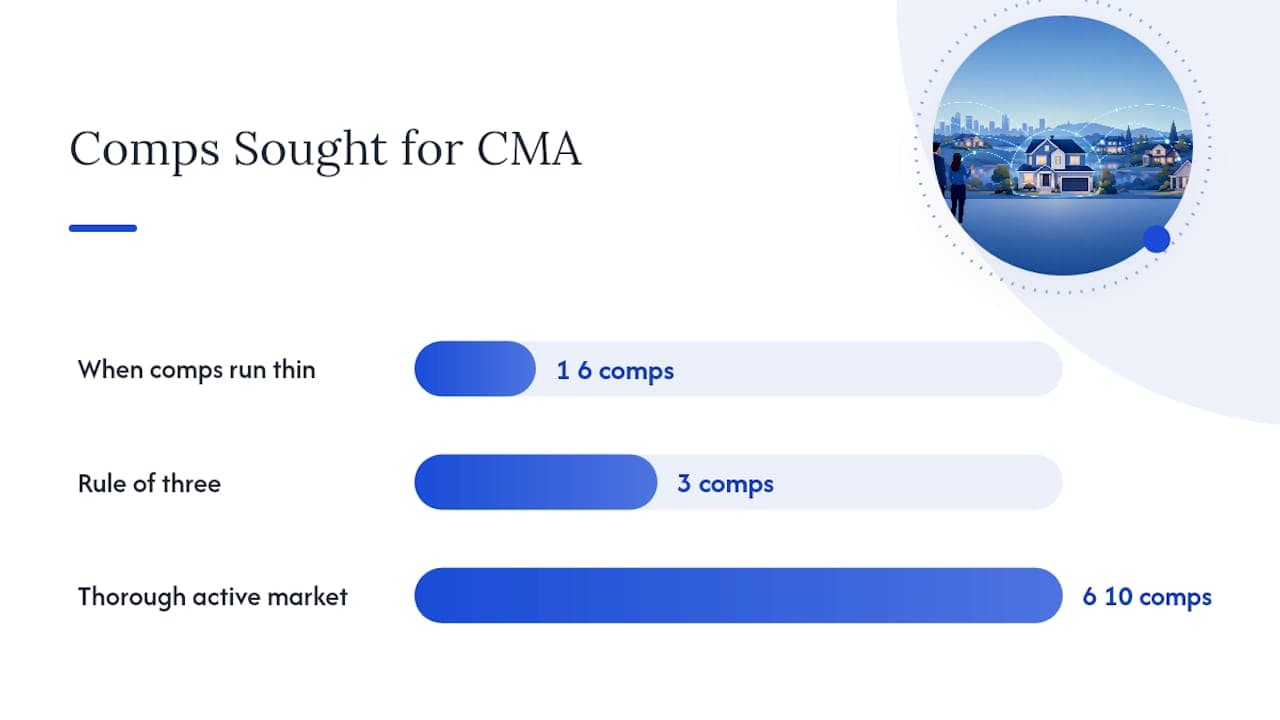
On volume, the common floor is at least three comparable sales, sometimes called the rule of three, though a thorough CMA in an active market often pulls six to ten comps to smooth out any single outlier. When comps run thin, a good agent expands the search radius or stretches the timeframe to find sufficient comparable data rather than settling for one or two shaky data points.
Pro Tip: Ask the agent whether they called the listing agents on any comps to confirm sale terms. A sale price that included seller concessions, a rushed relocation, or an unusual buyer situation can distort a comp if nobody checks the backstory.
How Is a CMA Different From an Appraisal or a BPO?
The gap between a CMA and a formal appraisal comes down to who prepares it, what rules govern it, and who is legally allowed to rely on it.
- Preparer: a CMA comes from a real estate agent; an appraisal must come from a state-licensed appraiser.
- Standards: a CMA follows no fixed format, while an appraisal must comply with USPAP and often incorporates cost and income approaches on top of sales comparison.
- Legal weight: lenders and courts require a licensed appraisal for mortgage underwriting; a CMA generally isn’t accepted for that purpose.
- Cost: a CMA is usually free as part of an agent’s listing pitch, while an appraisal typically runs several hundred dollars.
A Broker Price Opinion, or BPO, sits somewhere between the two. It’s still agent- or broker-prepared rather than a licensed appraisal, but it follows a more standardized format and usually comes with a fee, often ordered by lenders for smaller decisions like a loan modification review rather than a full mortgage. Think of it as a CMA with more structure and a price tag, but still short of appraisal-grade legal standing.
A real estate agent cannot legally perform or represent a CMA as an appraisal. Only a licensed appraiser can issue a valuation that carries the legal and lending weight a mortgage or court proceeding requires.
That distinction matters for how agents talk about their own work. An agent who calls a CMA an “appraisal” in marketing materials or client conversations is misrepresenting what the document actually is, and that kind of language can create real problems if a buyer or seller relies on it for something it was never built to support.
How Do Sellers and Buyers Use a CMA to Make Decisions?
For sellers, a CMA does the heavy lifting behind the number that goes on the listing. It shapes not just the price itself but the strategy behind it, whether that’s pricing slightly under market to spark competing offers or setting a firm number in a slower market where buyers negotiate harder.
Buyers get value from a CMA too, just from the other side of the table. A buyer’s agent can run one to check whether a seller’s asking price actually lines up with recent sales, which shapes how aggressively to negotiate and where to draw a walk-away line before overpaying.
- Sellers: use a CMA to set an initial list price, decide whether to price for a bidding war, and adjust strategy if showings stall.
- Buyers: use a CMA to judge whether an asking price is fair, build an offer with room to negotiate, and set a hard ceiling before bidding wars get emotional.
- Agents: lean on the CMA during listing appointments to justify pricing to a client and again during negotiations to defend an offer or counteroffer with data instead of gut feeling.
There’s one underused move worth knowing: a solid CMA can support a Reconsideration of Value request if a home appraises low. If the agent’s comps genuinely differ from what the appraiser used, and the differences are documented, that CMA becomes ammunition for asking the lender to take a second look.
Pro Tip: If your appraisal comes in below the agreed price, ask your agent for a written CMA that specifically highlights comps the appraiser may have missed, especially recent sales that closed after the appraiser pulled their data.
What Are the Common Pitfalls in a Comparative Market Analysis?
A CMA is only as good as the comps and judgment behind it, and there are a handful of ways it can go sideways.
- Thin markets: rural areas or unusual properties sometimes have almost no true comps, forcing an agent to stretch distance or time until the comparison gets shaky.
- Overreliance on active listings: active listings show asking prices, not what buyers actually paid, and leaning on them too heavily inflates the estimate.
- Missed adjustments: skipping a correction for condition, lot size, or seller concessions distorts the whole range.
- Agent bias: a commission-driven incentive to price a listing high to win it, or low to guarantee a fast sale, can quietly creep into the numbers.
- Rapid market shifts: in a market swinging fast in either direction, sales from even two months ago can already be stale.
The red flags for spotting a weak CMA are pretty consistent: a report built around a single comp, adjustments with no explanation attached, no MLS reference numbers, or a document that skips the narrative about local market trends entirely.
A defensible CMA discloses its sources, MLS identifiers, and sale dates, and documents every adjustment so a reader can trace exactly how the final number was reached. A report that hides that work is a report you should question.
If your agent can’t explain why a comp got adjusted up $8,000 for a finished basement or down $5,000 for a busier street, that’s not a minor gap. It’s the difference between a real analysis and a guess with a nice cover page.
A Worked Example: Building a CMA From Scratch
Here’s how the math actually plays out on a real subject property: a 1,800 square foot, three-bedroom, two-bath home in average condition, built in 1995, with a two-car garage and no major updates in the last decade.
Working through the adjustments: Comp A’s price rises to $323,000 to account for its smaller footprint and missing garage. Comp B drops to $320,000 once the kitchen upgrade is factored out. Comp C climbs to $308,000 to offset the roof it needs. Comp D falls to $325,000 once its finished basement, a feature the subject property lacks, is subtracted.
- Adjusted prices: $323,000, $320,000, $308,000, $325,000.
- Average of the four: roughly $319,000.
- Median (the two middle values averaged): about $321,500.
- Recommended list range: $315,000 to $325,000, weighted toward the median but leaving room for negotiation.
If this were a fast-moving market with multiple offers common, the agent might push the top end of that range and price aggressively to spark a bidding situation. In a slower market, or if the home had a genuinely unusual feature like a pool or an oversized lot, that range would need wider adjustments and possibly a fifth or sixth comp to stay defensible. A strong grasp of how condition affects buyer perception also shapes where in that range a seller should realistically expect to land.
Why Local Judgment Still Matters More Than the Spreadsheet
A CMA isn’t a formula you can automate away, and that’s worth sitting with for a second. Industry professionals point out that local demand, lot orientation, and even a home’s architectural style can matter as much as the raw sales numbers, which is exactly why two competent agents can hand you two slightly different price ranges for the same property.

That flexibility is also where things can go wrong if there’s no accountability behind it. Regulatory boundaries exist for a reason: only a licensed appraiser conducts a formal appraisal under USPAP standards, and agents who blur that line, intentionally or not, put clients at risk of relying on a document for a purpose it was never designed to serve.
Before trusting any CMA, run it through a short checklist:
- Are the comps’ MLS ID numbers listed, so you could verify them yourself?
- Are the adjustments documented with a dollar figure and a reason, not just a vague explanation?
- Are the comps recent, generally within the last three to six months?
- Does the report include a written narrative about local market trends, not just a spreadsheet of numbers?
- Does the agent clearly identify this as a CMA, not an appraisal?
Pro Tip: A CMA that skips a written market narrative entirely is often a sign the agent pulled numbers quickly rather than actually analyzing the neighborhood’s current conditions.
The best CMAs read less like a form letter and more like a case being made. If the agent can’t tell you why the number landed where it did, the number isn’t worth much.
What This Means for Your Own Pricing Decision
Rely on a well-built CMA for everyday pricing decisions. It’s fast, usually free, and grounded in real recent sales when an agent does the work properly. Reach for a formal appraisal instead when a lender requires one, when you’re heading into a legal dispute over value, or when a low appraisal is threatening to sink a deal and you need documentation with actual standing behind it.
There’s also a third path worth knowing about if speed matters more to you than squeezing out the last few thousand dollars a CMA-guided listing might get. Selling as-is for a fast cash offer sidesteps the whole pricing negotiation dance, along with repairs, showings, and the weeks of uncertainty that come with a traditional listing.

Selling Fast for Cash: A Different Path Than a CMA-Driven Listing
A CMA-driven listing plays a long game: price it right, wait for showings, negotiate, and hope the appraisal lines up when it matters. If your priority is speed or you’d rather skip repairs and agent commissions entirely, a cash-offer marketplace changes that math completely.

Housegoodbye works by putting your home in front of multiple vetted local investors who compete for it with real cash bids, no listing, no staging, and no repairs required first. Instead of one agent-estimated price range, you get multiple actual offers side by side, and that competitive bidding process tends to push prices higher than a single lowball cash offer ever would. It’s not a replacement for every seller’s situation. If maximizing price over months is your goal, a traditional CMA-guided listing still makes sense. But if you’re facing a tight timeline, a house that needs work you can’t afford, or a life situation that just needs to move fast, this is the more practical route, and it can close in as little as seven days. If that sounds closer to what you need, compare real cash offers for your Michigan home and see what investors are actually willing to pay.
Where to Learn More About CMAs and Appraisals
- The LicensePrep breakdown of CMA versus appraisal standards covers the licensing and USPAP distinctions in plain terms.
- LegalClarity’s explainer on agent-prepared CMAs versus appraisals walks through cost differences and when a CMA can support a value dispute.
- Zillow’s guide to comparative market analysis explains how sold, pending, and active listings feed into a price range.
- Rocket Mortgage’s CMA overview details comp selection practices, including the rule of three.
- Chase’s comparative market analysis guide focuses on the documentation and transparency that make a CMA defensible.
- The Mogavero Group’s market analysis primer offers additional context on local pricing factors that feed into comp selection.
This article is general information, not a substitute for advice from a qualified financial advisor. Consult a qualified financial professional about your own circumstances before acting on anything here.
Sources
- CMA vs. Appraisal | Real Estate Exam Questions | LicensePrep
- Do Real Estate Agents Do Appraisals or Just CMAs? - LegalClarity
- What Is a Comparative Market Analysis (CMA)? | Zillow
- What is a CMA in real estate? | Rocket Mortgage
- Comparative market analysis guide | Chase
FAQ
Do Realtors Charge for a Comparative Market Analysis?
No. Most agents provide a CMA free as part of the listing process, since it helps them win the listing and price the home to sell.
How Does a Realtor Actually Perform a CMA?
An agent gathers your property’s details, pulls comparable sales and active listings, adjusts for differences like condition or square footage, and converts those adjusted figures into a recommended price range.
What Is the Main Purpose of a CMA?
Its purpose is to give sellers, buyers, and agents a data-backed price range for listing, offering, or negotiating, built from recent comparable sales rather than guesswork.
Who Typically Prepares a Comparative Market Analysis?
A licensed real estate agent or broker prepares a CMA, distinct from a formal appraisal, which only a state-licensed appraiser can legally perform.
Is a CMA the Same Thing as an Appraisal?
No. A CMA is an informal, usually free estimate from an agent, while an appraisal is a licensed, USPAP-compliant valuation that lenders and courts require for legal and financing decisions.